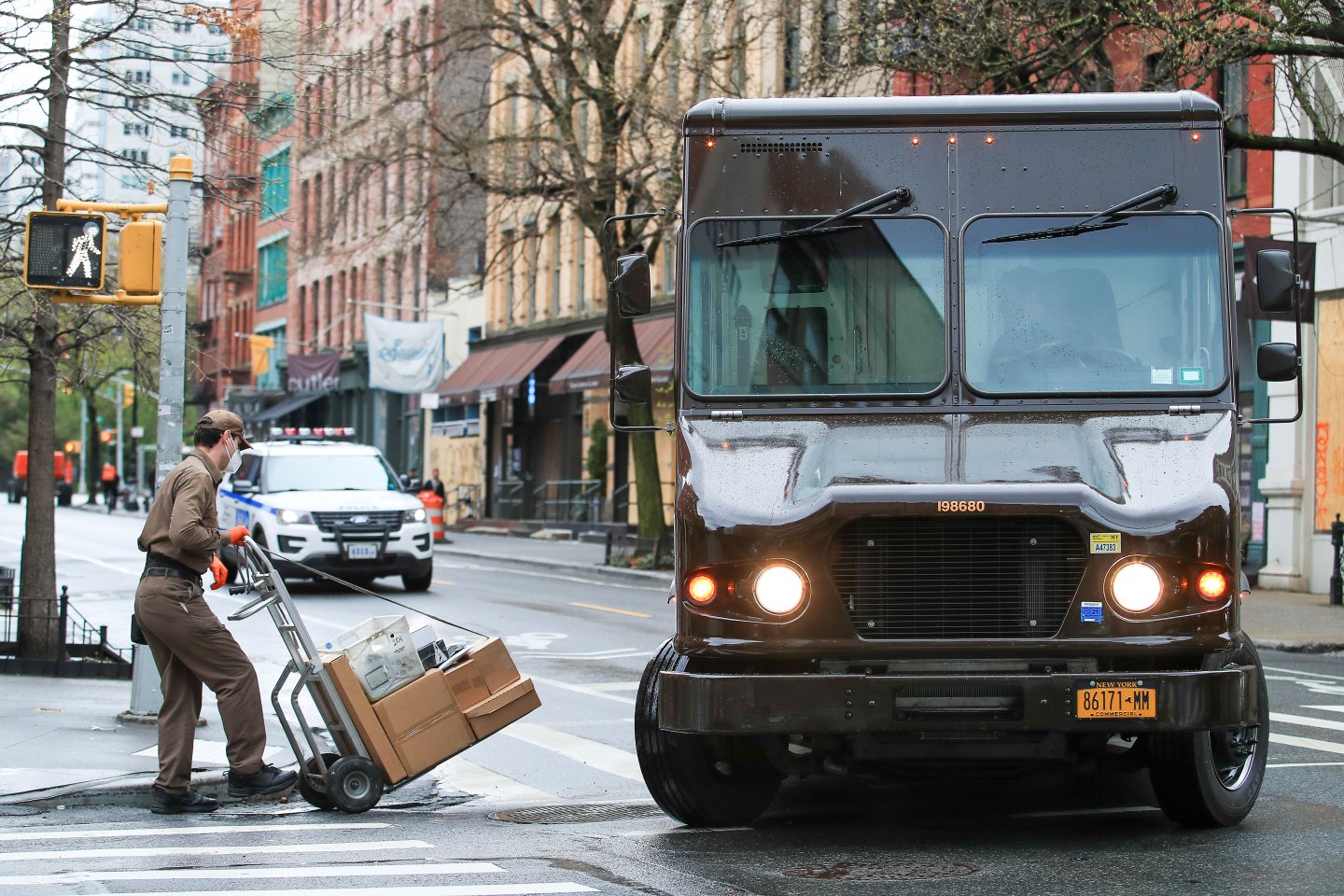
In less than a year, one microscopic virus has brought upheavals large and small in the way people and goods move around. Transit ridership is way down; automobile traffic is increasing. People are ordering goods online rather than shopping in stores—UPS deliveries in the second quarter of this year were up nearly 23% from the same time last year. Ninety percent of consumers now prefer delivery over a store visit.
The consequence? Shopping mall parking lots are empty, while delivery vehicles fill up our streets. Around the country, there is more road congestion, double-parking, and idling time at the curb as companies increasingly bring their goods to us.
Pandemics, despite (or perhaps because of) their devastation, are known to lead to periods of great creativity. Upheaval has given us the gift of thinking, on many fronts, “Why weren’t we doing this all along?”
Here’s one of those ideas: For nearly 100 years, we have charged drivers of personal cars for parking at the curb. It’s time to start charging delivery companies for stopping there too. To create new revenue streams for cities and towns and finally make order out of the chaos of curb congestion, have the Ubers, Amazons, and DoorDashes of the world pay for the right to stop and deliver.
Our company, Automotus, helps cities manage curbside delivery and ride-hailing. As a result, our business could benefit from cities charging for commercial curbside use.
Much like with public street parking, managing the curb involves charging ride drop-off companies and package delivery companies for dedicated space. One study found that double-parking by delivery vehicles led to 264.4 hours of delays annually on two-lane streets and 866.5 hours on four-lane streets. By 2029, these delays are estimated to increase by 135%.
Changing how we allocate curb space is about more than traffic. Fallout from the pandemic has left cities in desperate need of new income streams. New York City is facing layoffs of 22,000 city employees, and the Metropolitan Transportation Authority has already borrowed $450 million from the Federal Reserve to cover operating costs. The city of Miami Beach is facing a $13.8 million shortfall in its parking fund and may privatize up to 50% of its parking enforcement functions.
Charging ride-share and delivery companies for curb access creates revenue from a previously untapped source. In New York City, 20% to 30% of parking violations are committed by commercial operators who rack up millions of dollars in fines each quarter. While other cities across the U.S. may have less delivery traffic, there is still significant revenue opportunity.
We have been deploying video technology and analytics to measure demand at the curb for two years. Rest assured, this is not surveillance—the video feeds are processed in real time to extract data only and are not recorded. We’ve found the sweet spot for balancing vehicle stoppage with parking needs, allowing cities to create paying models through which ride-share and delivery companies can proactively claim their spot at the curb.
Some cities have already done trial runs. In one pilot we ran on the campus of Loyola Marymount University, traffic caused by drivers searching for parking dropped by more than 20%. In Columbus, delivery drivers accessing a curb with specified stopping areas prevented approximately 9,700 double- or illegal parkings.
Charging someone for something they used to have for free is of course never easy. But some companies in the delivery and ride-share space are already on board, with commercial operators paying for dedicated, well-managed curb space in Columbus, Aspen, and Washington, D.C. In 2018, one-quarter of the $181.5 million in commercial parking fines in New York City were paid by UPS and FedEx. None of that is tax-deductible. Paying for parking, on the other hand, is.
Having devoted curb space also saves operators time. Commercial vehicles using designated areas reduce their time at the curb by 28% on average, saving two minutes on each pickup and drop-off. Designated space for commercial vehicles also leads to safer vehicle operation. Double-parking is a safety hazard and disrupter to the normal flow of traffic.
There’s long been a push and pull balancing the needs of cyclists, restaurants, delivery drivers, and ride-share passengers. By changing how we manage our street space, we can create more order in our streets and make them work more efficiently and safely.
We can use this tragic pandemic as a launchpad to make our cities work better. If you’re fortunate enough to see your delivery driver pull into a designated space rather than circle for parking while your tacos get cold, you may delight in thinking, “Wow, why didn’t we do it this way all along?”
Prajwal Kotamraju is head of computer vision at Automotus.