Our mission to make business better is fueled by readers like you. To enjoy unlimited access to our journalism, subscribe today.
This summer the Black Lives Matter movement and the fight for racial justice spilled over into the most unlikely of places—the supermarket aisle.
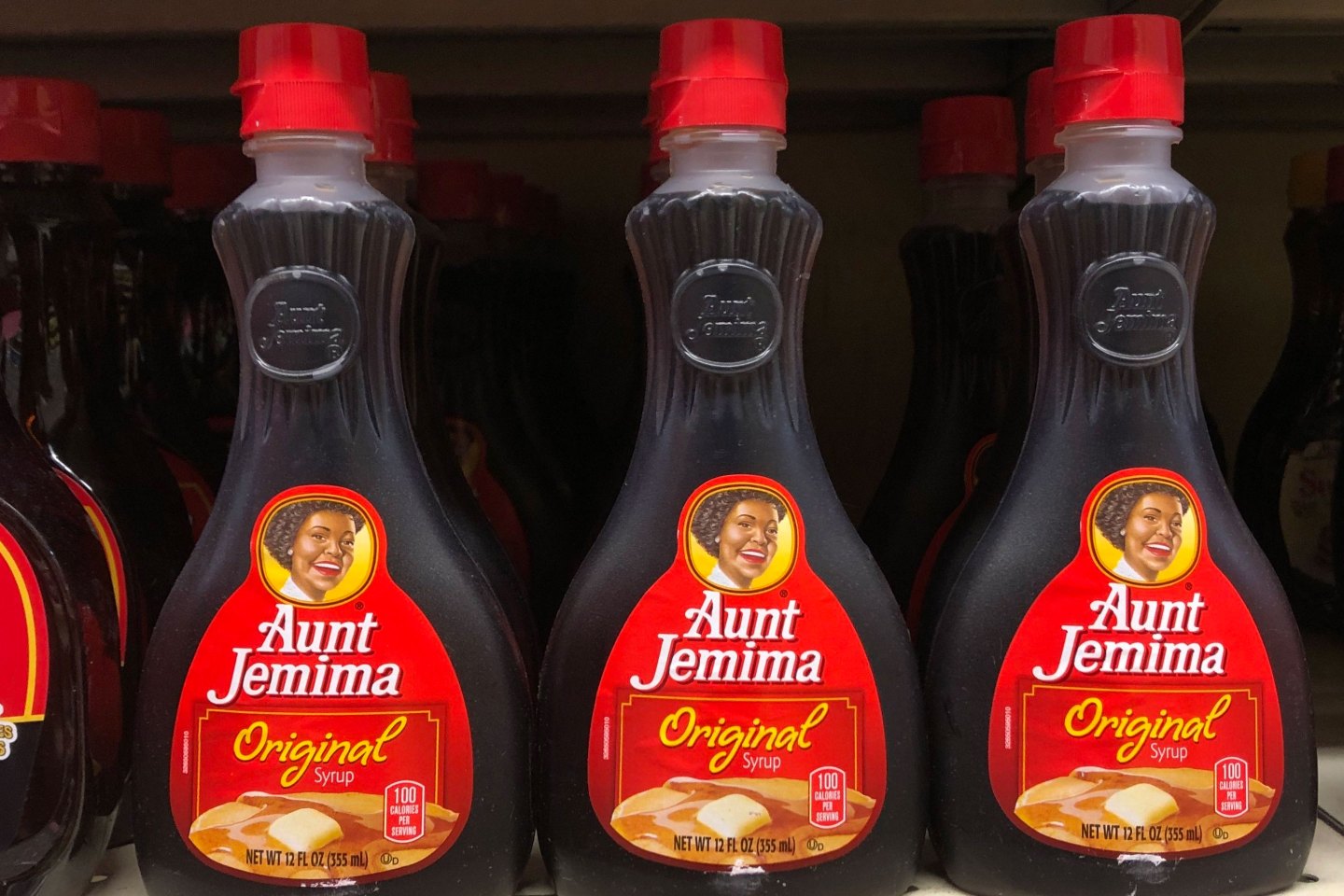
Quaker Oats, a PepsiCo subsidiary, acknowledged that the origins of its Aunt Jemima brand, with overt ties to American slavery, “are based on racial stereotypes” and said it would change its name and logo. Mars echoed that promise with its Uncle Ben’s rice line, declaring that the company stood “in solidarity with the Black community.” Dreyer’s, the parent company of Eskimo Pie ice cream bars, said it recognized that the term Eskimo was derogatory and would rebrand in its commitment to “being a part of the solution on racial equality.”
The companies, aware for decades of the racist history of the names and images of certain brands, had tried in the past to update them. Quaker removed the kerchief from the Aunt Jemima figure in 1989, for example, and in 2007, Mars “promoted” Uncle Ben from butler to executive. But during the 2020 summer of racial reckoning in the U.S., the companies decided the value of these famous brands no longer outweighed the risk to their broader reputations.
Activists who had pushed for the changes celebrated—but so did those operating within an obscure corner of the trademark world. The fact that the companies were dropping these iconic brand names meant that someone else could eventually obtain and use them instead. After the food giants made their announcements, the U.S. Patent and Trademark Office (USPTO) received three trademark applications apiece for Aunt Jemima and Eskimo Pie and one for Uncle Ben’s, with the applicants indicating they wanted to use the marks on food items.
“Trademark abandonment is a new kind of industry. It’s a new kind of gold rush,” says Jeff Kaplan, whose company Retrobrands filed applications for all three marks. His operation acquires trademarks for brands that companies have let lapse—Chipwich and Victrola are part of his portfolio—and either licenses the names or manufactures the revamped products himself.
But giving a second life to brands rooted in racist stereotypes—ones that big companies have deemed too problematic to maintain—is a vastly different proposition from reviving those that capitalize on innocent nostalgia. Kaplan feels that brands like Aunt Jemima have been sufficiently updated and still have big markets, which include Black customers who he says agree that the brands are no longer derogatory.
Sonia Katyal, a professor at UC-Berkeley School of Law who specializes in the intersection of intellectual property and civil rights, says that obtaining the trademarks will be an uphill battle for the likes of Kaplan. And that’s just the legal hurdle. There’s also the social cost of resurrecting brands with painful histories, she says.
“Big companies are feeling the public pressure,” she says, “but these smaller individuals don’t seem to care so much.”
The business of reviving abandoned brands relies on trademark law’s use-it-or-lose-it structure. An owner of a trademark must actively use the name in order to maintain it. “You don’t want people to be able to sit on trademarks and then sue everybody,” explains Josh Gerben, an attorney specializing in trademark law.
Obtaining an abandoned trademark, however, is not a simple process. Unless a company files to surrender a trademark with the USPTO, applicants have to prove that the mark is no longer in use. And companies do have strategies for holding onto their old brand names. Coca-Cola, for example, said in October that it would stop producing Tab soda. But months before the public announcement, the beverage giant filed an application with the USPTO to use the Tab brand on clothing—a move that gives it continued ownership of the mark.
For companies like PepsiCo, printing T-shirts and ball caps with the Aunt Jemima logo does not provide much of a solution. “If you’re saying a name is racist, are you going to still sell that merchandise and continue to profit from it?” Gerben asks.
Mars has skirted the issue with Uncle Ben’s by renaming the brand Ben’s Original. Experts say it’s unlikely the USPTO would allow for another rice line that includes the name Ben because it would lead to confusion for consumers in the marketplace. “It doesn’t really feel like a significant change,” Gerben says, “but from a trademark standpoint, it’s genius.” Kaplan concedes that the new name has killed his chances, and in October he withdrew his application for Uncle Ben’s.
PepsiCo has yet to announce an alternative for Aunt Jemima but says that once it does, it will continue using the old brand name on the back of its packaging—a decision that it says will let the company hold “on to the trademark, which in turn enables us to appropriately preserve the history.” Gerben says that legally that could be enough for PepsiCo to maintain the mark, but that the decision signals the company is not serious about its commitment to truly abandoning the brand. “From a business standpoint, that’s a really hard place to get to,” he says.
Kaplan believes his strongest shot is with Eskimo Pie. Parent company Dreyer’s announced in October it had renamed the ice cream sandwiches Edy’s Pie, and Kaplan says the public announcement will make it hard for the company to fight him on it. (Dreyer’s declined to comment for this article.)
Kaplan has experience in the ice cream sandwich business through Chipwich. Nestlé abandoned the brand in favor of Toll House and surrendered the brand name after fighting Kaplan on it for a few months, he says. Kaplan obtained the Chipwich mark and sold it to an investment company. “I was astounded that they stopped making Chipwich,” he says, adding that he believes Eskimo Pie will be even bigger.
If consumers find the name offensive, Kaplan says they have the option to vote with their wallets and simply not buy the product. “There’s going to be people who are going to protest, and that’s your right to do that. That’s America,” he says. “But I think it just got a little bit too much out of hand.”
A 2017 Supreme Court decision is at the crux of why brands built on racist stereotypes can still survive in the marketplace at all. Until then, the Lanham Act prevented people from registering marks that were scandalous, deceptive, immoral, or disparaging.
But in 2010, an Asian-American rock band led by Simon Tam called the Slants was banned from registering its trademark by the USPTO, which declared that the name was offensive. “Tam wanted to basically recode this slur,” says UC-Berkeley’s Katyal.
Tam filed a legal challenge under the First Amendment, arguing that part of the Lanham Act was unconstitutional because it violated an individual’s right to freedom of speech. Tam won the case, which went all the way up to the Supreme Court, and that provision of the Lanham Act was overturned.
Tam was quoted as saying that it was a win for all marginalized groups. But at the same time, a group of Native American activists was using the Lanham Act to argue that the Washington Redskins mark should be canceled because it’s disparaging. The decision in the Tam case meant that the group had to withdraw its litigation against the Washington football team, which was winding its way through the court of appeals.
“One of the big tragedies of that case is that in recoding the name the Slants,” Katyal says, “it recoded this provision of the Lanham Act as a civil rights issue, when in reality a win for Simon Tam meant that it was a loss for Native Americans.”
Katyal says that the decision led to a flood of disparaging marks being registered. “The results of that 2017 decision is that other people could still register these really offensive brands,” she says.
In July, the Washington football team agreed to give up the Redskins brand—not because of this “virtually worldwide movement against the name,” says Katyal, but because of economic pressure from sponsors. Since then, at least one application has been filed with the USPTO for the mark.