Even with positive developments on the vaccine front, the pandemic is far from over: On Thursday, new confirmed COVID-19 cases in the United States hit a daily record of over 150,000.
But on the economic front, we’re continuing to see improvement. As states eased lockdown restrictions in the spring and summer, the economy switched from the worst contraction in history to one of the fastest recoveries. Indeed, the unemployment rate that hit a peak of 14.7% in April has since come down to 6.9% as of October.
That said, we aren’t out of the woods yet. More business failures are on the way as companies hardest hit by the pandemic run out of cash. Not to mention the weak labor market makes it hard for the employed to get raises and the millions of unemployed Americans to find a paycheck. We’re in recovery, but not all of us are feeling it.
To give Fortune readers a better understanding of where the economy is and where it’s heading, here’s a look at eight economic measurements we’ve been tracking throughout the crisis:
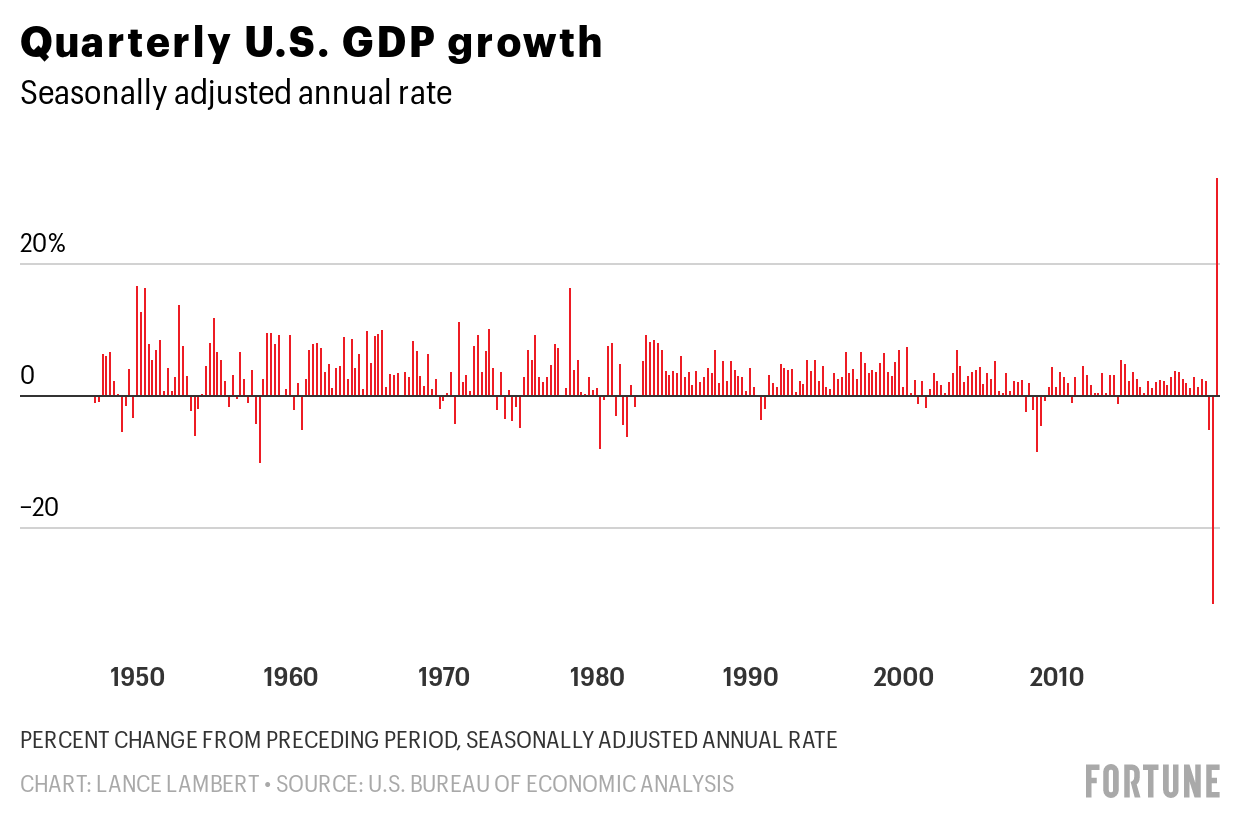
The lockdowns took a massive toll on gross domestic product. In the first quarter, GDP declined 5% on an annualized basis, followed by a record 31.4% annualized GDP decline in the second quarter. During that period economists around the world were in a panic and questioning if the United States—as well as the rest of the world—was on the cusp of an economic depression.
Once states began to ease lockdown restrictions, the U.S. economy sprung from deep contraction to high growth. In the third quarter, from July to September, GDP climbed 33.1% on an annualized basis, according to data released by the U.S. Bureau of Economic Analysis.
But GDP is still down. Over the course of the first two quarters, annualized U.S. GDP fell from $21.8 trillion to $19.5 trillion. In the third quarter that swung back up to about $21.2 trillion. It’s expected to fully rebound sometime in 2021.
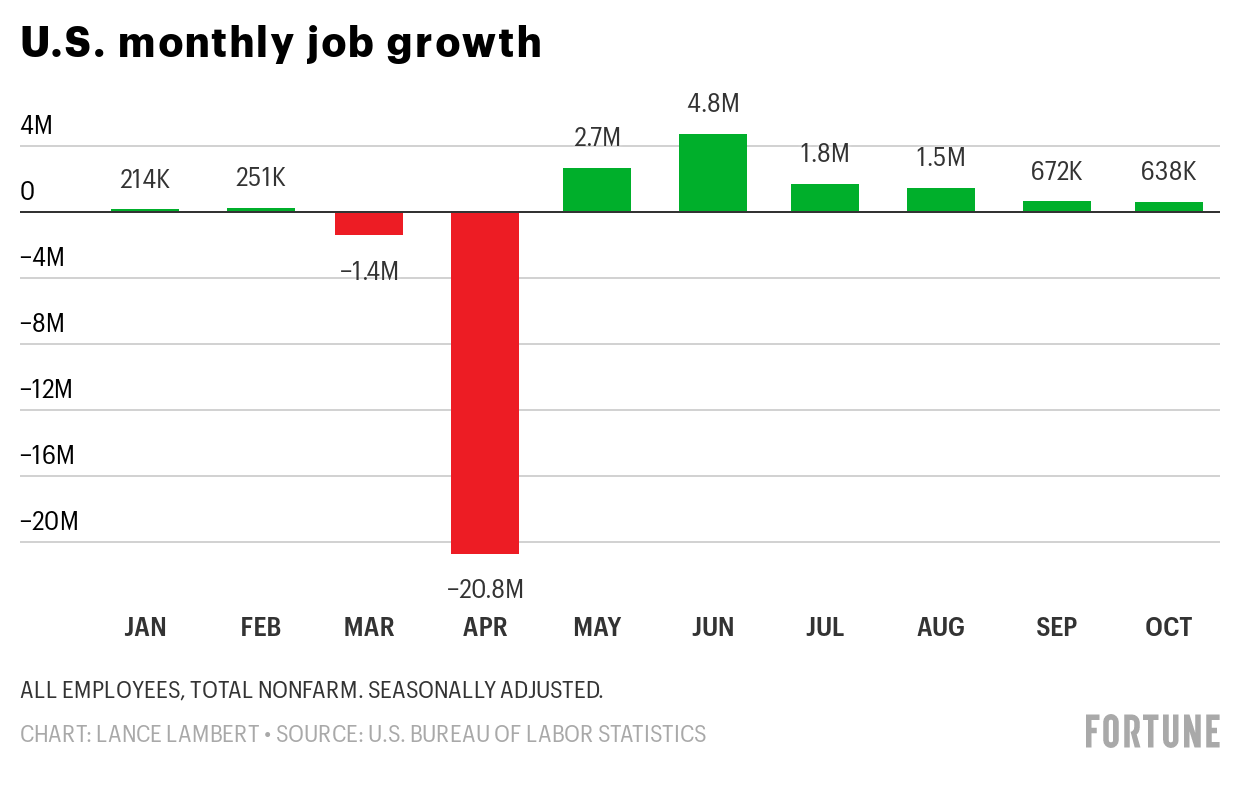
While GDP is seeing something closer to a V-shaped recovery—bouncing back nearly as fast as it fell—that isn’t the case for U.S. employment. The U.S. added 638,000 jobs in October. If that pace were to continue, it would take over 16 months—into 2022—to recover all the jobs lost during the COVID-19 recession. And that’s not even the bad news. Most economists actually expect that pace of hiring to slow further, meaning a full employment recovery could take until 2023 or longer.
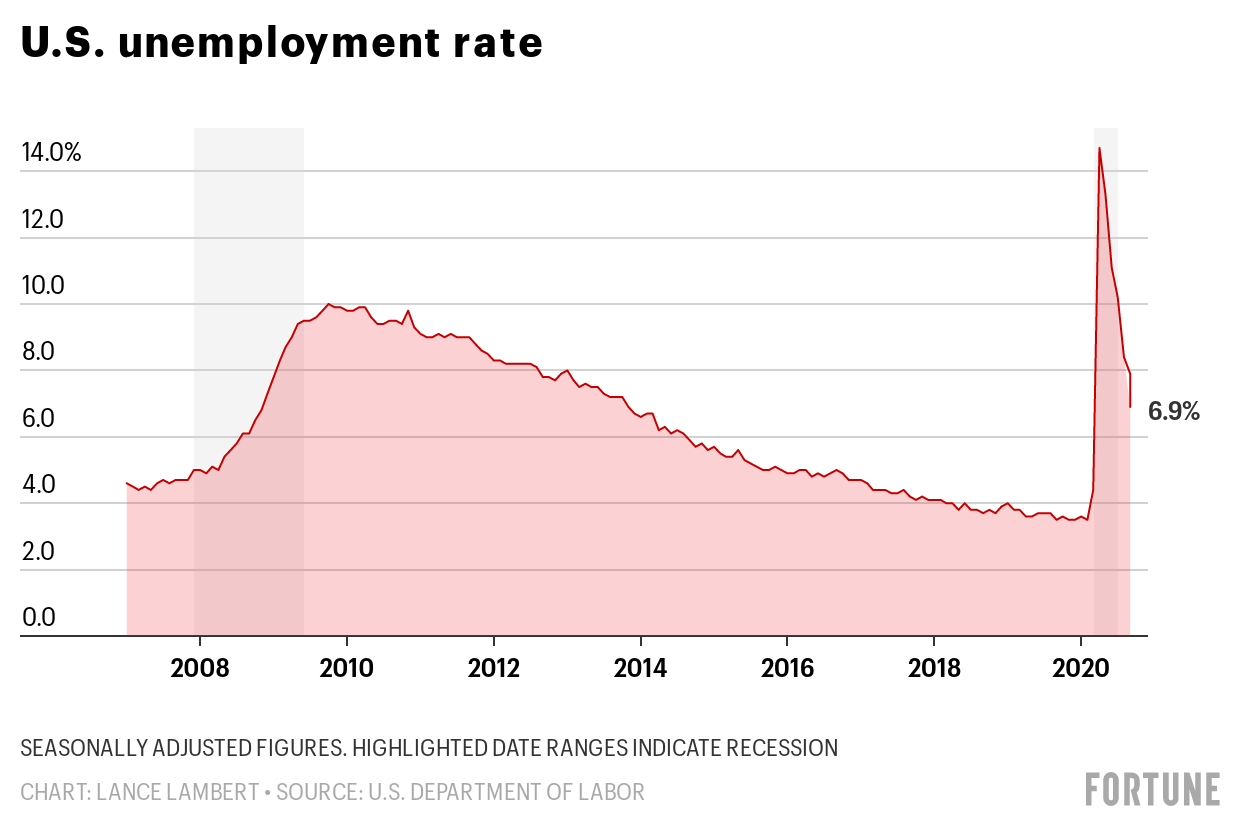
The economic contraction following the March shutdowns was the sharpest in U.S. history: The jobless rate jumped from 3.5% in February—a 50-year low—to 14.7% in April——the highest level since 1940.
We’ve since shifted into a recovery that is moving faster than many economists expected. The unemployment rate stands at 6.9% as of October. That beats the timeline the Congressional Budget Office projected in May, when it forecasted a 9.5% unemployment rate at the end of 2021.
During the Great Recession era, the unemployment rate peaked at 10% in October 2009. And it didn’t make it back down to 6.9% until November 2013. So by recent historical standards, this recovery is moving at a swift pace.
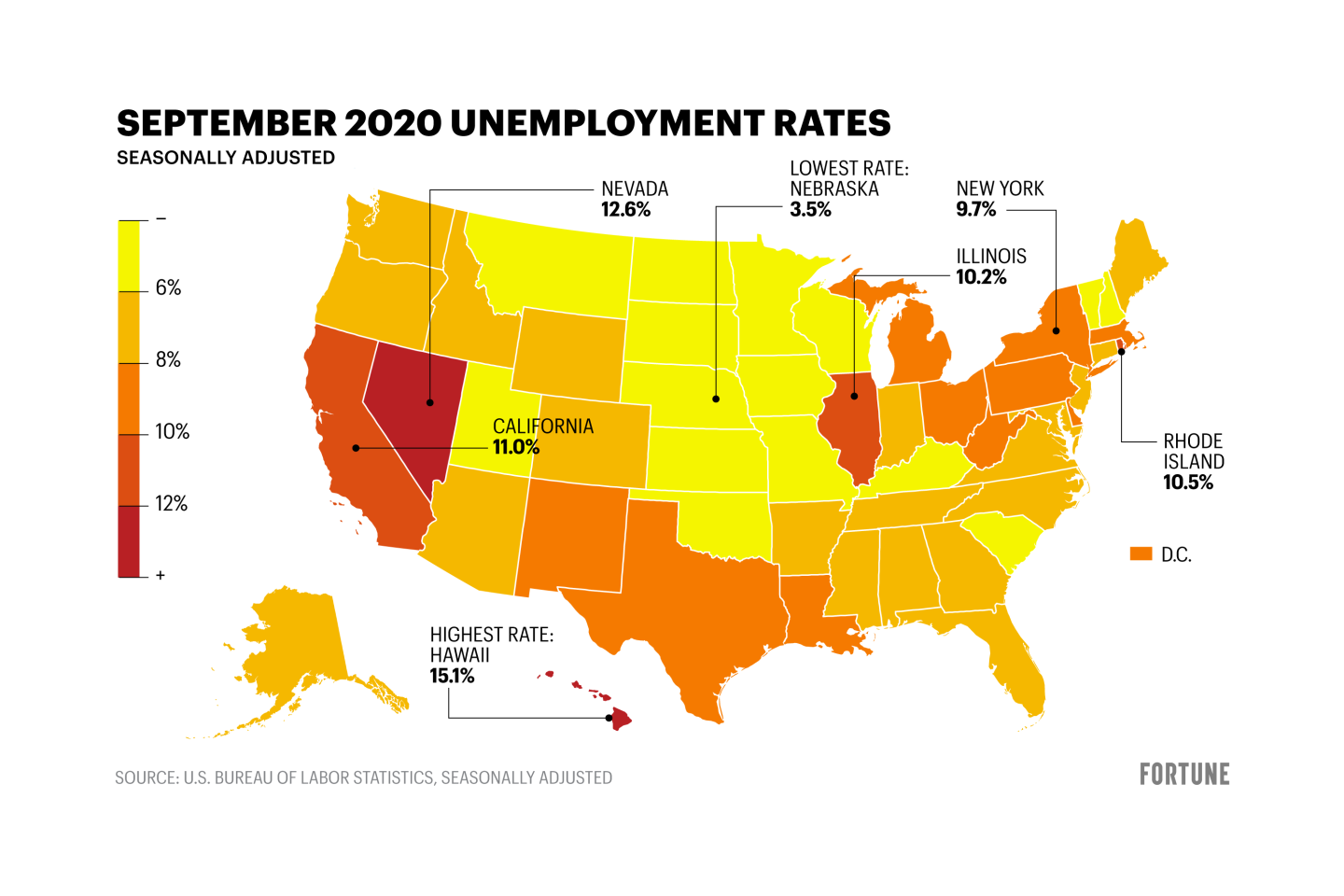
But this economic recovery is anything but even. While the unemployment rate in September in Nebraska sits at 3.5%, Nevada has a jobless rate of 12.6%.
How did these economies get so divided? A lot of it boils down to what types of jobs make up each state’s economy. Look no further than tourism-heavy Nevada which saw its jobless rate soar from 3.8% in February to a staggering 30.1% in April. While Nevada has since improved to a 12.6% jobless rate, it will struggle to fully recover until the Las Vegas tourism business has returned to normal—something that is unlikely to happen until the pandemic is under control.
Meanwhile, rural agriculture-heavy economies like Iowa and Nebraska are recovering at a much faster clip.
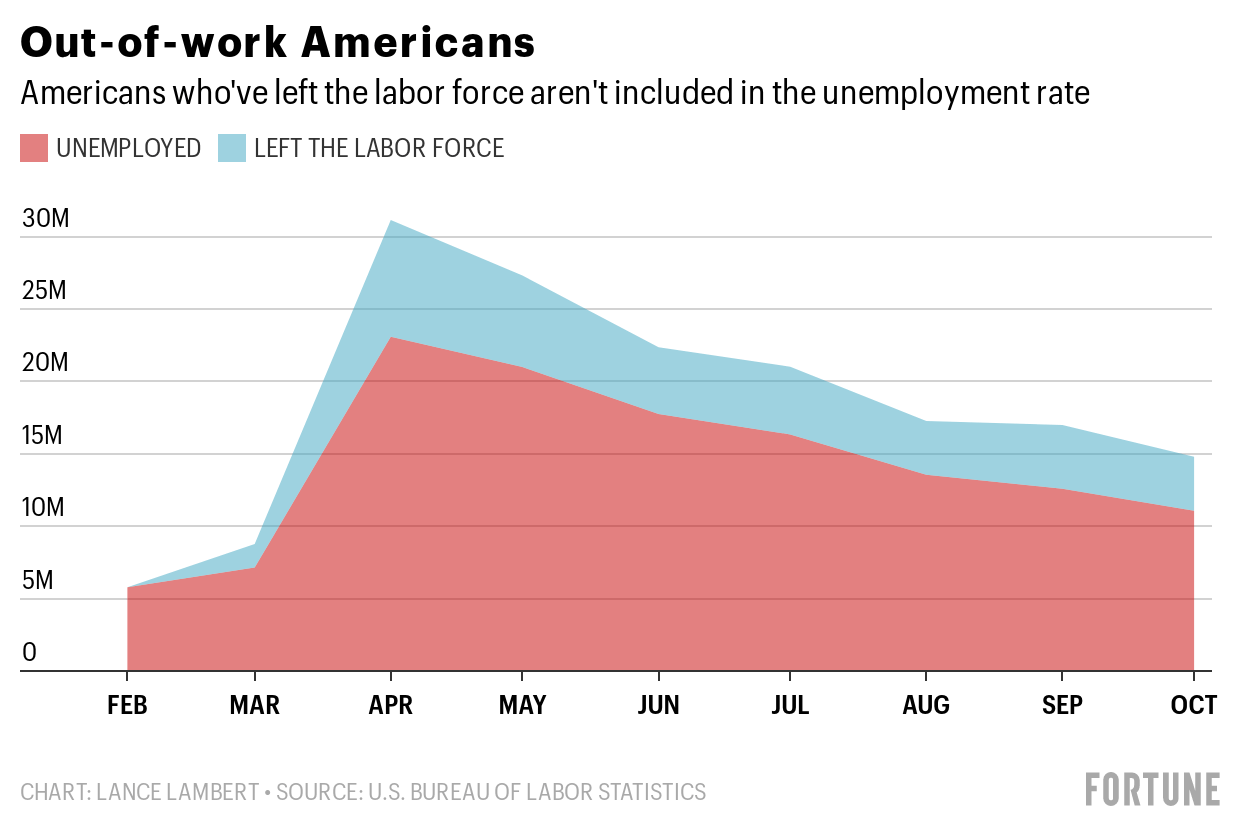
While the sustained drop in the unemployment rate signals an economy moving from recession to growth, it’s also severely undercounting joblessness. It boils down to how the Bureau of Labor Statistics (BLS) calculates the official unemployment rate: Only out-of-work Americans who are searching for new positions are categorized as unemployed. If the jobless aren’t searching, they get thrown out of the civilian labor force altogether. (The unemployment rate is calculated by dividing the number of unemployed Americans by the civilian labor force count).
That’s been the case during the pandemic, with millions of jobless Americans choosing to wait out the virus and stay-at-home order before starting their job search, or to stay home with their kids who have not resumed in-person learning. Overall the civilian labor force declined from 164.5 million in February to 156.5 million in April. It has since climbed up to 160.9 million—but it’s still down 3.6 million.
If the 3.6 million jobless Americans who’ve yet to return to the workforce were to be included in the unemployment rate—what Fortune considers the “real” unemployment rate—it would sit at 8.9% in October, Fortune calculates. That’s well above the 6.9% official unemployment rate calculated by the BLS.
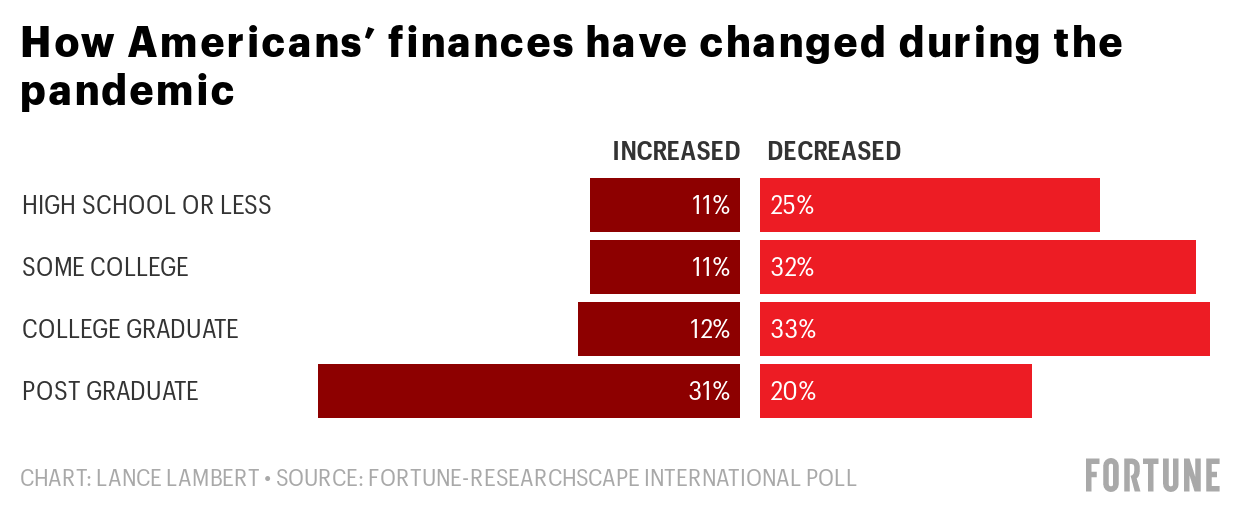
While some Americans are struggling to make ends meet, others who have escaped layoffs are actually better off financially as they save money that would have been spent on commuting, eating out, or traveling. And that divide is happening along class lines: Among Americans with a postgraduate degree, 31% say their finances have improved, finds a Fortune–Researchscape International poll of 3,133 U.S. adults conducted between Oct. 3 and Oct. 19. While only 11% of U.S. adults with a high school degree or less—who are more likely to work in fields hardest hit by the pandemic—say they’re financially better off now.
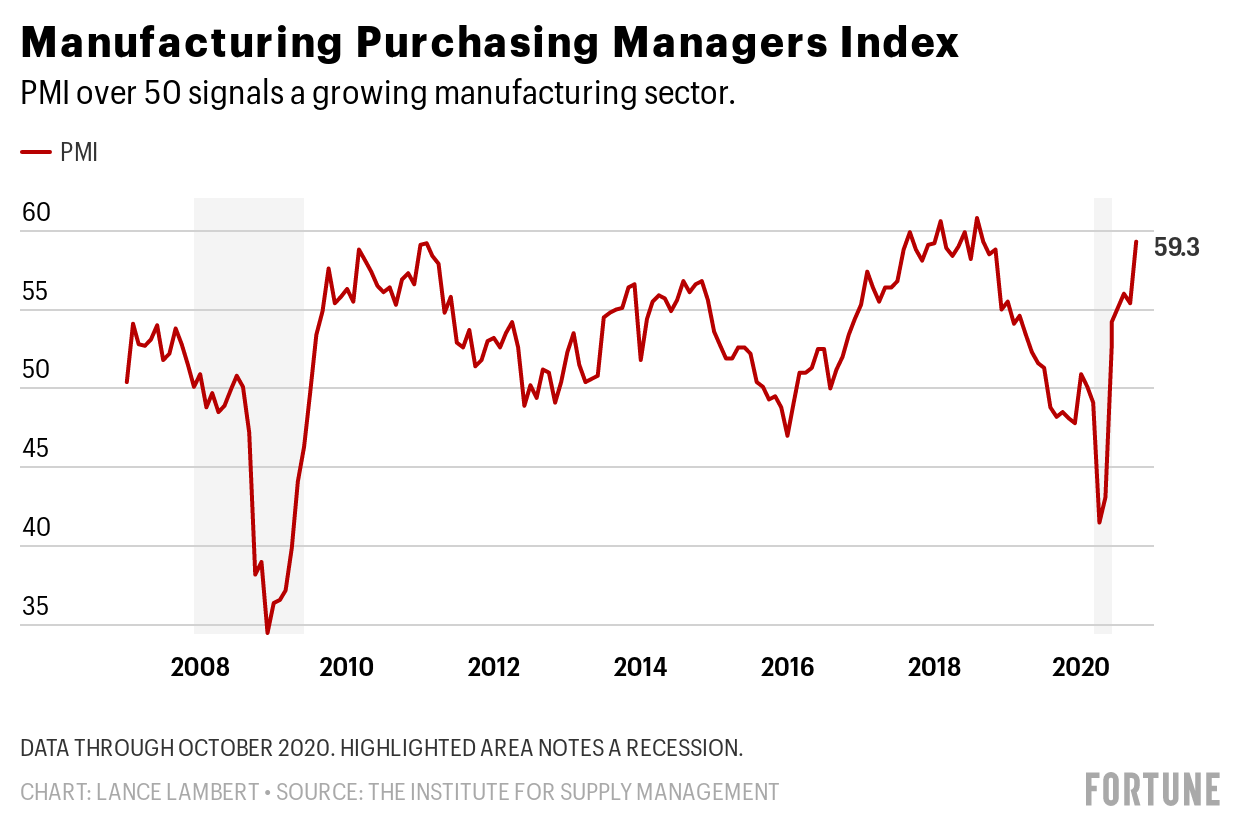
While the Great Recession hammered manufacturing, this time around the sector is among our bright spots. The Institute for Supply Management’s Purchasing Managers Index (PMI) came in at 59.3 in October, up from its 41.5 bottom in April. A PMI below 50 signals a contracting manufacturing sector, while a rate over 50 signals growth—something we’ve achieved for five consecutive months.
The spring lockdowns closed numerous factories, which led to widespread shortages. In the immediate future, manufacturers are busy making up for those shortfalls.
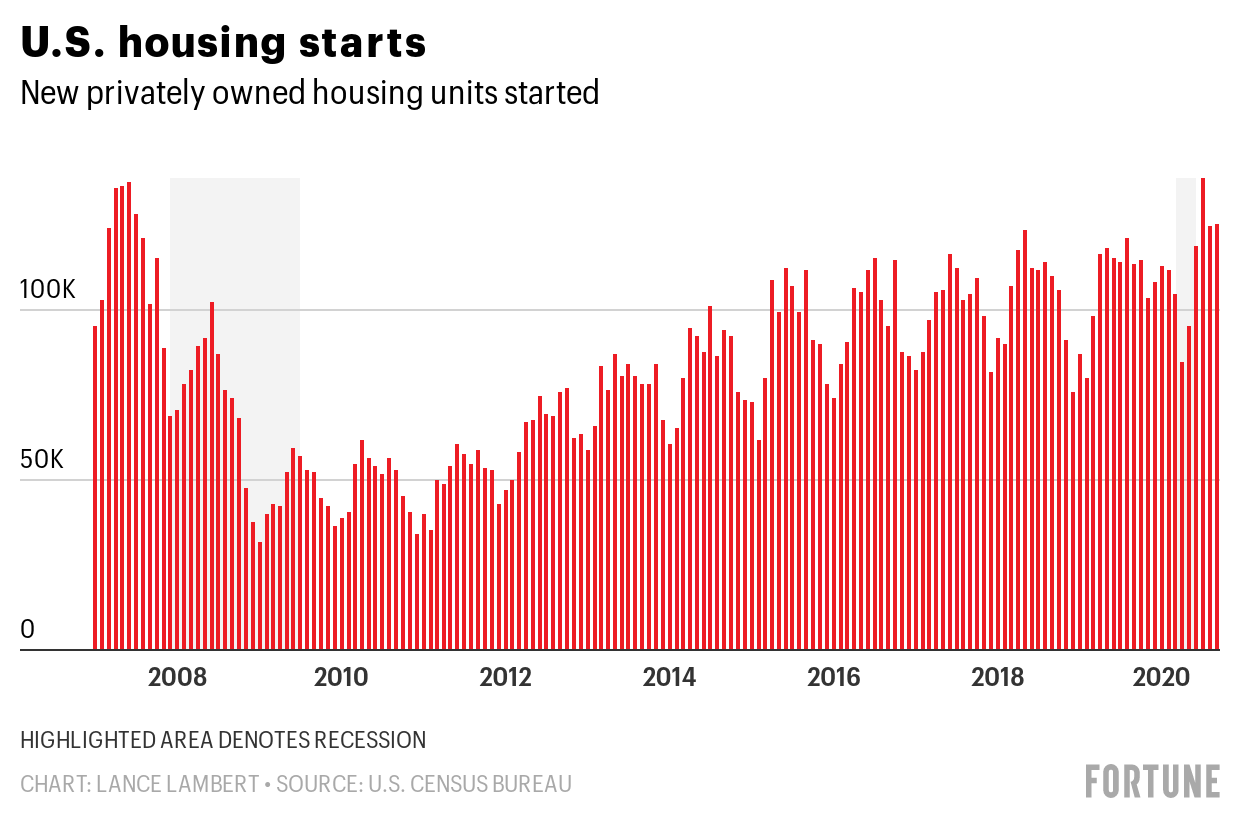
The last time homebuilders were this busy George W. Bush was in the White House. In total, construction crews started working on 1.4 million new homes in September, up 11% from a year prior. The rebound in homebuilding is so strong that it has worsened the national lumber shortage; for a period lumber prices spiked 130%.
How can housing be so robust? For starters the sector has been helped by falling interest rates, a record stock market, and wealthy city dwellers buying up second homes. But it’s also demographics. The biggest years for millennial births ranged from 1989 to 1993. And we’re currently amid the five-year period when all these young millennials will hit their thirties—the peak years for homebuying. That rush of millennials into the market is causing real estate to push upward.
Overall, economic data is most helpful to piece together a story about the economy. What’s this one telling us? It’s truly a tale of two recoveries whereby some people, professions, and geographic areas have recovered swiftly (or never felt too much pain in the first place), while others are mired in a long slog, trying to recapture the gains so swiftly lost to a deadly pandemic.
More must-read finance coverage from Fortune:
- Now that Pfizer is the vaccine front-runner, should you buy the stock?
- Will another $1,200 stimulus check ever come? Here’s what we know
- From mentorship to friendship to love: What I learned from three investing giants
- J.P. Morgan analysts call these 25 stocks “short” candidates as a COVID vaccine gets closer
- A journalist-turned-detective on how corporate America depends on private sleuths