• Home
  • Latest
  • Fortune 500
  • Finance
  • Tech
  • Leadership
  • Lifestyle
  • Rankings
  • Multimedia
MagazineChina

Xi Jinping’s ‘carbon neutrality’ bombshell leaves China in a climate conundrum

By
Naomi Xu Elegant
Naomi Xu Elegant
Down Arrow Button Icon
By
Naomi Xu Elegant
Naomi Xu Elegant
Down Arrow Button Icon
October 31, 2020, 6:30 AM ET

On Sept. 22, Chinese President Xi Jinping made a bombshell environmental declaration to the United Nations General Assembly. China, the world’s largest producer of green- house gases, would begin reducing its overall emissions after peaking in 2030—and by 2060, Xi said, the nation would achieve carbon neutrality.

Xi’s pledge broke through the pandemic-dominated news cycle, pitching China as a global leader in environmental responsibility. But it didn’t affect the goings-on at the Hohhot Jinshan power station.

There, on the fringes of the Gobi Desert in Inner Mongolia, hundreds of workers are building two new power generation units to supply more electricity to the 2 million–plus residents of Hohhot, the regional capital.

The 5 billion yuan ($735 million) project, which broke ground May 31, will more than triple Hohhot Jinshan’s energy capacity to 1,920 megawatts once the units go live in October 2022. And it will all be fueled by coal, one of the world’s dirtiest energy sources.

The Hohhot project is no outlier. Provincial governments in China green-lit more coal-plant projects in the first half of 2020 than they did in 2018 and 2019 combined—17 gigawatts in all, enough to power several million homes.

That fact helps illustrate one of China’s vexing paradoxes: The planet’s biggest investor in green-energy technology is also “addicted” to coal, as Li Shuo, a Beijing-based policy adviser for Greenpeace China, puts it.

Energy security concerns and entrenched industrial interests, Li continues, have made it “very difficult to get rid of the dirty little rock.”

It’s a habit China needs to kick. Since 2006, when it overtook the U.S., China has been the world’s largest carbon polluter. A carbon-neutral China would lower the projected global average temperature in 2060 by 0.2 to 0.3 degrees Celsius, a meaningful impact, climate researchers estimate.
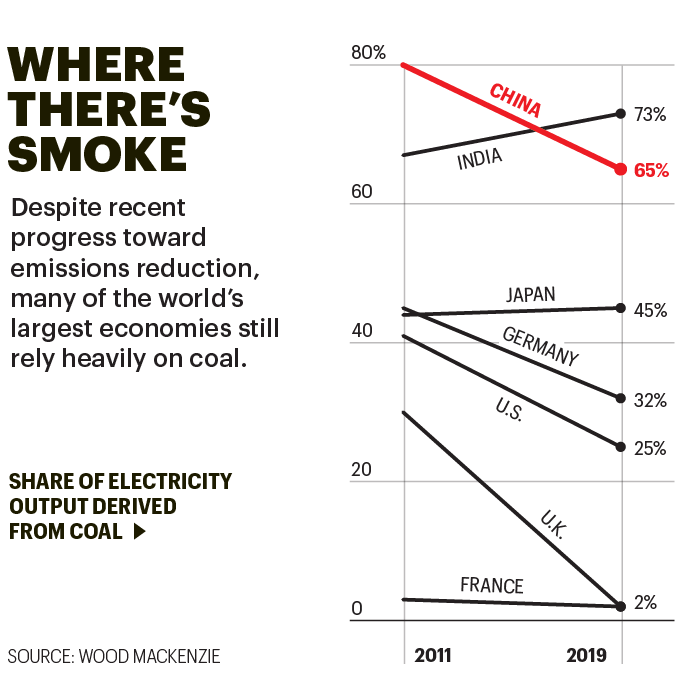
But for China to reach carbon neutrality, coal’s share of its power generation mix would need to fall to 12%, from 62% today, according to energy consultancy Wood Mackenzie. And China’s quest for a greener energy economy has repeatedly taken a back seat in recent years to maximizing economic growth.

The country’s coal consumption declined from 2013 through 2017, during a national campaign to fight air pollution—then rebounded, as pressure to mitigate an economic slowdown took precedence. Today, large-scale infrastructure projects like coal plants are helping jump-start economic activity that slowed early this year because of the coronavirus.

The coal surge also reflects a tension between the needs of regional leaders and the goals of the Beijing government. Coal project approvals boomed after 2014, when the authority to permit new construction passed from the central government to provincial leaders. For the latter, the projects are a surefire way to boost jobs and GDP in the short run.

“As a local governor, that’s your legacy,” Li says.

A desire for self-reliance also keeps coal paramount in China’s energy mix, says Gørild Heggelund, a senior research fellow at the Fridtjof Nansen Institute in Norway who studies China’s energy and climate policy. China’s huge coal reserves mean industries needn’t rely on other countries to meet their energy demands.

By contrast, for its second-largest energy source, oil, China is highly dependent on imports. Energy security “tops the leadership agenda,” says Heggelund.

Newsletter-Red-Line-15

The irony is that even as it has nurtured its coal industry, China’s government has outpaced most others in promoting renewables.

China is the world’s largest producer, exporter, and installer of solar panels and wind turbines. In 2019, it invested $83.4 billion in renewable energy capacity, more than any other nation. (The U.S. invested $55.5 billion that year.)

Renewables accounted for 8.9% of China’s total electricity generation in 2018. Factor in hydropower and nuclear power, and China’s share of energy from non- fossil-fuel sources rises to about 30%.

Impressive as its growth has been, however, renewable energy hasn’t reached critical mass in China—in part because wind and sunshine are less reliable than coal, and in part because the privately owned enterprises that dominate the renewable sector lack the clout and connections that state-owned coal giants enjoy.

Tipping the balance in favor of green energy will require dramatic steps. In order to reach the goals Xi announced, China needs to stop building new coal plants, accelerate the phaseout of existing ones, and table the construction of recently permitted projects.

Coal projects are a surefire way to boost jobs in the short run. “As a local governor, that’s your legacy.”

Li Shuo, Beijing-based policy adviser for Greenpeace China

The most challenging part of the shift will be “the social transition that comes with it,” says Prakash Sharma, Asia-Pacific head of markets and transitions for Wood Mackenzie. Coal-rich provinces like Shanxi and Inner Mongolia—the home of the Hohhot Jinshan plant—will face extensive job losses and short-term economic decline.

Sharma expects the government will try to preserve mining jobs by retrofitting coal-fired power plants with carbon capture and storage technology, which lessens the amount of waste carbon dioxide that enters the atmosphere. But that technology hasn’t yet been proven to work at a scale that can match China’s consumption needs.

So how will China reconcile its climate goals with its energy reality? For now, observers are looking to the next five-year plan, the central government’s latest round of reforms and economic growth targets, which will be publicly available in March 2021. Climate activists hope the plan will include specifics that weren’t included in Xi’s UN speech.

Li, of Greenpeace China, says the government needs to set a “much higher” target for renewable energy use and an absolute carbon- reduction target.

As for coal-fired plant construction, Li says, “This needs to be immediately put on the shelf.”

A version of this article appears in the November 2020 issue of Fortune with the headline “A Carbon Conundrum” 

About the Author
By Naomi Xu Elegant
See full bioRight Arrow Button Icon

Latest from the Magazine

Finance
Lorem ipsum dolor sit amet, consectetur adipiscing elit, sed do eiusmod tempor incididunt ut labore et dolore magna aliqua. Ut enim ad minim veniam
By Fortune Editors
October 20, 2025
Finance
Lorem ipsum dolor sit amet, consectetur adipiscing elit, sed do eiusmod tempor incididunt ut labore et dolore magna aliqua. Ut enim ad minim veniam
By Fortune Editors
October 20, 2025
Finance
Lorem ipsum dolor sit amet, consectetur adipiscing elit, sed do eiusmod tempor incididunt ut labore et dolore magna aliqua. Ut enim ad minim veniam
By Fortune Editors
October 20, 2025
Finance
Lorem ipsum dolor sit amet, consectetur adipiscing elit, sed do eiusmod tempor incididunt ut labore et dolore magna aliqua. Ut enim ad minim veniam
By Fortune Editors
October 20, 2025
Finance
Lorem ipsum dolor sit amet, consectetur adipiscing elit, sed do eiusmod tempor incididunt ut labore et dolore magna aliqua. Ut enim ad minim veniam
By Fortune Editors
October 20, 2025
Finance
Lorem ipsum dolor sit amet, consectetur adipiscing elit, sed do eiusmod tempor incididunt ut labore et dolore magna aliqua. Ut enim ad minim veniam
By Fortune Editors
October 20, 2025

Most Popular

Finance
Lorem ipsum dolor sit amet, consectetur adipiscing elit, sed do eiusmod tempor incididunt ut labore et dolore magna aliqua. Ut enim ad minim veniam
By Fortune Editors
October 20, 2025
Finance
Lorem ipsum dolor sit amet, consectetur adipiscing elit, sed do eiusmod tempor incididunt ut labore et dolore magna aliqua. Ut enim ad minim veniam
By Fortune Editors
October 20, 2025
Finance
Lorem ipsum dolor sit amet, consectetur adipiscing elit, sed do eiusmod tempor incididunt ut labore et dolore magna aliqua. Ut enim ad minim veniam
By Fortune Editors
October 20, 2025
Finance
Lorem ipsum dolor sit amet, consectetur adipiscing elit, sed do eiusmod tempor incididunt ut labore et dolore magna aliqua. Ut enim ad minim veniam
By Fortune Editors
October 20, 2025
Finance
Lorem ipsum dolor sit amet, consectetur adipiscing elit, sed do eiusmod tempor incididunt ut labore et dolore magna aliqua. Ut enim ad minim veniam
By Fortune Editors
October 20, 2025
Finance
Lorem ipsum dolor sit amet, consectetur adipiscing elit, sed do eiusmod tempor incididunt ut labore et dolore magna aliqua. Ut enim ad minim veniam
By Fortune Editors
October 20, 2025
Rankings
  • 100 Best Companies
  • Fortune 500
  • Global 500
  • Fortune 500 Europe
  • Most Powerful Women
  • Future 50
  • World’s Most Admired Companies
  • See All Rankings
Sections
  • Finance
  • Leadership
  • Success
  • Tech
  • Asia
  • Europe
  • Environment
  • Fortune Crypto
  • Health
  • Retail
  • Lifestyle
  • Politics
  • Newsletters
  • Magazine
  • Features
  • Commentary
  • Mpw
  • CEO Initiative
  • Conferences
  • Personal Finance
  • Education
Customer Support
  • Frequently Asked Questions
  • Customer Service Portal
  • Privacy Policy
  • Terms Of Use
  • Single Issues For Purchase
  • International Print
Commercial Services
  • Advertising
  • Fortune Brand Studio
  • Fortune Analytics
  • Fortune Conferences
  • Business Development
About Us
  • About Us
  • Editorial Calendar
  • Press Center
  • Work At Fortune
  • Diversity And Inclusion
  • Terms And Conditions
  • Site Map

© 2025 Fortune Media IP Limited. All Rights Reserved. Use of this site constitutes acceptance of our Terms of Use and Privacy Policy | CA Notice at Collection and Privacy Notice | Do Not Sell/Share My Personal Information
FORTUNE is a trademark of Fortune Media IP Limited, registered in the U.S. and other countries. FORTUNE may receive compensation for some links to products and services on this website. Offers may be subject to change without notice.


Latest from the Magazine

MagazineWarren Buffett
Warren Buffett: Business titan and cover star
By Indrani SenDecember 7, 2025
14 days ago
MagazineMarkets
Why an AI bubble could mean chaos for stock markets—and how smart investors are protecting their portfolios
By Alyson ShontellDecember 3, 2025
17 days ago
MagazineMedia
CoComelon started as a YouTube show for toddlers. It’s now a $3 billion empire that even Disney can’t ignore
By Natalie JarveyDecember 3, 2025
18 days ago
MagazineFood and drink
A Chinese ice cream chain, powered by super-cheap cones, now has more outlets than McDonald’s
By Theodora YuDecember 3, 2025
18 days ago
AITikTok
China’s ByteDance could be forced to sell TikTok U.S., but its quiet lead in AI will help it survive—and maybe even thrive
By Nicholas GordonDecember 2, 2025
18 days ago
MagazineAnthropic
Anthropic is all in on ‘AI safety’—and that’s helping the $183 billion startup win over big business
By Jeremy KahnDecember 2, 2025
19 days ago

Most Popular

placeholder alt text
Success
The scientist who helped create AI says it’s only ‘a matter of time’ before every single job is wiped out—even safer trade jobs like plumbing
By Orianna Rosa RoyleDecember 19, 2025
2 days ago
placeholder alt text
Success
As graduates face a ‘jobpocalypse,’ Goldman Sachs exec tells Gen Z they need to know their commercial impact 
By Preston ForeDecember 18, 2025
2 days ago
placeholder alt text
Economy
James Talarico says the biggest 'welfare queens' in America are 'the giant corporations that don't pay a penny in income taxes'
By Dave SmithDecember 20, 2025
15 hours ago
placeholder alt text
AI
Meta’s 28-year-old billionaire prodigy says the next Bill Gates will be a 13-year-old who is ‘vibe coding’ right now
By Eva RoytburgDecember 19, 2025
2 days ago
placeholder alt text
Politics
Congressmen who pushed to release Epstein files say massive blackout doesn't comply with law and start work on drafting articles of impeachment
By Jason MaDecember 19, 2025
1 day ago
placeholder alt text
Economy
Sneaking unemployment rate means the U.S. economy is inching closer to a key recession indicator, says Moody’s
By Eleanor PringleDecember 19, 2025
2 days ago