
IonQ says it has built the world’s most powerful quantum computer, as measured by a common industry metric.
On a machine featuring 32 qubits—the quantum equivalent of classical computing’s bits—IonQ says it has achieved “an expected” quantum volume greater than 4 million. The figure vaults ahead of the previous record: a quantum volume of 128 announced just one day prior by Honeywell, the industrial conglomerate.
Peter Chapman, IonQ’s chief executive, said that as the company releases newer iterations of its machines in the years ahead, updated measures will be required. “The number will become so large, we’ll have to leave quantum volume behind,” he said.
Quantum volume attempts to grade quantum computers on a combination of metrics, including a machine’s number of qubits, their “connectivity,” and error rates. IBM, a rival quantum computing pioneer, introduced the yardstick three years ago in an effort to create a more holistic ranking system for quantum computing engineers.
Qubits tend to be unstable, but in an ideal world each additional one adds exponential power to a quantum machine. Because of IonQ’s unique hardware design, it says it is able to tap into those exponential increases, helping push its machine far ahead of the pack, at least according to quantum volume.
IonQ is tilting against tech giants many times the company’s size, such as IBM, Google, Honeywell, Intel, and Microsoft. The five-year-old startup based in College Park, Md., is racing, like the others, to give businesses a computing edge in domains such as chemistry, financial modeling, medicine, and artificial intelligence.
The industry’s holy grail is to create general purpose quantum computers capable of solving presently incalculable problems. Google offered an early, arcane demonstration of the feat last year.
IonQ did not release detailed specifications for its new, turbocharged machine. Chris Monroe, IonQ’s cofounder and chief scientist, told Fortune the company would do so “in the coming months.”
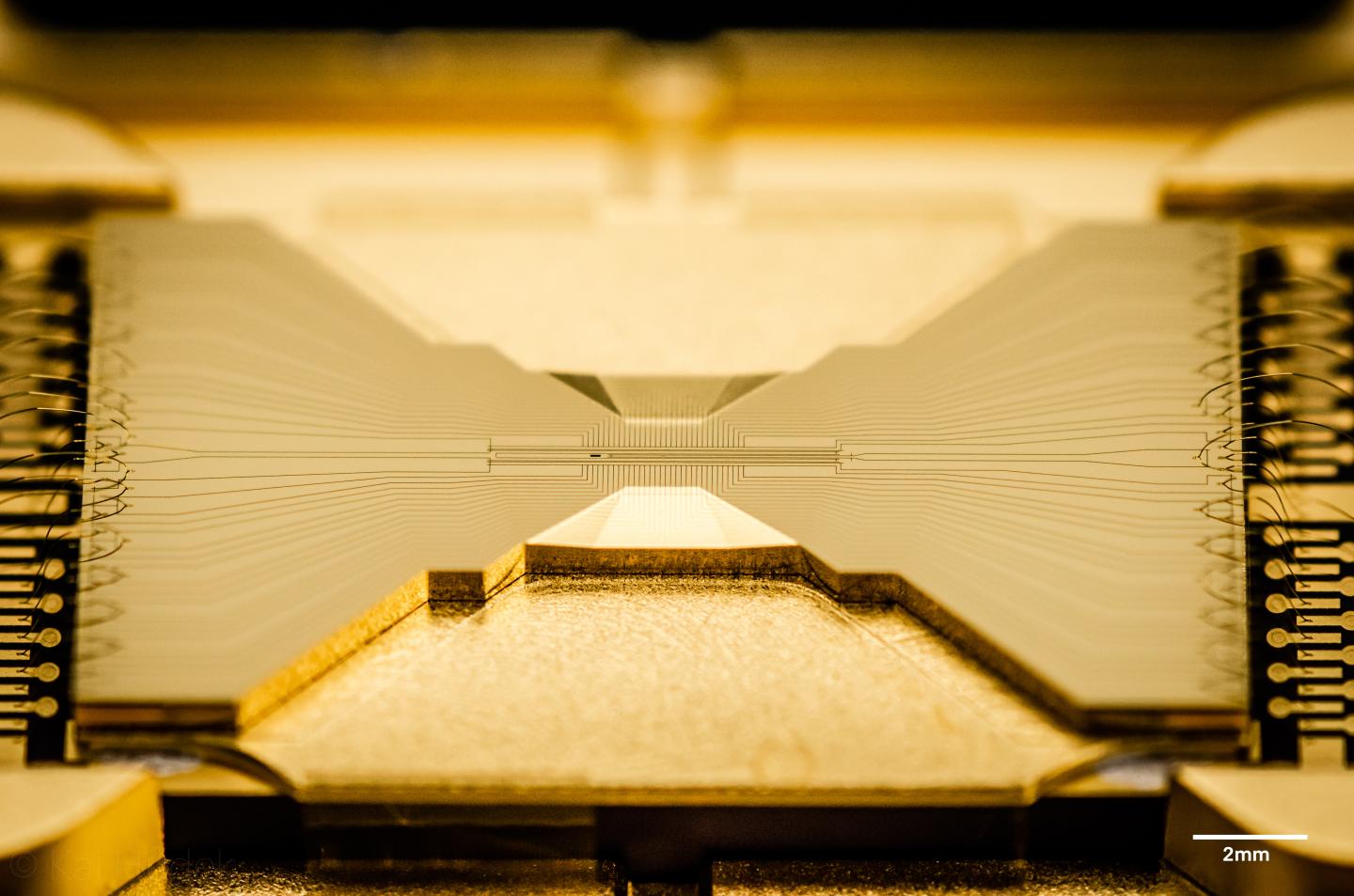
In a preprint article posted on Sept. 24 to ArXiv, an online science database, a team of scientists including Monroe recently claimed to have achieved “error correction with gain” on a 13-qubit mahcine. The experiment, if verified, marks a quantum computing milestone—a drastic reduction in error for notoriously finicky qubits.
“It looks like at least very good research; I don’t know whether it is truly great research,” said Greg Kuperberg, a mathematician at the University of California at Davis who specializes in quantum theory. Until benchmarking data and additional feedback from the scientific community is available, Kuperberg said the announcement “puts me in wait-and-see mode.”
Tony Uttley, Honeywell’s quantum leader, said IonQ’s milestone validates the ion trap hardware approach that is being pursued by both Honeywell and IonQ. “That’s why trapped ion technology is so exciting, because you have the potential with this kind of high-fidelity system to be able to really rapidly increase the computational capability of these quantum computers.” (IBM and Google are, in contrast, developing “superconducting qubit” quantum computers, an entirely different technology.)
Even though IonQ and Honeywell are both pursuing ion trap quantum computers, there’s a big difference in the architectures. IonQ is creating “static array” machines where the atomic qubits essentially remain in place, while lasers, used to program circuits, move around. Honeywell, on the other hand, shuttles the atoms themselves around.
The difference in approach means that one company’s machine may be suited to certain quantum algorithms and operations, while another’s might be suited to a different set, says Christopher Savoie, CEO of Zapata Computing, a quantum software startup. It is difficult, if not impossible, he said, to judge one as better than another at this early stage of development.
“If you want an analogy, it feels like announcing a new sports car that could be very good, together with comments about specs like engine power as well as comments about customers, but before releasing a video or data of track performance,” Kuperberg said of IonQ’s machine.
Kuperberg and Scott Aaronson, a quantum computing expert at the University of Texas at Austin, said IonQ appeared to have made substantive quantum computing progress. Both scientists took issue, however, with the company’s description of having created “perfect” qubits.
Aaronson called the claim of perfection “obvious hyperbole” until the qubits’ capacity for full error-correction can be proved. Kuperberg similarly noted “they do not say what ‘low’ means when they say that the gate errors are low.”
CEO Chapman said IonQ would release a five-year product road map “in about six weeks or so.” The plan follows closely on the heels IBM’s hardware timeline release.
Customers of IonQ will soon be able to use the new machine in private “beta,” Chapman said. Through partnerships, the startup will offer customers of Amazon and Microsoft’s cloud computing businesses access by the first quarter of 2021, he said.