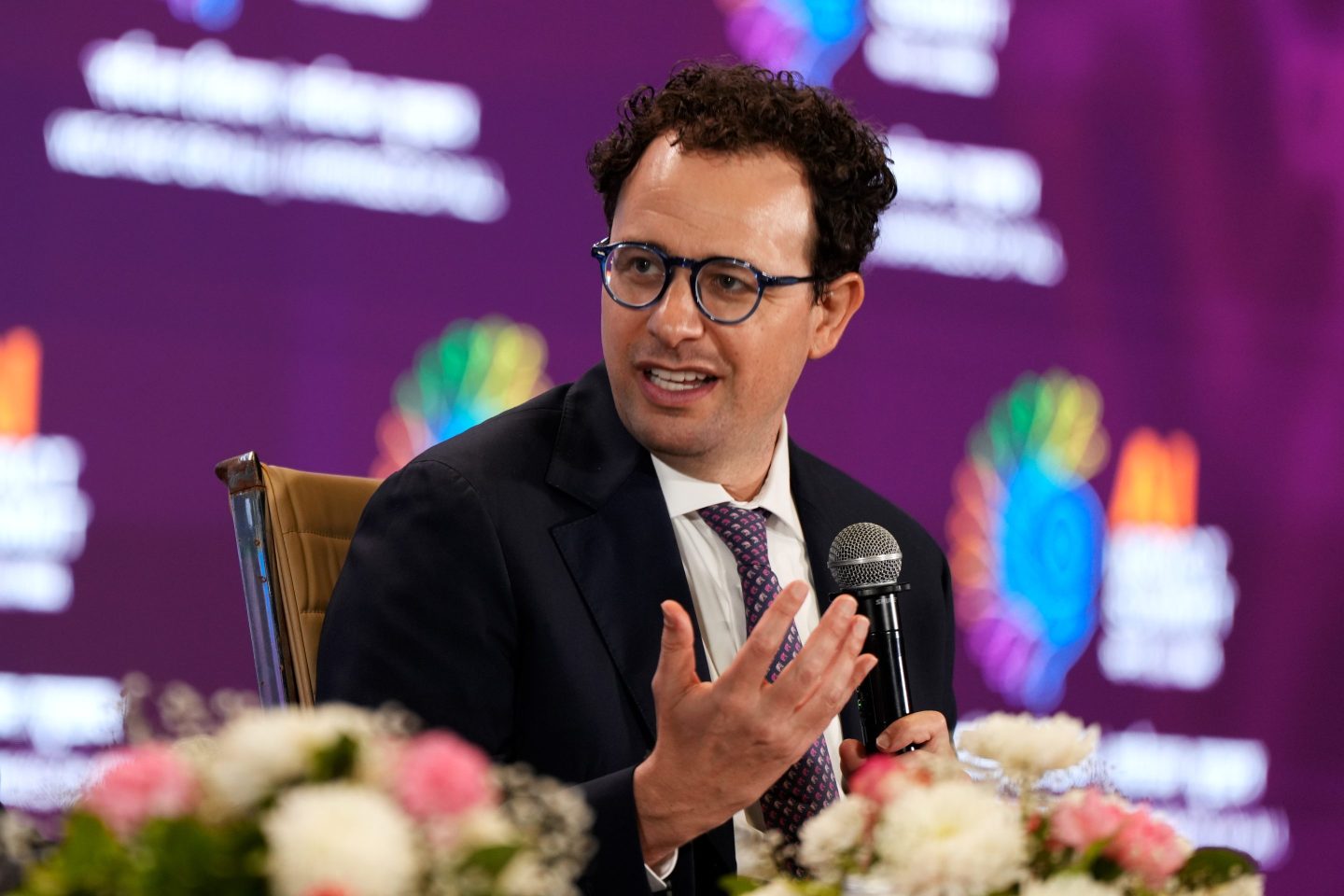
Daniel Ek, the founder and chief executive of Spotify, announced that he plans to invest 1 billion euros of his own money over the next decade into Europe’s fledgling technology startups.
Ek is himself the exception that proves the rule about European tech: a founder who built a consumer technology brand from startup into a global heavyweight with 300 million active monthly users, a public listing on the New York Stock Exchange, and a market valuation of $43 billion.
Precious few European tech companies ever make it on the global stage. The whole continent has just one technology company valued at over $100 billion—venerable enterprise software firm SAP. In recent years, Europe has produced a growing number of venture capital–backed companies with valuations north of $1 billion: There were a total of 99 last year, according to a report from venture capital firm Atomico, compared to fewer than 50 just two years earlier.
But the truth remains that Europe continues to badly lag the U.S. and Asia in its ability to produce independent technology companies with global impact. In 2019 in the U.S., 78 venture-backed startups crossed the $1 billion valuation threshold in just that 12 months alone. It is still true that many of Europe’s most promising tech companies wind up being acquired by U.S. or Asian technology giants or moving their headquarters to the U.S. to have better access to both investors and customers.
“If you compare Europe versus the U.S., we’re still, by an order of two or three, underfunding for each and every stage in Europe compared to American [venture capital] companies,” Ek said, speaking at the technology conference Slush earlier this week.
He said that too many European entrepreneurs leave Europe for the U.S. because they don’t feel valued. And he said that Europe needed to build more “super-companies” that “raise the bar and can act as an inspiration.”
Ek certainly has the diagnosis right: Europe does badly trail the U.S. in venture funding. In 2019, a record $37.7 billion in venture capital funding was invested in European companies, according to data compiled by the research and financial data firm PitchBook. But that pales next to the $130 billion VC funds poured into U.S. companies.
The problem is Ek’s solution—committing €1 billion ($1.2 billion) of his own wealth to promising technology companies—won’t fix the problem. First of all, it’s just not that much money. Over a decade, it’s just $116 million annually, and even if Ek’s example inspires a dozen other billionaires to make similar pledges, it still hardly closes a $90 billion funding gap.
Not all money is the same
What Europe really needs to catch up with the U.S. is institutional money. While wealthy individuals and family offices have played a greater role as limited partners in venture funds in recent decades, the vast majority of venture capital funding in the U.S. comes from pension funds and philanthropic and university endowments. Just one giant pension fund in the U.S.—the California Employee Retirement System (Calpers)—had about $550 million committed to venture capital at the end of 2019, according to the Venture Capital Journal.
Meanwhile, in Europe, many pension funds, especially government-affiliated ones, have been prohibited from investing in venture capital because it was seen as too high-risk. This is starting to change. About 62% of European pension funds have built a private equity investing program of some kind, and they currently make up about 30% of the funds committed to European private equity. But that compares to north of 50% in the U.S.
The need for pensions to start backing venture capital is even more acute in Europe because another big investor in U.S. venture funds—university and philanthropic endowments—is almost completely absent in Europe, where these institutions are largely publicly funded without significant private endowments to fall back on.
In some ways, if you want to know why Europe continues to lag the U.S. in venture capital, the answer is simple: socialism. The legacy of having a much more socialistic form of capitalism is that many institutions that are privately funded in the U.S., such as universities, are primarily state-funded in Europe. And Europe likes it that way. But it may mean Europe will perpetually struggle to close the venture capital gap with the U.S.
European governments have tried to make up for some of the shortfall by directly backing venture capital funds through the European Union–backed European Investment Fund. But the EIF is too underpowered—in 2020 it committed less than $12 billion in total— and its mandate to support small and growing companies across all 27 member states of the EU has led it to spread this funding so widely that its potential impact has been muted.
Startup bugs
Then there’s the other problem that Ek put his finger on: European founders’ lack of “inspiration.” In some ways, that problem is fixing itself because of people like Ek. Whereas once young European graduates aspired to nothing more than nice cushy jobs in a big, established corporations with five weeks of vacation a year and the prospect of early, pensioned retirement, many have now been bitten by the startup bug. It isn’t hard these days to find young entrepreneurs in Europe who want to grow big companies and become rich like Ek himself has.
But it’s not a given that that kind of ambition produces world-beating technology giants. What European founders seem to lack, to quote former U.S. President George H.W. Bush, is “the vision thing.”
It’s rare to find a European entrepreneur who speaks of their company in the messianic, “change the world” language that’s commonplace among their brethren (and they are mostly bros) in Silicon Valley. About the best you get from Europe’s founders is a promise to radically transform a particular industry. But higher consciousness through software, saving souls one download at a time—Europe doesn’t do that.
But without that kind of vision it’s hard to see Europe producing a rival to Google, Apple, or Facebook anytime soon.
Capital can be fixed. Culture is another matter.