Microsoft stopped making its own line of phones four years ago, as consumers rejected its mobile platform in favor of those from Apple and Google. But if you can’t beat them, join them, so the saying goes.
On Thursday, Microsoft puts on sale its new Surface Duo device, a unique take on the folding phone trend that runs plenty of the company’s own mobile apps on top of Google’s Android operating system. I’ve been using the slick $1,400 device for a few weeks, and there’s a lot to love in Microsoft’s return to the mobile market. But there are also a few missing elements included in most rival phones—folding and traditional—that are hard to live without.
The Surface Duo specs
Known for most of its history as a software powerhouse, Microsoft has certainly upped its hardware game under chief product officer Panos Panay. And the Surface Duo is one of Panay’s proudest accomplishments yet.
The hardware is absolutely stunning, from the bright white glass exterior to the dual 5.6-inch sharp interior displays. Thanks to two cleverly designed hinges, the Duo opens and closes silently and smoothly over a full 360 degrees. Unlike folding phones that have bending glass screens, the Duo has two distinct screens separated by a clearly visible air gap at the crease in the middle of the device.
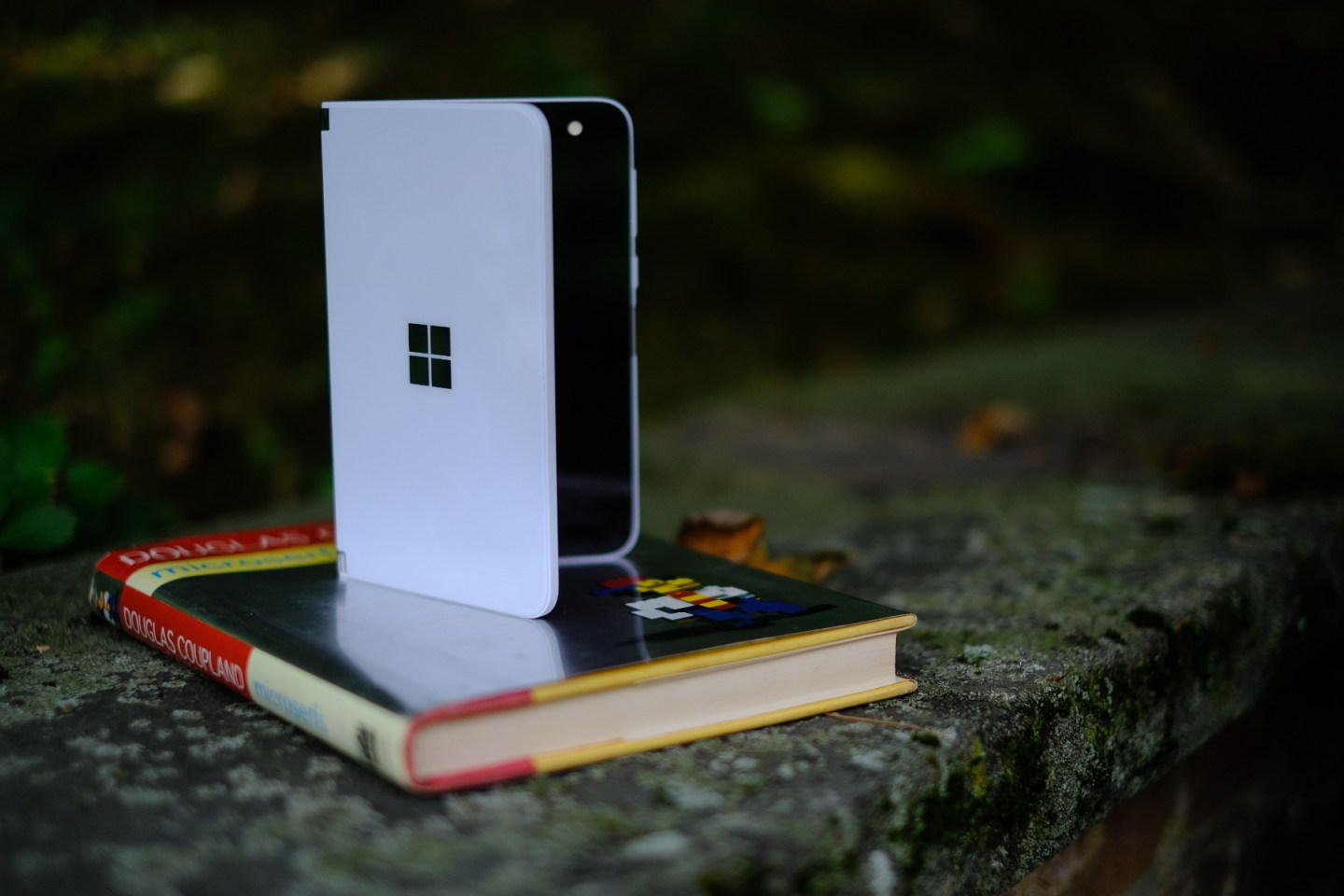
When opened, the Surface Duo is the thinnest mobile device I have ever beheld at just 4.8 millimeters, barely enough room to fit its USB-C port. Even folded, it’s hardly thicker than an iPhone 11 Pro Max or Samsung Galaxy S20 Ultra. And there’s no ugly camera bump (a mixed blessing—more on that below).
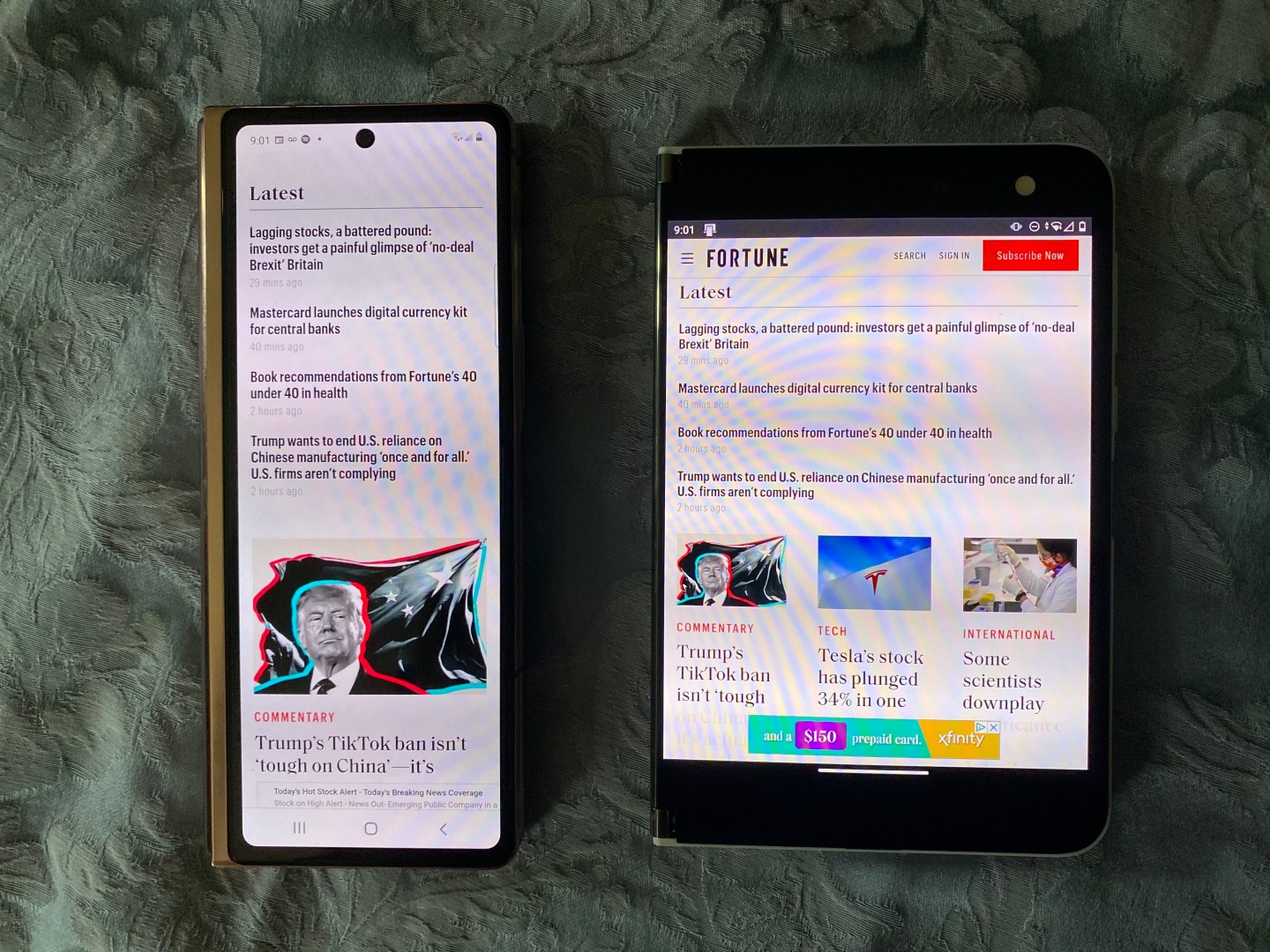
Another hardware highlight is the screen ratio of 3 to 2, just like Microsoft’s Surface laptops. While most smartphone screens are getting taller and narrower, with screen ratios of 16 to 9 up to even 21 to 9, the Surface Duo goes the other way. The decision to go with wider, squatter screens enhances productivity, as apps have more room to spread out and show more information. Websites can take advantage of the extra width to display more stories.
The Surface Duo is compatible with Microsoft’s line of Surface styluses, useful for writing notes, highlighting and editing text, and generally using in place of your fingers to scroll around. The wider display makes it more comfortable to scrawl across the screen than on thinner, taller phones, too.
Still, the Surface Duo has been in development for a long time, and that shows up in some less than cutting-edge specs.
The processor is a Qualcomm Snapdragon 855, which generally powered flagship phones released in 2019. There’s also no 5G, the superfast new wireless technology that carriers are slowly rolling out across the country and have included in most new phones this year. And the two screens have massive top and bottom bezels compared with rivals that have moved to nearly all-glass front displays.
Some people find the act of using the Surface Duo as a phone awkward, with the wide device folded in half pressed to your ear, but I got used to it pretty quickly. Call quality is fine and even better using your favorite pair of wireless Bluetooth earbuds (sorry, no headphone jack).
There is also the matter of the camera. Panay has said that photography was not an emphasis of the Surface Duo, and it shows. There is just one camera, located above the right-hand interior screen of the device, and there are no cameras on the outside. That means no wide angle or telephoto lenses.
The 11-megapixel shooter is decent enough for selfies, but taking a regular picture requires folding the Surface Duo with both screens facing out, and correctly pointing the side with the camera at the desired subject. Maybe it’s because I’m right-handed or maybe it’s because the camera is on the right side of the fold, but I occasionally found it awkward to fold the phone and take a picture. After I folded the Duo, sometimes I ended up with the camera facing toward me, not my subject, and the Duo remained in selfie mode. Flipping the phone over fixed the problem, as the software instantly adjusted, but it was annoying every time it happened.
All of the resulting photos looked a little lacking in vibrant color and fine detail compared with some of the top cameras on other phones. But the portrait, panorama, and video modes all worked well.
A productivity app machine
The obvious benefit of the Surface Duo’s split-screen design is that you can display two different apps side by side.
It’s great to read an article in Chrome on one screen and take notes in OneNote on the other screen. Or do a Zoom call on one screen and review a PowerPoint on the other screen. Microsoft CEO Satya Nadella is said to have fallen in love with using the Surface Duo to read a book on one screen and take handwritten notes on the second screen.
Microsoft even added a feature to Android that lets you create preselected pairs of apps that can be launched at once from a single icon on the home screen.
The two distinct screens offer an experience for dual apps that’s a bit smoother and less janky than phones and tablets that let you display multiple apps on a single screen. On the other hand, the Duo’s software had some glitches of its own, not always quickly adapting to changes in orientation or swiping away apps immediately. Microsoft posted one software update during the review period, which was a big improvement, and says more will be forthcoming.
You can also stretch one app across both screens, but it’s unsightly and awkward to have your content sliced down the middle with a big blank bar. Despite its size, the Surface Duo doesn’t really give you the ability to watch videos across a bigger screen, the way other folding phones can, for instance.
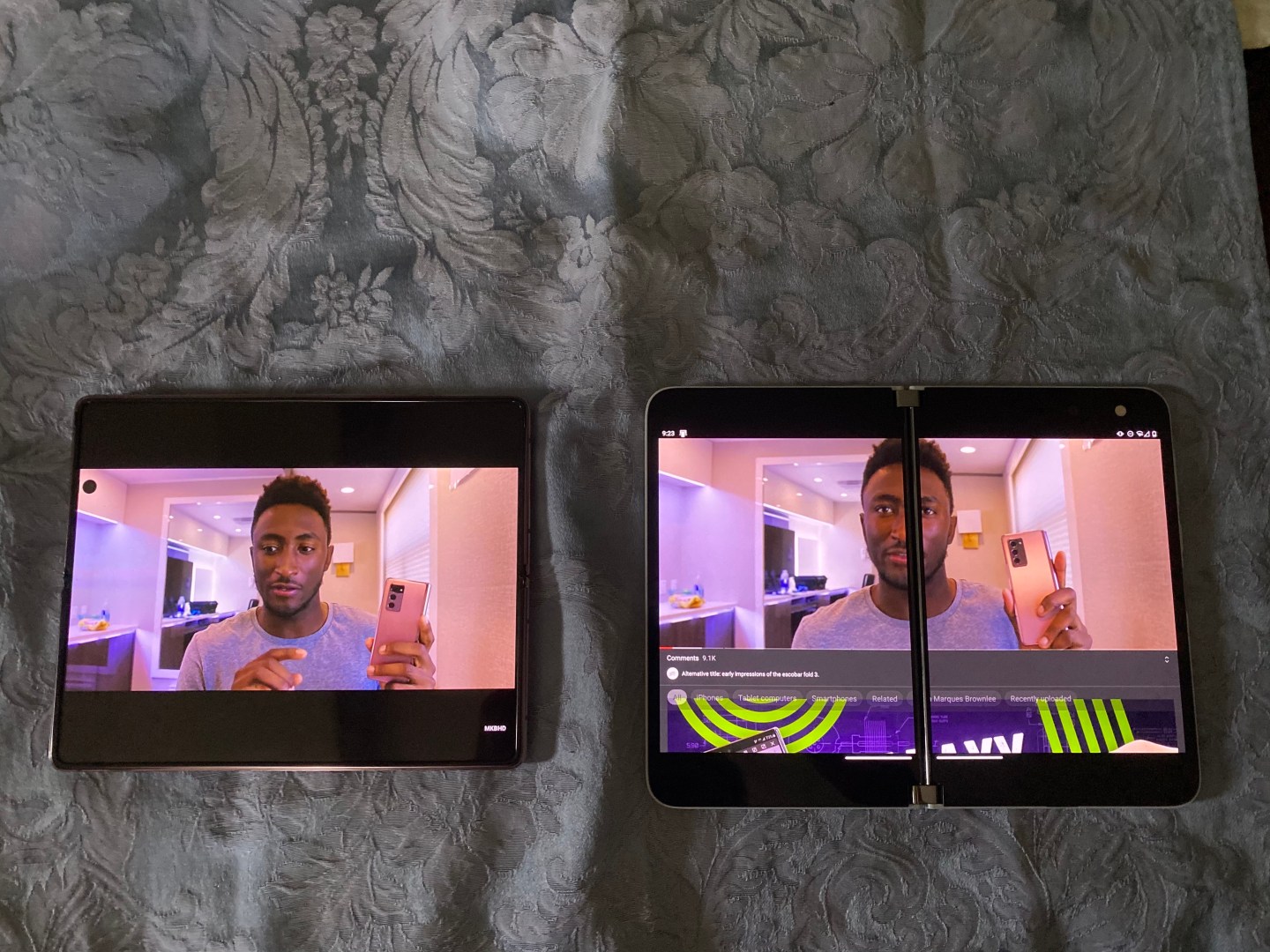
On the other hand, Microsoft and Google cooperated to add a new split-screen mode for Android apps, and many of Microsoft’s apps take advantage of the new mode.
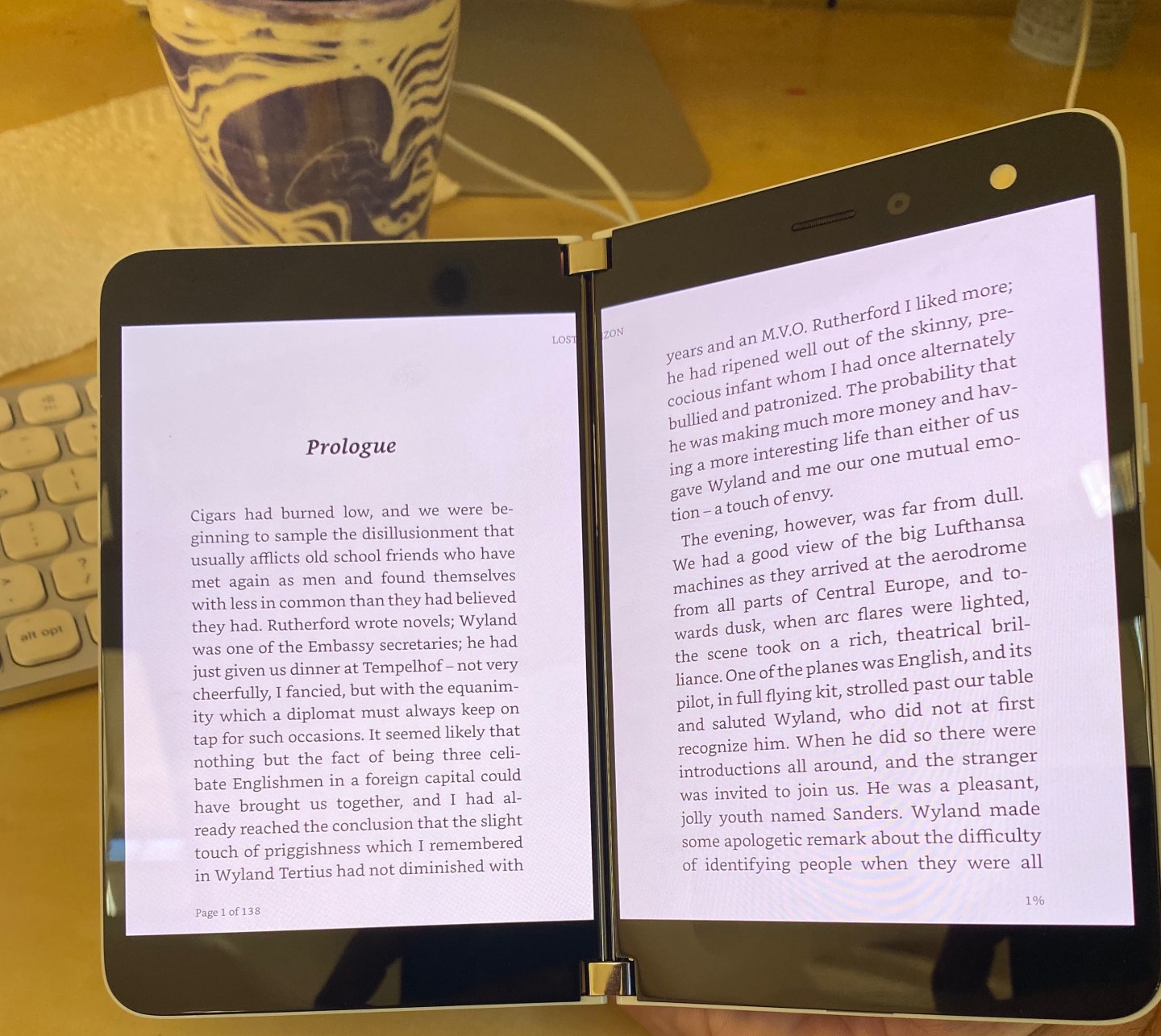
Spread Outlook across both screens and you get a list of emails on one side and the contents of a selected email on the other. Microsoft’s News app has a “book mode” that spreads articles across the two screens like two facing pages in a book. I didn’t find any Google apps that could use the new mode, however, and there aren’t many other third-party apps that have been updated yet to take advantage of the two screens. Amazon’s Kindle e-reader has been updated and looks fantastic picking up the two-page “book mode,” as well.
Not quite there yet
There are so many things to love about the Surface Duo, from the “dropped in from the future” looks and smooth feel to the clever hinges and the new split-screen app mode. But there are also a few big misses, perhaps to be expected in any innovative first-generation product. Few people, if any, need 5G in a phone at this point, but the photo features the Duo lacks may prove a disappointment for those who rely on their mobile device as their main camera.
That’s left me torn. I reach for the Duo first to read e-books, to check websites while tweeting, and generally to get things done on the go (as limited a situation as that is these days). But when I want to snap a cute picture of my dog or kick back and watch some YouTube videos, other devices come to mind.
When BlackBerry first came on the scene, a lot of people used to carry two phones, one for work and one for personal stuff. I don’t think I want to go back to those days. But I’m not ready to rely solely on the Surface Duo yet, either. Here’s hoping for a great version 2.0.