• Home
  • Latest
  • Fortune 500
  • Finance
  • Tech
  • Leadership
  • Lifestyle
  • Rankings
  • Multimedia
Commentaryworld leaders

Why female leaders are faring better than ‘wartime presidents’ against COVID-19

By
David A. Bell
David A. Bell
Down Arrow Button Icon
By
David A. Bell
David A. Bell
Down Arrow Button Icon
August 20, 2020, 5:18 PM ET
Covid-19-Leaders-Women
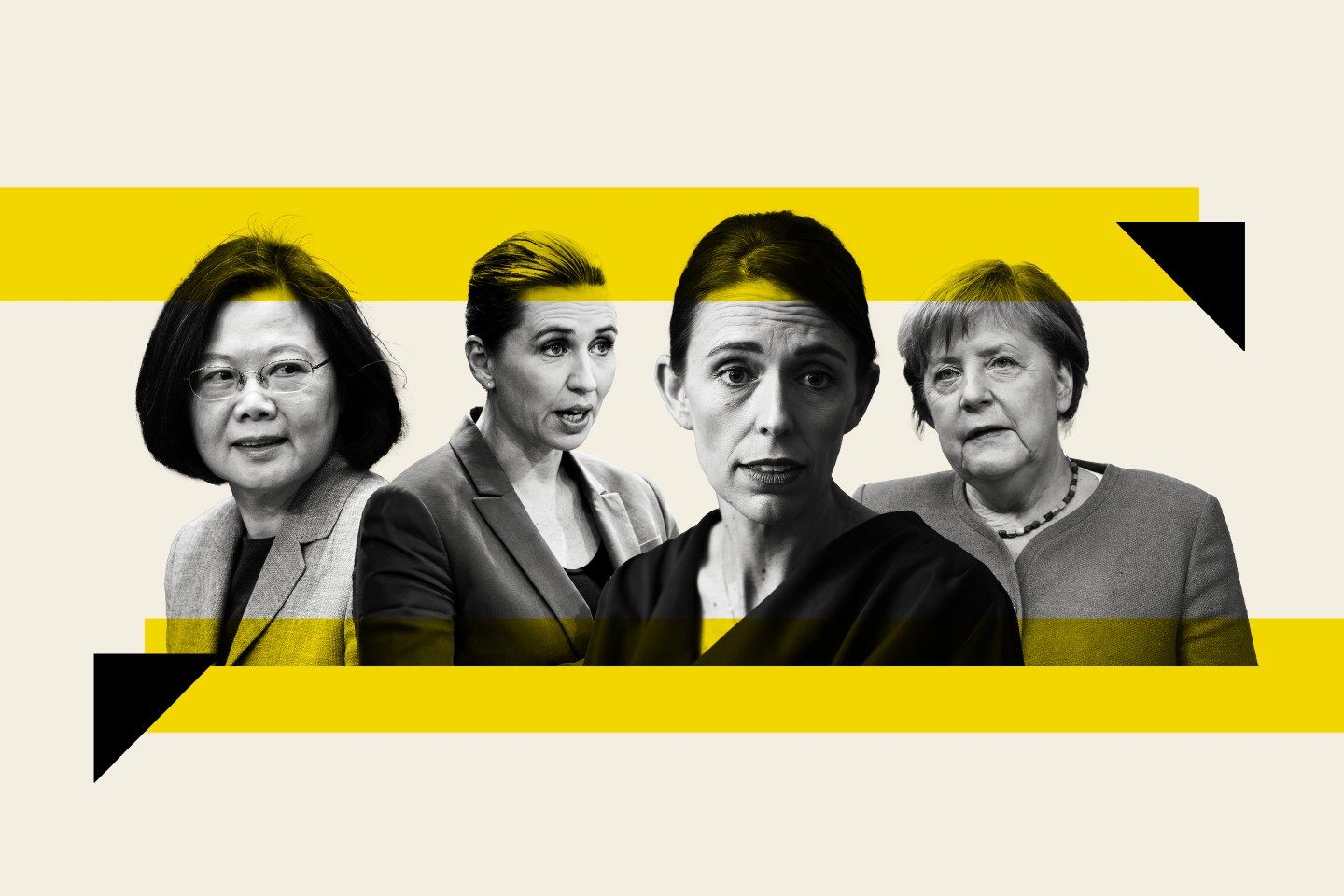
From left: Ashley Pon—Bloomberg/Getty Images; Ida Guldbaek Arentse—Ritzau Scanpix/AFP/Getty Images; Hagen Hopkins/Getty Images; Pool/Getty ImagesAshley Pon—Bloomberg/Getty Images; Ida Guldbaek Arentse—Ritzau Scanpix/AFP/Getty Images; Hagen Hopkins/Getty Images; Pool/Getty Images

When COVID-19 surged in March, Donald Trump described himself as a “wartime president.” Emmanuel Macron of France solemnly proclaimed that “we are at war.” Rodrigo Duterte of the Philippines even threatened to treat citizens who defied lockdown orders as enemy soldiers and shoot them.

The military imagery was understandable. In response to an unprecedented threat, emergency mobilization on a wartime scale seemed necessary. The politicians knew that nations tend to rally around military heroes and war leaders, and the charisma and masculinity they seem to embody. More than half the men elected to the American presidency have either had distinguished military records or led the country successfully in a war.

Yet, today, months after the brash declarations of a war on COVID, the pandemic has shown once again that military-style leadership is poorly suited to contemporary crises. Instead, the most successful responses to COVID-19 have come from women leaders—Jacinda Ardern of New Zealand, Angela Merkel of Germany or Mette Frederiksen of Denmark—who combine public empathy with political skills and technocratic know-how. Is the age of the hyper-masculine, charismatic war leader at its end?  

The human tendency to associate charismatic leadership with masculine, military-style heroism is ancient, of course. Long before the modern age, those perceived as the greatest leaders—from Alexander the Great to Charlemagne—protected their people from conquest and made glorious conquests of their own. 

Democracy changed little about this perception. The great revolutions out of which modern democracies emerged were all accompanied by significant bloodshed and were led by generals who became founding fathers: George Washington in the United States, Toussaint Louverture in Haiti, José de San Martín in Argentina, and Simón Bolívar across South America. 

In the 20th century, the American presidents seen as most charismatic had a macho strength associated with international conflict: the war hero John Kennedy, and his Cold War successor Ronald Reagan. But the spell they cast has worn off. Importantly, the strategy of treating any intractable challenge as if it were a foreign enemy has worked less and less well. Nixon’s “war on crime” and “war on cancer,” Reagan’s “war on drugs,” and George W. Bush’s “war on terror” produced few victories, and disastrous side effects.

Despite these conspicuous failures, climate change too is now being described with the rhetoric of warfare. Last year, former U.S. Senator John Kerry, a Massachusetts Democrat, and former Gov. Arnold Schwarzenegger, a California Republican, announced an initiative they called “World War Zero” to fight for a target of zero carbon emissions. But the news sank with barely a ripple. How do we declare war on CO2?

The COVID-19 pandemic is another crisis poorly suited to be treated as a war. “Victory” will happen when an effective vaccine has been developed, produced, and distributed. Beyond providing money to the vaccine developers and preparing manufacturing and distribution facilities, there is little that governments can do on this front except wait for the science. 

China, Europe, and New York City have all shown what it means to win an initial “battle” against COVID-19: shutting down society and reducing human interaction to the point that the virus stops spreading and comes close to dying out. During the initial shutdowns, health care professionals, standing on the “front lines,” were treated as military heroes of a sort. 

But these shutdowns have come at massive cost, and were followed not with victory parades but by difficult choices. How can citizens be persuaded to alter fundamental sorts of behavior over an indefinite period of time? What risks are tolerable in return for rescuing an economy? 

Heroism of a different kind

In the newest phase of the crisis, it is less evident who the heroes are. Not surprisingly, the politicians most eager to claim the mantle of war leaders have performed poorly and lost public support. Donald Trump has frenetically oscillated between declaring premature victory and insisting that the entire crisis is a hoax perpetrated by his political enemies. Trump, along with Macron and Boris Johnson, has seen his approval levels drop precipitously in polls. 

A different sort of charismatic leadership has proven far more effective, with women leaders shining. Ardern, Merkel, Frederiksen, and Tsai Ing-Wen of Taiwan have emphasized compassion and patience, rather than war and victory. They have not posed as commanders dispatching brave conscripts off to the front, but rather as mothers and daughters sharing the fears and privations of their fellow citizens.

 Ardern has hosted Facebook Live videos from her living room, dressed in a sweatshirt, after just putting a child to sleep, driving home the point that everyone has an equal role to play in containing the virus. Frederiksen, the Danish leader, posted a clip of herself singing Danish pop songs while doing the dishes, injecting much-needed humor into the grim diet of daily news. Each of these women has calmly refused to sugarcoat the threat, or to predict easy victory in the manner of Trump. Merkel shocked her citizens near the start of the crisis when she predicted that 70% of Germans would ultimately come down with COVID-19. Most importantly, each of these women has emphasized the absolute priority of saving lives.

These approaches have won cooperation from the citizenry when it comes to wearing face masks and other behavioral changes. As a result, the countries with women leaders have had far lower levels of COVID-19 mortality than countries led by would-be strongmen like Trump, Vladimir Putin, and Jair Bolsonaro of Brazil. While New Zealand is now struggling with a new surge in cases, Ardern herself now has the highest approval ratings of any New Zealand prime minister in the last century—since the First World War, in fact.

Political charisma is an elusive phenomenon. It is usually spoken of as a personal quality. But in fact, charisma is more of a relationship. It depends on the public recognizing a special quality in a leader and feeling an intense attraction as a result. Perhaps, by the time the crisis ends, worldwide understandings of political charisma will have changed. The figure of the compassionate mother may come to have greater appeal than that of the aggressive wartime commander.

David A. Bell is a historian at Princeton University and the author of Men on Horseback: The Power of Charisma in the Age of Revolution.

This was written for Zócalo Public Square.
About the Author
By David A. Bell
See full bioRight Arrow Button Icon

Latest in Commentary

Finance
Lorem ipsum dolor sit amet, consectetur adipiscing elit, sed do eiusmod tempor incididunt ut labore et dolore magna aliqua. Ut enim ad minim veniam
By Fortune Editors
October 20, 2025
Finance
Lorem ipsum dolor sit amet, consectetur adipiscing elit, sed do eiusmod tempor incididunt ut labore et dolore magna aliqua. Ut enim ad minim veniam
By Fortune Editors
October 20, 2025
Finance
Lorem ipsum dolor sit amet, consectetur adipiscing elit, sed do eiusmod tempor incididunt ut labore et dolore magna aliqua. Ut enim ad minim veniam
By Fortune Editors
October 20, 2025
Finance
Lorem ipsum dolor sit amet, consectetur adipiscing elit, sed do eiusmod tempor incididunt ut labore et dolore magna aliqua. Ut enim ad minim veniam
By Fortune Editors
October 20, 2025
Finance
Lorem ipsum dolor sit amet, consectetur adipiscing elit, sed do eiusmod tempor incididunt ut labore et dolore magna aliqua. Ut enim ad minim veniam
By Fortune Editors
October 20, 2025
Finance
Lorem ipsum dolor sit amet, consectetur adipiscing elit, sed do eiusmod tempor incididunt ut labore et dolore magna aliqua. Ut enim ad minim veniam
By Fortune Editors
October 20, 2025

Most Popular

Finance
Lorem ipsum dolor sit amet, consectetur adipiscing elit, sed do eiusmod tempor incididunt ut labore et dolore magna aliqua. Ut enim ad minim veniam
By Fortune Editors
October 20, 2025
Finance
Lorem ipsum dolor sit amet, consectetur adipiscing elit, sed do eiusmod tempor incididunt ut labore et dolore magna aliqua. Ut enim ad minim veniam
By Fortune Editors
October 20, 2025
Finance
Lorem ipsum dolor sit amet, consectetur adipiscing elit, sed do eiusmod tempor incididunt ut labore et dolore magna aliqua. Ut enim ad minim veniam
By Fortune Editors
October 20, 2025
Finance
Lorem ipsum dolor sit amet, consectetur adipiscing elit, sed do eiusmod tempor incididunt ut labore et dolore magna aliqua. Ut enim ad minim veniam
By Fortune Editors
October 20, 2025
Finance
Lorem ipsum dolor sit amet, consectetur adipiscing elit, sed do eiusmod tempor incididunt ut labore et dolore magna aliqua. Ut enim ad minim veniam
By Fortune Editors
October 20, 2025
Finance
Lorem ipsum dolor sit amet, consectetur adipiscing elit, sed do eiusmod tempor incididunt ut labore et dolore magna aliqua. Ut enim ad minim veniam
By Fortune Editors
October 20, 2025
Rankings
  • 100 Best Companies
  • Fortune 500
  • Global 500
  • Fortune 500 Europe
  • Most Powerful Women
  • Future 50
  • World’s Most Admired Companies
  • See All Rankings
Sections
  • Finance
  • Leadership
  • Success
  • Tech
  • Asia
  • Europe
  • Environment
  • Fortune Crypto
  • Health
  • Retail
  • Lifestyle
  • Politics
  • Newsletters
  • Magazine
  • Features
  • Commentary
  • Mpw
  • CEO Initiative
  • Conferences
  • Personal Finance
  • Education
Customer Support
  • Frequently Asked Questions
  • Customer Service Portal
  • Privacy Policy
  • Terms Of Use
  • Single Issues For Purchase
  • International Print
Commercial Services
  • Advertising
  • Fortune Brand Studio
  • Fortune Analytics
  • Fortune Conferences
  • Business Development
About Us
  • About Us
  • Editorial Calendar
  • Press Center
  • Work At Fortune
  • Diversity And Inclusion
  • Terms And Conditions
  • Site Map
  • Facebook icon
  • Twitter icon
  • LinkedIn icon
  • Instagram icon
  • Pinterest icon

Latest in Commentary

powell
CommentaryMiddle class
Forget the K-Shape: We have a barbell economy—and the middle class is buckling under the weight
By Katica RoyJanuary 14, 2026
22 hours ago
engineer
Commentaryengineering
China graduates 1.3 million engineers per year, versus just 130,000 in the U.S. We need AI to bridge the gap
By Paul Eremenko and Ashish SrivastavaJanuary 14, 2026
1 day ago
powell/trump
CommentaryFederal Reserve
Is Powell’s Fed head independence dead? Trump outfoxes himself this time
By Jeffrey SonnenfeldJanuary 13, 2026
2 days ago
paramount
CommentaryM&A
A cautionary Hollywood tale: the Ellisons’ lose-lose Paramount positioning
By Jeffrey Sonnenfeld and Stephen HenriquesJanuary 12, 2026
3 days ago
Walken
Commentarybeverages
Molson Coors CEO: We’re doing our part to solve society’s ‘occasion problem’ – and we’re getting some unexpected help
By Rahul GoyalJanuary 12, 2026
3 days ago
AsiaChina
What global executives need to ask about China in 2026
By Joe Ngai and Jeongmin SeongJanuary 11, 2026
4 days ago

Most Popular

placeholder alt text
Personal Finance
Peter Thiel makes his biggest donation in years to help defeat California’s billionaire wealth tax
By Nick LichtenbergJanuary 14, 2026
21 hours ago
placeholder alt text
AI
'Godfather of AI' says the technology will create massive unemployment and send profits soaring — 'that is the capitalist system'
By Jason MaJanuary 12, 2026
3 days ago
placeholder alt text
Success
Despite his $2.6 billion net worth, MrBeast says he’s having to borrow cash and doesn’t even have enough money in his bank account to buy McDonald’s
By Emma BurleighJanuary 13, 2026
2 days ago
placeholder alt text
AI
Being mean to ChatGPT can boost its accuracy, but scientists warn you may regret it
By Marco Quiroz-GutierrezJanuary 13, 2026
2 days ago
placeholder alt text
Economy
Jamie Dimon warns $38 trillion national debt is going to 'bite': 'You can't just keep borrowing money endlessly'
By Eleanor PringleJanuary 14, 2026
1 day ago
placeholder alt text
Future of Work
'Microshifting,' an extreme form of hybrid working that breaks work into short, non-continuous blocks, is on the rise
By Nick LichtenbergJanuary 13, 2026
2 days ago

© 2025 Fortune Media IP Limited. All Rights Reserved. Use of this site constitutes acceptance of our Terms of Use and Privacy Policy | CA Notice at Collection and Privacy Notice | Do Not Sell/Share My Personal Information
FORTUNE is a trademark of Fortune Media IP Limited, registered in the U.S. and other countries. FORTUNE may receive compensation for some links to products and services on this website. Offers may be subject to change without notice.