This article is part of Fortune‘s quarterly investment guide for Q3 2020.
Over the past decade, U.S. homeowners saw their cumulative home equity climb by $6 trillion. That massive gain—larger than the GDP of every nation with the exception of the U.S. and China—confirms that real estate is still a winning strategy for wealth building.
But the coronavirus pandemic is reshaping where that money is going to be made in the years to come. Millions of Americans have physically uprooted themselves in recent months, fleeing cities to second homes or to stay with relatives (in my case, with my in-laws in Ohio). That is already disrupting the housing market. And if more employers make remote working the new norm, it could further transform real estate. Like the 2007–2009 recession, this downturn is hitting some regions and cities—in particular, tourist destinations—harder than others.
Before joining Fortune, I spent almost two years as a data journalist at realtor.com, where I closely tracked U.S. housing markets. Over the past two months, I’ve reconnected with many of my real estate sources across the nation and analyzed reams of data to pinpoint the best and worst places to invest in real estate during the pandemic.
One theme quickly became clear: The coronavirus disruption created a new normal for real estate virtually overnight.
“The expectations for the [2020] spring homebuyer season was it was going to be the best in 13 or 14 years. But the pandemic hits and everything falls off a cliff,” says Frank Nothaft, chief economist at CoreLogic. As states ease lockdowns and home showings return, housing is already starting to rebound in some markets. The key word: some.
To be poised for strong real estate growth, Ellie Mae COO Joe Tyrrell says, you’d want a market with a lot of twenty- and thirtysomething buyers—who are expected to drive the housing recovery—and a local economy that isn’t dragged down by mass joblessness. These factors were included in Fortune’s ranking of the best and worst places to buy real estate during the pandemic.
Our analysis focused on the 200 largest metropolitan areas in the country. In all, we weighted 10 metrics, including price appreciation, availability of second/vacation homes (highly sought-after during the pandemic), home affordability, millennial populations, population growth, and jobs impacted by the pandemic. (Scroll to the bottom of the article for a full breakdown of the methodology.*)
Keep in mind that we examined metropolitan areas, and not just city centers. So if a city’s urban neighborhood loses a resident to the local burbs, it equates to a net loss or gain of zero.
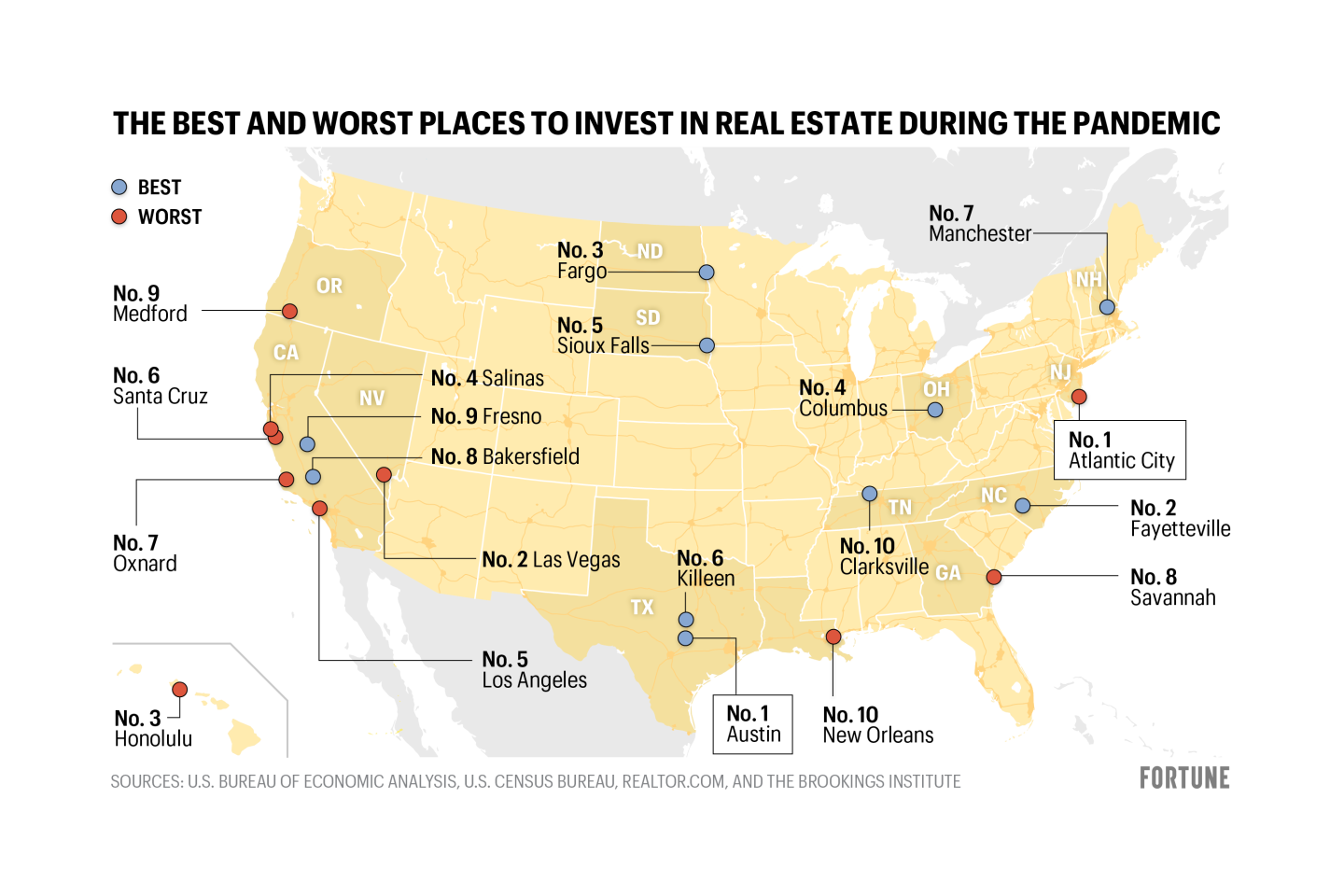
Best markets to invest
Earlier this month Tesla secured tax breaks and land usage approval it sought for the Gigafactory it plans to build in the Austin metro area. This is a sign that the pandemic isn’t going to stop tech companies or twenty- and thirtysomethings from moving to Austin—a.k.a., the factors that have driven the city’s growth for decades.
What draws them in? As compared to other tech hubs, Austin still has reasonably priced real estate when compared to incomes. The median home price in the San Francisco metro area is $998,050, or 10 times greater than local median household incomes. Compare that to Austin’s median price of $377,040, which is 6.4 times household income.
That potent combination of demographics and affordability makes Austin the No. 1 market in Fortune‘s rankings of best places to buy.
The strength of the market has been evident in recent weeks as buying activity has rebounded strongly. “Things started to take off again in June and July. I’ve seen it pick right up where it left off,” says Jason Bernknopf, a realtor at austinrealestate.com. Earlier this month he helped a client put in a bid in for a multifamily fourplex in Austin for $20,000 over its $650,000 listing price. His client lost out on the property, which got a total of seven bids—a surprising number when considering the Texas is still sitting at a double-digit unemployment rate.
Austin is one of the prime beneficiaries of a demographic explosion in the U.S. The millennials, born from 1981 to 1996, are known as a big generation. It wasn’t until 1989, however, when births really spiked. The five biggest birth years for millennials were 1989 to 1993. That means that a hefty percentage of millennials are just hitting age 30—the all-important milestone for first-time homebuying. Housing markets such as Austin that are packed with younger millennials and have reasonably priced real estate are poised to explode in the coming years.
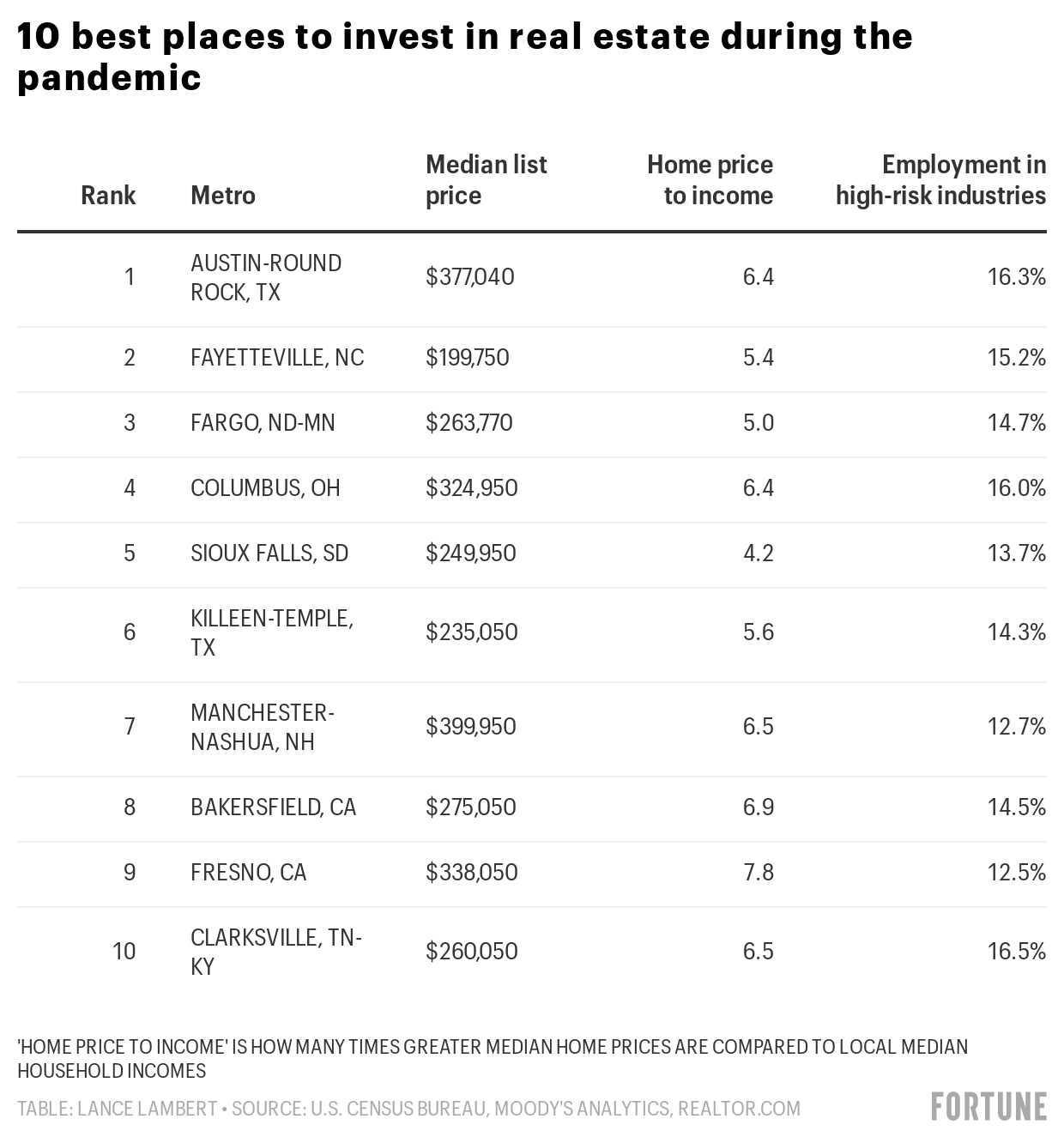
Almost all of the top 10 markets to invest, including No. 2 ranked Fayetteville, N.C., and No. 3 ranked Fargo, N.D., have the same combination of lots of soon-to-be prime age first-time buyers and affordable real estate found in Austin. In No. 4 ranked Columbus, the median home price is just 6.4 times greater than the metro’s median household income. In Los Angeles that ratio is 14.3 times.
As city dwellers continue to flee urban centers that remain under strict stay-at-home orders, second homes and vacation homes are seeing greater interest. Anthony Hitt, CEO of Engel & Völkers Americas, tells Fortune that he expects this trend to continue past the pandemic as remote working helps the affluent be less tied to their primary residences in cities.
However, the markets with the greatest percentage of residences serving as second homes, such as Myrtle Beach, S.C., at 29%, also are being pulled down because the pandemic has crashed their tourism-heavy job markets.
Worst places to invest
The hustle and bustle of the Las Vegas Strip was replaced with an eerie emptiness after the governor of Nevada issued a statewide shutdown of nonessential businesses in March. And the tourism dependent economy in Las Vegas saw its jobless rate soar to 34% in April. That number came down only to 29% in May—still above the U.S. peak of 25.6% during the Great Depression.
“It’s going to take a long time for Las Vegas to recover,” Nothaft says. He expects home prices in Las Vegas to fall over the coming 12 months.
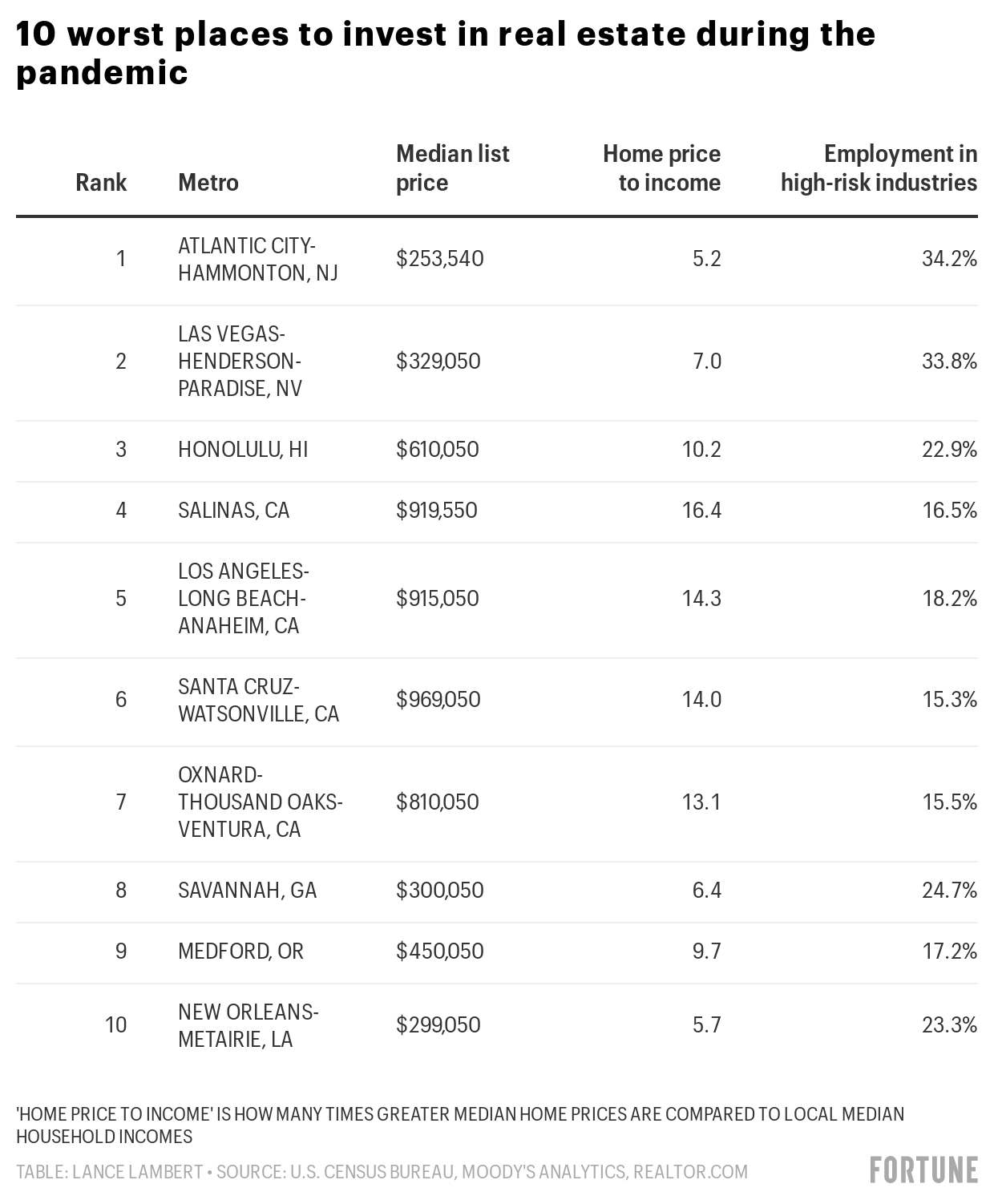
The three worst places to invest in real estate during the pandemic, according to Fortune’s analysis, are all in heavy tourism markets: No. 1 Atlantic City, N.J.; No. 2 Las Vegas; and No. 3 Honolulu. A meaningful recovery for the hospitality and leisure industry is unlikely until there is a vaccine for the virus. That makes investing in tourism markets risky in the short term. If prices fall significantly, however, it could create buying opportunities.
Employers like Twitter and Slack have already said more of their employees can permanently work from home. That could hamper price growth in expensive neighborhoods in big cities previously valued for their proximity to the office. And we’re already seeing signs, as rental prices get cut in some cities. Adriel Lubarsky, CEO and founder of Riveter, says he recently got a double-digit rent cut when he renewed his lease last month in San Francisco.
Among the potential losers of WFH is No. 5 ranked Los Angeles. The reason? Affluent buyers in L.A. are already ducking out for nearby second home markets.
“Buying and selling is on fire right now in Santa Barbara. People are leaving L.A. in droves. They’re getting the heck out and going toward Santa Barbara,” says Terence Alemann, owner and broker of Alemann & Associates. “No one wants to be in San Francisco or L.A. right now. Imagine paying $40 million for a penthouse and being stuck taking a crowded elevator up?”
Plus, the median list price of $915,050 in Los Angeles will continue to hold many of its twenty- and thirtysomethings out of the housing market. Not to mention it has a massive tourism industry that has been hammered by the pandemic.
*Notes on methodology: To find the best and worst places to invest in real estate, we looked at the following metrics for the 200 largest metropolitan areas in the U.S.:
- Home affordability, or the ratio of median list price (realtor.com) to median household income (U.S. Census Bureau)
- Employment in high-risk industries (like tourism) that were most affected by the pandemic (Moody’s Analytics)
- Population age 25 to 34 (U.S. Census Bureau)
- Percentage of second homes (U.S. Census Bureau)
- Housing market’s Hotness Score (realtor.com)
- Page views per home listing, monthly change in page views per property, page views per property as compared to the nationwide rate (realtor.com)
- Monthly change in home listing price and housing inventory (realtor.com)
More from Fortune’s Q3 investment guide:
- A comprehensive guide for first time homebuyers
- To buy or to rent? Residential real estate calculus in the time of COVID-19
- Where are housing prices heading? Gain, then pain
- Are people really fleeing cities because of COVID? Here’s what the data shows
- What the post-pandemic housing market might look like, according to the CEO of Century 21
- This is what every generation thinks of real estate—and what each has spent on it
- How to hedge your home