Subscribe to How to Reopen, our weekly newsletter on what it takes to reboot business in the midst of a pandemic.
While small businesses across the country struggle amid shutdowns, the brunt of the impact has fallen on black-owned businesses.
According to a recent study for the National Bureau of Economic Research by Robert Fairlie at the University of California at Santa Cruz, the number of black business owners actively working fell 41% from February to April—representing a massive loss of 440,000 black business owners. The number of black business owners who were working in April was 640,000, down from 1.1 million. Active white business owners dropped 17%.
Fairlie, the author of the study, tells Fortune he was “shocked” at the findings. But those like Eugene Cornelius, senior director at the Milken Institute’s Center for Regional Economics and California Center and alum of the Small Business Administration, don’t think anyone should be surprised.
“What is amazing is everybody is asking why—we knew this,” he tells Fortune. “The virus has pulled the sheet off of what has been going on in the black community for years.”
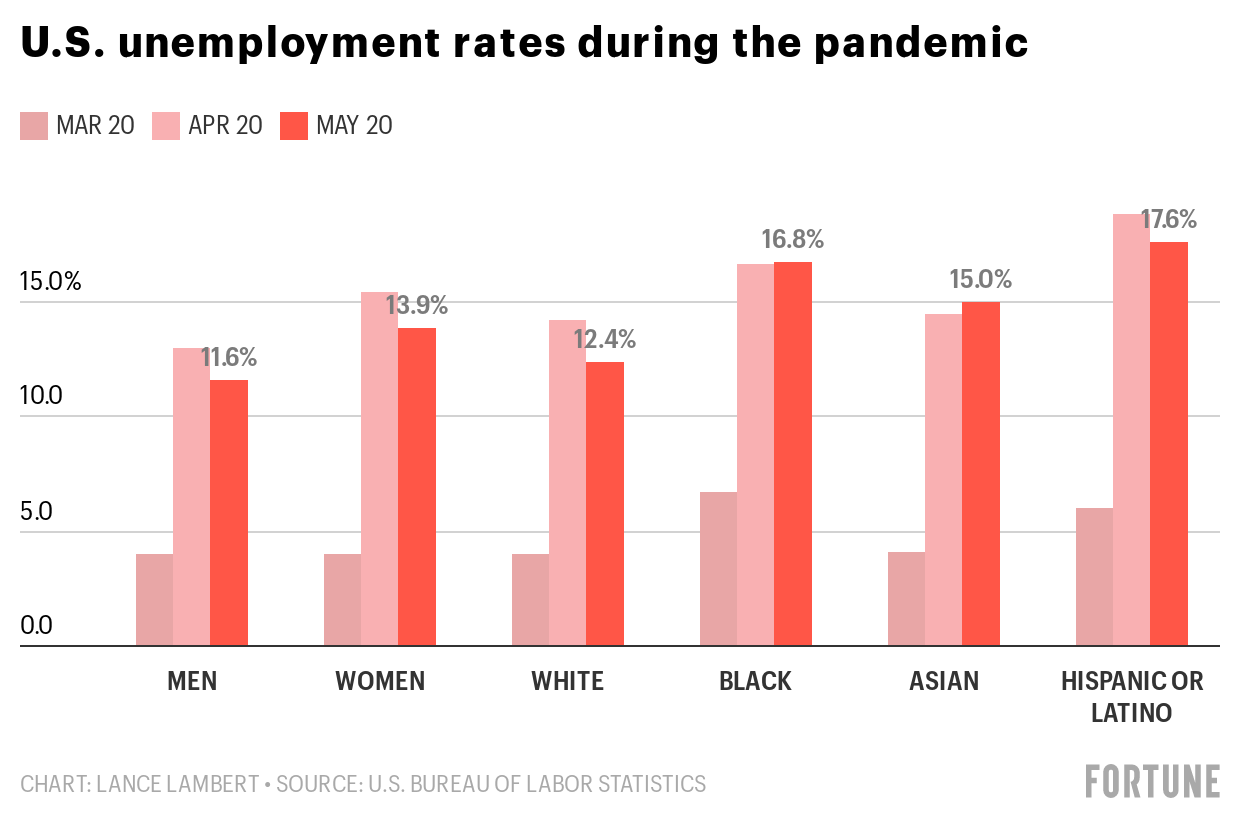
Not only have black Americans been harder hit by unemployment during the crisis (the unemployment rate for white Americans fell to 12.4 % in May, while the rate for black Americans rose 0.1% to 16.8%), they’ve also been disproportionately affected by the virus itself, with higher deaths and hospitalizations reported among black Americans.
But black-owned businesses faced disadvantages even before the coronavirus hit the U.S.
A ‘financially precarious’ position
Many black small-business owners “were already in financially precarious positions before the start of COVID-19,” Everett Sands, the founder and CEO of Lendistry, a black-owned fintech and community development financial institution, tells Fortune.
A large portion of black-owned businesses are in service industries like retail, health care, and restaurants—sectors hit hard by shutdowns. According to Fairlie, the “industry distribution of black [business owners] was partly responsible, placing black business owners at greater risk of losses due to the pandemic.”
But many black-owned businesses were struggling before the crisis hit, too. According to a Federal Reserve survey, 21% of non-Hispanic black and African-American businesses were financially “distressed” at the end of 2019, considering things like earnings and credit, versus only 5% of white-owned businesses.
Meanwhile, the wealth gap between black and white Americans is a yawning gulf—an average black family’s net worth is $17,150, a fraction of an average white family’s net worth of $171,000, based on the latest Federal Reserve data. And 19% of black families have a zero or negative net worth, compared with 9% of white families.
With so little cash to fall back on, “What can you do? That might pay [for] a month or two of rent, [or for] your equipment [for] your business, but you’ve also got to pay the rent and mortgage on your home and all of the other bills you have for yourself,” Fairlie says.
Some of these disparities set up black businesses to take a bigger hit as the country plunged into shutdown. “Wealth and income gaps are the difference between whether a business can survive a shutdown, survive an economic downturn, survive a pandemic, or not,” says Ashley Harrington, the director of federal advocacy and senior counsel at the Center for Responsible Lending (CRL), a nonprofit advocacy group. “Many of these businesses and the communities of color they are based in don’t have that wealth that helps with the shock of an economic downturn, so they’re coming to this without that cushion, without any cushion whatsoever.”
A ‘systematic issue’ with bank relationships
Over the past five years, just 23% of black-owned businesses got credit from banks—versus 46% for white-owned businesses. “Drilling down, why is that?” asks Cornelius. He offers, “because of lack of collateral, because of net worth, they tend to have less relationships with banks.” Without those banking relationships and loans to bolster their businesses during crises like this, Cornelius adds, “then it’s the systematic issue.”
Meanwhile, the historical impact of racist practices like redlining on home values has hurt black business owners’ ability to use homes for collateral, Cornelius suggests, which has translated into being denied loans.
Moreover, black-owned small businesses have historically been underserved by the Small Business Administration’s traditional 7(a) lending program. In 2019 and 2018 fiscal years, only 3% of loan volume went to black-owned small businesses, while roughly half went to white-owned businesses.
Yet research shows black-owned businesses are also more likely to hire people within their communities, CRL’s Harrington points out, “so all of these things are impacted, not just the individual business owner but the community itself.”
Government lending programs largely failed to provide relief
Despite the disproportionate impact of the shutdowns on black-owned businesses, government emergency aid programs appear to have been less helpful for black businesses based on early data. The biggest lifeline for small businesses in the crisis, the $670 billion Paycheck Protection Program (as part of the CARES Act), appears to have been inaccessible for a large portion of black-owned businesses from the outset.
While the SBA has not released demographic information for loans, a recent survey conducted by equal rights groups Color of Change and UnidosUS found that only 12% of black and Hispanic businesses polled from April 30 and May 12 received the emergency loans they asked for, while some 41% were denied.
Part of the problem, experts say, has been the historic lack of access to traditional banking institutions for black business owners—institutions programs like the PPP relied on, especially early on, to dole out funds. Without those established relationships, black-owned businesses faced a hurdle to getting funds. “It puts black businesses so far behind the starting line,” Jade Magnus Ogunnaike, senior campaign director at Color of Change, tells Fortune. Meanwhile, a large portion of black-owned businesses have fewer employees or are sole proprietors, making accessing programs like the PPP more challenging earlier.
While the administration has made several changes to the PPP to direct more funds to underserved communities (including allotting more funds to community development financial institutions, or CDFIs), “minority-owned small businesses…continue to struggle with accessing PPP loans, despite about $130 billion remaining in the program,” chairwoman Nydia Velázquez (D-N.Y.) said Wednesday at a House Small Business Committee hearing on the implementation of the PPP.
Kevin Cohee, the CEO of OneUnited Bank, the largest black-owned bank in the U.S., says his bank approached lending through the program as “a war effort.” While the smaller loans many sole proprietors and black-owned businesses applied for were not as profitable for the bank, Cohee tells Fortune, “for us, it was really a matter of patriotism on one hand, and commitment to black America on the other.”
Despite changes to the program to address these issues, members of Congress acknowledge further efforts are needed to direct funds to minority-owned and underserved businesses.
‘Extremely resilient’
Across the board, it’s likely many small businesses won’t survive the pandemic. For one, Cornelius estimates that of those hundreds of thousands of black business owners who stopped operating, “I don’t see 70% of them coming back.”
But many businesses are fighting to stay alive, and of the 41% of black-owned businesses that had to shut down in the early stages of the crisis, Lendistry’s Sands says he would guess “that 100% don’t want to, maybe 99%.” He contends black business owners are strong: “They’ve been dealing with a racial wealth gap their whole life,” he says.
As businesses start to reopen, those like Cohee suggest one key way to help is to support and frequent black-owned businesses, while others like Harrington and Sands say more pure grants (not more PPP loans) and directing funds to CDFIs would better support black-owned businesses through the crisis.
Cohee, for one, is optimistic: “Black people are extremely resilient.”
More coverage on the intersection of race and business from Fortune:
- Working While Black: Stories from black corporate America
- Why making Juneteenth a company holiday is a powerful statement
- Stacey Abrams: Safeguarding voting rights fights the “virus” of systemic racism
- Fortune survey: 62% of CEOs plan policy changes in response to current calls for racial justice
- How Sean “Diddy” Combs is helping black-owned businesses survive the coronavirus pandemic