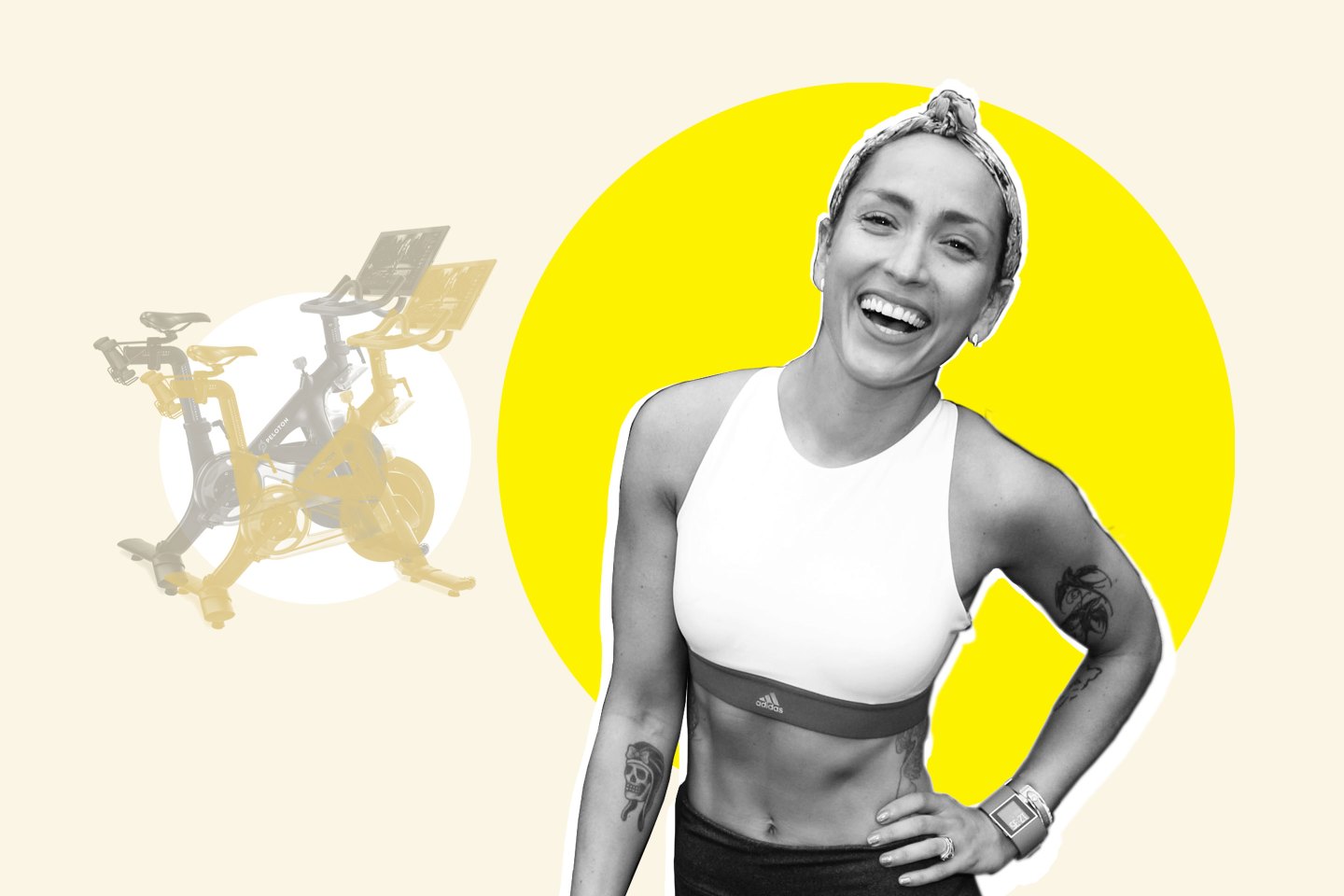
Robin Arzón was a lawyer with a top-notch New York City law firm when she realized she’d rather be running. The challenge was turning her passion for fitness into a career. Today, she is the vice president of fitness programming and head instructor for Peloton, the remote-training upstart whose fortunes have surged while its customers shelter in place.
Equally committed to the motivational art as the physiological science of fitness, Arzón affectionately cheers on the “hustlers” in her classes who make up her remotely sweating “family.” In a sprint of an interview last week, she talks about Peloton’s unplanned pivot to leading classes from the homes of its instructors, including Arzón; her methodical approach to transitioning her career; and importance of social media in building a corporate and personal brand.
Fortune: I’ve taken your classes recently, and I feel like you’ve been in my home, and I’ve also been in yours. What has this unexpected working-from-home experience been like for you?
Arzón: I never imagined I would have a production studio in my New York City apartment, but here we are. I have needed to teach the classes and take the classes with my teammates just as much as everyone on the other side of the screen. It has been a source of positivity and purpose for me.
What has been the biggest challenge?
I have so much admiration for the folks on our production team. I never understood how much work it was, from the lighting to the camera angles to the Wi-Fi. At first I said: “I’m not sure I was cut out for this.” But they have been amazing.
Especially for Fortune’s business audience, I’m intrigued by your transition from corporate litigator at Paul Hastings to your position at Peloton. How did you pull that off?
I was a rising eighth-year litigator, and I thought I was going to be a career attorney. But then I fell in love with running. I was counting down the hours in my day until I could go for my run. I thought, “There has to be a way to monetize this passion.” So I began a two-year process of figuring it out, doing informational interviews and thinking about it. We tend to think of the Jerry Maguire moment where you throw the books on the floor and everything changes. But our journeys don’t work like that. The most pivotal question I asked myself, and still ask myself, was, “Why not me?” I started to do an honest assessment of my skill set. I said: “I know how to read, I know how to write. I have a nascent social media platform. Okay, what do I do with this?”
I was just trying to figure out how to pay my rent while running. I set a recurring calendar appointment for 10 minutes a day where I did something, anything, to move the needle, including just googling “how to be a sportswriter.” I was really living the story in my runs. Eventually, I ended up leaving my law firm two weeks before the London Olympic Games. I went to the London Games as a spectator and blogger. That’s how I started laying the foundation for what I’m doing now.
About six months after I left my firm, I read an article in Fast Company about Peloton. I had done a vision board that included companies like Apple. When I read about Peloton, I realized this was the marriage of movement and modernity. I wrote an email to John Foley, the founder and CEO of Peloton, and said, “I need to be working with you.” I had a job two days later.
I understand that while you’re an avid runner and an ultramarathoner, in fact, you weren’t among the best in the sport.
There was nothing remarkable about my running. That’s why I wrote my book Shut Up and Run. I wanted to demystify what seems complicated or unattainable, especially in a world with Pinterest and Facebook, where it seems like everybody has it together and is running a five-minute mile. What can feel really overwhelming is when someone is starting a journey or restarting a journey.
What makes a Peloton workout unique?
We’re not re-creating the wheel. We didn’t invent the squat. We didn’t invent the bicycle. What we have done is married something that’s entertaining with something that is scientifically sound. That’s not lost on us. We work our asses off. We do the training ourselves. We’re there working right alongside you. In terms of designing the classes, we’ve also done the work. We’ve put in Malcolm Gladwell’s 10,000 hours. We also know it’s so important that people have enough fun that they come back and do it again.
Would you comment on the performance aspect of Peloton? I’m thinking in particular about what a corporate audience can learn from you about presentations and production value.
There absolutely is a performative aspect. But it’s real. We host television shows while sprinting. It’s unscripted and without anyone in our ears. We collaborate with producers, of course, but I’m emoting while sweating with people. That’s why we are the best at what we do, and that’s the secret sauce: passion plus production.
What are Peloton’s plans regarding nutrition instruction?
There’s nothing I can announce right now. We’re aware of the interest. The instructors share their own anecdotal viewpoint on social media, but there’s nothing to announce.
Speaking of social media, how important is it to Peloton’s success and to yours?
What we’re doing requires the conversation to continue, and sometimes start, on social media. The conversations we’re having bubble over into comments and posts and in our brand channel. It’s always been more than a bike. We’re being citizens of the world. We can’t do that in a vacuum.
I see what members are gravitating toward on social media. On our brand channel, I love seeing members celebrate each other, whether it’s #PelotonDads [which really exists] or #BrooklynDogOwners [which doesn’t]. If you like puzzles, I guarantee you’ll find people on Peloton who like puzzles.
Peloton has jumped into the national conversation on social justice and in support of Black Lives Matter. What’s your advice for other companies?
I am incredibly proud that Peloton is committed to becoming an anti-racist organization. I posted this week about the long game. I look at this like I look at training. I wouldn’t recommend that a first-time runner go out and run 50 miles. For me, having this conversation on social media and, at times, in my classes will be a matter of little by little amounting to a lot. I’m not a social justice expert. But in the ways we’re lifting each other up by sweat, we need to lift each other to the point where “together we go far” [a favorite Peloton instructor exhortation] has a lot of meaning now.
More must-read careers coverage from Fortune:
- Coffee startup BLK & Bold’s cofounders on incorporating social impact into the business model
- How work will be different for young professionals—and their employers—because of the coronavirus pandemic
- Escaping “Zoom fatigue” is surprisingly complicated
- The founder of wellness startup Golde on launching a business inspired by personal experience
- PODCAST: An inclusion expert and a CEO on how businesses can keep the anti-racist momentum going
- WATCH: College students face uncertain career beginnings owing to COVID-19