This article is part of a Fortune Special Report: Business in the Coronavirus Economy—a look at the impact of the pandemic on more than 50 industries.
Little about the massive, coronavirus-wrecked, and inarguably unessential cruise industry is American. Now that corporate foreign allegiance has cost cruise operators their chance at a U.S. government bailout.
Cruise operators are not eligible for the sweeping $2 trillion federal stimulus package passed by the U.S. Senate on Wednesday night and the House on Friday, because the bill limits assistance to companies incorporated in the U.S. It’s a double blow for an industry that has been hit hard by the global COVID-19 pandemic—and which is now shut out of a rescue owing to some longstanding (and oft-criticized) corporate behavior.
“It’s very tough to make a loan to a company when they are based in a different country,” President Trump, a longtime friend to the cruise industry and to Carnival Corp. chairman Micky Arison, acknowledged on Thursday.
The President, who has repeatedly said he wants to find a way to bail out the industry, also suggested that it would be easier to help cruise operators if they register in the U.S. and pay federal taxes.
In an emailed statement, a spokeswoman for trade group Cruise Lines International Association told Fortune the industry “will continue to work with policymakers to help our community recover from the impact of this pandemic.”
The discussion around the potential for cruise bailouts has intensified public and political scrutiny of the cruise industry in recent weeks, especially after its starring role in the Diamond Princess debacle and several of the pandemic’s other early disasters. Taxpayer-funded rescues for cruise companies are broadly unpopular, in part because the industry, though large and unquestionably struggling, is purely recreational in nature (and less essential than airlines).
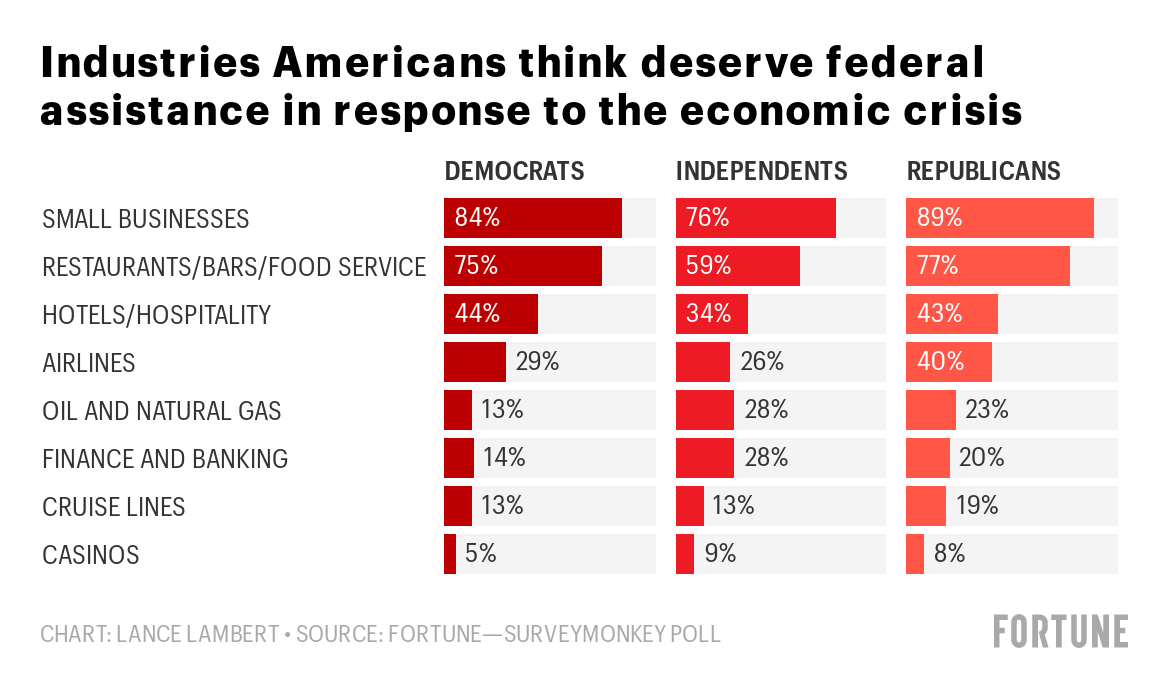
Only 15% of Americans think federal assistance should go to cruise lines, versus 32% for airlines and 82% for small businesses, according to a Fortune-SurveyMonkey poll published in our premium Fortune Analytics newsletter.
Top cruise executives have said they don’t want a bailout, exactly. “We don’t need a bailout in terms of giving us money,” Carnival CEO Arnold Donald told Axios on HBO on Sunday. “Getting a loan guarantee would be helpful.”

“The giant cruise companies incorporate overseas to dodge U.S. taxes, flag vessels overseas to avoid U.S. taxes and laws, and pollute without offset,” Rhode Island Sen. Sheldon Whitehouse, a Democrat, said on Twitter earlier this month. “Why should we bail them out?”
Indeed, the largest cruise companies don’t hire many U.S. citizens, pay very much in U.S. corporate tax, or abide by many U.S. laws. And although these multinational corporations largely have their headquarters and operations in Miami, the top three cruise operators aren’t technically American. Instead, the biggest cruise companies are incorporated overseas, and register their ships under “flags of convenience” from other countries, often ones with relatively lax labor laws.
“I’m highly critical of this industry because I think they take advantage of their offshore status, and they reap tremendous benefits,” says Jim Walker, a maritime lawyer who writes the Cruise Law News blog and who represents employees and passengers in lawsuits against cruise companies. “They don’t have any obligation legally to comply with U.S. wage and labor laws.”
Subscribe to Outbreak, a daily roundup of stories on the coronavirus pandemic and its impact on global business, delivered free to your inbox.
Arison’s Carnival, the largest cruise company and the owner of Princess, Holland America, and several other brands, puts out press releases from Miami but is a corporate citizen of Panama. Royal Caribbean Cruises Ltd., which owns Celebrity Cruises and others, chose Liberia as its on-paper home.
Meanwhile, Norwegian Cruise Line Holdings, the third-largest operator, is neither Norwegian nor American; though headquartered in Miami, its country of origin is technically Bermuda.
These arrangements allow cruise operators to largely avoid paying U.S. corporate income tax, under a section of the tax code that exempts “gross income derived by a foreign corporation from the international operation of ships.” As a result, for example, Royal Caribbean last year paid income taxes of $32.6 million, or just 1.7% of its $1.9 billion in net income.
The foreign incorporations and flags of convenience also allow cruise companies to avoid complying with U.S. labor laws, including those around minimum and overtime wages. For many crew members, long hours, very low pay, and other harsh working conditions are the result.
With the pandemic’s near-total shutdown of their operations, cruise operators currently are facing problems beyond the new negative attention. But the missed opportunity at a bailout raises the possibility that the industry’s foreign flags might not survive the global health and economic crises.
Still, “the typical American passenger doesn’t care about where the ships are flagged,” Walker points out. “They just want the cheapest fare to have an enjoyable experience with their families.”
More must-read stories from Fortune:
—Everything you need to know about the coronavirus stimulus checks
—The quickest way to boost the economy isn’t even being considered. Why?
—How does America pay for the coronavirus relief bill? With two shiny coins
—Will the “Great Cessation” be worse than the Great Recession?
—Listen to Leadership Next, a Fortune podcast examining the evolving role of CEOs
—WATCH: The U.S. tax deadline has been pushed from April 15 to July 15
Subscribe to Fortune’s Bull Sheet for no-nonsense finance news and analysis daily.