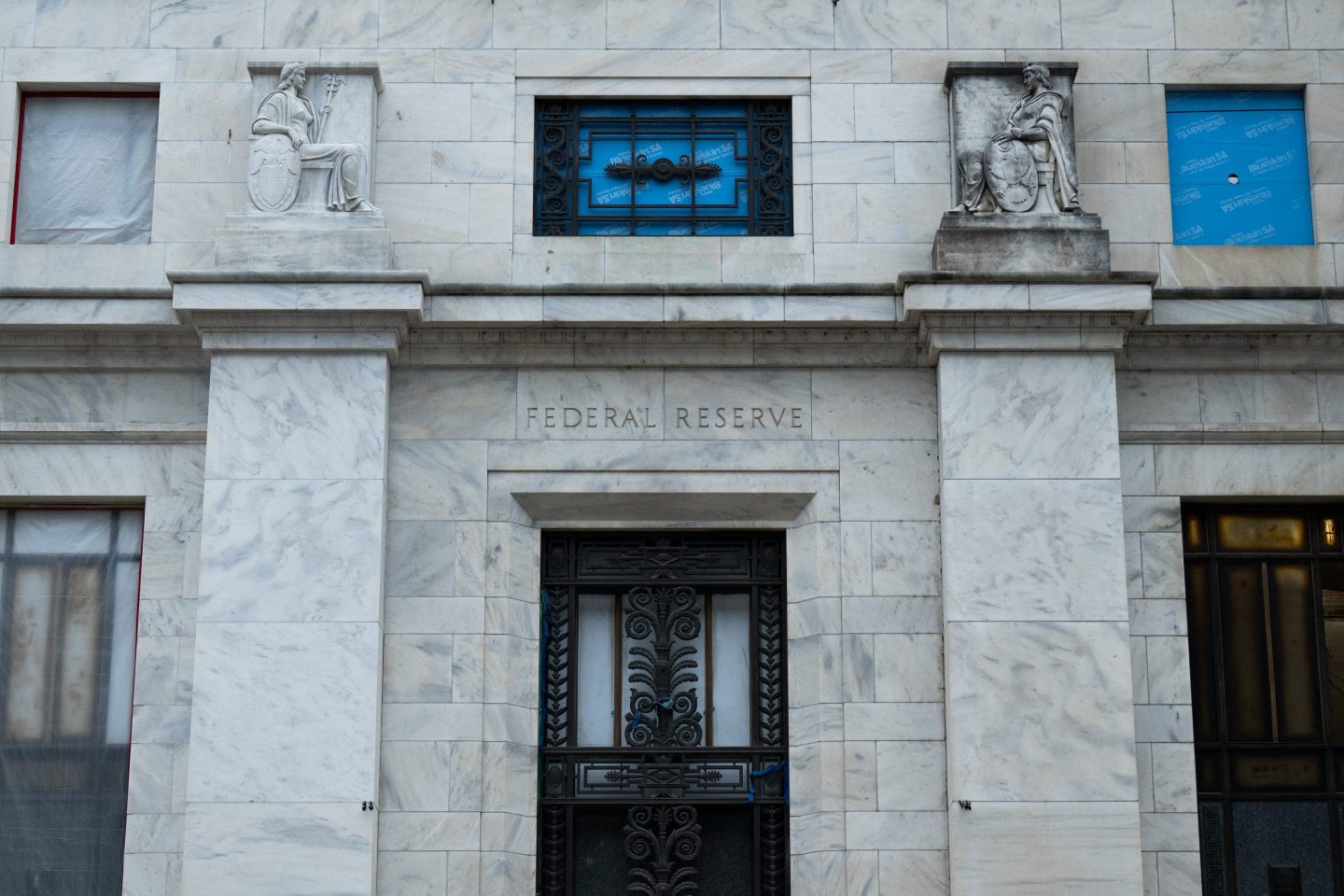
Investors and traders around the world were anxiously waiting on Monday to see if the U.S. Federal Reserve’s sweeping moves Sunday to inject additional liquidity into the economy would restore normal market conditions.
The Fed’s goal is not to save the stock market: It’s to protect the real economy from worrying signs that both cash and credit are drying up, and the banks, which provide essential grease to the markets, have stopped lending as usual.
The question now is whether the Fed’s move—or any move—will be enough to stanch the spread of the coronavirus contagion in the real economy.
The Fed’s big step
After a week in which plummeting equity markets were met with discord in the bond and credit markets, the central bank announced yet another round of emergency measures on Sunday. In addition to slashing its benchmark interest rate yet again, to a range of 0% to 0.25%, the Fed announced that it will be purchasing $700 billion worth of Treasury bonds and mortgage-backed securities—pumping additional liquidity into markets.
Perhaps as crucially for businesses, consumers, and the banks that they borrow from, the Fed also said that it will expand its “discount window” to depository institutions to 90 days and reduce their reserve requirement ratios to 0%. Those actions are intended to allow banks to more readily “meet unexpected funding needs” and support “the smooth flow of credit” to borrowers feeling the economic impact of the coronavirus outbreak, it said.
The Fed’s dramatic actions follow moves last week that attempted to alleviate roiling securities markets, including an initial emergency interest rate cut and the extension of $1.5 trillion worth of short-term repurchasing agreements to financial institutions. But it appears that those moves alone failed to adequately address the cracks appearing in the financial markets.
Most notably, U.S. Treasury yields—which had previously slipped to historic lows as investors flocked to the safety of government bonds—uncharacteristically climbed last week despite the stock market’s continued losses, indicating liquidity issues in what is usually considered one of the safest, most liquid markets in the world. Other assets considered traditional safe havens—namely, gold—also suffered losses.
Strange market moves
Market participants told Fortune that the strange movements were troubling and may have indicated that large, highly leveraged investors, such as hedge funds, were being forced to liquidate even their highest quality assets to raise cash to cover losses or margin calls on other bets.
Among the firms that some market participants believe were in this position were Bridgewater Associates, the large hedge fund founded by billionaire Ray Dalio. Over the weekend, Dalio acknowledged that at least one Bridgewater investment vehicle, its Pure Alpha II fund, has been caught off guard by last week’s market plunge and endured double-digit losses, although he did not say whether Bridgewater had been forced to liquidate safe assets, like Treasuries and gold, to cover these losses.
More alarming for many were indications that banks were becoming wary of lending to one another. The spread between two instruments banks often use for this purpose, three-month forward rate agreements and overnight interest rate swaps, jumped to nearly 0.66% on Friday morning, from 0.6% on Thursday.
There were also worrying signs that the Fed’s usual tools for jump-starting liquidity flows might not work after years of ultra-low interest rates and the new capital and risk controls put in place following the 2008 financial crisis.
For instance, despite the Fed offering $1.5 trillion in short-term repurchase agreements on Thursday and Friday, banks drew down only about $119.5 billion of this facility at the end of last week. Market participants said this indicates the Fed’s repo market intervention was likely to be ineffective this time for reasons that are not fully understood.
Some suggested banks already hold too many U.S. Treasuries on their balance sheets and are therefore unwilling to take on more, even on a short-term basis, in exchange for lending out cash. That may be why the Fed over the weekend said it would begin buying those securities back from banks directly.
Corporate bond fears
Meanwhile, the markets for municipal bonds and mortgage-backed securities also showed signs of shakiness last week. And just as worryingly, concerns arose regarding trillions of dollars of outstanding corporate bonds—particularly lower-rated, triple-B notes, which make up over half of the investment-grade bond market—and the ability of some companies, such as those in the coronavirus-hit energy and transportation sectors, to repay or refinance their debts given current economic headwinds.
“There’s a risk that a lot of these triple-B [bonds] can get downgraded to junk, which would make it more difficult for [those companies] to refinance,” Charles Schwab fixed-income strategist Collin Martin told Fortune. “If you’re a company that has been triple-B-rated and has been able to issue debt with relatively low yields, and now you’re suddenly a junk-rated company, you’re going to be faced with higher financing costs.”
In the face of such concerns, the Fed’s latest efforts look to ensure that banks have ample liquidity to meet borrowers’ credit needs should economic conditions continue to worsen, as seems likely. Goldman Sachs revised its U.S. GDP growth forecast to 0% in the first quarter of 2020 and, more worryingly, called for a 5% contraction in the second quarter, in anticipation of economic damage from the coronavirus.
“If things continue to deteriorate and corporates start withdrawing from their credit facilities, then banks need to be able to provide financing and we need to be sure they have [liquidity],” said Martin, who pointed to Boeing’s recent draw-down of a $14 billion credit facility as an example of a beleaguered company relying on its lenders to get it through an exceptionally tough time.
“The good thing is that [Boeing is] able to get that money, and now they are liquid,” he added. “But a risk for the broader market is if a lot of corporates have to be doing this down the road, and what kind of strain this puts on the financial markets.”
By pursuing an exceptional, emergency round of quantitative easing and freeing up banks to lend more easily, the Fed is hoping to avoid such strains on the U.S. financial system. As market participants noted, that system is significantly better prepared to deal with liquidity constraints than it was 12 years ago, when the financial crisis sent the global economy into a recession.
But with the coronavirus outbreak, and its impact on global commerce, showing no signs yet of going away, it appears that major financial markets and institutions—and the businesses that rely on them—will once more be put to the test.
More must-read stories from Fortune:
—The stock market is usually a poor predictor of recessions—but this time it’s right
—Bitcoin bloodbath: What people are saying about the crypto collapse
—1 in 3 Americans were stocking up before coronavirus was ruled a pandemic
—It’s time to start preparing your personal finances for a recession. Here’s how
—Dormant PayPal Credit accounts are coming back to hurt credit scores
Subscribe to Fortune’s Bull Sheet for no-nonsense finance news and analysis daily.