• Home
  • Latest
  • Fortune 500
  • Finance
  • Tech
  • Leadership
  • Lifestyle
  • Rankings
  • Multimedia
crude oil

‘This is a bloodbath for U.S. oil:’ Price plunge will test how robust the shale boom really is

By
Anne Sraders
Anne Sraders
and
Katherine Dunn
Katherine Dunn
Down Arrow Button Icon
By
Anne Sraders
Anne Sraders
and
Katherine Dunn
Katherine Dunn
Down Arrow Button Icon
March 10, 2020, 5:02 AM ET

Subscribe to Fortune’s Outbreak newsletter for a daily roundup of stories on the coronavirus outbreak and its impact on global business.

Coronavirus was already giving oil prices a year to remember.

But on Monday, as a breakdown between Russia and Saudi Arabia spiraled into an all-out price war, crude futures plunged 25% to $30/barrel, hitting a four-year low with a single-day drop not seen since the outbreak of the Gulf War.

That plunge prompted companies including DiamondBack Energy and Parsley Energy, players in the Permian basin at the heart of the U.S. shale boom, to immediately announce cuts in production and activity. It also fueled already-mounting worries that sinking demand and a looming debt crunch could spur widespread cost-cutting, layoffs, and even bankruptcies.

The shale boom is known for being notoriously robust. But amid sinking demand and looming debt, its endurance may finally be put to the test.

Boom into bust?

Before this weekend’s disastrous OPEC meeting, oil prices were already facing a serious problem: coronavirus.

The virus hit China early, quarantining whole cities and putting a hold on the manufacturing engine that has made the country the world’s second largest oil consumer, after the U.S. That undercut demand, forcing analysts to repeatedly trim forecasts and fueling a price drop that was only partially balanced out by a supply outage in war-torn Libya.

By Monday, the International Energy Agency was forecasting that oil demand would actually decline in 2020—by 90,000 barrels/day—the first contraction since 2009, amid the financial crisis.

Meanwhile, the shale industry was facing its own problem: debt, and lots of it.

According to Moody’s, the North American oil and gas sector is facing $86 billion in debt—between rated bonds, term loans, and revolving credit facilities—that comes due in the next four years.

That includes $22 billion worth of debt coming due just this year, according to S&P Global, a looming financing crunch that was worrying analysts even before the price shock.

Now, with oil hovering at about $30/barrel late on Monday, most operators in the region won’t be able to break even. Most analysts put the break-even rate at a minimum of $40/barrel, and some as high as $55/barrel.

At current prices, that debt “will become increasingly hard to refinance, and as such we can expect a large increase of bankruptcies over the next 12 months,” said Chris Midgley, head of global analytics at S&P Global Platts.

Prices below $40/barrel alone would trigger a wave of “brutal cost cutting” in an industry that has already trimmed much of the fat, says Fraser McKay, head of upstream analysts at energy consultancy Wood Mackenzie.

“Discretionary spend would be slashed, including buybacks and exploration. But given the lack of excess in the system, the cuts to development activity will be necessarily fast and brutal,” McKay added. The sector would react “immediately,” he said.

The expected impact of the rout was already hitting equities on Monday, sending 40 U.S. energy stocks down at least 30% by late Monday afternoon, with stocks like Matador Resources Co., Diamondback Energy, and Noble Corp down around 63%, 44%, and 35% respectively.

The sector en masse has suffered a 44% drop year to date, per the S&P 500 Energy Index.

The fallout could have very real consequences to those who work in the sector. As oil historian Gregory Brew tweeted on Monday: “Just to emphasize, this is billions of dollars disappearing from balance sheets across the country. The shock from this will be felt immediately. Rigs will shut down, thousands will be laid off, activity on the major fields will slow to a crawl,” he wrote. “This is a bloodbath for U.S. oil.”

Just to emphasize, this is billions of dollars disappearing from balance sheets across the country. The shock from this will be felt immediately. Rigs will shut down, thousands will be laid off, activity on the major fields will slow to a crawl. This is a bloodbath for US oil

— Gregory Brew (@gbrew24) March 9, 2020

A tight squeeze

Shale has experienced price shocks before—for much of the 2010s, it created them.

In the early 2000s, the U.S. lagged behind countries like Saudi Arabia and Russia in the global oil market. But starting around 2010, fracking technology centered on the oil-rich region called the Permian basin, spanning 75,000 square miles largely in west Texas, produced a surge of oil, more than quadrupling daily output, according to the EIA.
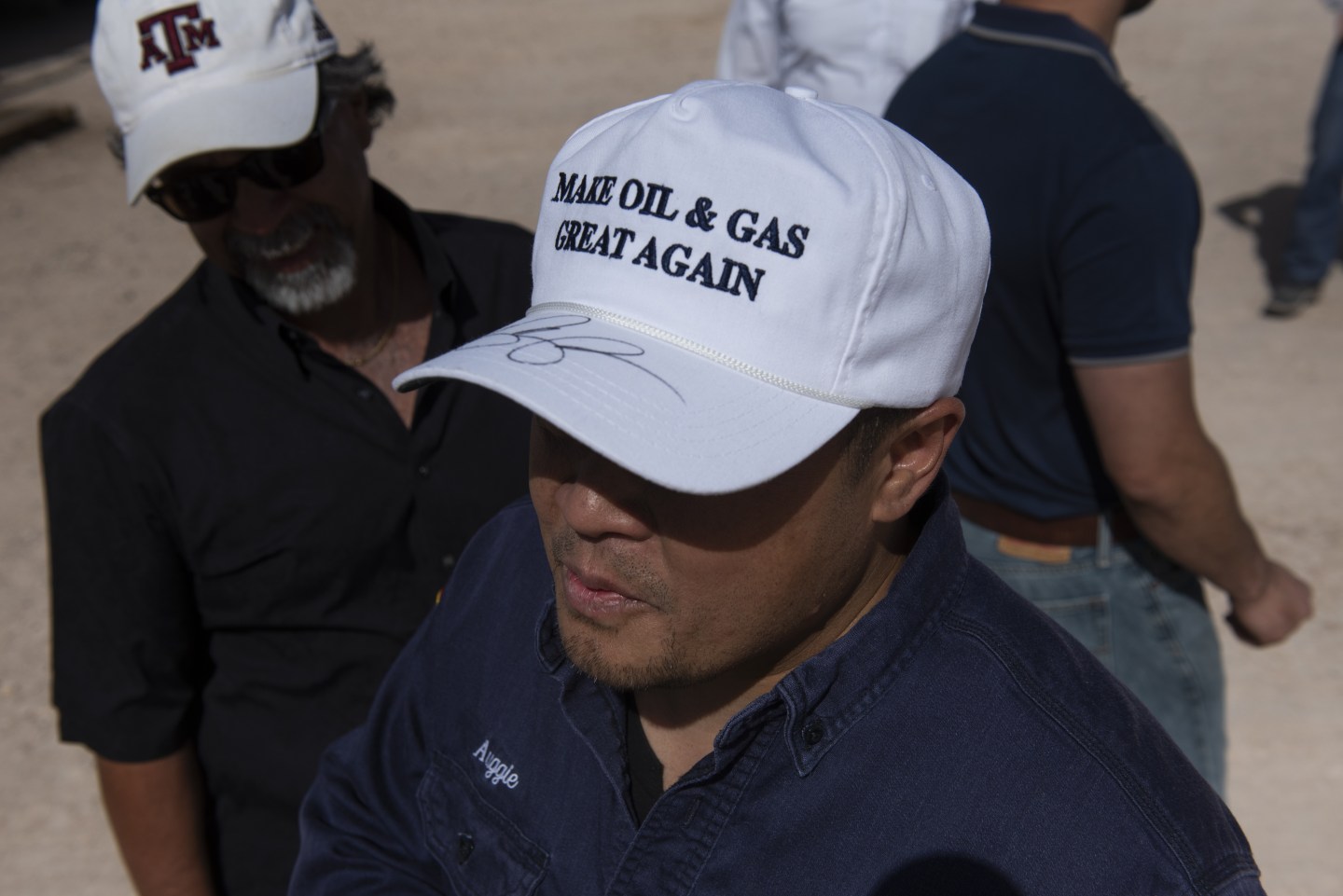
An employee wears a hat signed by U.S. Vice President Mike Pence during his tour of a Diamondback Energy oil rig in Midland, Texas, on April 17, 2019. Monday's oil price plunge prompted companies like DiamondBack, a player in the Permian basin at the heart of the U.S. shale boom, to immediately announce cuts in production and activity.
An employee wears a hat signed by U.S. Vice President Mike Pence during his tour of a Diamondback Energy oil rig in Midland, Texas, on April 17, 2019. Monday’s oil price plunge prompted companies like DiamondBack, a player in the Permian basin at the heart of the U.S. shale boom, to immediately announce cuts in production and activity.
Callaghan O’Hare—Bloomberg via Getty Images

The shale boom—referring to the kind of sedimentary rock the resources are extracted from—totally upended the global energy industry. It transformed the U.S. from an importer to a frequent exporter, putting it on track to one day become the world’s largest source of crude, and flooded global markets with an abundance of oil.

That sunk prices and ultimately spurred years of production cuts by OPEC, led by Saudi Arabia, in an effort to stabilize prices. But those lower prices, even as oil demand continued to rise, also put pressure on the shale producers themselves, forcing many of them into years of cutbacks that leave little fat left to trim.

“There are fewer companies that still hold a face card they haven’t played, much less an ace in the hole,” said Cliff Vrielink, a partner at of law firm Sidley who specializes in energy, in reference to the moves companies have already made to reduce costs and debt.

“As to what comes next, the fear is that the price war will not end any time soon, which means this downturn will not turn around quickly—if so, the pain will reverberate across the industry and be felt by the producers, lenders and equity investors,” Vrielink said.

And this time, prices aren’t merely facing oversupply, they’re facing the demand shock of coronavirus, too.

“Contrary to 2014-2016, when market imbalances primarily stemmed from the supply side, the coronavirus demand shock could combine to create a level of short-term pressure not seen since the mid-1980s. Stay tuned,” said Paul Sheldon, Chief Geopolitical Advisor at S&P Global Platts.

All doom and gloom?

While the drop has been dramatic, some say the sector’s hedging will protect it from the worst of the drop—and that a sector notorious for continuing to produce record amounts of oil no matter the price may still have room to shake this off.

“The nature of U.S. shale production suggests that while there may be consolidation, its recovery time can be quick and a dramatic reduction on the number of wells does not necessarily result in significantly reduced production,” David L. Goldwyn, chairman of the Atlantic Council’s energy advisory group, said in a comment.

Others think the impact will merely be delayed until later this year.

“There will be a lag time in the industry reaction time due to service commitments and cash flow support from hedges,” with modest production growth already locked in for the second quarter, said Artem Abramov, head of shale research at Oslo-based consultancy Rystad. But after that, the cuts would be expected to shear back oil production through the remainder of 2020 and into 2021, he says.

For energy investors, while the perfect storm of uncertainty, depressed demand, increasing competition, and low profitability will be a major blow to the domestic U.S. industry, the oil historian Gregory Brew tweeted.

“It wont kill it entirely, but it will certainly depress investment.”

More must-read stories from Fortune:

—In China, oil won’t be the only sector battered by the coronavirus
—The oil industry is finally talking climate, but don’t expect quick changes
—Oil demand was set to rise in 2020, then the coronavirus outbreak hit
—Can Germany phase out nuclear energy and coal?
—Coronavirus may be the straw that breaks the back of oil fracking

Subscribe to The Loop, a weekly look at the revolutions in energy, tech, and sustainability.

About the Authors
Anne Sraders
By Anne Sraders
LinkedIn iconTwitter icon
See full bioRight Arrow Button Icon
By Katherine Dunn
LinkedIn iconTwitter icon
See full bioRight Arrow Button Icon

Latest in

Finance
Lorem ipsum dolor sit amet, consectetur adipiscing elit, sed do eiusmod tempor incididunt ut labore et dolore magna aliqua. Ut enim ad minim veniam
By Fortune Editors
October 20, 2025
Finance
Lorem ipsum dolor sit amet, consectetur adipiscing elit, sed do eiusmod tempor incididunt ut labore et dolore magna aliqua. Ut enim ad minim veniam
By Fortune Editors
October 20, 2025
Finance
Lorem ipsum dolor sit amet, consectetur adipiscing elit, sed do eiusmod tempor incididunt ut labore et dolore magna aliqua. Ut enim ad minim veniam
By Fortune Editors
October 20, 2025
Finance
Lorem ipsum dolor sit amet, consectetur adipiscing elit, sed do eiusmod tempor incididunt ut labore et dolore magna aliqua. Ut enim ad minim veniam
By Fortune Editors
October 20, 2025
Finance
Lorem ipsum dolor sit amet, consectetur adipiscing elit, sed do eiusmod tempor incididunt ut labore et dolore magna aliqua. Ut enim ad minim veniam
By Fortune Editors
October 20, 2025
Finance
Lorem ipsum dolor sit amet, consectetur adipiscing elit, sed do eiusmod tempor incididunt ut labore et dolore magna aliqua. Ut enim ad minim veniam
By Fortune Editors
October 20, 2025

Most Popular

Finance
Lorem ipsum dolor sit amet, consectetur adipiscing elit, sed do eiusmod tempor incididunt ut labore et dolore magna aliqua. Ut enim ad minim veniam
By Fortune Editors
October 20, 2025
Finance
Lorem ipsum dolor sit amet, consectetur adipiscing elit, sed do eiusmod tempor incididunt ut labore et dolore magna aliqua. Ut enim ad minim veniam
By Fortune Editors
October 20, 2025
Finance
Lorem ipsum dolor sit amet, consectetur adipiscing elit, sed do eiusmod tempor incididunt ut labore et dolore magna aliqua. Ut enim ad minim veniam
By Fortune Editors
October 20, 2025
Finance
Lorem ipsum dolor sit amet, consectetur adipiscing elit, sed do eiusmod tempor incididunt ut labore et dolore magna aliqua. Ut enim ad minim veniam
By Fortune Editors
October 20, 2025
Finance
Lorem ipsum dolor sit amet, consectetur adipiscing elit, sed do eiusmod tempor incididunt ut labore et dolore magna aliqua. Ut enim ad minim veniam
By Fortune Editors
October 20, 2025
Finance
Lorem ipsum dolor sit amet, consectetur adipiscing elit, sed do eiusmod tempor incididunt ut labore et dolore magna aliqua. Ut enim ad minim veniam
By Fortune Editors
October 20, 2025
Fortune Secondary Logo
Rankings
  • 100 Best Companies
  • Fortune 500
  • Global 500
  • Fortune 500 Europe
  • Most Powerful Women
  • Future 50
  • World’s Most Admired Companies
  • See All Rankings
Sections
  • Finance
  • Fortune Crypto
  • Features
  • Leadership
  • Health
  • Commentary
  • Success
  • Retail
  • Mpw
  • Tech
  • Lifestyle
  • CEO Initiative
  • Asia
  • Politics
  • Conferences
  • Europe
  • Newsletters
  • Personal Finance
  • Environment
  • Magazine
  • Education
Customer Support
  • Frequently Asked Questions
  • Customer Service Portal
  • Privacy Policy
  • Terms Of Use
  • Single Issues For Purchase
  • International Print
Commercial Services
  • Advertising
  • Fortune Brand Studio
  • Fortune Analytics
  • Fortune Conferences
  • Business Development
About Us
  • About Us
  • Editorial Calendar
  • Press Center
  • Work At Fortune
  • Diversity And Inclusion
  • Terms And Conditions
  • Site Map
Fortune Secondary Logo
  • About Us
  • Editorial Calendar
  • Press Center
  • Work At Fortune
  • Diversity And Inclusion
  • Terms And Conditions
  • Site Map
  • Facebook icon
  • Twitter icon
  • LinkedIn icon
  • Instagram icon
  • Pinterest icon

Latest in

U.S. President Donald Trump delivers the State of the Union address during a joint session of Congress in the House Chamber at the Capitol on February 24, 2026 in Washington, D.C.
EnergyData centers
Your utility bills keep going up. Here’s everyone you can blame—AI data centers included
By Jordan BlumMarch 1, 2026
15 minutes ago
UN
Middle EastMiddle East
Israel, U.S. stiff-arm U.N. during emergency Security Council meeting
By Edith M. Lederer, Farnoush Amiri and The Associated PressFebruary 28, 2026
5 hours ago
massie
PoliticsCongress
Thomas Massie among few Republicans to criticize Trump over war powers: ‘This is not ‘America First”
By Lisa Mascaro and The Associated PressFebruary 28, 2026
6 hours ago
protest
Middle EastMiddle East
A month before Iran strikes, Trump told Iranian protesters help was on the way amid a government crackdown
By Aamer Madhani, Josh Boak and The Associated PressFebruary 28, 2026
6 hours ago
trump
PoliticsWhite House
Marjorie Taylor Greene rips Iran strikes as Trump betraying America First: ‘It’s always a lie and it’s always America Last’
By Steven Sloan and The Associated PressFebruary 28, 2026
6 hours ago
lavrov
Middle EastMiddle East
Russia accuses America of ‘pre-planned and unprovoked act of armed aggression’ against Iran
By Claudia Ciobanu, Sam McNeil, Sam Metz and The Associated PressFebruary 28, 2026
6 hours ago

Most Popular

placeholder alt text
Success
Japanese companies are paying older workers to sit by a window and do nothing—while Western CEOs demand super-AI productivity just to keep your job
By Orianna Rosa RoyleFebruary 27, 2026
2 days ago
placeholder alt text
Middle East
Iran is now on 'death ground' amid existential threat from U.S. attacks and could 'go big' in retaliation, former NATO commander warns
By Jason MaFebruary 28, 2026
15 hours ago
placeholder alt text
AI
The week the AI scare turned real and America realized maybe it isn't ready for what's coming
By Nick LichtenbergFebruary 28, 2026
22 hours ago
placeholder alt text
Success
Walmart exec says U.S. workforces needs to take inspiration from China where ‘5 year-olds are learning DeepSeek’
By Preston ForeFebruary 27, 2026
2 days ago
placeholder alt text
Personal Finance
Current price of gold as of February 27, 2026
By Danny BakstFebruary 27, 2026
2 days ago
placeholder alt text
Middle East
Dubai’s worst nightmare unfolds as Iran strikes Gulf neighbors
By Dana Khraiche, Fiona MacDonald and BloombergFebruary 28, 2026
10 hours ago

© 2026 Fortune Media IP Limited. All Rights Reserved. Use of this site constitutes acceptance of our Terms of Use and Privacy Policy | CA Notice at Collection and Privacy Notice | Do Not Sell/Share My Personal Information
FORTUNE is a trademark of Fortune Media IP Limited, registered in the U.S. and other countries. FORTUNE may receive compensation for some links to products and services on this website. Offers may be subject to change without notice.