Will the Fed rise to the rescue?
Wall Street overwhelmingly expects the Federal Reserve’s policymaking arm to cut interest rates when it next meets on March 18. If not sooner. And the Street’s wish may well come true.
Trouble is, there’s a lot of justifiable skepticism about whether a rate reduction will do much good fending off the economic destruction that the worldwide coronavirus outbreak is starting to spawn.
Historically, the Fed’s role hasn’t been preventing catastrophes. Rather, it has been damage control—easing the pain after an economic plunge and trying to get strapped businesses and consumers to borrow and spend again. Those remedies take a while to kick in. These days, should people across the globe be too petrified to work or consume, due to the China-originated flu, lower credit card interest won’t be much help.
“A Fed rate cut won’t reopen Chinese factories,” said Peter Boockvar, chief investment officer of Bleakley Advisory Group. “Or get people to travel. Or go out to eat. Or buy cars. Or make companies increase capital spending.”
The dire economic scenarios surrounding the contagion begin with choking off the international supply chain. The widespread shutdown of Chinese production threatens to ripple across the face of the earth. That’s why Goldman Sachs predicts that U.S. corporate earnings growth for the rest of this year will be zero. Shipments to West Coast ports are down around 25%, according to Bank of America, creating a major problem for the likes of Apple, whose iPhones are assembled in China.
Right now, the fed funds rate, the Fed-set benchmark for short-term U.S. interest rates, is in a target range of 1.5% to 1.75%. The Fed futures market, which reflects investors’ expectations about the central bank’s policy, is unanimous that rates will be cut at the March meeting, with 26% forecasting a quarter-point cut and 74% a half-point.
Fed monetary easing will at least provide “psychological relief,” said Rich Sega, global chief investment strategist at investment management firm Conning.
The Fed fizzle
Fed Chair Jerome Powell last Friday issued a brief statement saying the central bank was open to lowering rates if need be. Acknowledging that “the coronavirus poses evolving risks to economic activity,” Powell indicated the Fed would monitor developments and deploy “our tools and act as appropriate to support the economy.”
Investors have come to assume that when things get bad, they have the comforting assurance of what’s called “the Fed put.” In other words, the Street expects the Fed to stop the economy from really going to hell. (The “put” term originates from shareholders selling a put option on a stock, which provides them downside protection: When the share price is tanking, they can bail out at a predetermined price.)
For years, the Fed has been intervening in the economy to provide recession-fighting stimulus. In response to the 2008-09 financial crisis, between Bush and Obama, the government spent $939 billion on stimulus. The Fed, in addition to reducing the funds rate to almost zero from 5.25%, bought an enormous amount of bonds, almost $4 trillion, to pump cash into the economy.
The reality, however, is that the Fed’s rescue operations served as a palliative for a damaged economy, not an elixir that magically restored the old mojo.
Despite the Fed’s preventing the Great Depression 2.0, corporate borrowing limped along for years after the downturn was over. The U.S. gross domestic product’s post-recession growth seldom has logged much more than 2% per year, an unusually tepid pace for a recovery. Corporate capital spending expansion was sluggish for a long time. Company borrowing took a while to return, only matching its pre-crisis levels in 2013.
Another reason for the sluggish comeback could be that low, low rates have reached a point of diminishing returns. Making money even cheaper may not deliver the old bang of a rate cut. As University of Chicago economist Austan Goolsbee wrote in a New York Times op-ed piece, “after 10 years of extremely low interest rates, there probably aren’t many consumers with pent-up demand.”
Today, “the Fed is not as effective as it used to be,” said Michael Reynolds, an investment strategist at Glenmede Trust. “Even lower rates won’t fix the risk that U.S. businesses will run out of inventory” from China’s shuttered industrial base, not to mention cascading factory and distribution freeze-ups around the world.
Low, low rates are the Fed’s lot, as people nowadays are addicted to cheap money. Fed officials discovered this the hard way in recent years when they set out raising rates again, figuring that economic health had finally been restored and borrowing costs should return to a more normal level—read: pre-crisis. The idea was to give the Fed more room to lower rates in a crisis: Dropping them from 5% is more effective than from 1.75%.
Unfortunately, the result of the rate-hike campaign was a credit crunch and a 15% stock market plunge in late 2018. Chastened, the Fed last year whittled 0.75 point off the funds rate. As Norm Conley, CEO of JAG Capital Management, drily observed, by boosting rates, “the Fed saw that it had made a policy mistake.”
Why the Fed will cut rates
But, argues Kathy Jones, chief fixed-income strategist at discount broker Charles Schwab, the Fed has other motives to lower rates.
One, she said, centers on the threat that a pandemic panic may bring about deflation, meaning slumping prices, which the Fed views as economic poison. Such a condition, a noxious feature of the 1930s Depression, might appear if no one is buying many goods and services anymore. Then the value of people’s assets—real estate, stocks, etc.—would shrivel, a body blow to the economy.
Another impetus for Fed action, she said, would be to pull the credit markets back from their present discombobulation. A case in point is the tumbling prices of junk bonds, a circumstance that has long served as the harbinger of bad times coming to the economy.
The low-grade bonds’ credit spread—the distance between junk yields and those of risk-free Treasuries—has widened by almost a full percentage point since mid-January. That’s a signal that junk is becoming riskier, which means nervous investors are dumping the bonds, so their prices have dropped; yields move in the opposite direction. A number of junk-rated companies, which sought to float new issues of bonds, lately have pulled them from the market because they wouldn’t fetch much money.
Even worse is the advent of an inverted yield curve, where short-term rates exceed long-term ones. An inversion is a classic warning of an impending recession. This scary development stems from the free fall of the benchmark 10-year Treasury note’s yield, now at 1.3% (half of what it was a year ago). The three-month Treasury bill is above this, at 1.45%. Typically, the longer-term Treasury yields far more, as holding a bond for years is riskier than for a few months.
In other words, normally investors think they know what will happen in the immediate future, but the far future is the big unknown, which is why the 10-year almost always yields more. People need to be paid extra interest because their money is tied up longer. An inversion occurs when the near term uncertainly pushes them towards buying oodles of long-maturity bonds, driving up those securities’ prices and driving down their yields. If the Fed lowers short-term rates, the 10-year would presumable return to its rightful place in the bond yield hierarchy. And one destabilizing worry would get removed from the table.
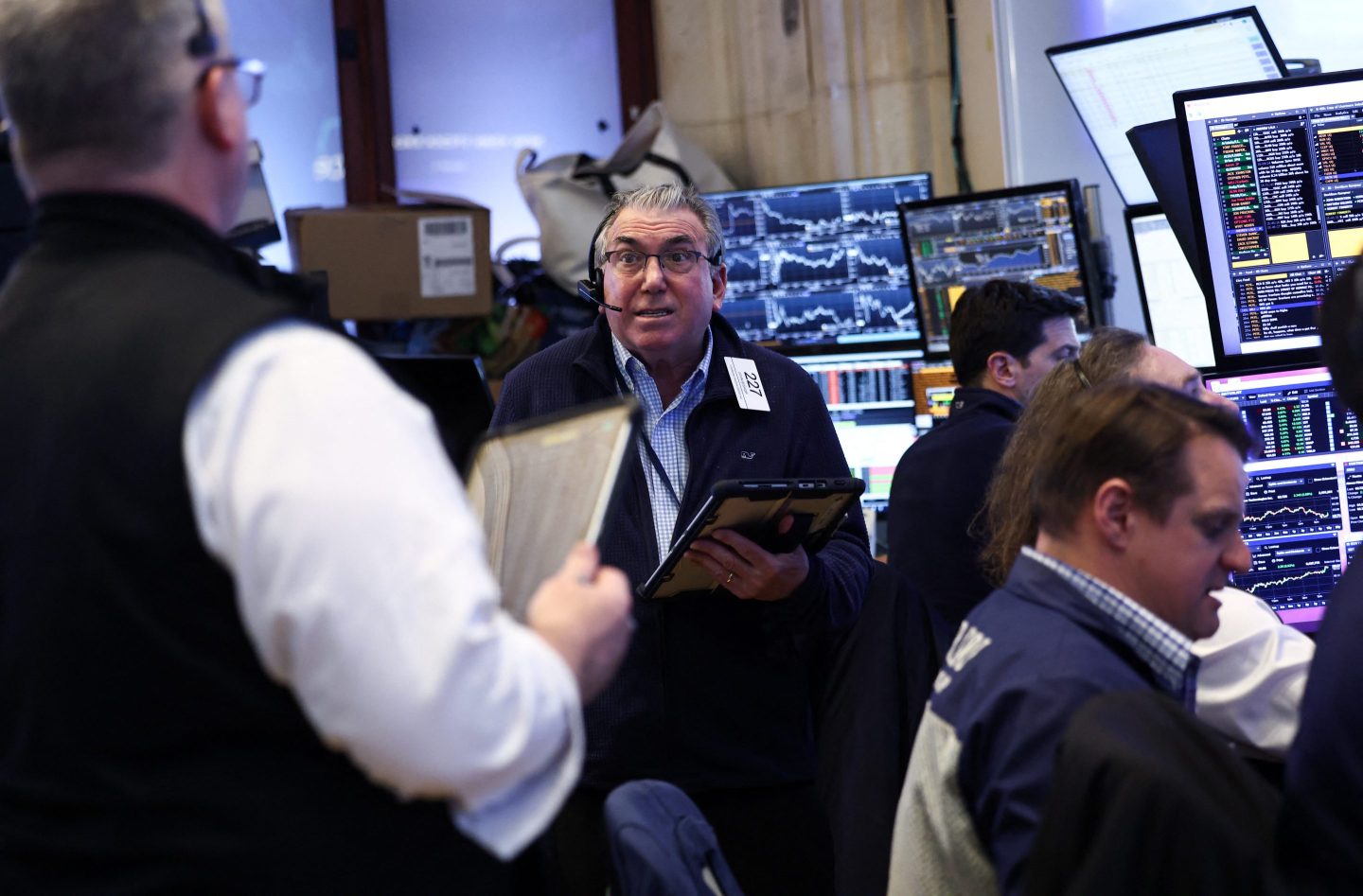
A final catalyst to push down rates: the stock market bloodbath. The Fed likes to say that it does not follow the market. That’s a dubious assertion at a time that 55% of Americans own stocks, by Gallup’s count. With a big chunk of the public’s wealth tied up in equities, much of that in workplace retirement accounts like 401(k)s, last week’s epic market rout is not something that Fed policymakers can shrug off. After all, the market is a barometer of what people think, or fear, is about to happen. Restoring confidence could convince investors to buy stocks again.
What could make this whole sorry set of affairs better? An antidote to the disease and a peaking of new infections, said Jim McDonald, chief investment strategist at Northern Trust. Note that he didn’t say lower rates. Absent good news on the epidemic front, he said, forging a good plan is very difficult. “What we must do is not well-defined, as the duration of this virus is unspecific.”
Meanwhile, at a minimum, a Fed rate reduction would give the public the temporary solace, or perhaps the necessary illusion, that someone at the upper levels is getting a handle on this dreadful dilemma of lost money—and lost lives.
More must-read stories from Fortune:
—New tech-centric Mastercard CEO has his eyes on the fintech prize
—Investors shouldn’t underestimate election volatility, warns UBS
—You can now buy a fractional share of Amazon stock
—These cities have the most jobs with six-figure salaries
—Credit Karma was acquired rather than pursuing an IPO. Will more companies follow suit in 2020?