• Home
  • Latest
  • Fortune 500
  • Finance
  • Tech
  • Leadership
  • Lifestyle
  • Rankings
  • Multimedia
Politicscampaign finance

5 surprising consequences from a decade of Citizens United

By
Jeff John Roberts
Jeff John Roberts
Editor, Finance and Crypto
Down Arrow Button Icon
January 23, 2020, 7:30 AM ET

Ten years ago this week, the Supreme Court issued a bombshell decision that tore up rules limiting what corporations could spend on political campaigns. Conservatives hailed the 5–4 ruling, known as Citizens United, as a victory for free speech, but critics warned it would distort democracy.

A decade later, the actual impact of the court’s ruling has become clearer. It is now apparent that Citizens United has indeed altered the course of American politics and that critics’ fears have been validated—though not in the ways they may have predicted. Here are five fallouts from one of the most significant Supreme Court cases in modern history:

Remaining limits on election spending are all but meaningless

Even though the Supreme Court ended limits on what companies could spend on political campaigns, it left in place rules that forbid or limit direct contributions to candidates. In theory, this would let companies and wealthy individuals advertise their views on candidates and issues, but without influencing those candidates directly. In practice, it has created a distinction without a difference.

That’s because Citizens United helped fueled the emergence of so-called super PACs—political action committees that can raise and spend unlimited funds for and against candidates—that often host events where people pay to see a candidate speak. Even though candidates who attend can’t solicit funds directly, the events serve as fundraisers in everything but name. Meanwhile, nonpartisan research firm OpenSecrets notes how campaigns and super PACs have worked hand in glove to coordinate ad spending, barely concealing their cooperation. One egregious example, reported by the Brookings Institution, involved both political parties communicating with super PACs over Twitter to coordinate ad buys and polling strategies.

The takeaway is that limits on direct giving may remain, but Citizens United opened a loophole big enough to drive a Brinks truck through.

Wealthy individuals dominate election spending

In the aftermath of Citizens United, many predicted that big corporations would seize on the new opportunity to make unlimited donations to super PACs and other outside groups that spend money to boost—or more often tear down—certain candidates. And indeed, the amount of money flowing into politics has surged, including in the 2018 midterms, which saw nine of the 10 most expensive non-special- election House races in history. Most of this, however, is not coming from corporations.

According to an OpenSecrets report on Citizens United, corporations have accounted for less than 10% of outside fundraising each election cycle. Instead, it is ultrawealthy individuals such as casino magnate Sheldon Adelson and Chicago billionaires James and Mary Pritzker who are behind the gusher in political money, which has amounted to $4.5 billion in the last decade. Such figures have benefited from a follow-up court ruling, which held that Citizens United meant there can no longer be limits on what individuals can donate to PACs or other independent political entities. Underscoring the point, the report found that 10 major donors and their spouses alone accounted for 7% of all election-related spending in 2018.

Liberal groups are a big reason for the spending surge

While Citizens United is regarded as a victory for Republicans, Democrats and their liberal allies have not been shy about joining in the financial free-for-all. The two super PACs that have raised the most money since the decision are dedicated to electing Democratic presidential and Senate candidates, while No. 9 is the influential liberal women’s group, Emily’s List.
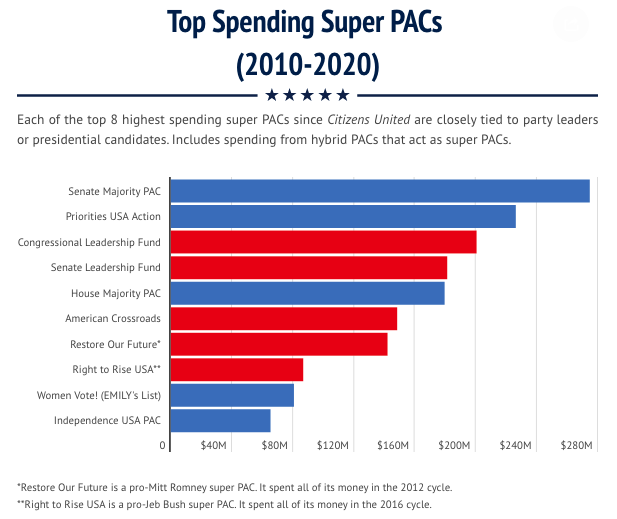
All of this has led the likes of the Wall Street Journal and other publications to claim that Citizens United has not distorted democracy, and to point out that election spending by unions and other left-leaning groups has counterbalanced that of Republican-allied groups.

Common Cause, a nonpartisan group that advocates for fairness in U.S. democracy, disagrees. Its vice president, Paul S. Ryan, told Fortune, “It’s entirely true that the wealthy in both parties are using this new system, but who is not benefiting is the everyday American.”

Ryan believes that massive campaign expenditures by a handful of wealthy people, which can outstrip the collective donations of thousands of ordinary individuals, diminishes the power of regular voters. And while the Democratic candidates running for President have railed about the corrupting influence of money on politics, they have nonetheless embraced the money spigots available in the post–Citizens United era. Joe Biden, for instance, initially refused to accept super PAC support but quietly changed his position last fall after a soft fundraising quarter.

“Dark money” is a new force

Critics’ concerns that Citizens United would allow big corporations to dictate election outcomes appear to have been overblown. The decision, however, seems to have paved the way for an equally troubling phenomenon: the rise of nonprofit entities known as “dark money” groups.

These groups, which enjoy a different legal status than super PACs, came into being thanks to another ruling by the Supreme Court’s conservatives, which held that nonprofit groups don’t have to disclose their donors. That ruling came in 2007, but Citizens United served to magnify its impact by removing restrictions on how much donors could give to dark money groups.
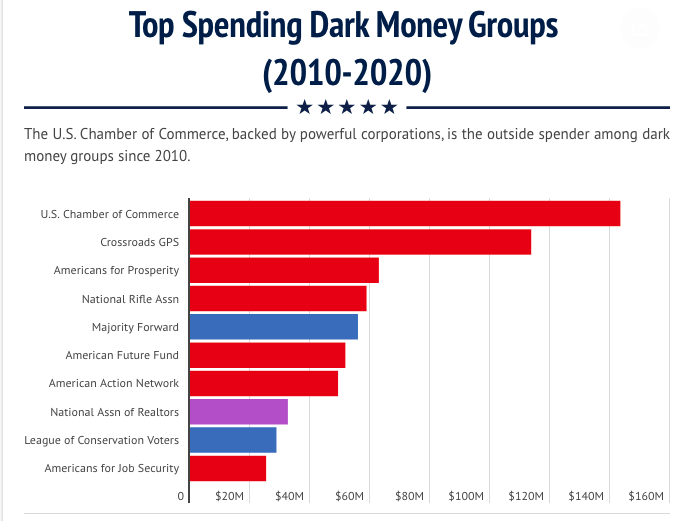
As the chart above shows, conservative groups, including Karl Rove’s Crossroads GPS and the National Rifle Association, have been the most active in deploying dark money tactics. In the past decade, they spent nearly $1 billion on election ads without disclosing who paid for them.

Campaign finance reform has moved to the local level

The ruling in Citizens United is more entrenched than ever at the federal level thanks to a more conservative Supreme Court and its embrace by politicians from both political parties. Campaign finance reform, however, remains very much active in the United States.

Ryan of Common Cause notes that the Supreme Court did not strike down laws that require groups to disclose who is funding them or that forbid coordination between candidates and outside groups. In response, local governments have taken up the cause of preventing money from distorting politics.

“We are getting lots of wins at the state and local level in passing laws obliging disclosure, including the city of Seattle and in Montgomery and Howard counties in Maryland,” says Ryan. “There are wins all over the place—just not on Capitol Hill.”


About the Author
By Jeff John RobertsEditor, Finance and Crypto
LinkedIn iconTwitter icon

Jeff John Roberts is the Finance and Crypto editor at Fortune, overseeing coverage of the blockchain and how technology is changing finance.

See full bioRight Arrow Button Icon

Latest in Politics

Finance
Lorem ipsum dolor sit amet, consectetur adipiscing elit, sed do eiusmod tempor incididunt ut labore et dolore magna aliqua. Ut enim ad minim veniam
By Fortune Editors
October 20, 2025
Finance
Lorem ipsum dolor sit amet, consectetur adipiscing elit, sed do eiusmod tempor incididunt ut labore et dolore magna aliqua. Ut enim ad minim veniam
By Fortune Editors
October 20, 2025
Finance
Lorem ipsum dolor sit amet, consectetur adipiscing elit, sed do eiusmod tempor incididunt ut labore et dolore magna aliqua. Ut enim ad minim veniam
By Fortune Editors
October 20, 2025
Finance
Lorem ipsum dolor sit amet, consectetur adipiscing elit, sed do eiusmod tempor incididunt ut labore et dolore magna aliqua. Ut enim ad minim veniam
By Fortune Editors
October 20, 2025
Finance
Lorem ipsum dolor sit amet, consectetur adipiscing elit, sed do eiusmod tempor incididunt ut labore et dolore magna aliqua. Ut enim ad minim veniam
By Fortune Editors
October 20, 2025
Finance
Lorem ipsum dolor sit amet, consectetur adipiscing elit, sed do eiusmod tempor incididunt ut labore et dolore magna aliqua. Ut enim ad minim veniam
By Fortune Editors
October 20, 2025

Most Popular

Finance
Lorem ipsum dolor sit amet, consectetur adipiscing elit, sed do eiusmod tempor incididunt ut labore et dolore magna aliqua. Ut enim ad minim veniam
By Fortune Editors
October 20, 2025
Finance
Lorem ipsum dolor sit amet, consectetur adipiscing elit, sed do eiusmod tempor incididunt ut labore et dolore magna aliqua. Ut enim ad minim veniam
By Fortune Editors
October 20, 2025
Finance
Lorem ipsum dolor sit amet, consectetur adipiscing elit, sed do eiusmod tempor incididunt ut labore et dolore magna aliqua. Ut enim ad minim veniam
By Fortune Editors
October 20, 2025
Finance
Lorem ipsum dolor sit amet, consectetur adipiscing elit, sed do eiusmod tempor incididunt ut labore et dolore magna aliqua. Ut enim ad minim veniam
By Fortune Editors
October 20, 2025
Finance
Lorem ipsum dolor sit amet, consectetur adipiscing elit, sed do eiusmod tempor incididunt ut labore et dolore magna aliqua. Ut enim ad minim veniam
By Fortune Editors
October 20, 2025
Finance
Lorem ipsum dolor sit amet, consectetur adipiscing elit, sed do eiusmod tempor incididunt ut labore et dolore magna aliqua. Ut enim ad minim veniam
By Fortune Editors
October 20, 2025
Rankings
  • 100 Best Companies
  • Fortune 500
  • Global 500
  • Fortune 500 Europe
  • Most Powerful Women
  • Future 50
  • World’s Most Admired Companies
  • See All Rankings
Sections
  • Finance
  • Leadership
  • Success
  • Tech
  • Asia
  • Europe
  • Environment
  • Fortune Crypto
  • Health
  • Retail
  • Lifestyle
  • Politics
  • Newsletters
  • Magazine
  • Features
  • Commentary
  • Mpw
  • CEO Initiative
  • Conferences
  • Personal Finance
  • Education
Customer Support
  • Frequently Asked Questions
  • Customer Service Portal
  • Privacy Policy
  • Terms Of Use
  • Single Issues For Purchase
  • International Print
Commercial Services
  • Advertising
  • Fortune Brand Studio
  • Fortune Analytics
  • Fortune Conferences
  • Business Development
About Us
  • About Us
  • Editorial Calendar
  • Press Center
  • Work At Fortune
  • Diversity And Inclusion
  • Terms And Conditions
  • Site Map

© 2025 Fortune Media IP Limited. All Rights Reserved. Use of this site constitutes acceptance of our Terms of Use and Privacy Policy | CA Notice at Collection and Privacy Notice | Do Not Sell/Share My Personal Information
FORTUNE is a trademark of Fortune Media IP Limited, registered in the U.S. and other countries. FORTUNE may receive compensation for some links to products and services on this website. Offers may be subject to change without notice.


Most Popular

placeholder alt text
Economy
The $38 trillion national debt is to blame for over $1 trillion in annual interest payments from here on out, CRFB says
By Nick LichtenbergDecember 17, 2025
2 days ago
placeholder alt text
Future of Work
LinkedIn CEO says it's 'outdated' to have a five-year career plan: It's a 'little bit foolish' considering the pace AI is changing the workplace
By Sydney LakeDecember 18, 2025
1 day ago
placeholder alt text
Success
As millions of Gen Zers face unemployment, McDonald's CEO dishes out some tough love career advice for navigating the market: ‘You've got to make things happen for yourself’
By Preston ForeDecember 16, 2025
3 days ago
placeholder alt text
Economy
‘This is a wacky number’: economists cry foul as new government data assumes zero housing inflation in surprising November drop
By Eva RoytburgDecember 18, 2025
20 hours ago
placeholder alt text
Success
As graduates face a ‘jobpocalypse,’ Goldman Sachs exec tells Gen Z they need to know their commercial impact 
By Preston ForeDecember 18, 2025
23 hours ago
placeholder alt text
C-Suite
Red Lobster CEO Damola Adamolekun says the key to being a better leader is being a better person: ‘Leadership is self-improvement’
By Sydney LakeDecember 17, 2025
2 days ago

Latest in Politics

Trump
PoliticsMedia
Why did Trump get 18 minutes of prime-time television for a totally partisan, largely inaccurate monologue?
By Bill Barrow and The Associated PressDecember 19, 2025
27 minutes ago
Erica Kirk
PoliticsRepublican Party
‘I was like, ‘Wow, if Erika can do it, I can do it”: TikTok and Turning Point draw in conservative Gen Z women
By Sejal Govindarao and The Associated PressDecember 19, 2025
32 minutes ago
Shapiro
PoliticsRepublican Party
MAGA Civil War grips Turning Point conference as Ben Shapiro, Tucker Carlson clash over mainstreaming of anti-semitism
By Jonathan J. Cooper and The Associated PressDecember 19, 2025
42 minutes ago
Hunt
PoliticsObituary
Jim Hunt, the ‘education governor’ who served 4 terms in North Carolina as a Democrat, dies at 88
By Gary D. Robertson and The Associated PressDecember 19, 2025
1 hour ago
zohran
PoliticsNew York City
Top advisor to Zohran Mamdani resigns over antisemitic old tweets despite now being married to a Jewish man and having Jewish children
By The Associated PressDecember 19, 2025
2 hours ago
Jelly Roll
LawCrime
Jelly Roll, country-rap superstar who found music while serving prison time, pardoned by Tennessee governor in front of Christmas Tree
By Jonathan Mattise and The Associated PressDecember 18, 2025
16 hours ago