• Home
  • Latest
  • Fortune 500
  • Finance
  • Tech
  • Leadership
  • Lifestyle
  • Rankings
  • Multimedia
Finance

How much further can stocks climb before markets encounter the dreaded ‘blow-off top’?

By
Erik Sherman
Erik Sherman
Down Arrow Button Icon
By
Erik Sherman
Erik Sherman
Down Arrow Button Icon
January 21, 2020, 2:00 PM ET

Markets continue driving upward to dizzying heights as investors bet the good times will keep on rolling. Maybe they will, but there’s also the possibility they could instead confront the converse—the “blow-off top.”

What’s that, you ask?

A blow-off top is nothing to shrug off. It’s defined as a rapid ascent followed by a series of slides, partial rebounds, and further drops, leading finally to a precipitous decline in market performance, like what happened in 2007 to 2009 or from 2000 to 2002. Like major storms of any type, they happen periodically—more than a dozen times since the 1950s according to some counts.

Time it right, and you can make a tidy profit. If you’re off, which is just as possible, you could face a big loss. And under the right—or wrong, if you will—conditions, a blow-off top could blow up your portfolio.

“A blow-off top is the final stage of a bullish move in the stock market,” said David Russell, vice president of market intelligence at TradeStation Securities. “It follows a long period of gains, and usually results from naysayers throwing in the towel and going [along for the ride],” pushing prices and volume upward.

“Blow-off tops are often only clear in retrospect, and it’s hard to judge when the big run higher is going to end,” Russell said.

However, a blow-off top is more complicated and extended than the description suggests. The easiest way to start understanding the phenomenon is to look at a picture of one. Below is a graph of the S&P 500, demonstrating large-cap activity, and the Russell 2000 for small- and medium-cap. The period from May 2007 into 2009 was a stomach-churning roller coaster that’s hard to forget for anyone who went through it.
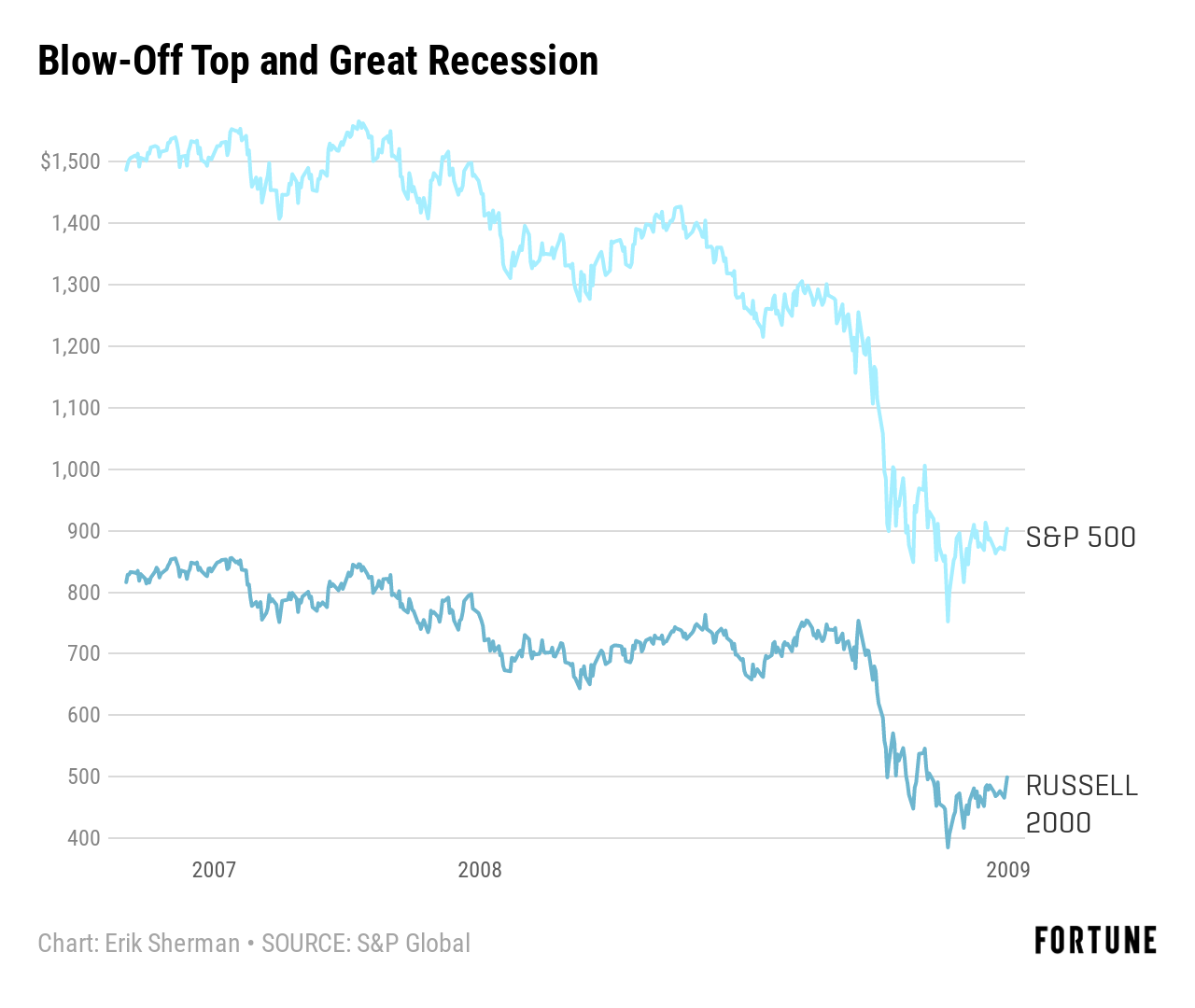
As the graph shows, in a blow-off top, not all parts of the market move at the same time. “In 2007, the Russell 2000 completed a double top,” or a pair of peaks, on June, 4 and July, 13, said financial and tax adviser Steven Jon Kaplan. “The S&P 500 didn’t peak until October 9. From top to bottom the S&P 500 slid 57.7% while the Russell 2000 lost 60.0%.”

The whole event can take many months, from the initial highs and then multiple rounds of drops and rebounds. The subsequent peaks keep dropping in size, while the bottoms get deeper.

The pattern of one part of a market peaking earlier than others repeats in other ways. “For example, with commodities, it is almost always the case that the producers of the commodity reach their peaks ahead of the commodity itself,” Kaplan said. “When the commodity is peaking, the producers make lower highs.” That’s a sign a sector may be ready for a major decline.

Kaplan pointed to the example of gold mining funds peaking in April 2011. The price of gold itself hit a high in September 2011 and the funds saw a peak, but a lower one than in the Spring. “This was an early warning of a price drop, and sure enough the entire commodity sector, including precious metals, collapsed and didn’t bottom until January 20, 2016,” he said.

“Period of euphoria”

In any market, increased investment is what pushes shares higher. Additional money represents additional demand with a relatively fixed available supply of stocks at a given time. In a nod to classic economic theory, share prices respond by going up.

The economic explanation of a blow-off top is a “period of euphoria that causes the last of the bears to become bulls [and is] the process of the market sucking in the last of the sideline cash,” which means any available money not invested, said Robert Phipps, director and portfolio manager of Per Stirling Capital Management.

When the sideline cash is exhausted, there is a sudden reduction in the money people will invest into equities. Demand for high-priced stocks suddenly becomes weak and, as a result, prices drop. The dynamic is one that, to some experts, the markets may be playing out right now. Look at the progress of the S&P 500 and Russell 2000 from October 2017 through March 2018 in the following graph.
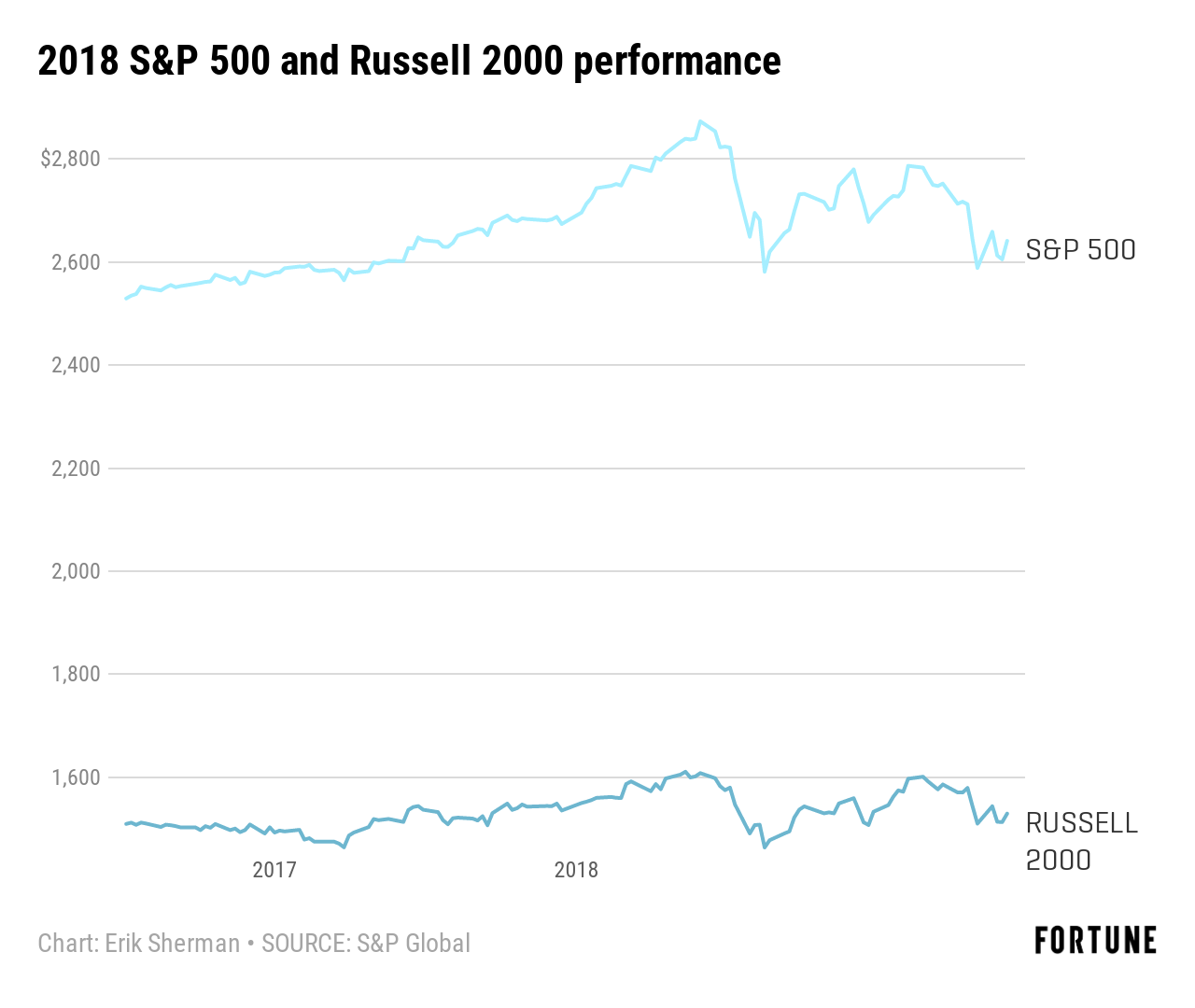
Kaplan argued that the markets are showing “exactly the same blow-off behavior”—like people putting more money into the markets and growing share valuations, and small- to medium-caps peaking—that previous such events have shown. For example, the Russell 2000 hit a peak at the end of August 2018 and then a secondary one in December 2019 that was down almost 4% from the previous one.

“Not many people pay attention to that, but that’s how many bear markets start, with the smaller and mid-sized companies,” Kaplan said. “Hardly anybody reports on a story how the Russell 2000 did on a particular day or week or year.”

Watch the bond market for clues

An additional concern is that investors may have largely lost their fear, and are increasingly pouring money without concern into markets, also fueled by low interest rates that push interest in stocks over many other investments.

One indicator is in the bond market, with a narrow difference in the yields offered by junk and investment-grade bonds. Investors see risk as systemically lower and so ask less of a premium for it.

Passive trading, which is a much bigger deal these days, can also exacerbate blow-off top conditions. Managers at many passive funds are restricted in the actions they can take. When money comes in, they may have to invest it rather than holding more cash because valuations seem too high. That pushes up share prices. When markets cool and people begin to take money out, the funds then sell shares to create liquidity, which increases the amount of selling and further depresses prices.

Stocks show the lack of fear, and a rush to greater return, as their moving averages are significantly below the current prices. Values are growing faster than usual and that concerns Phipps. “Right now, the S&P 500 is almost 8% of its 125-day moving average,” Phipps said. Had that been 2% or even 4% of the moving average, “it wouldn’t raise an eyebrow.”

Prices have clearly seen the effect. “Right now, we’re at 18.5 times forward earnings, which is really, really expensive on the S&P 500,” Phipps said. The market breadth has been strong, with most stocks having ridden the surge and suggesting that investors are discriminating little between different stocks.

Still, it’s still extraordinarily difficult to tell when the market is about to have a blow-off top. On one hand, the volume of shares trading hands hasn’t been all that high, which would suggest less of a rush to invest mania gripping the markets. Then again, according to a regular survey by the American Association of Individual Investors, as of Jan. 15, 41.8% of respondents expect the market to be up in the next six months. This historical average is 38%.

Keep in mind, the prospect of a blow-off top cannot be adequately predicted—such is the nature of any phenomenon that can be observed only retroactively. Experts therefore advise investors to work with a financial adviser to consider some hedging actions to limit losses.

But whatever you do, don’t blow it off.

More must-read stories from Fortune:

—Wells Fargo is the big bank that investors like least
—What we can learn from the man who tried to sell the Eiffel Tower—twice
—Why it’s time for a futures market in health care
—Retailers reuse and recycle the way to increased growth
—3 things investors can bank on in the uncertain 2020s
Subscribe to Fortune’s forthcoming Bull Sheet for no-nonsense finance news and analysis daily.
About the Author
By Erik Sherman
See full bioRight Arrow Button Icon

Latest in Finance

Finance
Lorem ipsum dolor sit amet, consectetur adipiscing elit, sed do eiusmod tempor incididunt ut labore et dolore magna aliqua. Ut enim ad minim veniam
By Fortune Editors
October 20, 2025
Finance
Lorem ipsum dolor sit amet, consectetur adipiscing elit, sed do eiusmod tempor incididunt ut labore et dolore magna aliqua. Ut enim ad minim veniam
By Fortune Editors
October 20, 2025
Finance
Lorem ipsum dolor sit amet, consectetur adipiscing elit, sed do eiusmod tempor incididunt ut labore et dolore magna aliqua. Ut enim ad minim veniam
By Fortune Editors
October 20, 2025
Finance
Lorem ipsum dolor sit amet, consectetur adipiscing elit, sed do eiusmod tempor incididunt ut labore et dolore magna aliqua. Ut enim ad minim veniam
By Fortune Editors
October 20, 2025
Finance
Lorem ipsum dolor sit amet, consectetur adipiscing elit, sed do eiusmod tempor incididunt ut labore et dolore magna aliqua. Ut enim ad minim veniam
By Fortune Editors
October 20, 2025
Finance
Lorem ipsum dolor sit amet, consectetur adipiscing elit, sed do eiusmod tempor incididunt ut labore et dolore magna aliqua. Ut enim ad minim veniam
By Fortune Editors
October 20, 2025

Most Popular

Finance
Lorem ipsum dolor sit amet, consectetur adipiscing elit, sed do eiusmod tempor incididunt ut labore et dolore magna aliqua. Ut enim ad minim veniam
By Fortune Editors
October 20, 2025
Finance
Lorem ipsum dolor sit amet, consectetur adipiscing elit, sed do eiusmod tempor incididunt ut labore et dolore magna aliqua. Ut enim ad minim veniam
By Fortune Editors
October 20, 2025
Finance
Lorem ipsum dolor sit amet, consectetur adipiscing elit, sed do eiusmod tempor incididunt ut labore et dolore magna aliqua. Ut enim ad minim veniam
By Fortune Editors
October 20, 2025
Finance
Lorem ipsum dolor sit amet, consectetur adipiscing elit, sed do eiusmod tempor incididunt ut labore et dolore magna aliqua. Ut enim ad minim veniam
By Fortune Editors
October 20, 2025
Finance
Lorem ipsum dolor sit amet, consectetur adipiscing elit, sed do eiusmod tempor incididunt ut labore et dolore magna aliqua. Ut enim ad minim veniam
By Fortune Editors
October 20, 2025
Finance
Lorem ipsum dolor sit amet, consectetur adipiscing elit, sed do eiusmod tempor incididunt ut labore et dolore magna aliqua. Ut enim ad minim veniam
By Fortune Editors
October 20, 2025
Fortune Secondary Logo
Rankings
  • 100 Best Companies
  • Fortune 500
  • Global 500
  • Fortune 500 Europe
  • Most Powerful Women
  • Future 50
  • World’s Most Admired Companies
  • See All Rankings
Sections
  • Finance
  • Fortune Crypto
  • Features
  • Leadership
  • Health
  • Commentary
  • Success
  • Retail
  • Mpw
  • Tech
  • Lifestyle
  • CEO Initiative
  • Asia
  • Politics
  • Conferences
  • Europe
  • Newsletters
  • Personal Finance
  • Environment
  • Magazine
  • Education
Customer Support
  • Frequently Asked Questions
  • Customer Service Portal
  • Privacy Policy
  • Terms Of Use
  • Single Issues For Purchase
  • International Print
Commercial Services
  • Advertising
  • Fortune Brand Studio
  • Fortune Analytics
  • Fortune Conferences
  • Business Development
  • Group Subscriptions
About Us
  • About Us
  • Editorial Calendar
  • Press Center
  • Work At Fortune
  • Diversity And Inclusion
  • Terms And Conditions
  • Site Map
  • About Us
  • Editorial Calendar
  • Press Center
  • Work At Fortune
  • Diversity And Inclusion
  • Terms And Conditions
  • Site Map
  • Facebook icon
  • Twitter icon
  • LinkedIn icon
  • Instagram icon
  • Pinterest icon

Latest in Finance

The petrodollar faces increased risk, but a petroyuan is ‘far-fetched’ as fears of U.S. losing superpower status are overhyped, strategist says
EconomyCurrency
The petrodollar faces increased risk, but a petroyuan is ‘far-fetched’ as fears of U.S. losing superpower status are overhyped, strategist says
By Jason MaApril 11, 2026
2 hours ago
Average price of new cars nears $50,000 as automakers focus on big pickups and SUVs while cheaper sedans get phased out
EconomyAutos
Average price of new cars nears $50,000 as automakers focus on big pickups and SUVs while cheaper sedans get phased out
By Alexa St. John and The Associated PressApril 11, 2026
3 hours ago
Three oil supertankers sail through the Strait of Hormuz
EnergyOil
Three oil supertankers sail through the Strait of Hormuz
By Julian Lee, Weilun Soon and BloombergApril 11, 2026
6 hours ago
Boeing’s moon rocket faces uncertain future under Trump’s NASA
PoliticsNASA
Boeing’s moon rocket faces uncertain future under Trump’s NASA
By Sana Pashankar and BloombergApril 11, 2026
6 hours ago
Some of cheapest fuel can be found on Native American reservations as tribes are exempt from state gas taxes
Energygas prices
Some of cheapest fuel can be found on Native American reservations as tribes are exempt from state gas taxes
By Mead Gruver and The Associated PressApril 11, 2026
6 hours ago
JD Vance begins talks with Iran in Pakistan while Trump claims U.S. has begun ‘clearing out’ the Strait of Hormuz
PoliticsIran
JD Vance begins talks with Iran in Pakistan while Trump claims U.S. has begun ‘clearing out’ the Strait of Hormuz
By Munir Ahmed, Sam Metz, E. Eduardo Castillo, Samy Magdy and The Associated PressApril 11, 2026
6 hours ago

Most Popular

Scottie Scheffler joined Tiger Woods and Rory McIlroy in golf's $100M club—and donated his entire Ryder Cup stipend to charity
Success
Scottie Scheffler joined Tiger Woods and Rory McIlroy in golf's $100M club—and donated his entire Ryder Cup stipend to charity
By Fortune EditorsApril 10, 2026
1 day ago
The Navy confirmed an ‘abundant amount’ of Uncrustables when the Artemis II crew lands. Smucker’s just offered them a lifetime supply
Politics
The Navy confirmed an ‘abundant amount’ of Uncrustables when the Artemis II crew lands. Smucker’s just offered them a lifetime supply
By Fortune EditorsApril 10, 2026
23 hours ago
The 'affordability economy' has created a housing market nobody predicted: Prices collapsing in the Sun Belt, soaring in the Rust Belt
Real Estate
The 'affordability economy' has created a housing market nobody predicted: Prices collapsing in the Sun Belt, soaring in the Rust Belt
By Fortune EditorsApril 11, 2026
13 hours ago
Mark Cuban admits he made a mistake letting go of the Mavericks: 'I don't regret selling. I regret who I sold to'
Investing
Mark Cuban admits he made a mistake letting go of the Mavericks: 'I don't regret selling. I regret who I sold to'
By Fortune EditorsApril 9, 2026
2 days ago
Warren Buffett says 'accumulating great amounts of money' doesn’t achieve greatness—He still lives in a $31,500 Nebraska home and clipped coupons
Success
Warren Buffett says 'accumulating great amounts of money' doesn’t achieve greatness—He still lives in a $31,500 Nebraska home and clipped coupons
By Fortune EditorsApril 11, 2026
10 hours ago
Schools across America are quietly admitting that screens in classrooms made students worse off and are reversing years of tech-first policies
Innovation
Schools across America are quietly admitting that screens in classrooms made students worse off and are reversing years of tech-first policies
By Fortune EditorsApril 10, 2026
2 days ago

© 2026 Fortune Media IP Limited. All Rights Reserved. Use of this site constitutes acceptance of our Terms of Use and Privacy Policy | CA Notice at Collection and Privacy Notice | Do Not Sell/Share My Personal Information
FORTUNE is a trademark of Fortune Media IP Limited, registered in the U.S. and other countries. FORTUNE may receive compensation for some links to products and services on this website. Offers may be subject to change without notice.