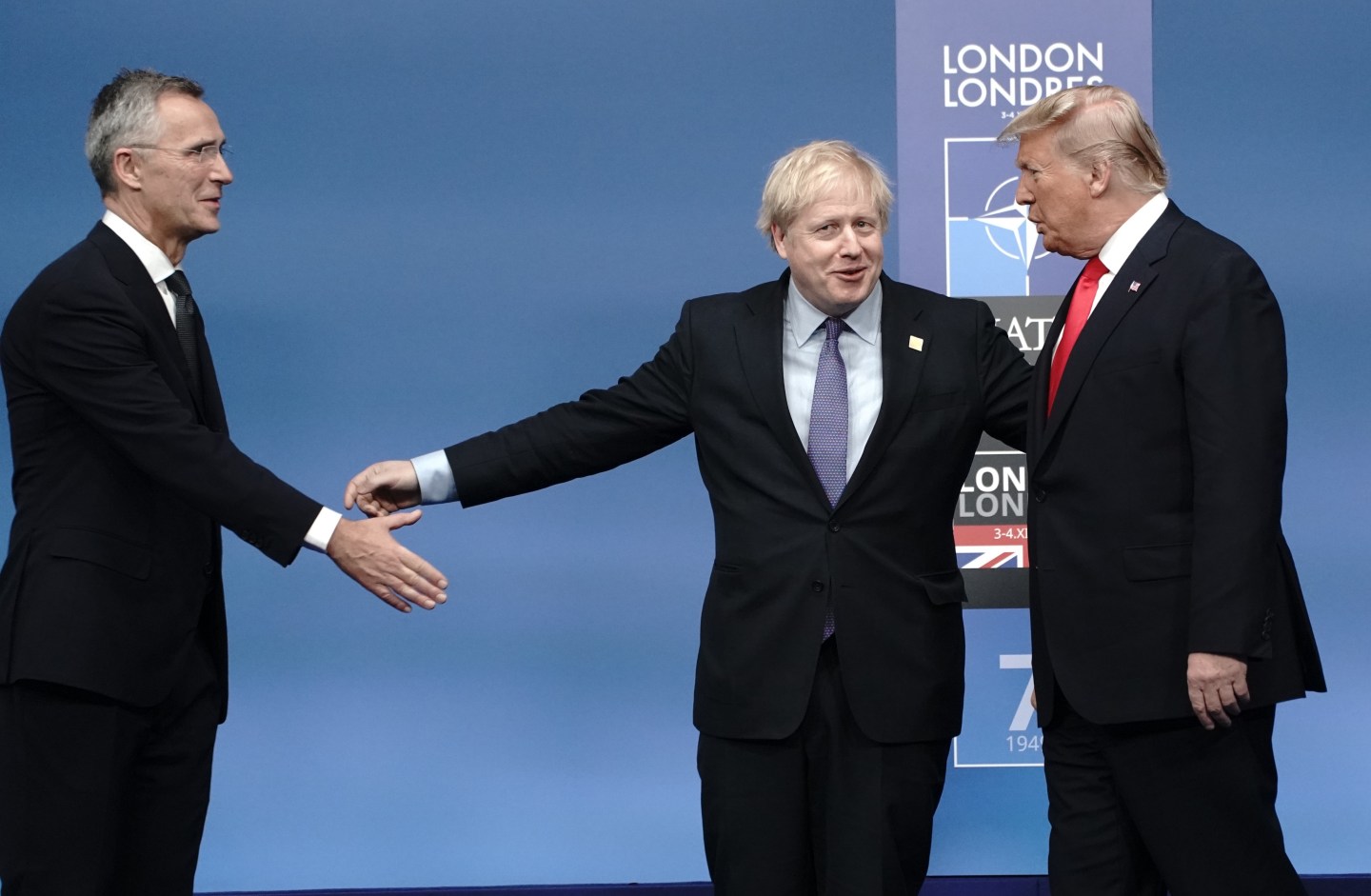
U.S. President Donald Trump’s criticism of the North Atlantic Treaty Organization has shaken seven decades of American defense policy and raised questions about the continuing purpose and durability of the military alliance connecting the U.S., Canada and Europe. Among those questions: Would an armed attack against any member still be considered an attack against all? French President Emmanuel Macron, for one, says he has doubts about the alliance’s commitment to collective defense, part of what he assailed as the “brain death of NATO.”
1. Why does NATO exist?
It was founded in 1949 to protect Europe against Soviet attack during the Cold War and has come to represent an underlying partnership between North America and Europe based on shared political and economic values. The pledge of collective defense, spelled out in Article 5 of the NATO treaty, established that an attack against one NATO member is considered an attack on all of them, increasing the risks for any potential aggressor.
2. What’s its modern function?
NATO’s role has expanded to include bombing Serb forces during the Bosnia and Kosovo wars of the 1990s, enforcing an arms embargo on Libya in 2011, helping Europe tackle a flood of Middle Eastern refugees that erupted in 2015, and stepping up cyber defense. Since Russia’s encroachment in Ukraine in 2014, the alliance has refocused on the military threat from Russia, deploying multinational battle groups in eastern Europe to reassure allies there and upgrading its command structure for the first time since the end of the Cold War. A 2019 summit expanded NATO’s remit to make outer space an “operational domain” along with air, land, sea and cyberspace and addressed for the first time challenges posed by China.
3. How many countries are in NATO?
Its membership has grown from 12 to 29 countries, with Montenegro the most recent to join, in 2017. North Macedonia is due to become the 30th member in 2020.
4. How often has Article 5 been activated?
Just once, after the Sept. 11, 2001, attacks on the World Trade Center and the Pentagon. The alliance used Airborne Warning and Control System planes to help patrol the skies over the U.S. That was followed by ship monitoring in the Mediterranean Sea, participation in the war in Afghanistan, and the training of Iraqi soldiers.
5. Why the worries over NATO’s future?
Macron described fading U.S. commitment and lack of consultation under Trump as undermining the foundations of the alliance. The French president pointed to Trump’s decision in October to green-light a military incursion by Turkey, a NATO member, into neighboring Syria to challenge Kurdish forces. France was among the NATO members that opposed what Macron called Turkey’s “uncoordinated aggressive action.” “You have partners together in the same part of the world, and you have no coordination whatsoever of strategic decision-making between the United States and its NATO allies,” Macron said.
6. What is Trump’s concern about NATO?
During his 2016 election campaign, Trump alarmed U.S. allies in Europe by suggesting the U.S. commitment to defend fellow NATO countries should depend on whether their military spending was high enough. European nations seeking a reassurance on this point were disappointed at the May 2017 Brussels summit, where Trump refused to offer an explicit endorsement of NATO’s collective-defense clause. (Two weeks later, in a press conference in Washington, Trump said he was “absolutely” committed to the clause.)
7. How is NATO funded?
Two ways. Countries make contributions based roughly on their gross national income to finance NATO’s relatively small annual budget, which is 2.4 billion euros ($2.6 billion) and covers the alliance’s headquarters, its integrated command and its own limited military capabilities. The U.S. had borne the heaviest share, but in 2019 its portion was reduced from 22% to 16%, the same as Germany’s, with all European countries except France raising their contributions to make up the difference. Most of NATO’s capacity comes from the armed forces of member nations. In 2006, members set a “guideline” to spend at least 2% of their gross domestic product on defense. In 2014, they agreed to “aim to move towards” the target by 2024. Nine members were expected to meet the goal in 2019.
8. What changes does Trump want?
He upended a July 2018 NATO summit by demanding that members meet the 2% level immediately and even broached the idea of doubling the target to 4%. He floated the idea of the U.S. “going it alone” if allies don’t comply. In a subsequent press conference, Trump said he didn’t think such a move was necessary and that “everyone’s agreed to substantially up their commitment.” Defense spending by NATO members has also been increasing more rapidly, with extra outlays by U.S. allies in the period 2016-2020 projected to total $130 billion — a development for which Trump has been quick to claim credit.
9. Has the U.S. always spent more on defense?
Yes, but the imbalance has grown. Military spending increased in the U.S. following the terrorist attacks on Sept. 11, 2001, and decreased in Europe after the Cold War ended in 1990 and again after the financial crisis broke out in 2008. Over the past 20 years, the U.S. share of defense spending by NATO members as a whole has risen to about 70% from 58%. Angela Merkel, chancellor of Germany, which aims to boost its spending on defense to 1.5% of GDP by 2024, has insisted on looking beyond purely military expenditures. She argues that because development aid is vital to security, it should be included in contributions toward the common defense.
More must-read stories from Fortune:
—These tech companies spend the most on lobbying
—Is divorce costing Florida too much money?
—2020 Crystal Ball: Predictions for the economy, politics, technology, and more
—All the candidates who qualify for the December Democratic debate—so far
—The 2020 tax brackets are out. Here’s what you need to know
Get up to speed on your morning commute with Fortune’s CEO Daily newsletter.