Venture capitalist Bill Gurley uses a fat black pen to circle the word “moronic” in a news story he has printed out. The recent article is a critique of the traditional process that startups use to go public: an initial public offering. It argues that IPOs—the path to Wall Street riches for nearly all big tech companies, including Amazon, Facebook, and Microsoft—are outdated and inefficient and that the investment banking industry’s inability to evolve is, yes, moronic.
In this particular case, Gurley wasn’t the one who used that strong adjective. The article attributes the word “moronic” to Barry McCarthy, chief financial officer of music-streaming service Spotify.
But Gurley, a well-known tech investor at Benchmark, might as well have uttered it—and written the whole manifesto himself. He’s one of the loudest proponents of so-called direct listings, an alternative to the IPO that’s gaining momentum in Silicon Valley.
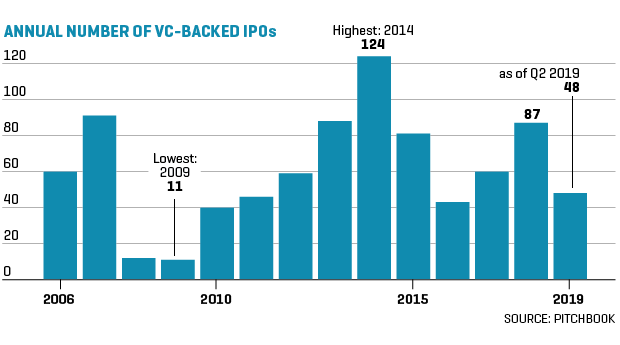
In traditional IPOs, bankers spend weeks (and earn hefty fees) lining up big institutional investors to buy shares. The newly public company gets the publicity of a splashy launch, and a large infusion of cash to boost growth.
But many of today’s startups, rich already with private capital, don’t need cash—they’re primarily looking for an efficient way for early investors to sell some of their stakes.
In a direct listing, a company doesn’t issue any new stock and therefore doesn’t raise additional money. Instead, shareholders sell existing stock directly to the public, leaving investment banks to serve merely as advisers in the process and not underwriters.
The benefits to venture capitalists are obvious: Companies undertaking direct listings don’t have to pay banks tens of millions of dollars in underwriting fees. They have to pay advisory fees only, which tend to be significantly less.
Furthermore, because no additional stock is made available, there’s less dilution for existing investors. In a traditional IPO, the “pie” becomes bigger, which means that early stockholders like VCs end up owning a smaller percentage of the overall company.
What’s more, insiders are free to sell their shares in the months after a direct listing because, unlike with IPOs, there is no “lockup period.”
Venture capitalists like Gurley bring up yet another benefit: disrupting the status quo. “We’ve been stuck with the old process for a long, long time,” says Gurley, an early investor in Uber and real estate site Zillow, among other startups that have upended traditional industries.
“We’ve been stuck with the old process for a long, long time.” — Benchmark investor Bill Gurley
So far, there have been only two notable direct listings in the U.S. Sweden-based Spotify went public via a direct listing on the New York Stock Exchange in April 2018, and workplace messaging service Slack followed suit this June. VCs like Gurley, a former Wall Street stock analyst, hope many more companies will follow suit.
“He is the godfather of all this,” says Mamoon Hamid, a partner at venture capital firm Kleiner Perkins. “Bill, being a former banker, is a student of this stuff—of venture capital and of public markets. I think this is kind of his calling, bringing disruption to banking.”
If 6-foot-9 Gurley is the godfather, his deep-pocketed consiglieri include not just Hamid but also investors from top venture capital firms like Sequoia, Andreessen Horowitz, and Greylock. Just a few weeks after Slack’s direct listing in June, a handful of top venture capitalists gathered at Kleiner Perkins’s swank Sand Hill Road offices in Menlo Park, Calif., to discuss direct listings. “It’s unprecedented from my standpoint,” Gurley says about how the highly competitive venture capital industry has banded together over direct listings.
The next step planned in the campaign is a summit later this fall with the founders of some of the most promising startups.
Already, Gurley says, the founders of payments platform Stripe, Irish entrepreneurs and brothers John and Patrick Collison, are interested in a direct listing, as is Dustin Moskovitz, CEO of project-management software provider Asana. (Both companies declined to comment.) Airbnb is also rumored to be looking at this option.
Well-capitalized companies like Slack, which had more than $800 million on its balance sheet, can afford to forgo raising money when going public. But investment banks, which tend to be a bit less messianic about direct listings, say that many companies will still prefer IPOs.
Fortune talked with four investment bankers about direct listings, but in a sign of the sensitivity about the topic, they would speak only on background. The consensus? While they say investment banks like direct listings, they don’t think they’re a good option for every company.
One banker likened the path to going public to the different ways you can give birth to a baby. “You can have natural birth, and you can have a cesarean, but today I don’t really think about how my kids were born—I think about how they’re doing now,” he says.
The bottom line is that while investment bankers can still make money via direct listings (there are some benefits to them, too, like the lack of a lockup period), they’re not as enthusiastic as VCs. It’s simple to understand why: Fewer banks will be involved, and those lucky few that are will make less money.
But longer term, perhaps direct listings will actually be a catalyst for more companies to go public, or to go public faster, which could have benefits for all involved—VCs, founders, investment bankers, and other shareholders. As John Tuttle, vice chairman and chief commercial officer of NYSE, puts it: “In a world awash with private capital and people not necessarily talking about the benefits of being a public company, this is one more avenue companies have to come to market.”
A version of this article appears in the October 2019 issue of Fortune with the headline “VCs Can’t Get Enough of Direct Listings.”
More must-read stories from Fortune:
—Airbnb plans huge IPO in 2020, continuing push by tech companies to go public
—What’s the difference between a recession and a depression? Here’s what history tells us
—Why the next recession may feel very different than 2008
—Why the repo market is such a big deal—and why its $400 billion bailout is so unnerving
—Apple Card: Here are all the credit card’s 3% cash back benefits partners
Don’t miss the daily Term Sheet, Fortune’s newsletter on deals and dealmakers.