The tidal wave of money pouring into index funds and ETFs has always been a concern to the asset management industry. Sporting rock bottom fees and yielding often superior returns, these fund vehicles have become something of an existential threat to asset managers.
Now those concerns are morphing from career risk to market risk. Michael Burry, the hedge fund manager who became famous from the Michael Lewis book The Big Short (and was later played by Christian Bale in the movie version), recently compared index funds to the toxic CDOs he made so much money shorting when the real estate bubble blew up. Burry claims the flows into index funds are distorting stock and bond markets, and when those flows reverse “it will be ugly.”
As long ago as 1991, legendary hedge fund manager Seth Klarman dismissed indexing as just another Wall Street fad. “When it passes,” he said, “the prices of securities included in popular indexes will almost certainly decline relative to those that have been excluded. When the market trend reverses, matching the market will not seem so attractive. The selling will then adversely affect the performance of the indexers and further exacerbate the rush for the exits.”
So these comparisons are nothing new from big-name traders. Still, individual investors ought to pay close attention when they read headlines about famous investors calling for a crash coming—especially when it involves funds so many people are now invested in. But the concerns about a bubble in passive investing are overblown. Here’s why:
No rip-off fees, no problem
It’s odd that some people think it’s somehow a bad thing investors are shifting money into funds that:
- save them money in fees
- are more tax-efficient
- have lower turnover and trading costs
- beat the majority of actively managed funds over the long-term
- are simpler and easier to understand than most investment strategies
It’s also bizarre to classify as a bubble the idea that more investors are actively avoiding the search for alpha by thinking and acting in a long-term perspective. It’s like worrying about McDonald’s sales if we were all to swear off junk food.
Wouldn’t it be more worrisome if investors were piling into the opposite scenario—into funds with high fees that are tax inefficient and routinely underperform simple market averages over time?
The tail is not wagging the dog
There’s a lot of fuss around mutual funds and ETFs. But, truth be told, ownership of the stock market goes far beyond these two vehicles. Vanguard founder John Bogle provided a breakdown on index ownership in his latest book:
Yes, U.S. index funds have grown to huge size, with their holdings of U.S. stocks doubling from 3.3% of their total market value in 2002, to 6.8% in 2009, and then doubling again to an estimated 14% in 2018. Other mutual funds now hold an estimated 20% of corporate shares, bringing the mutual fund total to almost 35%, the nation’s most dominant single holder of common stocks.
So, index funds represent less than 15% of share ownership in public companies. And, according to former Vanguard CEO Bill McNabb, indexing in stocks and bonds globally represents less than 5% of global assets.
Given that, it’s not at all provocative to wonder: Why aren’t people more worried about active managers then? Surely, they’re just as likely—if not more—to torpedo the markets. No?
Vanguard and iShares have experienced massive growth over the past two decades, seeing trillions of dollars worth of inflows. But this doesn’t mean indexing is a brand new phenomenon. It’s just being packaged in a cheaper wrapper now.
Professional money managers have been closely tracking their benchmarks for decades now. The upshot? These index funds and ETFs are quickly becoming benchmarks of their own for active fund managers. Furthermore, very few actively managed funds deviate much from those benchmarks because being different eventually leads to under-performance. And that’s what gets you fired in the asset management business.
Career risk may be one of the greatest market inefficiencies, one people seldom talk about. And because career risk is an enduring reality, closet indexing will be with us for some time.
Pensions and other large institutional investors add to the phenomenon. They have been creating their own index funds in-house for years. We’re just seeing a shift from the institutional practice of closet-indexing to a brimming marketplace for ETFs and other index funds as investors have wisened up.
Isn’t it a good thing investors are shifting away from expensive closet index funds?
Active funds literally own the market
When you buy an index fund of the total stock market, you are literally buying the stock market in proportion to the shares held by all active investors. If you sum up the collective holdings of active managers, what you essentially get is a market-cap-weighted index. Index fund investors are simply buying what the active investors have laid out for them.
Plus, we have to remember that not every cent flowing into index funds is going directly to the S&P 500 or a total market fund. Most of the money is going there but there are also index funds for small caps, mid caps, value, growth, sectors, themes, and everything in-between.
Many of the worries about indexing really boil down to career risk in the asset management space. By taking themselves out of the game through the direct purchase of index funds, there are now fewer suckers at the poker table for the pros to take advantage of.
Isn’t it a good thing then that most small investors have decided not to bother competing with the professional active managers who, it turns out, largely trade with one another?
Price discovery is a cop-out
Don’t feel sorry for the active management community. It will never completely go out of business. It’s far too lucrative and tempting for type-A personalities to prove themselves.
But people worry that as index funds continue to gain market share, the price-discovery mechanism could become fragile. This is nonsense. There’s plenty of price-discovery going on in the markets. In fact, you could probably make the case there’s too much of it these days.
Fifty years ago or so, for example, the entire trading volume of listed stocks on the New York Stock Exchange was 3 million shares. Today, Apple has an average trading volume of roughly 26 million shares a day. Facebook turns over more than 16 million shares a day, on average. The biggest stock market ETF (SPY) averages nearly 70 million trades a day.
Active managers will always set the prices, no matter how many there are. Charley Ellis wrote in his book, The Index Revolution, that indexing accounts for less than 5% of trading, with the remaining 95% or so done by active investors. This will always be the case, no matter the amount of money flowing into index funds.
Here’s the NYSE volume by year:
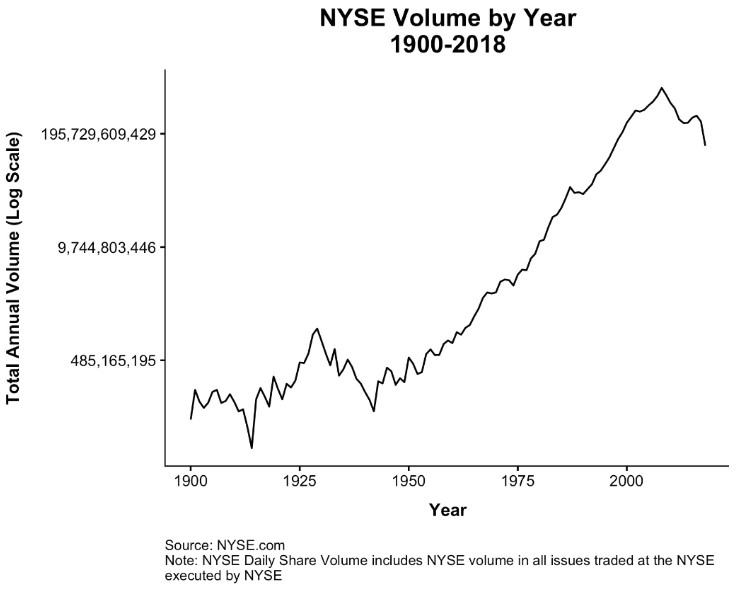
Mind you, I’m not complaining about the increase in volume. This is a good thing because it lowers trading costs and decreases bid/ask spreads.
But what’s a more worrisome trend for individual investors—people who have decided to trade less, or people who have decided to trade more?
Yes, index funds are free-riders, but so what?
Cliff Asness wrote a wonderful piece for Bloomberg a few years ago about the idea of index investors being free riders:
The use of price signals by those who played no role in setting them may be capitalism’s most important feature. That most of us and most of our dollars don’t have to pick stocks, or to price air conditioners, is a great benefit and taking advantage of it makes us honest smart capitalists, not commissars.”
Yes, index investors are free riders, but this is the way most markets work. We don’t go to the grocery store to bid on prices of oranges against one another to set an equilibrium. The market does that for us.
It’s also worth pointing out the success of indexing doesn’t mean all active management is inherently useless or bad. In fact, Vanguard itself still a ton of money in active funds. Here’s the breakdown of assets in index funds for the firm (also from Bogle’s book):
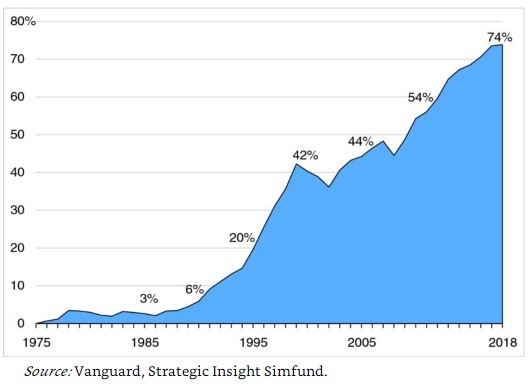
The trend is easy to spot, but the firm still has more than $1 trillion in actively managed funds. They just happen to manage their active funds using strategies that employ low turnover, long holding periods, and lower than average fees.
Wouldn’t it be a net positive then for the end investor should the surge in indexing force the asset management industry to adapt?
Liquidity is not a problem for index funds
One of the big worries is what happens if everyone who has piled into these funds in recent years decides to reverse course and rush to the exits all at once? There will always be investors that panic when markets fall, regardless of the type of fund they’re invested in.
When an index fund investor sells, they’re technically selling their holdings in direct proportion to their weighting in the index. So the market impact is muffled. It’s worth repeating: index fund investors are simply owning stocks in the proportion that all active investors own stocks.
Plus, index funds never lever up your holdings. They never receive a margin call. They don’t put 30% of your holdings in Valeant Pharmaceuticals. And no index fund has ever closed up shop to spend more time with the family.
Why then would index funds or ETFs be any different than any other fund type or security in that respect?
People love attaching a narrative to ups and downs of the markets. Index funds have been the perfect scapegoat in a market that has gone up for 10 years, and pretty much outperformed every other strategy. This won’t last forever. But the next time the market tanks, it will have more to do with investors than index funds.
Do you know what did not cause the Great Depression, or the Japan stock market crash ,or the 1987 crash, or the 1973-74 bear market? Index funds. Index funds also weren’t around for the South Sea Bubble on the 1700s.
Do you know what did cause these historic bubbles and crashes? Human nature.
Could the stock market itself become a bubble yet again? Of course. There will always be bubbles.
Are index funds perfect? No. They give you all of the upside of the stock market. And all of the downside. And, indexes can go nowhere for years on end just like individual stocks. They can become overpriced and underpriced. They own the good stocks and the bad stocks.
But that’s nothing new. That’s the stock market for you.
This passive bubble talk is silly. Wake me up when index funds control 90% of the stock market.
Ben Carlson, CFA is the Director of Institutional Asset Management at Ritholtz Wealth Management.
More must-read stories from Fortune:
—Deutsche Bank CEO on European Central Bank: “Negative rates ruin the financial system”
—September is historically the worst month for stocks. Will 2019 follow the pattern?
—Why the next recession may feel very different than 2008
—Here’s what it would take to get to “win-win” with China on trade
—”Zombie” companies are on the rise–and they could pose a threat to the U.S. economy
Don’t miss the daily Term Sheet, Fortune’s newsletter on deals and dealmakers.