• Home
  • Latest
  • Fortune 500
  • Finance
  • Tech
  • Leadership
  • Lifestyle
  • Rankings
  • Multimedia

Trendingnow

1

Corporate America has been draining the world's water. Matt Damon's new campaign calls on Gap, Starbucks, and Amazon to help give it back

2

When SpaceX starts trading, some 'shareholders' will discover they own nothing at all

3

Current price of oil as of June 12, 2026

1

Corporate America has been draining the world's water. Matt Damon's new campaign calls on Gap, Starbucks, and Amazon to help give it back

2

When SpaceX starts trading, some 'shareholders' will discover they own nothing at all

3

Current price of oil as of June 12, 2026

From the Civil Rights Era to Hong Kong: How Airports Became a Global Symbol of Protest

By
Katherine Dunn
Katherine Dunn
and Phil Boucher
Down Arrow Button Icon
By
Katherine Dunn
Katherine Dunn
and Phil Boucher
Down Arrow Button Icon
August 21, 2019, 5:30 AM ET

Terminals of major airports are often stale and clinical. They usually show few signs of local culture and flavor, with an environment that feels wholly apart from the vibrant metropolises they serve. But then there are times when protesters descend, and they become exhibitions of a nation’s deep political divisions on full, raw display.

That’s precisely what played out in Hong Kong last week, as scores of demonstrators swarmed the world’s second-busiest air transport hub, staging protests so disruptive they forced the cancellation of flights on two consecutive days.

The Hong Kong protesters’ choice of venue was, of course, strategic.

“It is an excellent platform to reach out globally,” says Wong Ka Ying, an official from the Hong Kong Artist Union, which actively campaigned at Hong Kong International earlier this month. The demonstrators, who are vying for more freedoms, were not the first to make such a determination. Indeed, the actions in Hong Kong were the latest chapter in a tradition of airport protests that’s closely paralleled the democratization of flight.

From Greenville to Hong Kong

In the 1950s and 60s, as commercial flying grew in popularity, airports became a backdrop of the U.S. civil rights movement. Though perceived as outposts of a national aviation system, some airports in the South remained segregated even as airports in the North desegregated, says Christopher Schaberg, the author of three books on airports, and a professor at Loyola University in New Orleans.
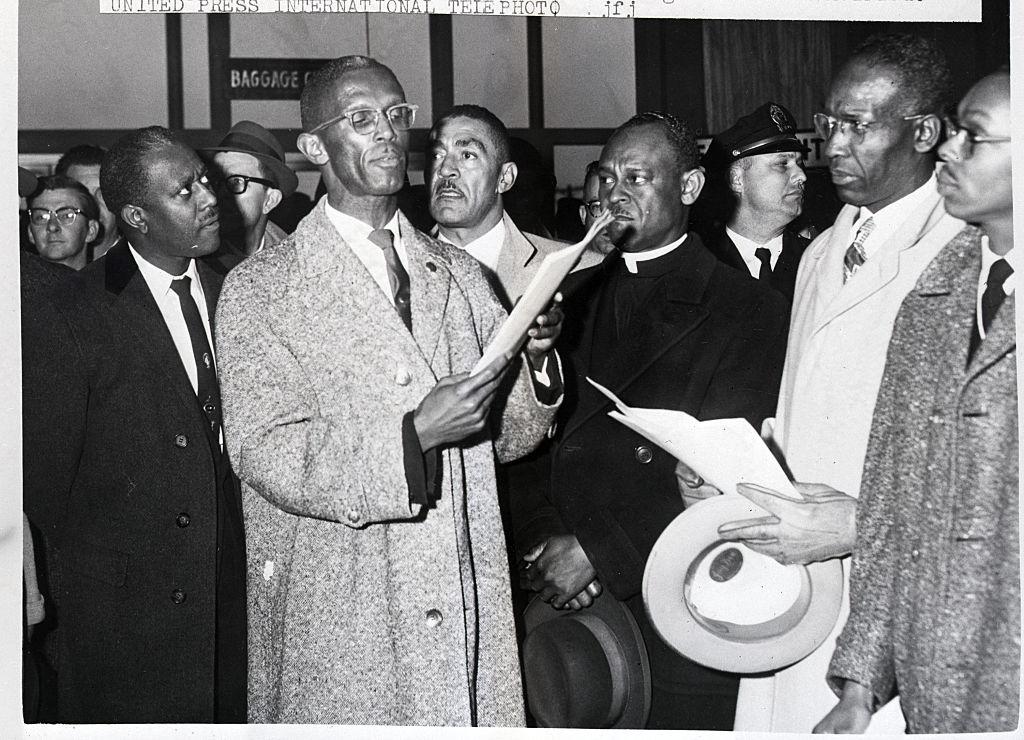
Rev. Mccollough At Airport Protest
Rev. M. D. McCollough of Orangeburg reads a resolution in the main terminal of the Greenville Municipal Airport during a New Years Day 1960 protest against airport officials who asked baseball star Jackie Robinson to leave a white waiting room months earlier. (Getty Images)
Getty Images

In 1959, former baseball player Jackie Robinson ignited protests after he and his companions refused to move from the main lounge to a segregated one at the Greenville, South Carolina airport. They’d visited the city to speak at an NAACP convention. Their defiance inspired a 1,000-strong march to the airport on New Year’s Day 1960 that called for an end to segregation.

Reaching critical mass

Despite that early instance, protests at airports are mostly a phenomenon of the last 20 years, when air travel has ballooned, says Schaberg. Between 1999 and 2018, the last year figures are available, the number of passenger trips rose by about 156% to a record 4.1 billion, according to data from the International Civil Aviation Organization, the UN’s aviation body.

“[W]e needed a critical mass of global travel for [protests at airports] to be as effective as they are now,” he says.

With so many international visitors now streaming through terminals, airports provide a near-unparalleled venue for protest messaging.

“[It] allows you to communicate who you are to other audiences that are very generalized,” says Brian Doherty, a professor of political sociology at Keele University in the U.K.

Getting global attention

For global attention, there’s not much that can compare with Hong Kong International. 

Last year, it attracted 75.3 million passengers, and was the world’s biggest air cargo hub, with more than 5 million metric tons cleared through its terminals, according to data from Airports Council International. Nearly 1,000 flights were canceled during the five consecutive days of protest through August 13. The disruption is likely to have caused the local aviation industry more than HK$600 million ($76.48 million), experts told the Hong Kong-based South China Morning Post.
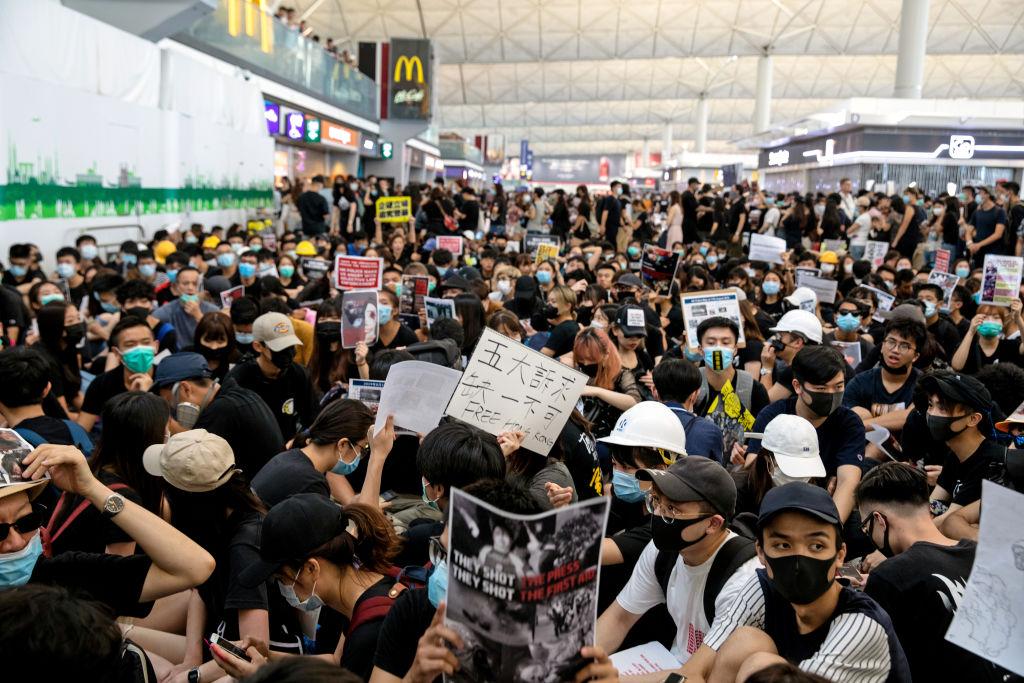
Demonstrators gather during a protest at the Hong Kong International Airport in Hong Kong on Aug. 12. (Kyle Lam—Bloomberg via Getty Images)
Kyle Lam—Bloomberg via Getty Images

Beyond visibility, protesters see airports as “a de facto safer space,” Schaberg says. “You’re not going to have immediate political and military involvement,” he says. A street, on the other hand, “can be mortared or gassed, and be cleaned up the next day.”

Taking those factors into account, it’s easy to see why protesters around the world—despite their different grievances and constituencies—are ending up in the same place.

In February, protesters demanding the resignation of Haiti President Jovenel Moïse blocked access to the airport in Port-au-Prince, stranding hundreds of tourists.

In early 2017, tens of thousands of protests descended on airports in the U.S. for largely spontaneous, mass demonstrations against the Trump administration’s executive order preventing travelers from seven majority-Muslim countries from entering the country. 
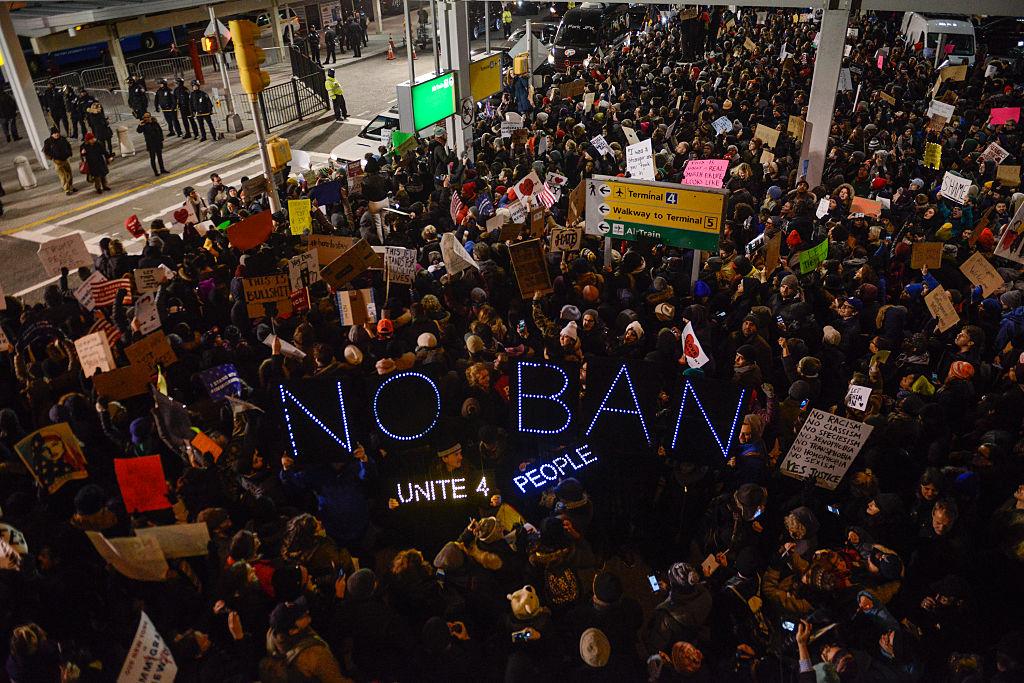
Protestors rally at John F. Kennedy International Airport in New York City in January 2017 after President Trump signed an executive order that halted refugees and residents from predominantly Muslim countries from entering the United States. (Stephanie Keith—Getty Images)
Stephanie Keith—Getty Images

Other protests have brought major U.K. airports to a standstill, including protests by Black Lives Matter in September 2016 at London City Airport and environmental campaigners Plane Stupid in July 2015 at London’s Heathrow Airport.

An airport’s drawbacks

But the airport venue does come with a downside. Because they’re usually privately-owned space, with many areas under tight security, there’s also a limit to how far into an airport protests can penetrate, Schaberg says.

In response to the protests, Hong Kong International Airport obtained an interim injunction to prevent people from “unlawfully and willfully obstructing or interfering with the proper use of HKIA,” which drew to an end to the demonstrations.

Despite their culmination, the Hong Kong airport protest seemed to take the city’s pro-Democracy movement to a new level, as news of disruption and flight cancellations zipped around the globe.

In that sense, the episode fits into how Schaberg sees the airport protest trend broadly: as mostly effective. “They dramatically interrupt what we think airports are for,” he says; utilitarian centers of transport and commerce with a population that’s never there for very long.

More must-read stories from Fortune:

—Vietnamese egg coffee is taking North America by storm–but what is it?
—Energy company earnings suffer in the gas glut era
—The U.S.-China trade war is forcing prunes to rebrand as a superfood
—The currency that’s quietly emerged as Asia’s safest bet
—Listen to our audio briefing, Fortune 500 Daily
Catch up with Data Sheet, Fortune’s daily digest on the business of tech.

About the Author
By Katherine Dunn
LinkedIn iconTwitter icon
See full bioRight Arrow Button Icon

Latest in

Finance
Lorem ipsum dolor sit amet, consectetur adipiscing elit, sed do eiusmod tempor incididunt ut labore et dolore magna aliqua. Ut enim ad minim veniam
By Fortune Editors
October 20, 2025
Finance
Lorem ipsum dolor sit amet, consectetur adipiscing elit, sed do eiusmod tempor incididunt ut labore et dolore magna aliqua. Ut enim ad minim veniam
By Fortune Editors
October 20, 2025
Finance
Lorem ipsum dolor sit amet, consectetur adipiscing elit, sed do eiusmod tempor incididunt ut labore et dolore magna aliqua. Ut enim ad minim veniam
By Fortune Editors
October 20, 2025
Finance
Lorem ipsum dolor sit amet, consectetur adipiscing elit, sed do eiusmod tempor incididunt ut labore et dolore magna aliqua. Ut enim ad minim veniam
By Fortune Editors
October 20, 2025
Finance
Lorem ipsum dolor sit amet, consectetur adipiscing elit, sed do eiusmod tempor incididunt ut labore et dolore magna aliqua. Ut enim ad minim veniam
By Fortune Editors
October 20, 2025
Finance
Lorem ipsum dolor sit amet, consectetur adipiscing elit, sed do eiusmod tempor incididunt ut labore et dolore magna aliqua. Ut enim ad minim veniam
By Fortune Editors
October 20, 2025

Most Popular

Finance
Lorem ipsum dolor sit amet, consectetur adipiscing elit, sed do eiusmod tempor incididunt ut labore et dolore magna aliqua. Ut enim ad minim veniam
By Fortune Editors
October 20, 2025
Finance
Lorem ipsum dolor sit amet, consectetur adipiscing elit, sed do eiusmod tempor incididunt ut labore et dolore magna aliqua. Ut enim ad minim veniam
By Fortune Editors
October 20, 2025
Finance
Lorem ipsum dolor sit amet, consectetur adipiscing elit, sed do eiusmod tempor incididunt ut labore et dolore magna aliqua. Ut enim ad minim veniam
By Fortune Editors
October 20, 2025
Finance
Lorem ipsum dolor sit amet, consectetur adipiscing elit, sed do eiusmod tempor incididunt ut labore et dolore magna aliqua. Ut enim ad minim veniam
By Fortune Editors
October 20, 2025
Finance
Lorem ipsum dolor sit amet, consectetur adipiscing elit, sed do eiusmod tempor incididunt ut labore et dolore magna aliqua. Ut enim ad minim veniam
By Fortune Editors
October 20, 2025
Finance
Lorem ipsum dolor sit amet, consectetur adipiscing elit, sed do eiusmod tempor incididunt ut labore et dolore magna aliqua. Ut enim ad minim veniam
By Fortune Editors
October 20, 2025
Fortune Secondary Logo
Rankings
  • 100 Best Companies
  • Fortune 500
  • Global 500
  • Fortune 500 Europe
  • Most Powerful Women
  • World's Most Admired Companies
  • See All Rankings
  • Lists Calendar
Sections
  • Finance
  • Fortune Crypto
  • Features
  • Leadership
  • Health
  • Commentary
  • Success
  • Retail
  • Mpw
  • Tech
  • Lifestyle
  • CEO Initiative
  • Asia
  • Politics
  • Conferences
  • Europe
  • Newsletters
  • Personal Finance
  • Environment
  • Magazine
  • Education
Customer Support
  • Frequently Asked Questions
  • Customer Service Portal
  • Privacy Policy
  • Terms Of Use
  • Single Issues For Purchase
  • International Print
Commercial Services
  • Advertising
  • Fortune Brand Studio
  • Fortune Analytics
  • Fortune Conferences
  • Business Development
  • Group Subscriptions
About Us
  • About Us
  • Press Center
  • Work At Fortune
  • Terms And Conditions
  • Site Map
  • About Us
  • Press Center
  • Work At Fortune
  • Terms And Conditions
  • Site Map
  • Facebook icon
  • Twitter icon
  • LinkedIn icon
  • Instagram icon
  • Pinterest icon

Latest in

ravi
CommentaryWeather and forecasting
I spent 8 years flood-proofing a city. Capital markets are running out of time to take El Niño seriously
By Ravi S. BhallaJune 13, 2026
2 hours ago
herrin
CommentaryInfrastructure
America just committed $1.2 trillion to fix its infrastructure. We’re still flying blind
By Gregg HerrinJune 13, 2026
4 hours ago
Melinda French Gates’ advice to new IPO millionaires: ‘Give half your money away’
Startups & VentureMost Powerful Women
Melinda French Gates’ advice to new IPO millionaires: ‘Give half your money away’
By Emma HinchliffeJune 13, 2026
5 hours ago
Aravind Srinivas wearing glasses
SuccessBillionaires
CEO of $20 billion AI firm Perplexity says the secret to success is ‘sleeping with that fear’ that your competitor will steal your idea
By Preston ForeJune 13, 2026
5 hours ago
Jamie Dimon says remote work breeds ‘rope-a-dope politics’ and stunts young workers’ growth
Successchief executive officer (CEO)
Jamie Dimon says remote work breeds ‘rope-a-dope politics’ and stunts young workers’ growth
By Marco Quiroz-GutierrezJune 13, 2026
5 hours ago
cyber
Commentarycyber
Accenture cyber leads: why hiring more people won’t solve the cybersecurity talent gap
By Harpreet Sidhu and Vikram DesaiJune 13, 2026
5 hours ago

Most Popular

Corporate America has been draining the world's water. Matt Damon's new campaign calls on Gap, Starbucks, and Amazon to help give it back
Environment
Corporate America has been draining the world's water. Matt Damon's new campaign calls on Gap, Starbucks, and Amazon to help give it back
By Catherina GioinoJune 9, 2026
4 days ago
When SpaceX starts trading, some 'shareholders' will discover they own nothing at all
Investing
When SpaceX starts trading, some 'shareholders' will discover they own nothing at all
By Jim EdwardsJune 12, 2026
1 day ago
Current price of oil as of June 12, 2026
Personal Finance
Current price of oil as of June 12, 2026
By Joseph HostetlerJune 12, 2026
1 day ago
American taxpayers have spent $33 billion on sports stadiums. They got fewer seats—and higher prices
Success
American taxpayers have spent $33 billion on sports stadiums. They got fewer seats—and higher prices
By Catherina GioinoJune 11, 2026
2 days ago
U.S. energy secretary says 7 million barrels of oil exiting Persian Gulf daily, but Chevron CEO rebuts the claim
Energy
U.S. energy secretary says 7 million barrels of oil exiting Persian Gulf daily, but Chevron CEO rebuts the claim
By Jordan BlumJune 12, 2026
19 hours ago
Anthropic disables Fable and Mythos AI models after U.S. government bars it from giving foreigners access
AI
Anthropic disables Fable and Mythos AI models after U.S. government bars it from giving foreigners access
By Jeremy KahnJune 13, 2026
10 hours ago

© 2026 Fortune Media IP Limited. All Rights Reserved. Use of this site constitutes acceptance of our Terms of Use and Privacy Policy | CA Notice at Collection and Privacy Notice | Do Not Sell/Share My Personal Information
FORTUNE is a trademark of Fortune Media IP Limited, registered in the U.S. and other countries. FORTUNE may receive compensation for some links to products and services on this website. Offers may be subject to change without notice.