James Bond is famous, among other things, for getting out of tight corners. He might want to share some tips with his favorite carmaker.
Aston Martin Lagonda’s shares have lost half their value in the last month after the company was forced to cut its production forecast for this year by nearly 10%, reflecting an economic slowdown that had left dealers with too many cars in their showrooms.
The news led ratings company Moody’s to cut its rating on the company’s bonds deep into junk territory, which implies a high risk of default. Moody’s analyst Tobias Wagner cited the company’s high leverage and weak cash flow, and the low chance of meaningful improvement by next year.
With the balance sheet already stretched, the company can ill afford any further slowdown in sales, which seems the default scenario given the global economic slowdown.
That has all combined to make the Gaydon, U.K.-based carmaker’s stock the worst performing in the European auto sector this year.

Brexit, trade wars, and a new SUV
The company’s woes are both home-made and external. It can be criticized for a 19 million pound write-down on consulting work it booked for another car marker, Detroit Electric, that it boasted of last year. DE was already experiencing financial difficulties, and now AML acknowledges the funds are highly unlikely to materialize.
But it can’t be blamed for the global slowdown that has badly hit car markets everywhere this year.
Nor can it be blamed for Brexit, which has forced it into an extensive and time-consuming rejig of its supply chain to ensure that its cars meet the threshold to be counted as “British” once the U.K. is no longer in the EU’s Single Market. After Brexit, 55% of a British product will have to be sourced locally for it to earn the domestic label, according to the World Trade Organization’s rules of origin.
Equally, few quibble with AML’s product mix of core models spiced up by short-run special editions, such as the $3.2 million Valkyrie or the immortal DB5, instantly recognizable from Bond films Goldfinger and Skyfall.
But AML’s future now depends to an alarming degree on a successful debut next spring for the DBX, the company’s first-ever SUV. It’s being built by a freshly-hired and trained workforce, at a factory that has only just opened its gates. That combination is challenging for a company that has to deliver near-perfect quality to stay competitive, although the project has so far been delivered on schedule and on budget. Overall, CEO Andy Palmer wants to more than double production to 14,000 cars a year within a decade.
“The number of new models to be launched and the target to increase manufacturing volumes looked to be conflicting goals,” said John Colley, associate dean at Warwick Business School.
A luxury IPO
Things would not look so bad today, Colley suggested in e-mailed comments, had its private equity owners based in Kuwait and Italy attracted fresh equity into the business at its IPO in October, strengthening its balance sheet, instead of merely cashing out their own investments.

At the time, Aston Martin had evoked the success of Ferrari, whose shares have tripled since Fiat Chrysler spun it off in 2015. Ferrari, too, had started out with a weak cash position but has proved itself capable of servicing that debt, generating over $3 billion in operating cash flow in the last three years.
But Ferrari’s brand, which stretches beyond automobiles, has more punch than Aston Martin’s: revenue from licensing and merchandise makes up around 14% of Ferrari’s total revenues. The comparable figure for AML, although it’s growing fast, is only 3.3%.
“The investors tried to sell [AML] as a luxury goods business to achieve a higher multiple on the sale price,” Colley said. “However, Aston Martin is clearly a luxury car business which occasionally lets others use their name.”
The difference is important: carmakers as a group trade at less than eight times earnings, according to data compiled by Investing.com, whereas Europe’s luxury goods industry trades at over 23 times. Ferrari has successfully escaped the car bracket, currently trading at 25.7 times earnings, having risen over 60% year-to-date.
However, analysts at Credit Suisse say that AML’s brand is less of an issue than its still-too-high dependence on the U.K. and Europe.
“If AML had Porsche’s geographical mix, second-quarter sales would be up 21%,” everything else being equal, they argued. As it was, despite more than doubling sales in China, overall sales were up only 4% from a year earlier.
Trouble ahead
The sellers also chose their moment expertly: AML came to market on the back of its only profit in the last four years, at a moment before the U.S.-China trade war had fed through into hard evidence of a global slowdown. Even so, many investors kept their distance, seeing the writing on the wall.
“Last autumn, a lot of the risks we’re now seeing materialize were already visible,” said Wolf Ingomar Faecks, transportation lead at consultancy Publicis Sapient in Munich.
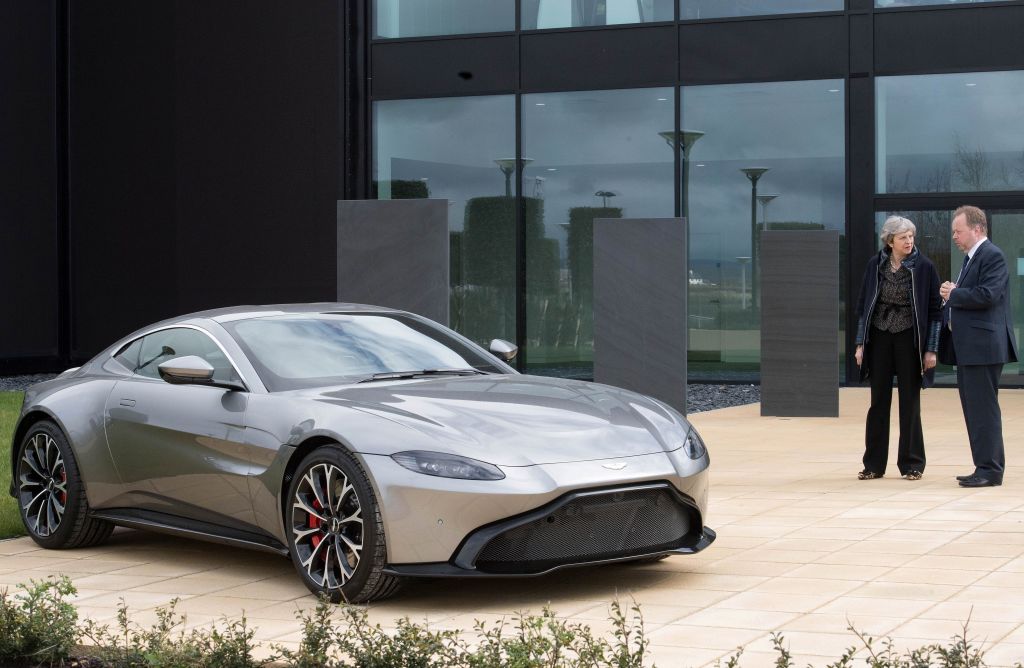
Faecks, who sees the next six to nine months as a make-or-break period for AML, considers it particularly exposed to the current slowdown, given its status as a standalone car business—and a small one at that—unable to afford big investments into electric motor technology or autonomous driving capacities on its own. Such strategic weaknesses go some way to explaining the company’s diversification into SUVs and its aim of more than doubling production to 14,000 within a decade.
But even if Aston Martin gets through the next year (despite the warning signals from the bond market, management says it would rather borrow again than ask shareholders for more money), it may still be too late to save relations with investors completely, warns Ana Nicholls, lead transport analyst with the Economist Intelligence Unit. The shares have lost three-quarters of their value inside 10 months, after all.
“At a company level,” she said, “it’s quite difficult to restore your reputation when your shares have seen that kind of slump.”
More must-read stories from Fortune:
—Vietnamese egg coffee is taking North America by storm–but what is it?
—Energy company earnings suffer in the gas glut era
—The U.S.-China trade war is forcing prunes to rebrand as a superfood
—The currency that’s quietly emerged as Asia’s safest bet
—Listen to our audio briefing, Fortune 500 Daily
Catch up with Data Sheet, Fortune’s daily digest on the business of tech.