• Home
  • News
  • Fortune 500
  • Tech
  • Finance
  • Leadership
  • Lifestyle
  • Rankings
  • Multimedia
Finance

Stocks, Bonds Are in Sync as They Rise Higher—at Least for Now

By
Ben Carlson
Ben Carlson
Down Arrow Button Icon
By
Ben Carlson
Ben Carlson
Down Arrow Button Icon
July 3, 2019, 10:46 AM ET

Stocks and bonds are moving higher together — for now.

The huge market gains in the first part of 2019 aren’t guaranteed to stick for the remainder of the year. But one thing is certain: It’s not out of the ordinary for stocks and bonds to rise in concert with one another. 

Through the end of June, the S&P 500 was up 18.5% in 2019. The Bloomberg Barclays U.S. Aggregate Bond Index, a proxy for the broad U.S. bond market, was up 6.1% at the halfway point of the year. A simple 60/40 mix of U.S. stocks and bonds returned 13.6% through the first six months of the year, the best start for this portfolio since the first half of 1997.

In fact, going back to the inception of the Aggregate Bond Index in 1976, this was just the eleventh time a 60/40 portfolio of stocks and bonds began the first half of the year up double digits.

It may seem odd to some investors that both stocks and bonds could be up so much at the same time. Yet, since 1976, stocks and bonds have both gained in the same calendar year in 32 out of 43 years. We can take things back even further using data on 5-year treasury bonds. Since World War II, U.S. stocks and bonds have seen positive returns in 50 out of 74 years or roughly two-thirds of the time.

This relationship might not make sense to those who assume stocks and bonds should move in different directions but the whole point of diversification is to combine assets that act differently during various market environments. The problem is investors often confuse how to think about correlations within a portfolio. Most investors assume you want to own negatively correlated investments that move in opposite directions. But what you really want is assets that have a positive expected return profile with correlations that change over time depending on the market environment.

A correlation of 1.0 implies that when one asset rises so does the other asset while a correlation of -1.0 implies when one asset rises the other one falls. A correlation close to zero implies little relationship in price movements, which is exactly what things look like for stocks and bonds over the long haul. Since 1945, the S&P 500 and 5-year treasuries have a correlation of -0.1, meaning there is little relationship in how they perform. But this relationship changes over time as you can see from the rolling 3-year correlation numbers:
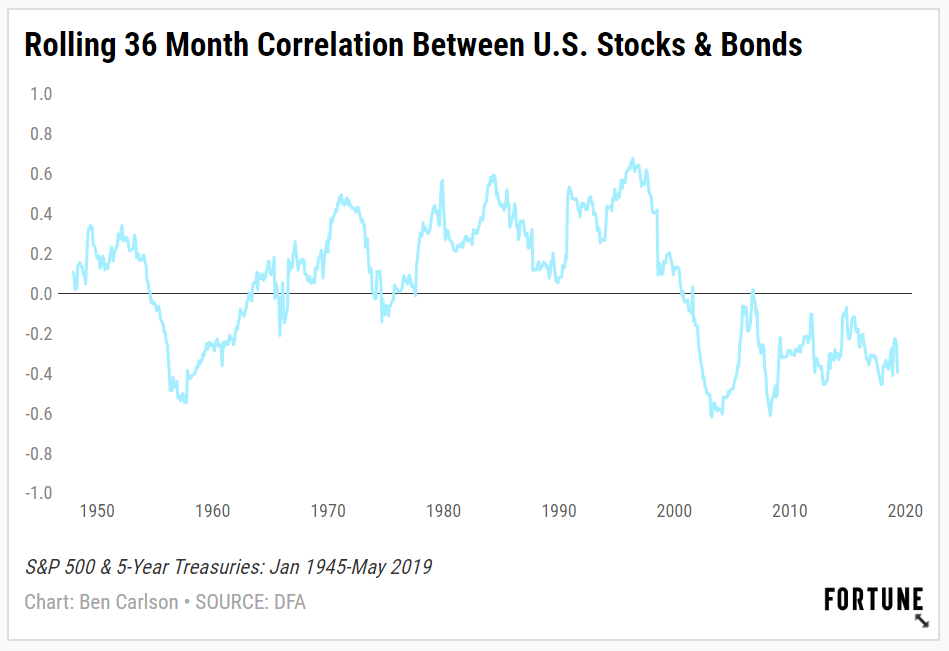
The relationship between stocks and bonds is anything but static, like nearly everything else in the financial markets but this is actually a good thing. The true time for bonds to shine in a portfolio is not when stocks are up but when they’re down, which is the only time you want that negative correlation to kick in.

Since 1945, the S&P 500 has been down in 16 out of 74 years, with an average loss of -11.7%. In those down years, 5-year treasuries were positive 15 out of 16 times, with an average gain of 6.2%. The last time stocks and bonds were down in the same year was 1969, when the S&P fell more than 8% while 5-year treasuries were down less than 1%.
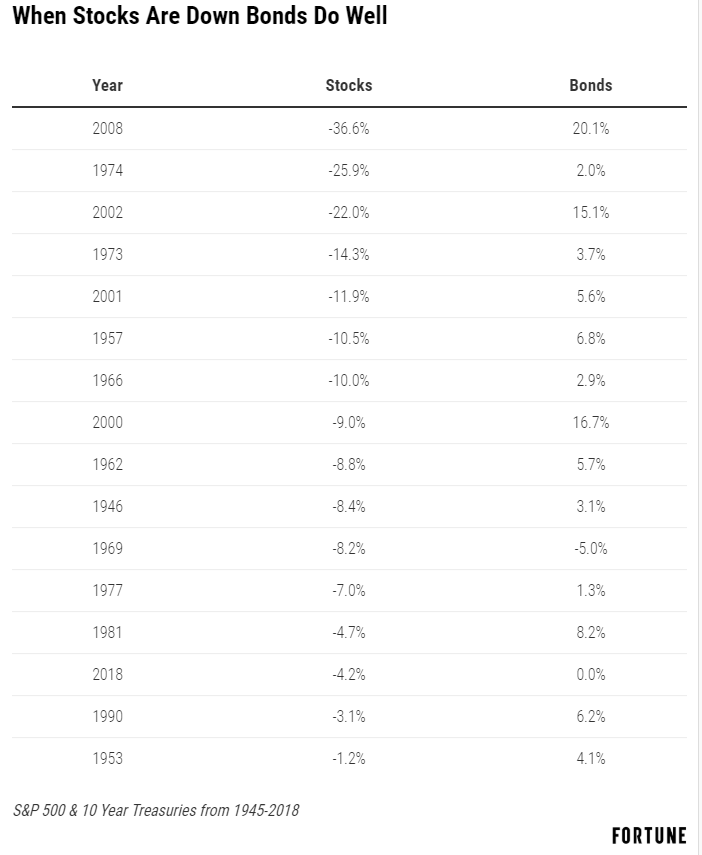
This is when bonds prove their worth in a portfolio, offering investors stability during times of volatility and the ability to rebalance into falling stocks or use bond proceeds for spending needs.

The first half of 2019 was about as good as it gets for investors in U.S. stocks and bonds. That won’t last forever. The good news is when the inevitable setback occurs in stocks, bonds tend to provide some shelter from the storm.

More must-read stories from Fortune:

—What Jony Ive’s departure means for Apple’s stock

—4 reasons to be skeptical about Facebook’s Libra cryptocurrency

—Bank of America CEO: “We want a cashless society”

—Will Facebook’s Libra become the go-to payment system where banks fall short?

—Listen to our new audio briefing, Fortune 500 Daily

Follow Fortune on Flipboard to stay up-to-date on the latest news and analysis.

About the Author
By Ben Carlson
See full bioRight Arrow Button Icon

Latest in Finance

RetailConsumer Spending
U.S. consumers are so financially strained they put more than $1 billion on buy-now, pay later services during Black Friday and Cyber Monday
By Jeena Sharma and Retail BrewDecember 5, 2025
14 hours ago
Elon Musk
Big TechSpaceX
Musk’s SpaceX discusses record valuation, IPO as soon as 2026
By Edward Ludlow, Loren Grush, Lizette Chapman, Eric Johnson and BloombergDecember 5, 2025
14 hours ago
data center
EnvironmentData centers
The rise of AI reasoning models comes with a big energy tradeoff
By Rachel Metz, Dina Bass and BloombergDecember 5, 2025
14 hours ago
Personal FinanceLoans
5 ways to use a home equity line of credit (HELOC)
By Joseph HostetlerDecember 5, 2025
14 hours ago
Netflix
InvestingAntitrust
Netflix–Warner Bros. deal sets up $72 billion antitrust test
By Josh Sisco, Samuel Stolton, Kelcee Griffis and BloombergDecember 5, 2025
14 hours ago
Schumer
Politicsnational debt
‘This is a bad idea made worse’: Senate Dems’ plan to fix Obamacare premiums adds nearly $300 billion to deficit, CRFB says
By Nick LichtenbergDecember 5, 2025
14 hours ago

Most Popular

placeholder alt text
Economy
Two months into the new fiscal year and the U.S. government is already spending more than $10 billion a week servicing national debt
By Eleanor PringleDecember 4, 2025
2 days ago
placeholder alt text
Success
‘Godfather of AI’ says Bill Gates and Elon Musk are right about the future of work—but he predicts mass unemployment is on its way
By Preston ForeDecember 4, 2025
2 days ago
placeholder alt text
Success
Nearly 4 million new manufacturing jobs are coming to America as boomers retire—but it's the one trade job Gen Z doesn't want
By Emma BurleighDecember 4, 2025
2 days ago
placeholder alt text
Success
Nvidia CEO Jensen Huang admits he works 7 days a week, including holidays, in a constant 'state of anxiety' out of fear of going bankrupt
By Jessica CoacciDecember 4, 2025
2 days ago
placeholder alt text
Real Estate
‘There is no Mamdani effect’: Manhattan luxury home sales surge after mayoral election, undercutting predictions of doom and escape to Florida
By Sasha RogelbergDecember 4, 2025
2 days ago
placeholder alt text
Big Tech
Mark Zuckerberg rebranded Facebook for the metaverse. Four years and $70 billion in losses later, he’s moving on
By Eva RoytburgDecember 5, 2025
18 hours ago
Rankings
  • 100 Best Companies
  • Fortune 500
  • Global 500
  • Fortune 500 Europe
  • Most Powerful Women
  • Future 50
  • World’s Most Admired Companies
  • See All Rankings
Sections
  • Finance
  • Leadership
  • Success
  • Tech
  • Asia
  • Europe
  • Environment
  • Fortune Crypto
  • Health
  • Retail
  • Lifestyle
  • Politics
  • Newsletters
  • Magazine
  • Features
  • Commentary
  • Mpw
  • CEO Initiative
  • Conferences
  • Personal Finance
  • Education
Customer Support
  • Frequently Asked Questions
  • Customer Service Portal
  • Privacy Policy
  • Terms Of Use
  • Single Issues For Purchase
  • International Print
Commercial Services
  • Advertising
  • Fortune Brand Studio
  • Fortune Analytics
  • Fortune Conferences
  • Business Development
About Us
  • About Us
  • Editorial Calendar
  • Press Center
  • Work At Fortune
  • Diversity And Inclusion
  • Terms And Conditions
  • Site Map

© 2025 Fortune Media IP Limited. All Rights Reserved. Use of this site constitutes acceptance of our Terms of Use and Privacy Policy | CA Notice at Collection and Privacy Notice | Do Not Sell/Share My Personal Information
FORTUNE is a trademark of Fortune Media IP Limited, registered in the U.S. and other countries. FORTUNE may receive compensation for some links to products and services on this website. Offers may be subject to change without notice.