The Democratic primary elections are a year away, and yet more than a dozen politicians with varying degrees of progressive ideals are vying for the 2020 Democratic nomination for president.
This may sound like a crowded ballot but, technically speaking, there are more than 200 Democratic candidates running for president in 2020. The Federal Election Commission requires any presidential potential to register their candidacy within 15 days of receiving or spending $5,000 or more, but some have registered without yet spending a dime.
Of course, not all of these candidates will be seen in debates. The Democratic National Committee has set guidelines to limit its debates to 20 participants: only those who register at least 1% support in three polls or raise funds from at least 65,000 unique donors (with a minimum of 200 per state in at least 20 states) are eligible to debate. In the event more than 20 candidates qualify, those meeting both thresholds will be favored for participation.
March measurements aggregated by RealClearPolitics show former Vice President Joe Biden leading in every poll, with Vermont Sen. Bernie Sanders often not far behind—the two are equally favored in an Emerson survey. This is despite the fact that Biden has yet to officially announce his candidacy, although he’s teased the possibility for months now.
California Sen. Kamala Harris, former Texas congressman Beto O’Rourke, Massachusetts Sen. Elizabeth Warren, and New Jersey Sen. Cory Booker are similarly well-known for their political careers, successful stumping, or fiery opinions. There are many more, however, who tail the polls with sometimes less than 1%.
These are the 2020 Democratic candidates you might not have heard of before and their platforms.

Tom Steyer: The Billionaire Candidate
Billionaire philanthropist Tom Steyer joined the race for president in early July—just as Rep. Eric Swalwell dropped his candidacy—despite previously stating he was not running. A late addition to the ring, Steyer is not likely to qualify for July’s debates and is instead focused on reaching September’s audiences.
A former hedge fund manager, Steyer left investment in 2012 to focus on political action. He has since started NextGen America, a nonprofit focused on combating climate change and increasing youth participation in politics, and Need to Impeach, an organization pushing for the impeachment of President Donald Trump.
Steyer has no prior experience in elected office. This, plus his immense wealth, is likely to be the source of much criticism. While Forbes states Steyer’s net worth is currently $1.6 billion, the democrat has donated millions to political causes. He and his wife, Kathryn Taylor, are listed as second in all-time lifetime political donations by the Center for Responsive Politics. They’re also signees of the Giving Pledge, meaning they’ve dedicated themselves to donating half of their wealth to charitable causes throughout their lifetimes.
While it may be a source of controversy, Steyer’s wealth may also give him an advantage. A spokesman for his campaign told the New York Times that Steyer plans to spend “at least $100 million” on the race.
Steyer’s presidential campaign is focused on the issue of corporate interests controlling politics, much like Sens. Elizabeth Warren and Bernie Sanders. His website touts campaigns he’s aided, like securing California’s clean-air laws, closing corporate tax loopholes, and forcing tobacco companies to share in healthcare costs.
“If this is a banana republic with a few very, very rich people and everybody else living in misery – that’s a failure,” Steyer says in his campaign video. “Almost every single major intractable problem, at the back of it, you see a big money interest for whom stopping progress, stopping justice, is really important to their bottom line.”
Steyer also has a “21st Century Bill of Rights” that he says are five rights that should be consistently protected, regardless of who’s in the White House. They include the right to an equal vote, the right to clean air and clean water, the right to a quality public education, the right to a living wage, and the right to universal healthcare (although he wouldn’t eliminate private options).
While he has long been an advocate for tackling climate change, Steyer does not directly support the Green New Deal. Still, he has applauded it as a landmark document “that has been extremely successful about drawing attention to a gigantic problem and reframing it.”

Joe Sestak: The Accountability Candidate
Former Pennsylvania Representative Joe Sestak became the 24th Democrat to throw his hat into the presidential ring late June, just days before the first Democratic debate. A retired three-star Navy admiral, Sestak served two terms in the House before running an ultimately unsuccessful bid for Senate in 2010.
Sestak—whose candidacy was delayed due to the return of his young daughter’s brain cancer—is running under the slogan “accountability to America.” His platform stresses his military background and experience leading a majority Republican district.
“I wore the cloth of the nation for over 31 years in peace and war, from the Vietnam and Cold war eras, to Afghanistan and Iraq, and the emergence of China,” said Sestak in his announcement video.
As a House representative during the recession, Sestak said he and his team saved over 800 homes from foreclosure, expanded health services, and aided veterans.
He also reflected on times when the U.S. worked with allies to be an example of fair and just leadership, criticizing President Donald Trump’s decision to strain such ties: “By bringing together those that shared these values in multilateral organizations and agreements, we all became stronger, safer, healthier and more prosperous in our freedoms. And that is what really makes ‘America First.’”
Sestak also mentioned China’s “emerging global order” and the need to address climate change on a global scale. The base of Sestak’s platform is the lack of accountability in today’s government. He spoke about the mistakes that led to the Iraq war and the following recession and criticized leadership for its irresponsibility.
“It is this unaccountable leadership that is responsible for the lack of trust in America today that undermines our sense of national unity, of who we are and what we stand for,” said Sestak.
Sestak’s website outlines a detailed policy plan, including expanding the Affordable Care Act to add a public option. Although he doesn’t directly mention the Green New Deal, Sestak supports similar goals such as stopping fossil fuel subsidies, charging carbon polluters, empowering the EPA, and rejoining the Paris Accord.
He also supports family and medical leave, a woman’s right to choose, and a path to naturalization for undocumented immigrants “willing to pay back taxes, pass criminal background checks, prove gainful employment, and pass a basic English language test.” Sestak’s platform also addresses infrastructure, poverty, veteran rights, and more.
Marianne Williamson: The Holistic Leader
As the best-selling author of more than a dozen books, Williamson is not your typical politician. She’s been teaching, counseling, and writing based on the principles of the 1976 book A Course in Miracles—which she says promotes not any specific religion, but rather universal spiritual reflection—for 35 years.
Her political campaign calls for a “renewal of the spirit of our democracy,” and aims to tackle issues at the root. The platform laid out on her website includes many of the usual Democratic views: creating a path to citizenship for undocumented immigrants, protecting the LGBTQ+ community, ending gerrymandering, supporting Planned Parenthood, rejoining the Paris agreement, reforming the criminal justice system, tightening gun control, etc. She also supports middle-class tax cuts, the repealing of Trump’s 2017 corporate tax cuts, the Green New Deal, and Medicare-for-All.
Coming from a background of spiritual teaching and activism (Williamson founded Project Angel Food during the AIDs epidemic to bring food to home-bound patients), there are some aspects of Williamson’s platform that stray drastically from what other Democrats have suggested.
Williamson is aware of her policies’ uniqueness and her position as an outsider in the political field, however, writing on her campaign page, “Spiritual audiences haven’t always been happy with my political activism, and political audiences haven’t always been happy with my spiritual convictions, but the combination of the two is who I am.”
She has proposed new federal departments, including a Department of Childhood and Youth to address children’s needs in schools and a Department of Peacebuilding to advise the president on non-violent solutions. She also aims to revamp the public school system to provide more social and emotional learning to children, including lessons on “comparative religion” for the purpose of “spiritual enlightenment and to help ease religious strife.”
Williamson’s platform addresses the needs of Native American people, saying she will stop Keystone Pipeline construction and promote the protection of tribal sovereignty. She also calls for a $200 billion to $500 billion plan of reparations for slavery, proposing the formation of a council of African-American leaders to determine which programs will benefit from the funds over a 20-year span.
[fortune-brightcove videoid=6002603967001]
Andrew Yang: The Human-Centered Capitalist
Yang is another candidate with no experience as an elected politician. The son of immigrants, Yang first worked in a healthcare startup and ran an education company before founding Venture for America in 2011. This two-year fellowship program provides opportunities for recent graduates who want to work at a startup.
The lack of political experience doesn’t mean his campaign is lacking in policy, however. The entrepreneur has one of the most exhaustive platforms, with three main highlights: human-centered capitalism, universal basic income, and Medicare-for-All.
The first policy would translate into better regulation of corporations. Yang argues that human-centered capitalism puts more value on people than money. Thus he states a new currency called Digital Social Credit (which can be converted into dollars) should be rewarded to people and organizations who “drive significant social value.”
The second policy, universal basic income, is the driving factor of Yang’s campaign. He proposes every U.S. citizen over the age of 18 should receive $1,000 per month, regardless of income or employment status. This money would come from the consolidation of some welfare programs and the implementation of a 10% value-added tax, or a tax on the production of goods or services a business produces. Universal basic income is also expected to lead to fewer people needing emergency healthcare and welfare, and, according to Yang, will grow the economy by about $2.5 trillion by 2025.
Medicare-for-All, Yang’s third leading policy, is a major part of many Democrats’ platforms. Yang doesn’t stop there, however. He’s fully outlined his beliefs on his campaign website, covering everything from Daylight Saving Time (he’ll extend it) to police brutality (he’ll give every police officer in the U.S. a body camera). He even promises free marriage counseling for all and says the NCAA should pay its athletes.
Like most Democrats, Yang supports stricter gun laws, a path to citizenship for undocumented immigrants, the protection of net neutrality, and criminal justice reform. He also proposes increased forgiveness and payback plans for student debt, and supports the Green New Deal.
[fortune-brightcove videoid=6002603180001]
John Delaney: The Bipartisan Candidate
Delaney’s presidential campaign presents him as a trustworthy, bipartisan lawmaker. He was an entrepreneur prior to entering politics, but has served as one of Maryland’s representatives to Congress since 2012.
In an effort poised to attract moderates, Delaney has promised to only pass bipartisan legislation for the first 100 days of his presidency and debate Congress four times a year to maintain an open dialogue.
Otherwise he has a traditionally Democratic platform, calling for improved voting rights, affordable higher education, and comprehensive immigration reform. He’s also pledged to address the effects of artificial intelligence on the economy and double the earned income tax credit.
His $1 trillion infrastructure plan proposes raising the corporate tax rate to 25%, and he’s suggested a 100% excise tax on big pharmaceutical companies to balance drug prices globally. To aid rural America, Delaney said he’d provide loan forgiveness for students who live and work there for 10 years.
While he does not support the Green New Deal, Delaney has promised to rejoin the Paris agreement, implement a federal carbon tax, and invest in green infrastructure, renewable energy, and negative emissions technologies while ending fossil fuel subsidies. He supports universal healthcare while also maintaining private options.
In addressing minority populations, Delaney presented a “Commitment to Black America” that pledges to increase access to banking services, ensure minority entrepreneurs have opportunities for capital, and amend the criminal justice system. Delaney is also one of the many candidates who supports the Student Non-Discrimination Act, which protects those in the LGBTQ+ community.
[fortune-brightcove videoid=6009054977001]
Pete Buttigieg: The Millennial Mayor
This millennial mayor is probably the most well-known of the unknown candidates. Pete Buttigieg one of four Democrats former President Barack Obama named as promising political figures back in 2016 (Kamala Harris was another) and with an impressive academic resume, he represents the intellect many wish to see in the White House once again.
Buttigieg is currently in his eighth and final year as mayor of South Bend, Ind.—the same town where he grew up. He’s a former Oxford Rhodes Scholar and a Harvard graduate, proficient in seven different languages. The brains don’t lack brawn, however: Buttigieg was also a lieutenant in the U.S. Navy Reserve, and took seven months leave from his position as mayor to deploy to Afghanistan.
As a presidential candidate, Buttigieg has stressed the need to move away from the “politics of the past.” His campaign video highlights his relationship to younger voters: the generation of school shootings, post-9/11 war, economic immobility, climate change activism, immigration, and more. He supports the Green New Deal and Medicare-for-All.
Buttigieg says he helped to transform a dying South Bend, and would offer a “fresh start” for a national politics. As a married gay man, he would be the first openly homosexual U.S. president.
[fortune-brightcove videoid=6002611297001]
Tulsi Gabbard: The Aloha Candidate
Like Buttigieg, Gabbard has an impressive resume for someone of just 37 years. She was raised in an interfaith, interracial household and began serving in the Hawaii state legislature at the age of 21. She was deployed twice to the Mideast with the Hawaii Army National Guard, and then served on the Honolulu city council upon her return. Today, Gabbard is a major in the National Guard and a four-term Hawaiian representative in Congress.
Gabbard’s campaign invites the country to “stand united in the spirit of aloha” and work towards peace. She calls for an end to regime change wars and the start of a cooperative foreign policy, saying she can bring a “soldier’s principles” to the White House, including “dignity, honor, and respect.”
Aside from the focus on diplomacy, Gabbard’s platform is overall similar to many other Democrats. She’s not enthusiastic about the Green New Deal, but does promise to tackle climate change with green energy and infrastructure. She supports universal healthcare and criminal justice reform while promising to take on big pharmaceuticals and Wall Street.
[fortune-brightcove videoid=6009885473001]
John Hickenlooper: The Pragmatic Candidate
Hickenlooper’s career started out pretty far from politics. He was a geologist until he got laid off in the 1980s, and two years of unemployment led him to pursue entrepreneurship.
He went on to open a restaurant and brewery in Denver’s warehouse district. This turned into 15 different restaurants mostly across the Midwest, where Hickenlooper frequently worked with local governments to transform the downtown areas surrounding his business.
In 2003, Hickenlooper successfully ran for Denver mayor, and then went on to serve two terms as Colorado governor, leaving office in January 2019. As a presidential candidate, the former geologist presents himself as a pragmatic person who can get things done with a centrist platform.
He supports universal healthcare, but isn’t fully on board with Medicare-for-All. He thinks the Green New Deal sets “unachievable goals,” but supports legislation that tackles climate change and focuses on green energy (a position that diverges from his usual support for hydraulic fracturing).
Hickenlooper touts his successes in Colorado politics, including expanding healthcare, improving the economy, setting methane emission laws, and implementing stricter gun control laws. While his former offices show his potential, he may also be followed by scandal: a state ethics watchdog committee is investigating whether Hickenlooper accepted free jet rides as governor in violation of state rules. He says he either paid for the rides or the trip wasn’t relevant to his policy formation.
[fortune-brightcove videoid=6009059273001]
Jay Inslee: The Climate Change Candidate
The Intergovernmental Panel on Climate Change released a report in October 2018 warning urgent and drastic changes are needed if humans are to avoid the worst effects of climate change. Inslee, a longtime advocate for environmental action, is taking that threat seriously: his entire campaign is centered around the U.S. response on climate change.
“I’m the only candidate who will make defeating climate change our nation’s number one priority,” Inslee says in his campaign launch video, arguing a future of 100% renewable energy with a thriving green economy is possible.
Inslee’s career in public service began in 1985. He spent years in the House of Representatives and is now in his second term as governor of Washington State.
As governor, he created a paid family leave program, protected net neutrality, expanded healthcare, and preserved rights for all voters, including women and those of the LGBTQ+ community. He also supports universal healthcare, and in January introduced a “public option” for Washington residents. When Trump enacted a travel ban targeting several majority-Muslim nations, Washington was the first state to sue.
While he supports the conversation around the Green New Deal, Inslee has his own answer to our damaged environment. His plan, titled America’s Climate Mission, has four parts: creating an economy fueled by 100% clean energy and net-zero greenhouse gas pollution; fighting for environmental justice and economic inclusion; investing in good jobs, infrastructure, and innovation; and ending fossil fuel subsidies.
[fortune-brightcove videoid=6002601287001]
Amy Klobuchar: The Candidate of Opportunity
As the snow pummeled down on Minneapolis last February, Klobuchar—a third-term Minnesota Senator and former lawyer—announced her candidacy for president. Her speech stressed her regional roots and called for unity within the nation, inviting listeners to see “obstacles as our path” to the future.
Like many Democrats, Klobuchar supports the Voting Rights Act, reforming the criminal justice and immigration systems, closing tax loopholes, and tightening gun control. She also stresses the need to guarantee net neutrality and protect privacy online, promising to take on big tech companies and ensure every household has internet by 2022.
The internet goal is part of her $1 trillion infrastructure plan, which also aims to repair roads, modernize public transit, rebuild schools, increase energy efficiencies, and ensure clean water. Part of her plan to pay for this includes raising the corporate tax rate to 25%.
While she doesn’t specifically support the Green New Deal, Klobuchar promised to rejoin the Paris agreement on day one of her presidency. She also pledged to focus her first 100 days on reinstating clean energy regulations and investing in green jobs and infrastructure. While she’s also hesitant to agree to Medicare-for-All, Klobuchar supports universal healthcare and has plans to take on big pharmaceutical companies.
The senator’s bold, hardworking character is a hint that she will always get the job done—but there’s been reports she doesn’t treat her staff very well in the process. The New York Times wrote that Klobuchar once used a comb to eat a salad mid-flight after berating her staff for dropping the fork, then ordered the staff member to clean it. Klobuchar has admitted to being a “tough boss,” but attributes this to the high expectations she sets for herself.
[fortune-brightcove videoid=6019272037001]
Wayne Messam: The Clean-Slate Candidate
Messam has a plan higher education graduates will likely adore: a one-time erasure of all federal and private student loans. With total student debt well above $1 trillion, Messam argues completely freeing graduates of this burden would boost annual GDP between $86 billion and $108 billion while creating more than 1 million new jobs each year. This ambitious plan would be paid for in part by the rescinding of Trump’s 2017 tax cuts, says Messam.
As the mayor of Miramar, Fla., Messam is used to tackling big problems on a smaller scale: his city has passed a living wage, fought the oil industry, pledged support to the Paris agreement, protected immigrants, brought jobs back from China, and sued the state to overturn a law backed by the National Rifle Association.
Like some other politicians, his career began with business. Messam, the son of immigrants, founded an environmentally minded construction company with his wife, and then went on to become a city commissioner. Now he’s in his second term as the first black mayor of Miramar.
Aside from the student loan cancellation and a focus on gun control, Messam has not made many overt statements about his platform. He’s said he supports the “urgency and the end goal” of the Green New Deal, and plans to tackle the high costs of healthcare.
He has a point of trouble in his past, however, as the Broward Office of Inspector General investigated Messam during his 2015 mayoral race for questionable expenditures. The office closed the investigation after Messam refused to interview, but referred the matter to the Florida Elections Commission. The FEC has yet to make a public decision, according to the Center for Public Integrity.

Tim Ryan: The Blue-Collar Candidate
One of the most recent Democrat to throw their hat into the ring is Ryan, an Ohio representative since 2003. Ryan’s campaign, launched April 4, focuses on his Rust Belt roots. He grew up in Ohio with the majority of his family working in factories.
“A lot of people have been left behind,” Ryan says in his launch video.
While he represents a predominately red area and is playing off similar sentiments as Trump, Ryan is offering progressive solutions. He wants to help coal workers not by revitalizing a dying industry, but by providing green energy jobs “that are equivalent in wages and benefits,” Ryan told The Washington Post. He supports some version of the Green New Deal and Medicare-for-All.
As the New York Times writes, Ryan’s stances on gun control and abortion used to be more conservative, but have since shifted to align more closely with his Democratic peers.
[fortune-brightcove videoid=6024396219001]
Eric Salwell: The Gun Control Candidate
Salwell dropped out of the race on July 8, almost two weeks after the first Democratic primary debates.
This 38-year-old representative from California became the eighteenth Democrat to officially announce their candidacy for president Monday, running on a platform of gun control, healthcare, and education with the motto “Go big. Be bold. Do good.”
Salwell’s campaign video focuses on his Iowa roots, presenting him as a family man facing the same struggles as many millennials today. He was the first in his family to go to college, and with just under $100,000 in student loans, he proposed amendments to borrowing programs that will help “re-associate college with opportunity instead of crushing debt.”
He’s also family to law enforcement officers and the son of two Republicans (“Somehow we raised them all the same and one of them turns out to be a Democrat,” his mother chides in the campaign video), with experience bridging the partisan divide. A California representative since 2013, Salwell touted his many committee appointments and roles in the founding of both the United Solutions Caucus and the Democratic Future Forum.
He supports the usual Democratic ideals—voting rights, LGBTQ+ equality, immigration reform, etc.—but Salwell’s headlining issue is gun control. He supports universal background checks and laws to ensure those guilty of domestic violence don’t get guns. His most controversial proposal is probably the mandatory national ban and buyback of military-style semiautomatic assault weapons—something he says no other candidate is proposing.
Salwell promised that within his first 100 days as president, he’d address gun violence, amend the student debt crisis, and work towards Medicare-for-All. Salwell also expressed support of the Green New Deal.
[fortune-brightcove videoid=6002609706001]
Julián Castro: The Immigration Candidate
Castro is no stranger to the national stage, so chances are, you’ve probably heard his name before, but don’t know much about him. After serving as mayor of San Antonio from 2009 to 2014, he became the Secretary of Housing and Urban Development under Obama, where he focused on accessible housing, veteran homelessness, and the need for internet in public housing.
The grandchild of an immigrant and raised by a single mother, Castro’s main platform is his People First immigration policy. The program calls for changes most of the Democratic candidates support, including a path to citizenship for undocumented individuals and DREAMers (those who were brought to the U.S. illegally as children) and an end to President Donald Trump’s travel bans that many say were fueled by racial bias.
Castro also calls for increased refugee admissions, with adaptations to allow for those fleeing crises caused by climate change. He wants to reform Immigration and Customs Enforcement, end their use of detention (except in serious cases), and promote aid programs in Central America.
Outside of immigration, Castro supports the Green New Deal and Medicare-for-All. In his speech announcing his candidacy for president, Castro stressed the need to address police brutality against people of color and to reform the country’s criminal justice system. He implemented a universal pre-K program as mayor of San Antonio, and says he would aim to make it nationwide.
[fortune-brightcove videoid=6002605464001]
Kirsten Gillibrand: The #MeToo Candidate
Since being elected to the House of Representatives in 2006, Gillibrand has also made headlines as a champion for women. But here’s what else you should know about her:
Gillibrand moved from the House to the Senate in 2009, and shortly thereafter launched Off The Sidelines, a program dedicated to recruiting and supporting women candidates for higher office.
The New York senator has been a steadfast supporter of the #MeToo movement. She spoke out against former Sen. Al Franken, even when it wasn’t popular to do so, maintaining that there must be reparations for sexual misconduct no matter the political party. Despite this, a member of Gillibrand’s staff once quit over alleged mishandling of sexual harassment complaints. Gillibrand’s office said they had conducted a thorough investigation of the matter, but the ordeal has led to Gillibrand being criticized as hypocritical.
As a political candidate, Gillibrand comes across as a no-nonsense advocate for change. She supports both a Green New Deal and Medicare-for-All, and says she has introduced national paid family leave legislation every Congress since 2013. This, affordable child care, universal pre-K, and tax relief for middle-class and low-income families are all on her agenda.
The rest of her platform includes many Democratic norms, including support for the Voting Rights Act, a pathway to citizenship for DREAMers, tighter gun control, support for unions, and plans to address institutional racism and aid LGBTQ+ rights. She also proposes making community college tuition-free and eliminating tuition and fees at public four-year colleges for families that make up to $125,000 per year.
[fortune-brightcove videoid=6028755788001]
Seth Moulton: The Candidate of Service
Although he’s not the only veteran running for office, Moulton has shaped his campaign around his service in the Marines. In his campaign launch video, Moulton says that after four tours abroad, “I returned home and decided to run for Congress because I realized that a lot of Americans are feeling betrayed by Washington the same way that we did in Iraq.”
Now in his second term as a U.S. Representative from Massachusetts, the Harvard-educated politician is focusing his campaign on five main issues: national security, jobs, healthcare, climate change, and leadership.
“As a veteran of combat and of the Armed Services Committee in Washington, I will cut the massive weapons programs we don’t need so that we have the money to invest in the future,” says Moulton in his launch video. On his website, he expands on this, advocating for increased investment in a “smarter” military, including autonomous, hypersonic, and cyber weapons.
Moulton, a supporter of the Green New Deal, suggests investing in clean energy jobs and advanced infrastructure to build greater access to jobs and high-speed internet. He names climate change as the country’s largest challenge, second only to the changing economy. Moulton also promotes paid family leave policies and a tax system to help grow the middle class and small businesses. On gun control, he says “weapons of war have no place in our streets or in our schools.”
On healthcare, Moulton differs from some Democrats in that he’s not an advocate for the Medicare-for-All plan. He instead proposes offering a public option to give Americans a choice between public healthcare and private insurance, a situation he says would create competition and drive down costs.
In terms of leadership, Moulton says the Trump administration is guilty of “shredding our moral authority” as a nation.
“In training for the Marines, you could fail a test or you could fail a run—and you wouldn’t be sent home. But if you lied once, you were gone,” says Moulton’s campaign page. “That’s the same level of integrity we should demand from our leaders, particularly our commander-in-chief.”
He advocates for a new voting rights act that will pass automatic voter registration, stop gerrymandering, and confront voter suppression. Moulton also says he would get rid of the electoral college and the filibuster, “so no matter where you live or who you vote for, your vote matters.”
“I’m running because we have to beat Donald Trump,” says Moulton in his video, “and I want us to beat Donald Trump because I love this country.”
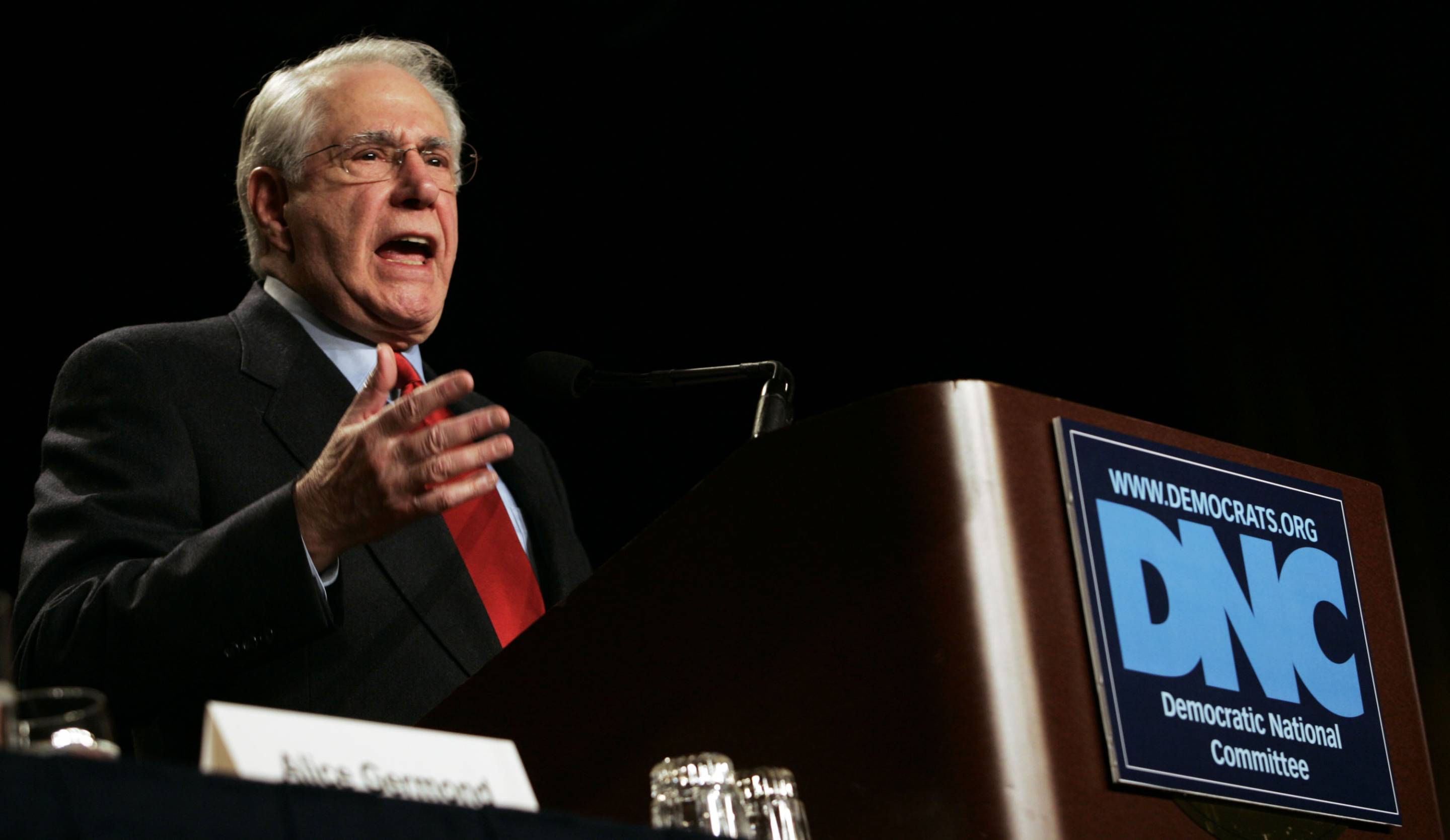
Mike Gravel: The Anti-War Rock-Thrower
Former Alaska Senator Gravel has centered his campaign around tearing down the political elite, who he says start wars to serve their “class interest.” His campaign page is headed with “War: What is it good for?”—a clear reference to the 1964 song by The Temptations—and a rapidly increasing count of what Gravel says has been spent on regime change wars since 2001.
As of May 1, the total was well over $5 trillion, or “enough to cover the full cost of tuition for every person wishing to enroll in community college in the United States,” reads the page.
At 88 years old, Gravel is by far the oldest candidate. While he served as Alaska senator from 1969 to 1981 and ran an unsuccessful bid for president in 2008, Gravel has not held office in over three decades. That, however, wasn’t the aim when his 2020 campaign started.
Gravel’s candidacy was started in late March by a group of teens who support his straightforward policies centered around limited foreign intervention and basic Democratic ideals. Gravel agreed to go along with the candidacy just to share his beliefs in the Democratic debates.
Now, however, Gravel is running to win.
“After extensive consideration and discussion,” Gravel tweeted Monday, “Sen. Gravel and the campaign have come to a decision: WE’RE RUNNING TO WIN FOLKS.” The accompanying video includes flashing letters and the word “win” in flames. It even includes a small dig at 2020 competitor Seth Moulton, implying the two have equal changes of winning the candidacy.
Gravel is certainly not afraid to speak out against his components. He’s called Joe Biden “Jailin’ Joe Biden” and berated former President Barack Obama for being friendly with foreign leaders with questionable human rights records.
Gravel’s campaign launch video begins with clips of other 2020 Democratic contenders speaking about the Green New Deal and Medicare-for-All, with an overlay of Gravel himself appearing disappointed in the background. The rest of the video cuts between clips of a younger Gravel debating on behalf of anti-war policies and the present-day Gravel throwing a large rock into a park river. The text aims to present Gravel as a no-nonsense candidate set on being the voice of justice.
The video, titled “Rock 2.0,” is an updated version of Gravel’s 2008 presidential campaign ad, in which he stares at the camera silently and then throws a rock into a body of water.
[fortune-brightcove videoid=6032308815001]
Michael Bennet: The Self-Declared Pragmatic Idealist
Bennet worked under 2020 contender and former Denver mayor John Hickenlooper as his chief-of-staff in the early 2000s. Now, however, the two are each running for the Democratic nomination with a platform focused on centrist ideals and economic development.
While the two-term Colorado Senator has been eyeing a 2020 bid for some time, Bennet’s candidacy was delayed by a prostate cancer diagnosis in April. After a successful surgery, however, Bennet said his illness only reaffirmed his desire to run for the White House.
“That gave me a chance to think about whether I really wanted to run or not,” he told CBS This Morning Thursday. “I think, like everyone else does, it’s a long shot. But I think everyone in the field is a long shot.”
A former Denver Public School superintendent turned senator, Bennet briefly became nationally known earlier this year when he broke his calm persona and berated Sen. Ted Cruz on the Senate floor for his “crocodile tears” over the partial government shutdown. Like Harris and Buttigieg, former President Barack Obama named Bennet as one of the up-and-coming Democrats to watch out for in 2016.
In his campaign launch video—titled “7,591 words,” for the number of words in the Constitution—Bennet acknowledges that aside from the aforementioned instances, he’s not well-known on the national stage.
“I didn’t go to Washington to get attention. I went to pay attention to what would help the people who sent me there make their lives better,” Bennet says in the video. “So you may not know me, but over the years I’ve learned a lot about what Americans struggle with.”
Bennet’s platform is focused on economic opportunity, American values, and broken politics. He says he’ll create new options for rural communities to grow the economy through zero-emissions energy, although he has not endorsed the Green New Deal. He aims to expand the Child Tax Credit to aid middle-class families, enact paid family and medical leave, and raise the minimum wage.
As opposed to Medicare-for-All, Bennet says he’ll introduce a public healthcare option called Medicare-X that increases competition and lowers costs while allowing people to keep their private insurance.
With the aim of “undoing the damage wrought by the Trump Administration,” Bennet says he will protect Dreamers, reverse the transgender military ban and the travel ban targeting many Muslim-majority nations, stop separating families at the border, and condemn bigotry. Like many Democrats, Bennet supports immigration, gun, and criminal justice reform. He also aims to overturn Citizens United, ban members of Congress from becoming lobbyists, and end gerrymandering.

Steve Bullock: The Champion Against Citizens United
Bullock—the two-term Montana governor, former state attorney general, and self-declared “expert at Dad jokes”—became the 22nd Democrat vying for the party’s nomination this week. As a progressive Democrat with ample support in a majority Republican state, Bullock’s campaign paints him as the best candidate to bridge the aisle and get dark money out of politics.
“As a Democratic governor of a state that Trump won by 20 points, I don’t have the luxury of just talking to people who agree with me,” says Bullock in his campaign launch video.
Despite having a largely Republican legislature, as governor Bullock has expanded Medicaid, frozen college tuition, protected net neutrality, and passed laws to protect the LGBTQ+ community. He says he’s also “racked up more vetoes than any other Montana governor in at least the last 42 years” by standing against Republican attacks on worker rights, civil rights, women’s rights, education, and the environment.
Although every Democratic candidate has opposed Citizens United, Bullock has made this issue the focal point of his campaign. He has a long history of opposing it as well. As attorney general, he fought Citizens United up to the Supreme Court, and lost. As governor, he has passed strict campaign disclosure laws and is suing the Trump administration over regulations allowing politically active nonprofits to hide donor identities.
On his website, under the heading “One Big Idea,” Bullock outlines his plan to tackle dark money in politics. On his first day in office, Bullock says he will sign an executive order requiring every company to disclose all electoral contributions if they are to do business with the federal government. From there, he says he will empower watchdogs, ban super PACs, and take steps towards overturning Citizens United. Bullock also supports the Disclose Act, which would ban campaign contributions from corporations that are “controlled, influenced, or owned by foreign nationals.”
Bullock’s wider platform is not yet fully available, but in general he seems to stand to the right of most of his peers in the 2020 Democratic ring. The New York Times reports that Bullock is not in favor of universal healthcare, although he does support the Affordable Care Act. He’s in favor of the Paris Agreement, but reportedly does not believe it’s possible to entirely reject fossil fuels in the short time period scientists have said is necessary. As both a gun owner and the uncle to a school shooting victim, Bullock approaches gun control from a moderate prospective. Still, he supports regulations similar to many other progressives: he wrote an op-ed last year coming out in support of background checks, red flag laws, a bump stock ban, and more.
One scandal may haunt Bullock, who says he champions women’s rights: a former senior aide of Bullock’s was fired over sexual harassment. Although Bullock knew the reason for his firing, the Times reports Bullock did not stop Mayor Bill de Blasio of New York from hiring him just weeks later. The man was later forced to resign from this position, after more women came forward with accusations of sexual harassment.
“I fell short in my role preventing sexual harassment,” Bullock later said, according to the Times. “I’m sorry, and I’m committed to doing much better.”