• Home
  • Latest
  • Fortune 500
  • Finance
  • Tech
  • Leadership
  • Lifestyle
  • Rankings
  • Multimedia
Commentaryclimate action

CEOs Need to Fill the Leadership Void on Climate Policy

By
Fred Krupp
Down Arrow Button Icon
By
Fred Krupp
Down Arrow Button Icon
February 21, 2019, 5:00 PM ET
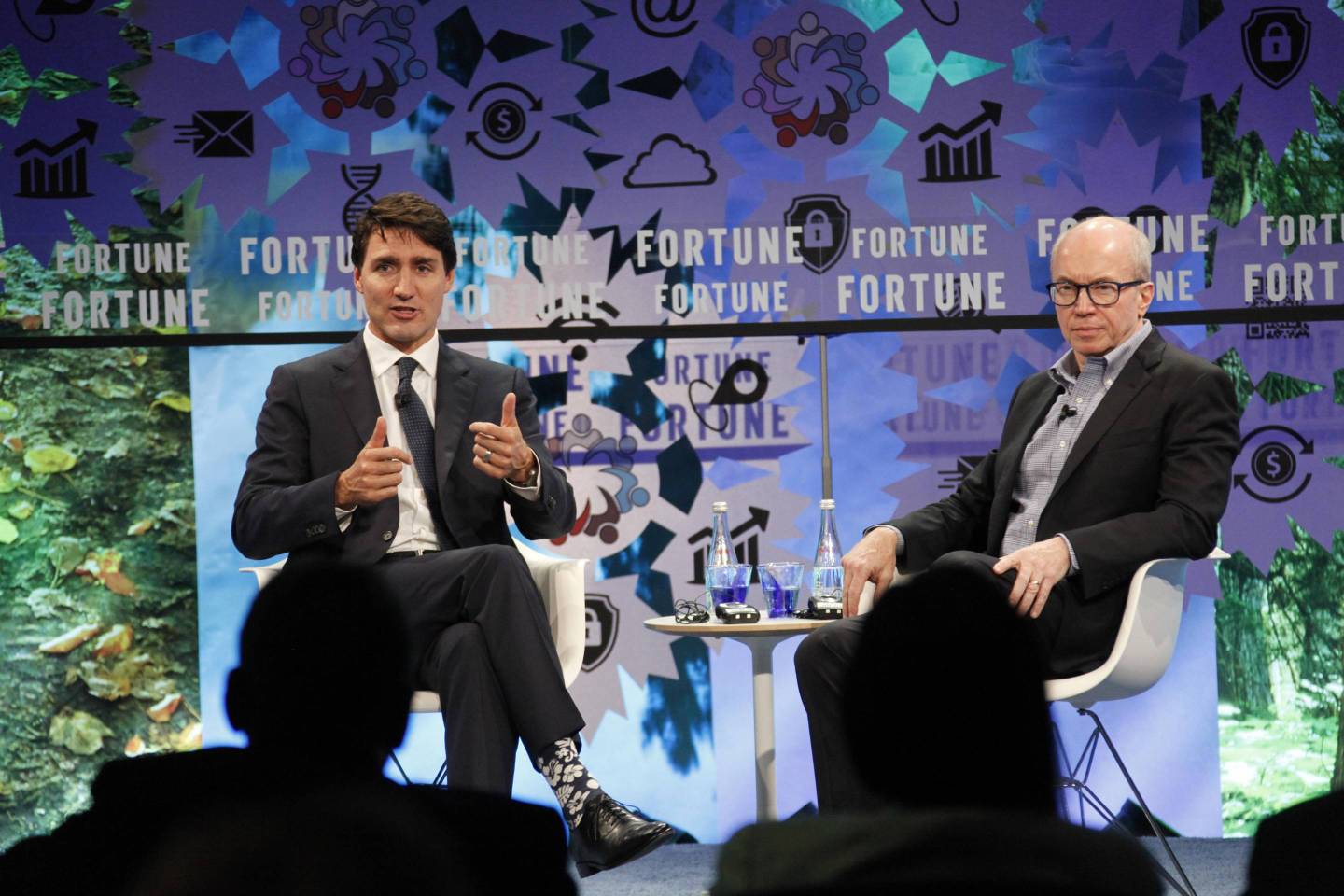
Canada's Prime Minister Justin Trudeau (L) receives an interview from Fortune CEO Alan Murray during last year's Fortune Global Forum.
Canada's Prime Minister Justin Trudeau (L) receives an interview from Fortune CEO Alan Murray during last year's Fortune Global Forum. Business leaders must build on the momentum started by the 2016 Fortune Global Forum and raise the bar on corporate sustainability, writes Fred Krupp. Yu Ruidong—China News Service/VCG via Getty ImagesYu Ruidong—China News Service/VCG via Getty Images

Business leaders know it’s no longer enough to simply post their company values online. CEOs need to publicly and visibly put those values to work because investors, employees, and customers now demand it. After 20,000 Google employees staged a walkout last November, for instance, the company overhauled its sexual harassment policies. When high school survivors of the Parkland massacre fostered a national debate on gun control, Walmart and Dick’s Sporting Goods increased restrictions on their retail firearm sales.

And in response to the current U.S. administration seeking to roll back critical environmental safeguards, business executives have started stepping up to fill the leadership void on climate policy.

An early sign of this new assertiveness came at the Fortune-Time Global Forum at the Vatican in December 2016, which I attended. I was heartened when the many participants—which included Fortune Global 500 CEOs as well as nonprofit organization and private sector delegates—committed to “helping governments everywhere implement the recent Paris Agreement on climate action,” and pledged “to deliver on our own public targets for reducing the carbon footprint of operations and supply chains.” It was an outcome described by then Fortune editor-in-chief Alan Murray “as a tipping point.”

And indeed it was. Last year, when the Trump administration proposed easing U.S. clean car standards, rules adopted in 2012 to reduce pollution from automobiles, Ford responded by stating they “support increasing clean car standards through 2025 and are not asking for a rollback.” James Verrier, CEO of BorgWarner at the time, a leading automotive component supplier, also said the industry had no intention of going backward. Additionally, last July, 34 businesses—including heavy-hitters like General Motors, Lyft, PG&E, and Shell—sent a public letter of thanks to Rep. Carlos Curbelo (R-Fla.) for introducing a bill to fund infrastructure investment while cutting climate pollution.

As the leader of an environmental organization, I might be expected to advocate for corporate sustainability above all else. However, in my view, businesses and the environment can—and must—thrive simultaneously. Like many Americans, corporate executives are coming to understand that we need to get serious about turning the corner on climate change. By 2050, the world will be home to some 9.8 billion people, all wanting more food, goods, and services that boost our economy while slapping a massive burden on the planet’s resources—and this growth cannot be sustained without a major shift in how we do business.

In order to raise the bar on corporate sustainability and build on the current momentum, there are four things business leaders must do.

First, business leaders must publicly commit to a future where both business and nature can prosper. CEOs must set aggressive, sustainability targets, work hard to achieve them, and communicate on progress. To that effect, 169 companies have set science-based targets on reducing greenhouse emissions and 165 companies have committed to source 100% of their global electricity consumption from renewable sources. Xcel Energy, a major electricity company, also recently switch to 100% carbon-free electricity by 2050.

Second, businesses need to partner across industries and global supply chains to deliver impact on a transformative scale. Project Gigaton is one example: It’s a collaboration between Walmart, environmental groups, and global suppliers that seeks to cut a billion tons of carbon pollution from the company’s global supply chain. Additionally, a coalition of major consumer product companies including Procter & Gamble, Nestlé, PepsiCo, and Unilever recently announced the zero-waste Loop platform to address the root cause of plastic waste by providing recyclable containers.

Third, business leaders must advocate for smart environmental policy. Taking steps to reduce the carbon footprint of your business is critical—but it isn’t enough. Corporate executives must also publicly engage on environmental policy, weigh in on climate debates at all levels, and ensure their policy stances reinforce their corporate sustainability standards. For instance, Danone, Mars, Nestlé, and Unilever co-founded the Sustainable Food Policy Alliance, a group formed specifically to advocate for public policies consistent with their environmental goals. These companies also filed a joint comment supporting the Clean Power Plan in response to the Trump administration’s decision to repeal it.

Fourth, business leaders must accelerate environmental innovation. From severe weather events and diminishing natural resources to power and supply chain disruptions, the impacts of climate change are costly. Disruptive technologies give business leaders a chance to scale solutions to their companies’ most urgent environmental challenges: For example, the oil and gas industry is exploring predictive analytics and remote sensors to manage harmful methane leaks from their operations.

While business leaders are making progress on sustainability, by necessity, the bar must be raised. With the right leadership from the corporate sector, I believe the pressure will be on the federal government to address climate policy but, in the meantime, CEOs must continue to step up. Our environmental and economic future depends on it.

Fred Krupp is president of the Environmental Defense Fund.

About the Author
By Fred Krupp
See full bioRight Arrow Button Icon

Latest in Commentary

Finance
Lorem ipsum dolor sit amet, consectetur adipiscing elit, sed do eiusmod tempor incididunt ut labore et dolore magna aliqua. Ut enim ad minim veniam
By Fortune Editors
October 20, 2025
Finance
Lorem ipsum dolor sit amet, consectetur adipiscing elit, sed do eiusmod tempor incididunt ut labore et dolore magna aliqua. Ut enim ad minim veniam
By Fortune Editors
October 20, 2025
Finance
Lorem ipsum dolor sit amet, consectetur adipiscing elit, sed do eiusmod tempor incididunt ut labore et dolore magna aliqua. Ut enim ad minim veniam
By Fortune Editors
October 20, 2025
Finance
Lorem ipsum dolor sit amet, consectetur adipiscing elit, sed do eiusmod tempor incididunt ut labore et dolore magna aliqua. Ut enim ad minim veniam
By Fortune Editors
October 20, 2025
Finance
Lorem ipsum dolor sit amet, consectetur adipiscing elit, sed do eiusmod tempor incididunt ut labore et dolore magna aliqua. Ut enim ad minim veniam
By Fortune Editors
October 20, 2025
Finance
Lorem ipsum dolor sit amet, consectetur adipiscing elit, sed do eiusmod tempor incididunt ut labore et dolore magna aliqua. Ut enim ad minim veniam
By Fortune Editors
October 20, 2025

Most Popular

Finance
Lorem ipsum dolor sit amet, consectetur adipiscing elit, sed do eiusmod tempor incididunt ut labore et dolore magna aliqua. Ut enim ad minim veniam
By Fortune Editors
October 20, 2025
Finance
Lorem ipsum dolor sit amet, consectetur adipiscing elit, sed do eiusmod tempor incididunt ut labore et dolore magna aliqua. Ut enim ad minim veniam
By Fortune Editors
October 20, 2025
Finance
Lorem ipsum dolor sit amet, consectetur adipiscing elit, sed do eiusmod tempor incididunt ut labore et dolore magna aliqua. Ut enim ad minim veniam
By Fortune Editors
October 20, 2025
Finance
Lorem ipsum dolor sit amet, consectetur adipiscing elit, sed do eiusmod tempor incididunt ut labore et dolore magna aliqua. Ut enim ad minim veniam
By Fortune Editors
October 20, 2025
Finance
Lorem ipsum dolor sit amet, consectetur adipiscing elit, sed do eiusmod tempor incididunt ut labore et dolore magna aliqua. Ut enim ad minim veniam
By Fortune Editors
October 20, 2025
Finance
Lorem ipsum dolor sit amet, consectetur adipiscing elit, sed do eiusmod tempor incididunt ut labore et dolore magna aliqua. Ut enim ad minim veniam
By Fortune Editors
October 20, 2025
Rankings
  • 100 Best Companies
  • Fortune 500
  • Global 500
  • Fortune 500 Europe
  • Most Powerful Women
  • Future 50
  • World’s Most Admired Companies
  • See All Rankings
Sections
  • Finance
  • Leadership
  • Success
  • Tech
  • Asia
  • Europe
  • Environment
  • Fortune Crypto
  • Health
  • Retail
  • Lifestyle
  • Politics
  • Newsletters
  • Magazine
  • Features
  • Commentary
  • Mpw
  • CEO Initiative
  • Conferences
  • Personal Finance
  • Education
Customer Support
  • Frequently Asked Questions
  • Customer Service Portal
  • Privacy Policy
  • Terms Of Use
  • Single Issues For Purchase
  • International Print
Commercial Services
  • Advertising
  • Fortune Brand Studio
  • Fortune Analytics
  • Fortune Conferences
  • Business Development
About Us
  • About Us
  • Editorial Calendar
  • Press Center
  • Work At Fortune
  • Diversity And Inclusion
  • Terms And Conditions
  • Site Map

© 2025 Fortune Media IP Limited. All Rights Reserved. Use of this site constitutes acceptance of our Terms of Use and Privacy Policy | CA Notice at Collection and Privacy Notice | Do Not Sell/Share My Personal Information
FORTUNE is a trademark of Fortune Media IP Limited, registered in the U.S. and other countries. FORTUNE may receive compensation for some links to products and services on this website. Offers may be subject to change without notice.


Most Popular

placeholder alt text
Economy
The $38 trillion national debt is to blame for over $1 trillion in annual interest payments from here on out, CRFB says
By Nick LichtenbergDecember 17, 2025
2 days ago
placeholder alt text
AI
Meta’s 28-year-old billionaire prodigy says the next Bill Gates will be a 13-year-old who is ‘vibe coding’ right now
By Eva RoytburgDecember 19, 2025
16 hours ago
placeholder alt text
Success
As graduates face a ‘jobpocalypse,’ Goldman Sachs exec tells Gen Z they need to know their commercial impact 
By Preston ForeDecember 18, 2025
1 day ago
placeholder alt text
Economy
‘This is a wacky number’: economists cry foul as new government data assumes zero housing inflation in surprising November drop
By Eva RoytburgDecember 18, 2025
1 day ago
placeholder alt text
Future of Work
LinkedIn CEO says it's 'outdated' to have a five-year career plan: It's a 'little bit foolish' considering the pace AI is changing the workplace
By Sydney LakeDecember 18, 2025
1 day ago
placeholder alt text
Success
Billionaire who sold two companies to Coca-Cola says he tries to persuade people not to become entrepreneurs: ‘Every single day, you can go bankrupt’
By Dave SmithDecember 19, 2025
12 hours ago

Latest in Commentary

Thomas “Tom” McInerney is President, CEO and a Director of Genworth Financial
CommentaryCaregiving
I’m a CEO who’s spent nearly 40 years talking to presidents, lawmakers and leaders about our long-term care crisis. They knew this moment was coming
By Thomas McInerneyDecember 19, 2025
11 hours ago
Kristin Olson
Commentaryinvesting advice
I lead Goldman Sachs’ alternatives for wealth globally. Around the world, investors want to know more 
By Kristin OlsonDecember 19, 2025
13 hours ago
unemployed
CommentaryLayoffs
The AI efficiency illusion: why cutting 1.1 million jobs will stifle, not scale, your strategy
By Katica RoyDecember 18, 2025
1 day ago
Muddu
CommentaryIT
IT service is reaching its breaking point. At Salesforce, we see 3 tipping points
By Muddu SudhakarDecember 18, 2025
2 days ago
small business
CommentaryLayoffs
Our data shows that companies of 500 and fewer workers mostly avoided the AI layoffs. They’re making AI work for them
By Gabby BurlacuDecember 18, 2025
2 days ago
Sophia Romee is the General Manager of the GenAI Studio at the College Board
CommentaryEducation
Gen Z is on the fence about AI in the classroom. That’s a good thing
By Sophia RomeeDecember 18, 2025
2 days ago










