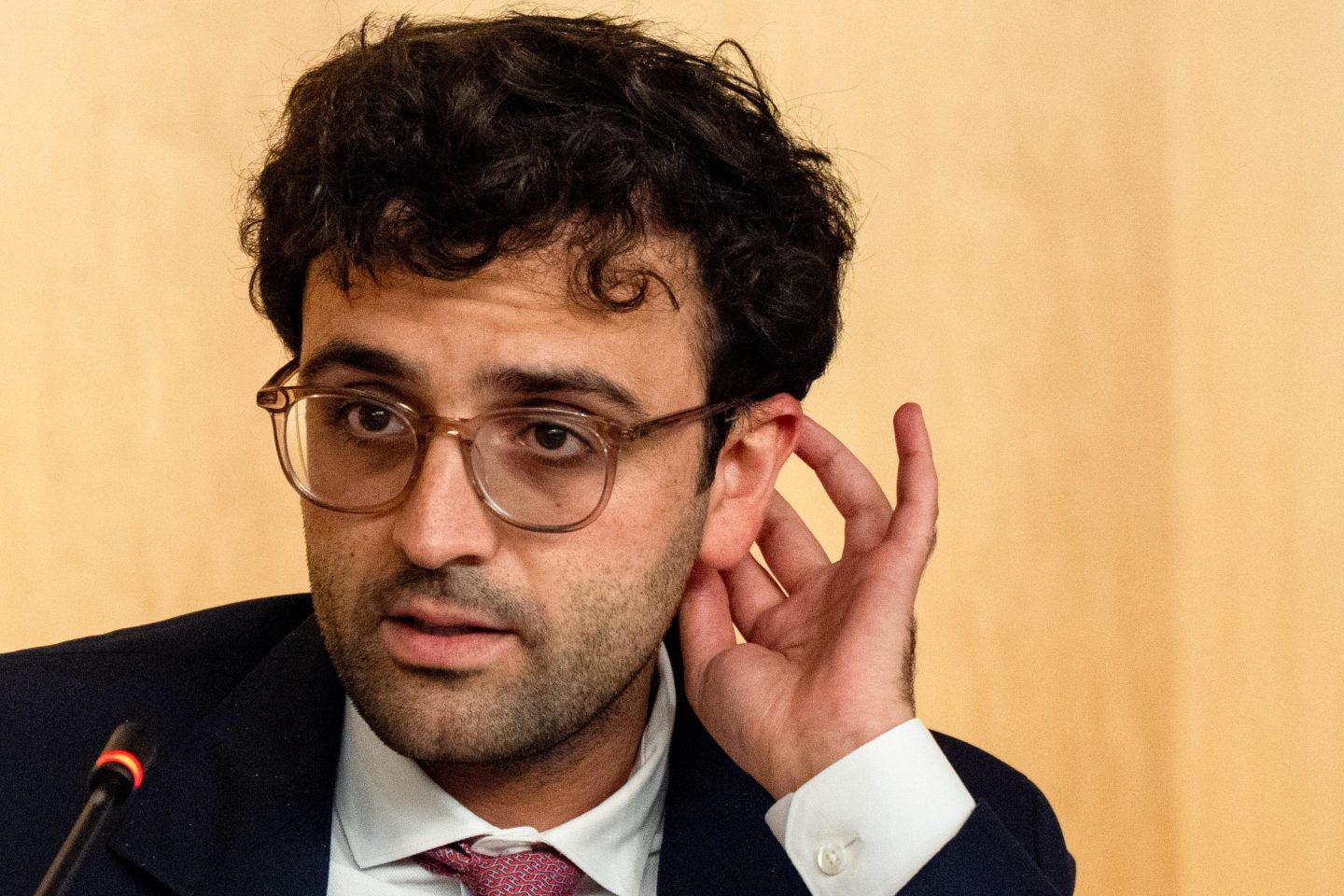
Verizon and AT&T have more fearsome rivals than David Beyerle, a communications engineer in Penn State University’s IT department. Nevertheless, the two telecom giants could soon have to bid against him at two major government airwave auctions.
“I obviously lack the mass and resources of AT&T and Verizon,” Beyerle says. “Nevertheless, I believe I’m both entrepreneurial and possess the technical capacity to be able to put the spectrum to use if I prevail.”
Beyerle, unlike the big carriers, is only interested in obtaining licenses for wireless service around Penn State’s home town in State College, Penn. But he didn’t want to talk much about how much he would bid or what he might do if he won.
The major carriers, in contrast, are expected to bid tens of millions of dollars each for airwave licenses that cover major metro areas. They sometimes skip bidding or don’t wager much for licenses covering smaller, out-of-the-way regions like State College.
About 20 years ago, Beyerle was the winning bidder for one of 14 licenses in a high frequency band for his local area, paying just under $12,000 (after getting a 35% discount that the Federal Communications offered to smaller bidders). The 14 local licenses in the 39 GHz band didn’t draw many big players and four got no bids at all. Later, when a couple of well-funded wireless startups that had also won licenses in the State College area went bankrupt, Beyerle bought their used transmission gear to create a small network capable of sending data wirelessly between fixed locations. One connection provided additional capacity between a cell tower at Penn State’s Beaver Stadium and a carrier’s tower site less than a mile away, for example.
Analysts are uncertain how hot the bidding will be in next month’s airwave auction for nearly 3,100 licenses in the 28 GHz band or the subsequent sale of 2,900 licenses in the 24 GHz band. Last year, the federal government collected $20 billion in an auction for rights in the 600 MHz band.
But the upcoming license auctions are for higher frequency bands than are typical for today’s cellphones, like 600 MHz or 2.5 GHz. They are considered to be best for 5G wireless networks, an emerging technology that would offer faster mobile service.
The new technology is so fast that customers could use it to replace their wired, home Internet connections. It could also be used to connect virtual reality devices—currently a sticking point with today’s slower 4G LTE speeds—and for other data-intensive technologies like self-driving cars.
How to make money
Despite the potential uses of the airwaves, the list of bidders who filed to participate in the upcoming auction underwhelmed many industry observers. The potential bidders included AT&T, Verizon, T-Mobile (TMUS), and Sprint (S), but not the major cable companies that are expanding into wireless service, Comcast (CMCSA) and Charter Communications (CHTR).
Nor did any big tech companies like Google (GOOGL) sign up. Big-name investors and hedge funds also mostly stood aside.
“Everyone talks about how awesome 5G will be, but no one really understands how to make money from it,” says Harold Feld, a telecom lawyer at the nonprofit advocacy group Public Knowledge. “Previous major auctions drew significant interest from cable operators and others.”
The problem may be just how critical the extreme high frequency bands, sometimes called millimeter wave bands, are for 5G service. Signals at those wavelengths can carry huge amounts of data, but they don’t travel far or penetrate well through walls and trees.
In some parts of the world, wireless companies and regulators are more focused on mid-level bands at 6 GHz and lower for 5G. But in the United States, Verizon and AT&T, in particular, have invested in the millimeter bands, including with Verizon’s (VZ) initial 5G home Internet service that premiered this month in parts of four cities.
The “disinterest” in the two upcoming FCC auctions so far may simply be another sign that the value of high-band spectrum is less than initially expected, BTIG Research analyst Walter Piecyk noted last week. Equally important in forecasting auction interest will be when the FCC discloses the amount of money that potential bidders have put down as deposits in advance. The FCC establishes a minimum amount of money a bidder must put up in advance to bid on each license, so the total amount of deposits from each bidder offers a window into how many licenses they could bid on simultaneously. Smaller deposits would signal lower interest in the auction, Piecyk says.
Among the companies that filed to participate in the auction were Crestone Wireless, a legal entity backed by Dish Network (DISH), the satellite TV operator that already owns a number of more standard mobile licenses, and mmWaveBroadband, backed by satellite communications company Viasat (VSAT).
Prior history
A new company, RNB Spectrum, which has a historic link to the millimeter band, also filed to participate. The company is backed by Ravi Potharlanka, the CEO of wireless startup LocusPoint Networks who is also the former COO of Fibertower, an early millimeter band pioneer that went bankrupt and was then acquired by AT&T (T) for $207 million earlier this year.
Beyond the companies, there is a long history of individuals bidding in airwave auctions, sometimes via their own tiny corporations, but their track records are mixed.
Two years ago, a 20-year-old college student, James Hulce, from Menomonee Falls, Wis., applied to bid in the FCC’s 600 MHz auction, drawing headlines. But he didn’t win any licenses and doesn’t appear to be preparing to bid in the upcoming auctions.
Another entity that filed to participate in the current auctions, 8538 Green Street, includes former mailman Vincent McBride as an owner. He got rich by buying and selling licenses starting in the 1990s, and in the new filing, revealed that he makes $1.2 million annually on average.
Then there’s High Band License, whose owners include billionaires Rajendra and Neera Singh. They started out as cellular engineers before parlaying winning spectrum bids into huge riches in the 1990s.
Other individuals filing for the upcoming auction included a construction contractor from Las Vegas named Omar Afifeh, Houston lawyer Ryan van Steenis, and hedge fund manager Alan Bezoza, of Dorsal Capital. None of the three responded to inquiries from Fortune about their filings.
IT expert Beyerle is still looking forward to the auction. “I’m very intrigued,” he says, noting that the amount of spectrum being sold is vast. Whether Verizon, AT&T and their ilk take notice is yet to be seen.