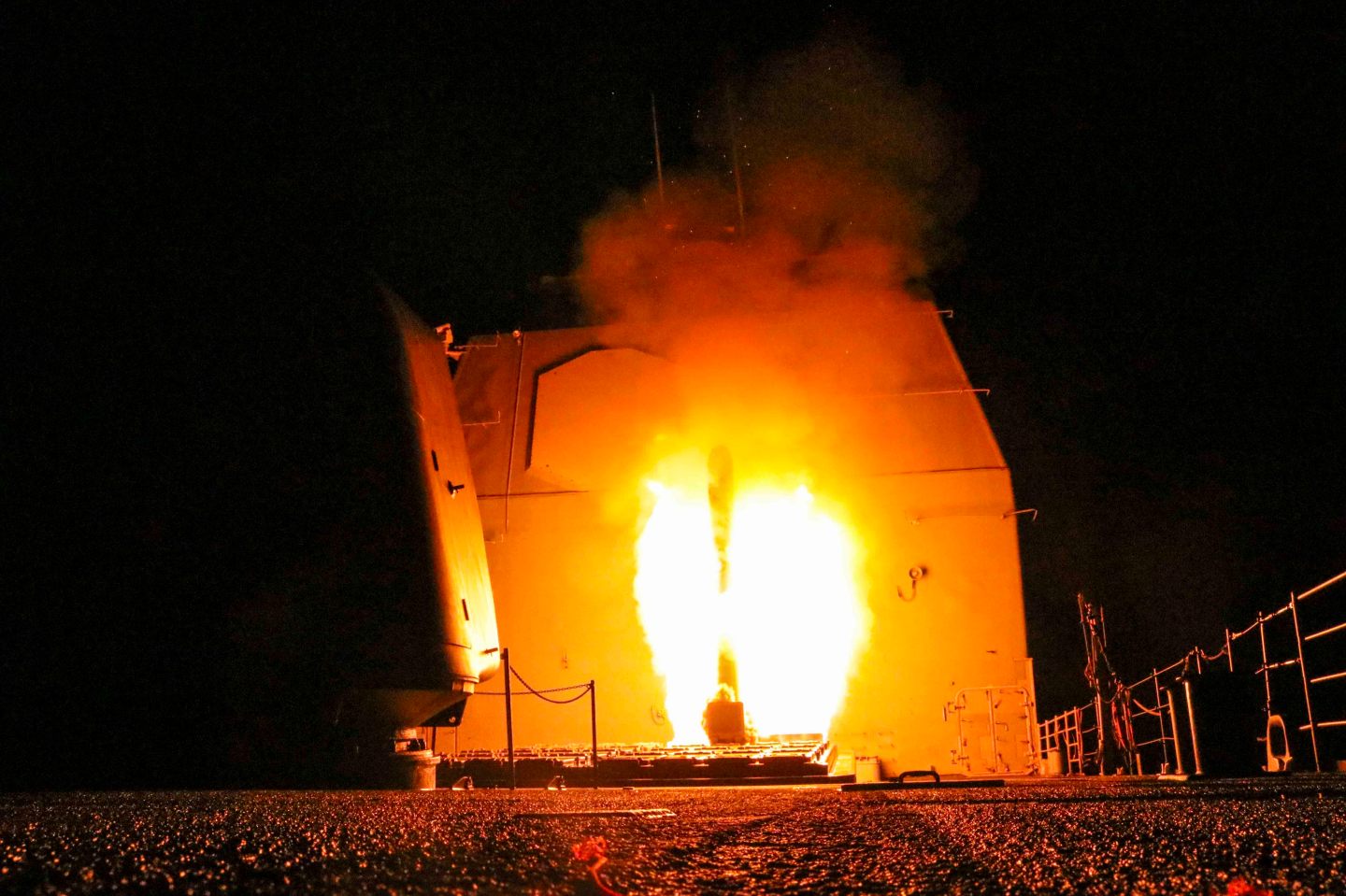
The U.S., U.K. and France launched strikes on Syria a week after U.S. President Donald Trump said there would be a “big price” to pay for the apparent use of chemical weapons by President Bashar al-Assad’s forces in the town of Douma, an attack that killed scores of civilians. Here’s what we know and what’s still to come:
1. What did they attack?
Trump, French President Emmanuel Macron and U.K. Prime Minister Theresa May released statements after the attack had begun, saying the missile strikes were focused on chemical weapons sites.
General Joseph Dunford, chairman of the Joint Chiefs of Staff, said that naval and air forces struck three primary targets, including a chemical weapons research facility outside Damascus and a weapons storage area near Homs.
The U.K.-based Syrian Observatory for Human Rights, which monitors the Syrian war through activists on the ground, said installations belonging to the country’s elite Republican Guards were also targeted. Russia’s defense ministry said more than 100 cruise missiles were fired.
“This was not geared towards weakening Assad’s conventional military capabilities,” said Kamran Bokhari, a senior fellow with the Center for Global Policy in Washington. It was “a little more than the symbolic strike from last year but steering clear of any major operation.”
2. How did Syria react?
Syria said the strikes failed to achieve their goal and breached international law. Syrian air defenses hit several incoming missiles, state-run media said. Analysts and diplomats said the strike was unlikely to shake Assad’s hold on power or change the trajectory of the conflict.
The attack “was a victory for Syria,” former lawmaker Sharif Shehadeh said by phone from Damascus. “Instead of weakening the government, it only made it stronger,” he said. “Trump did it to save face.”
Assad’s allies, including Iran and Lebanon’s Hezbollah group, also condemned the strikes. Iran’s Supreme Leader called the attack a crime and the country’s Revolutionary Guard Corps said it gave “the resistance a more open hand,” although it did not threaten to retaliate.
3. Are the attacks over?
May in her statement called it a “limited and targeted strike.” U.S. Defense Secretary Jim Mattis said that “right now, this is a one-time shot and I believe it has sent a very strong message to dissuade him, to deter him.” The U.K. Defense Ministry said the strikes were “successful.”
Still, Trump warned in his televised address of a readiness to “sustain this response until the Syrian regime stops its use of prohibited chemical agents,” though he didn’t specify what that meant.
4. How did Russia respond?
Russia denounced the attacks as aggression against its ally, but there was no sign of an immediate military response.
“Our worst apprehensions have come true. Our warnings have been left unheard,” Anatoly Antonov, Russia’s ambassador to the U.S., wrote on Facebook. “Insulting the President of Russia is unacceptable and inadmissible,” he added, an apparent reference to Trump’s mention of President Vladimir Putin in his speech.
The Kremlin released a statement from Putin saying the strike was an “act of aggression against a sovereign state which is in the front line in the fight against terrorism,” and that there was no proof a chemical weapons attack had taken place.
The strikes appeared to have taken place far from Russia’s bases near the Syrian coast. U.S. officials said they gave Russia no specific warnings of the attacks or the targets, but used the usual hotline with Moscow’s military to ensure the airspace was clear. Still, French Defense minister Florence Parly told reporters that Russian authorities were warned ahead of time, as proof the action would be limited to specific targets.
French authorities said the allies don’t seek any military escalation, nor confrontation with Russia. Macron, who called Putin on Friday to discuss the situation, still plans to travel to a security conference in St Petersburg in May, where they are expected to meet, an official said.
5. What about the U.K.?
May on Saturday made her case for action in the face of opposition from much of the public and the Labour Party, saying in a further statement it was highly likely Assad’s regime had used chemical weapons.
“We would have preferred an alternative path, but in this case there was none,” May said. “We cannot allow the use of chemical weapons to become normalized.”
She authorized the strikes without parliamentary backing and it’s not clear she would have got it if she’d sought it. Parliament refused U.K. participation in a planned punitive raid on Syria in 2013, one of the reasons then-U.S. President Barack Obama called it off.
May will address Parliament — where she doesn’t have a majority — next week. Opposition leader Jeremy Corbyn, a lifelong anti-war campaigner, has accused May of ” waiting for instructions from President Donald Trump.”
6. And Germany?
While Germany did not take part in the action against Syria, Chancellor Angela Merkel said on Saturday she supported steps taken by the allies.