• Home
  • Latest
  • Fortune 500
  • Finance
  • Tech
  • Leadership
  • Lifestyle
  • Rankings
  • Multimedia
Commentary

Commentary: A New Electric Truck? Tesla Should Stick to Cars.

By
Tony Hughes
Tony Hughes
and
Bethany Cianciolo
Bethany Cianciolo
Down Arrow Button Icon
By
Tony Hughes
Tony Hughes
and
Bethany Cianciolo
Bethany Cianciolo
Down Arrow Button Icon
November 21, 2017, 6:34 PM ET
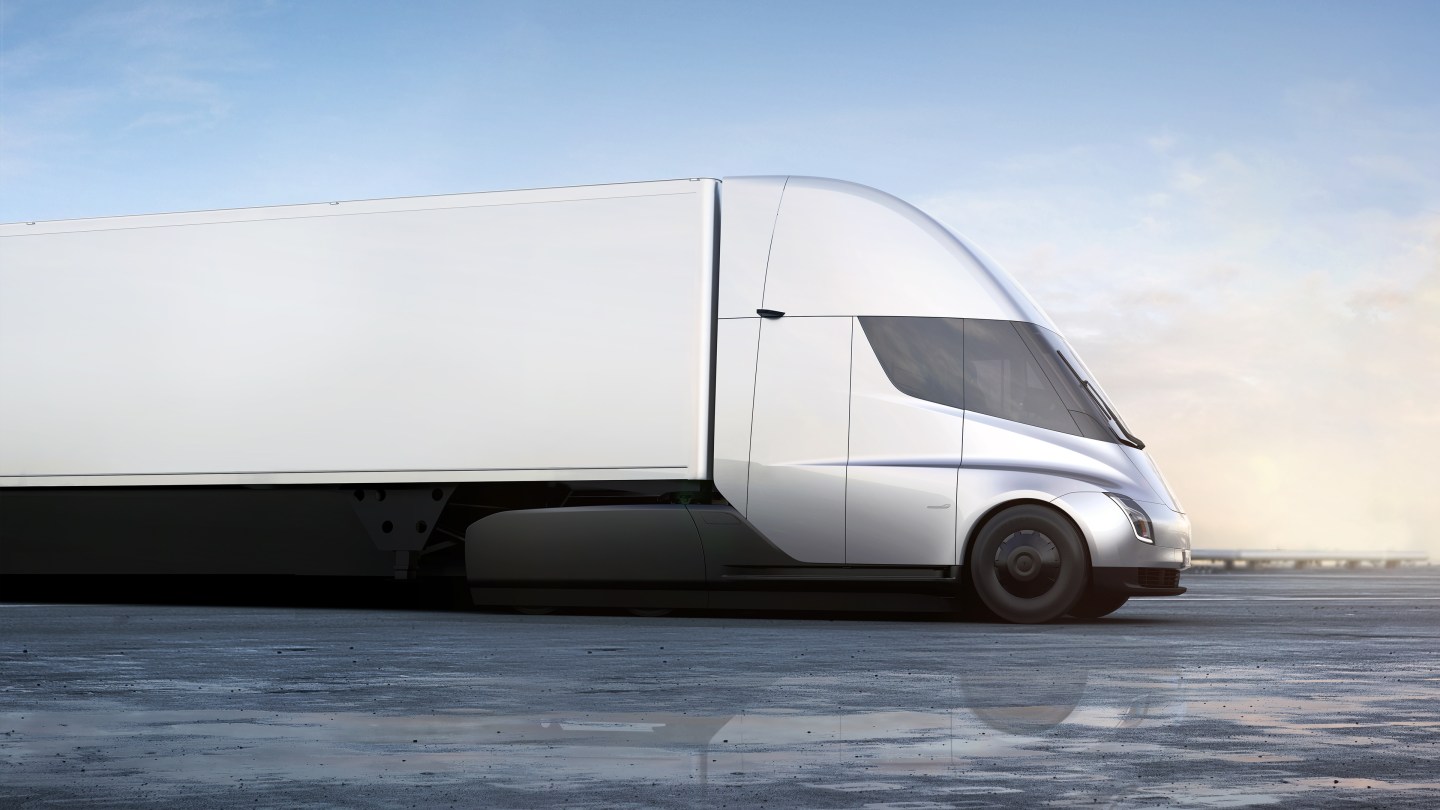
Courtesy of Tesla

Last week, Tesla unveiled a prototype of an electric, semi-autonomous truck that is set to enter production in 2019. But the company’s foray into the commercial truck space is unlikely to be a game changer for the cost-sensitive big rig market.

Tesla brings brand value to those who can afford it, but most companies will ask whether the brand is worth it.

The internal economics look challenging. If the Tesla truck could make more trips in a given period or arrive an hour earlier, customers may be willing to pay extra for better service. But few things shipped by semi-trucks are time-sensitive, so customers are unlikely to agree to a Tesla brand premium, and thus higher transportation costs.

One thing acting in Tesla’s favor is the distinctive truck design. Companies may be eager to flout their green credentials by having their merchandise hauled by Tesla trucks. This might be the reason Walmart (WMT) and Canadian supermarket chain Loblaw have already placed orders for the new vehicles. It is also true that autonomous driving technology will lead to genuine efficiencies in the industry through platooning, remote operation, or full automation.

However, these advances, in addition to plug-in hybrid technology, could be applied to the existing truck stock. There seems little reason for Tesla to manufacture its own skeleton to house its fuel-cell technology when truck chassis are already in mass production at a lower cost.

Other companies might progress faster in bringing zero-emission trucks to market, simply because they are opting not to reinvent the wheels that lie between the drivetrain and the tarmac. The recent application of Toyota’s hydrogen fuel-cell technology, housed in Kenworth semis, demonstrates how this partnership model could proceed.

It is undeniable that the new Tesla (TSLA) trucks have an array of impressive features, but many of these seem odd when viewed in the context of driverless technology. Much of last week’s launch presentation was spent on the new cabin design and safety features: Drivers can stand up in the cockpit; the trucks have a low center of gravity, which reduces the possibility of rollover; and there’s a mechanism that will alert relevant parties that the driver is non-responsive. The trend toward ever-greater automation, however, may render these capabilities redundant if the driver is removed from the vehicle entirely and replaced by a robot or a remote operator. The cabin headspace could instead have been used to provide extra battery capacity.

At this point, it seems the new truck will benefit humanity and other road users, while truckers will see little impact on the bottom line.

With impressive acceleration capabilities, Tesla truckers will be able to burn off sports cars at the lights and power up steep inclines at highway speeds fully laden. This will enable them to get to the half-hour recharge station several minutes before rival diesel drivers reach the adjacent gas pump.

Zero-emission haulage would be great for the environment, but everyone benefits equally if air quality or greenhouse gas levels are improved. This benefit is the primary argument behind subsidies offered by governments around the world. To reach the socially optimal rate of electric vehicle adoption, the external benefits enjoyed by everyone must be priced somewhere into the equation. Tesla seems willing to launch its truck without the prospect of a subsidy, which means it must live or die based on the economics of the potential owner considered in isolation.

Tesla has produced what looks like a wonderful machine for the environment and much safer for soon-to-be-redundant truck drivers. But with production of the new trucks not set to begin until 2019, and taking into account the prevailing problems with the Model 3 production line, it may be years before we see these vehicles on the road, if at all in their current form. In the meantime, Tesla will face stiff competition from existing industry players who are already well advanced in the development and implementation of new zero-emission truck designs.

Tony Hughes is managing director at Moody’s Analytics.

About the Authors
By Tony Hughes
See full bioRight Arrow Button Icon
By Bethany Cianciolo
See full bioRight Arrow Button Icon

Latest in Commentary

Sarandos
CommentaryAntitrust
Netflix’s takeover of Warner Brothers is a nightmare for consumers
By Ike BrannonDecember 11, 2025
18 hours ago
student
CommentaryEducation
International students skipped campus this fall — and local economies lost $1 billion because of it
By Bjorn MarkesonDecember 10, 2025
2 days ago
jobs
Commentaryprivate equity
There is a simple fix for America’s job-quality crisis: actually give workers a piece of the business 
By Pete StavrosDecember 9, 2025
3 days ago
Jon Rosemberg
CommentaryProductivity
The cult of productivity is killing us
By Jon RosembergDecember 9, 2025
3 days ago
Trump
CommentaryTariffs and trade
AI doctors will be good at science but bad at business, and big talk with little action means even higher drugs prices: 10 healthcare predictions for 2026 from top investors
By Bob Kocher, Bryan Roberts and Siobhan Nolan ManginiDecember 9, 2025
3 days ago
Google.org
CommentaryTech
Nonprofits are solving 21st century problems—they need 21st century tech
By Maggie Johnson and Shannon FarleyDecember 8, 2025
4 days ago

Most Popular

placeholder alt text
Success
At 18, doctors gave him three hours to live. He played video games from his hospital bed—and now, he’s built a $10 million-a-year video game studio
By Preston ForeDecember 10, 2025
2 days ago
placeholder alt text
Investing
Baby boomers have now 'gobbled up' nearly one-third of America's wealth share, and they're leaving Gen Z and millennials behind
By Sasha RogelbergDecember 8, 2025
4 days ago
placeholder alt text
Success
Palantir cofounder calls elite college undergrads a ‘loser generation’ as data reveals rise in students seeking support for disabilities, like ADHD
By Preston ForeDecember 11, 2025
15 hours ago
placeholder alt text
Economy
‘We have not seen this rosy picture’: ADP’s chief economist warns the real economy is pretty different from Wall Street’s bullish outlook
By Eleanor PringleDecember 11, 2025
20 hours ago
placeholder alt text
Economy
‘Be careful what you wish for’: Top economist warns any additional interest rate cuts after today would signal the economy is slipping into danger
By Eva RoytburgDecember 10, 2025
2 days ago
placeholder alt text
Politics
Exclusive: U.S. businesses are getting throttled by the drop in tourism from Canada: ‘I can count the number of Canadian visitors on one hand’
By Dave SmithDecember 10, 2025
2 days ago
Rankings
  • 100 Best Companies
  • Fortune 500
  • Global 500
  • Fortune 500 Europe
  • Most Powerful Women
  • Future 50
  • World’s Most Admired Companies
  • See All Rankings
Sections
  • Finance
  • Leadership
  • Success
  • Tech
  • Asia
  • Europe
  • Environment
  • Fortune Crypto
  • Health
  • Retail
  • Lifestyle
  • Politics
  • Newsletters
  • Magazine
  • Features
  • Commentary
  • Mpw
  • CEO Initiative
  • Conferences
  • Personal Finance
  • Education
Customer Support
  • Frequently Asked Questions
  • Customer Service Portal
  • Privacy Policy
  • Terms Of Use
  • Single Issues For Purchase
  • International Print
Commercial Services
  • Advertising
  • Fortune Brand Studio
  • Fortune Analytics
  • Fortune Conferences
  • Business Development
About Us
  • About Us
  • Editorial Calendar
  • Press Center
  • Work At Fortune
  • Diversity And Inclusion
  • Terms And Conditions
  • Site Map

© 2025 Fortune Media IP Limited. All Rights Reserved. Use of this site constitutes acceptance of our Terms of Use and Privacy Policy | CA Notice at Collection and Privacy Notice | Do Not Sell/Share My Personal Information
FORTUNE is a trademark of Fortune Media IP Limited, registered in the U.S. and other countries. FORTUNE may receive compensation for some links to products and services on this website. Offers may be subject to change without notice.