• Home
  • Latest
  • Fortune 500
  • Finance
  • Tech
  • Leadership
  • Lifestyle
  • Rankings
  • Multimedia
Leadership50 Best Workplaces for Diversity

What Georgetown University Is Teaching These Professionals About Diversity

By
Grace Donnelly
Grace Donnelly
Down Arrow Button Icon
By
Grace Donnelly
Grace Donnelly
Down Arrow Button Icon
February 21, 2017, 10:50 AM ET
Georgetown Slavery
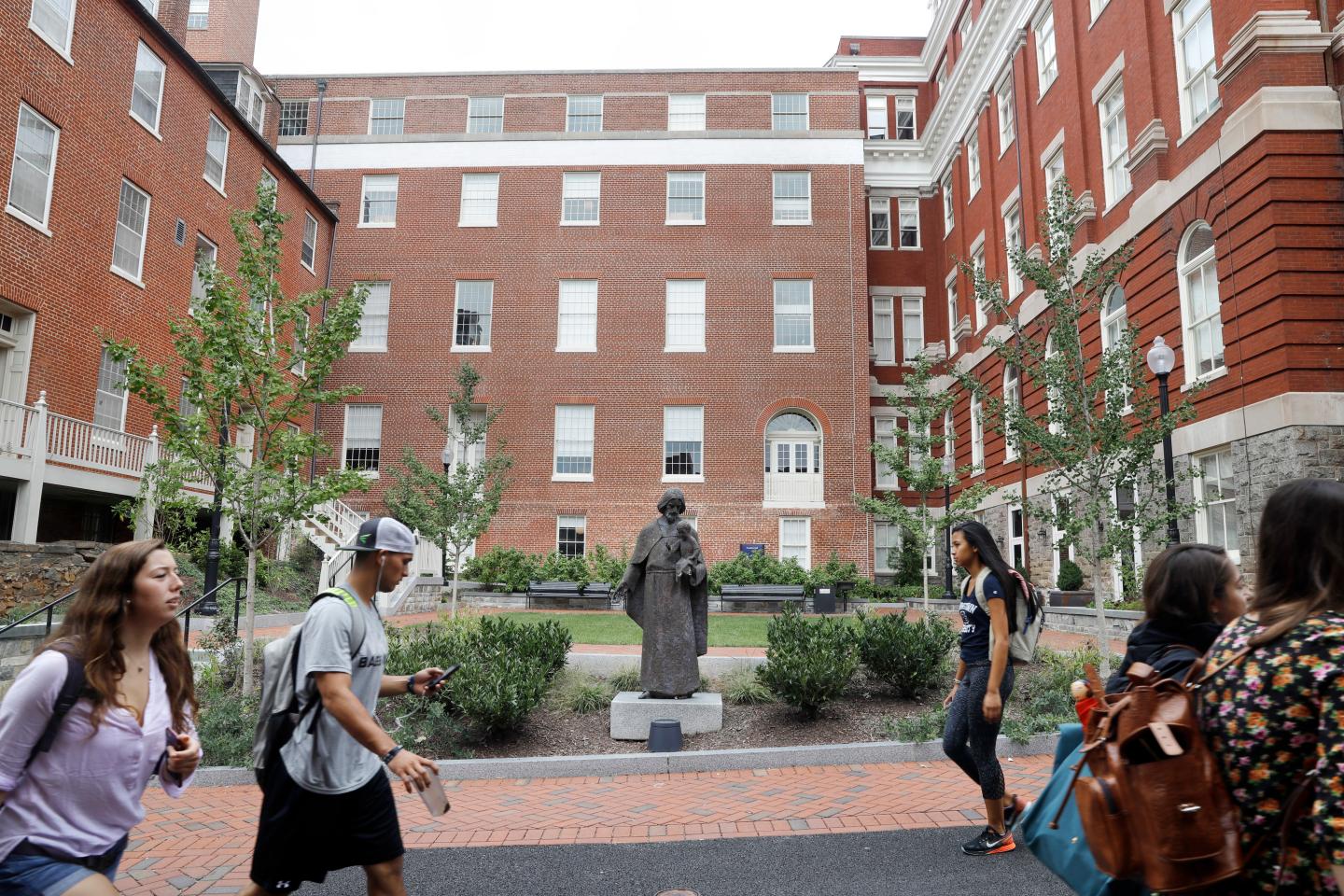
Students walk past a Jesuit statue in front of Freedom Hall, center, formerly named Mulledy Hall, on the Georgetown University campus, Thursday, Sept. 1, 2016, in Washington. After renaming the Mulledy and McSherry buildings at Georgetown University temporarily to Freedom Hall and Remembrance Hall, Georgetown University will give preference in admissions to the descendants of slaves owned by the Maryland Jesuits as part of its effort to atone for profiting from the sale of enslaved people. Georgetown president John DeGioia announced Thursday that the university will implement the admissions preferences. The university released a report calling on its leaders to offer a formal apology for the university's participation in the slave trade. (AP Photo/Jacquelyn Martin)Jacquelyn Martin—AP

A group of mid-career professionals-turned-students stood in front of American Red Cross leaders in a Georgetown University classroom last week to talk about a poster that landed them in hot water. Their goal was to make recommendations on how to check their blind spots before publishing potentially racist materials.

It wasn’t a tense conversation. It was the nonprofit’s idea to seek out advice from students enrolled in the university’s diversity and inclusion program.

The Executive Certificate in Strategic Diversity and Inclusion Management at Georgetown is a six-month course that was born out of the two-year master’s program in human resources management. It started with just eight students in 2011. The 2016-2017 cohort, the program’s fifth, admitted 25 participants leaving nearly as many on a waiting list, according to Professor Sukari Pinnock, who organizes the program.

Once a month for six months the group meets in Washington, D.C. for a three-day weekend of classes. This structure caters to working professionals and allows many out-of-town students to participate. In the most recent cohort, the majority traveled for each session, flying in from Connecticut, Texas, and Minnesota.

This speaks both to the program’s reputation — many chose it for the experiential approach — and its rarity. There are still relatively few post-graduate certificate or degree programs that focus specifically on diversity and inclusion. Cornell offers a similar certificate at their New York City Industrial and Labor Relations school and Tufts University has a masters degree in diversity and inclusion leadership, but curriculums that address these topics are still limited.

The students include private sector employees and public officials, academics and educators, nonprofit workers and corporate consultants. A few already from the most recent class had a background in human resources, but most were hoping to gain new perspective or transition into a more people-focused roles.

The Georgetown student advising team with clients TBWA after their presentation on Friday, February 10th. From left: Rajiv Desai, Annette Reimers, Amber Haggins, Amy Dunn (TBWA), Doug Melville (TBWA), Amy Ford, and Felicia Wilson Young, PhD.Georgetown
Georgetown

One of the students, project manager Mary Ford, has worked in the defense industry for her entire career.

After raising a special needs son, Ford is looking toward early retirement and what comes next. “I’m very passionate about human behavior and cognition and especially just disability, so I thought this was a good way to test the waters and look for a second career,” she said.

Her classmate, Annette Reimers, is a patent judge for the United States Patent and Trademark Office. Her own experience with cerebral palsy led her to the Georgetown course. She’s working to start a professional mentorship program for people with disabilities and felt she needed more expertise.

“I don’t have a lot of familiarity with this area, it’s not my line of work,” Reimers said, “so I wanted to dive in and get information from this program and use it as a resource.”

The curriculum of the class also blends personal and professional, leading students to self-reflect first, look at interpersonal interactions next, and then apply all the theory they’ve learned to advise a real-world client.

“The primary focus is on using yourself as a tool. It has completely changed the way that I do my job at the Department of Energy.” said Amber Haggins, who leads its diversity and inclusion office.

The course also teaches students to assess how individual, organizational, and systemic changes affect the whole.

“To really address the system you have to have a plan,” said Felicia Wilson Young, PhD, deputy director of certified staff care services at USAID, “You have to have a toolbox. And that’s kind of how I feel, like this [course] has given me a toolbox.”

The toolbox is put to the test at the end of the program with presentations to real-world clients, like the Red Cross.

For the Red Cross, the students suggested the nonprofit add new review process. For TBWA, an advertising firm, it was reimagining their recruitment process to attract more diverse job candidates. For Sodexo, a food services company, it was implementing a paid maternity leave policy.

Whether the clients choose to act on the suggestions from their student teams or not, many participants of the program said they feel personally transformed by what they’ve learned.

“One thing I’ve learned in this class, if I didn’t know it before, is we bring all of who we are to the table,” said Wilson. “We can sort of hide it and push it away or we can use it.”

About the Author
By Grace Donnelly
See full bioRight Arrow Button Icon

Latest in Leadership

Nicholas Thompson
C-SuiteBook Excerpt
I took over one of the most prestigious media firms while training for an ultramarathon. Here’s what I learned becoming CEO of The Atlantic
By Nicholas ThompsonDecember 13, 2025
8 hours ago
Lauren Antonoff
SuccessCareers
Once a college dropout, this CEO went back to school at 52—but she still says the Gen Zers who will succeed are those who ‘forge their own path’
By Preston ForeDecember 13, 2025
9 hours ago
Asiathe future of work
The CEO of one of Asia’s largest co-working space providers says his business has more in common with hotels
By Angelica AngDecember 12, 2025
17 hours ago
Donald Trump
HealthHealth Insurance
‘Tragedy in the making’: Top healthcare exec on why insurance will spike to subsidize a tax cut to millionaires and billionaires
By Nick LichtenbergDecember 12, 2025
24 hours ago
three men in suits, one gesturing
AIBrainstorm AI
The fastest athletes in the world can botch a baton pass if trust isn’t there—and the same is true of AI, Blackbaud exec says
By Amanda GerutDecember 12, 2025
1 day ago
Brainstorm AI panel
AIBrainstorm AI
Creative workers won’t be replaced by AI—but their roles will change to become ‘directors’ managing AI agents, executives say
By Beatrice NolanDecember 12, 2025
1 day ago

Most Popular

placeholder alt text
Economy
Tariffs are taxes and they were used to finance the federal government until the 1913 income tax. A top economist breaks it down
By Kent JonesDecember 12, 2025
1 day ago
placeholder alt text
Success
Apple cofounder Ronald Wayne sold his 10% stake for $800 in 1976—today it’d be worth up to $400 billion
By Preston ForeDecember 12, 2025
1 day ago
placeholder alt text
Success
40% of Stanford undergrads receive disability accommodations—but it’s become a college-wide phenomenon as Gen Z try to succeed in the current climate
By Preston ForeDecember 12, 2025
1 day ago
placeholder alt text
Economy
The Fed just ‘Trump-proofed’ itself with a unanimous move to preempt a potential leadership shake-up
By Jason MaDecember 12, 2025
22 hours ago
placeholder alt text
Economy
For the first time since Trump’s tariff rollout, import tax revenue has fallen, threatening his lofty plans to slash the $38 trillion national debt
By Sasha RogelbergDecember 12, 2025
1 day ago
placeholder alt text
Success
Apple CEO Tim Cook out-earns the average American’s salary in just 7 hours—to put that into context, he could buy a new $439,000 home in just 2 days
By Emma BurleighDecember 12, 2025
1 day ago
Rankings
  • 100 Best Companies
  • Fortune 500
  • Global 500
  • Fortune 500 Europe
  • Most Powerful Women
  • Future 50
  • World’s Most Admired Companies
  • See All Rankings
Sections
  • Finance
  • Leadership
  • Success
  • Tech
  • Asia
  • Europe
  • Environment
  • Fortune Crypto
  • Health
  • Retail
  • Lifestyle
  • Politics
  • Newsletters
  • Magazine
  • Features
  • Commentary
  • Mpw
  • CEO Initiative
  • Conferences
  • Personal Finance
  • Education
Customer Support
  • Frequently Asked Questions
  • Customer Service Portal
  • Privacy Policy
  • Terms Of Use
  • Single Issues For Purchase
  • International Print
Commercial Services
  • Advertising
  • Fortune Brand Studio
  • Fortune Analytics
  • Fortune Conferences
  • Business Development
About Us
  • About Us
  • Editorial Calendar
  • Press Center
  • Work At Fortune
  • Diversity And Inclusion
  • Terms And Conditions
  • Site Map

© 2025 Fortune Media IP Limited. All Rights Reserved. Use of this site constitutes acceptance of our Terms of Use and Privacy Policy | CA Notice at Collection and Privacy Notice | Do Not Sell/Share My Personal Information
FORTUNE is a trademark of Fortune Media IP Limited, registered in the U.S. and other countries. FORTUNE may receive compensation for some links to products and services on this website. Offers may be subject to change without notice.