• Home
  • Latest
  • Fortune 500
  • Finance
  • Tech
  • Leadership
  • Lifestyle
  • Rankings
  • Multimedia
Commentary

America’s Auto Industry Has Bigger Problems Than Mexican Workers

By
Tony Hughes
Tony Hughes
and
Bethany Cianciolo
Bethany Cianciolo
Down Arrow Button Icon
By
Tony Hughes
Tony Hughes
and
Bethany Cianciolo
Bethany Cianciolo
Down Arrow Button Icon
February 4, 2017, 11:00 AM ET
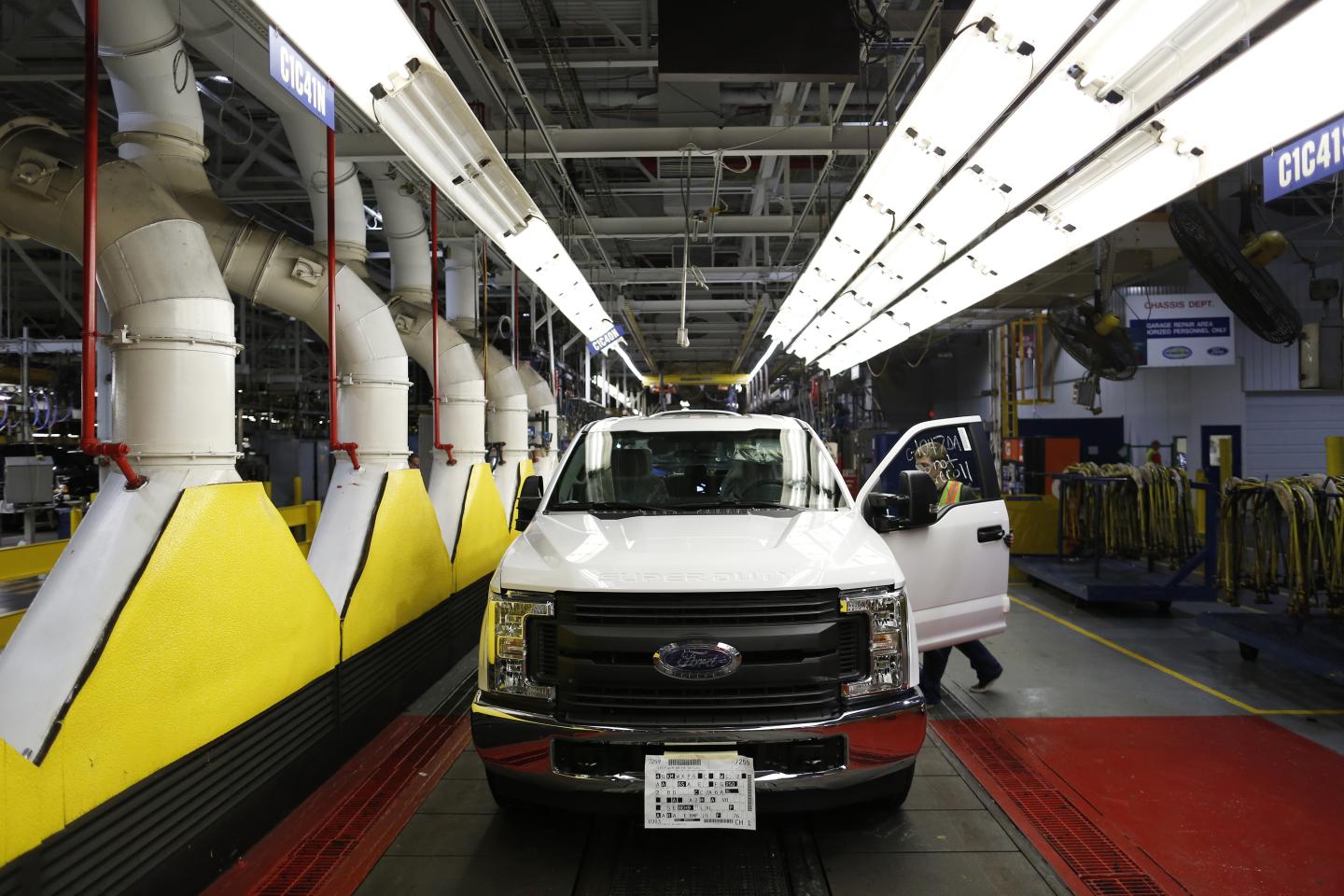
Operations Inside The Ford Motor Co. Kentucky Truck Manufacturing Facility
A Ford Motor Co. Super Duty Truck moves along the assembly line at the Ford Kentucky Truck Plant in Louisville, Kentucky, U.S., on Friday, Sept. 30, 2016. The all-new 2017 Ford F-Series Super Duty pickup is one of the many cars, trucks, and utilities that UAW-Ford workers build in the U.S. Photographer: Luke Sharrett/Bloomberg via Getty ImagesPhotograph by Luke Sharrett—Bloomberg via Getty Images

Mexican autoworkers should be worried. Their jobs are under threat, and affected workers should take concrete steps now to secure their economic future. Technological evolution is, in time, likely to spur high-tech auto-making jobs in countries like the U.S. And President Trump’s plan to build more traditional cars in the U.S., while tempting, only seems like a short-term solution for U.S. autoworkers. The question is what will be making cars in the future—not who.

The auto industry sits on the precipice of potentially monumental change. Ride-share technology is rapidly diffusing around the world, and the push toward autonomous vehicles is accelerating. Consumers will soon be able to commute in driverless, cheaply financed automobiles, and they’re nothing like the cars currently being manufactured in Mexico.

The process behind these trends is called “creative destruction.” During the 1980s and 1990s, many low-skilled auto jobs disappeared from the U.S. Midwest, as countries with cheaper labor developed to match the productivity of American factories. But sometime in the next decade or two, maybe sooner, it will be Mexican autoworkers who will have to cope with inevitable job loss. They will be forced to retrain for positions in other industries or, indeed, for higher-productivity jobs within the auto sector. The alternative is that they will be sidelined in a labor market that has simply passed them by.

President Trump has correctly identified the “destruction” inherent in this process—what he calls “American carnage”—though it is unclear whether he values the “creative” part of the equation as much as he could. The U.S. economy stands to benefit greatly if autonomous ride-sharing fulfills its tremendous potential.

Let us imagine for a moment that President Trump successfully holds back the tide of technological progress for a while. In order for manufacturing jobs to return, assuming that wages cannot be slashed to align with foreign competition, imports must be taxed at a high enough rate for domestic production to make sense to manufacturers. But this course of action would bring dire consequences for the current U.S. economy.
Title – One Line Only!
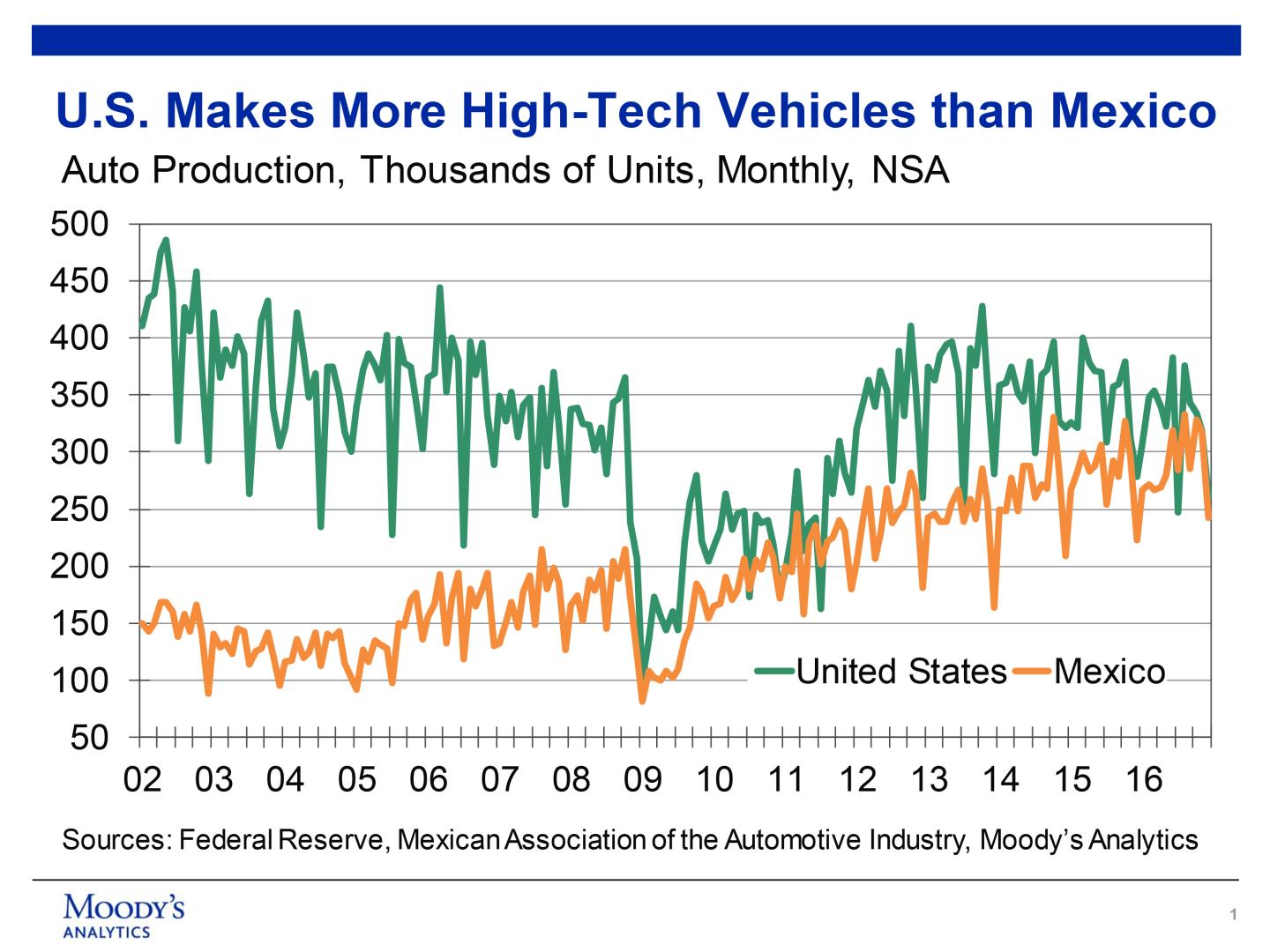
Courtesy of [hotlink]Moody’s[/hotlink] Analytics
Courtesy of Moody's Analytics

Prices of new vehicles would need to rise substantially in the U.S. Proposals being discussed have canvassed ideas such as a 20% border tax on Mexican imports. The scant details suggest the proposal might represent a value-added tax that hits domestically produced goods in the same manner as imports, and will therefore do little to reverse the trend toward foreign manufacturing.

If President Trump opts to impose a straight tariff on Mexican imports, manufacturers would shoulder some of the burden imposed by the tax, but it is consumers who would pay more for new vehicles. At the margin, this new reality would encourage carmakers to base new plants in the U.S., though a 20% tariff is likely too small to prompt the mass closure of Mexican plants with a significant cost advantage over similar U.S. factories. If the tariff is increased to the point where such closures do occur, the price of a new car in the U.S. will rise.

In the short term, this outcome will create winners and losers in the U.S. economy. The first thing to note is that higher prices for new cars will increase the nominal value of the entire U.S. vehicle fleet. Suppose that a new Camry rises in price from $20,000 to $25,000. A similar used vehicle must also be bid higher as buyers migrate to the cheaper substitute. On the face of it, such a result sounds like a boon for the owners of America’s 270 million cars and trucks. Your 1986 Buick LeSabre is now worth $800 rather than $600! Unlike homeowners, however, car owners cannot borrow against the equity they have in their vehicles. Selling the Buick and pocketing the $200 bounty simply means you will be perpetually late for work.

Auto finance companies, meanwhile, can benefit somewhat from the increased nominal value of the vehicle fleet. Loan repayments and outstanding balances on existing vehicles will be unaffected by the changed circumstances in the industry, so nominal credit losses will be lower than baseline as higher resale prices are reaped for repossessed vehicles. The news is not all good for the banks, however; higher prices and lower sales volume for new cars will cut deeply into loan originations, curtailing revenue growth for the auto finance industry for years to come. With many lenders and lessors concerned about excessive off-lease volume over the next few years, though, higher used car prices would at least provide some cushion against looming credit and residual losses.


Lower sales volume will hit the broader industry hard. Dealerships, which trade on thin margins, will lose business, and many will need to downsize or close. Higher vehicle prices imply more expensive motoring and fewer vehicle miles traveled, though U.S. demand for driving is remarkably inelastic. Nonetheless, any attempt to on-shore vehicle production will negatively affect employment in fields allied to the driving culture.

Finally, given the precedent being established for former autoworkers, one is forced to wonder how President Trump plans to respond to the looming carnage in the U.S. truck-driving industry. If you can make a Toyota Prius driverless, after all, you can apply precisely the same technology to a Mack Pinnacle. On the bright side, diffusion of driverless technology holds the potential to reduce transportation costs, and thus the price of all consumer goods offered for sale around the world. The downside is that truckers, spread widely across the heartland of America and elsewhere, will lose their livelihood and be forced to retrain.

This scenario sounds eerily familiar.

Like blacksmiths, coal miners, and autoworkers before them, truckers will be forced to adapt to changing economic circumstances. Unlike former autoworkers, however, truckers will not have a clear foreign scapegoat. All such workers will be affected equally, regardless of location or nationality.

Tony Hughes is a managing director at Moody’s Analytics.

About the Authors
By Tony Hughes
See full bioRight Arrow Button Icon
By Bethany Cianciolo
See full bioRight Arrow Button Icon

Latest in Commentary

Finance
Lorem ipsum dolor sit amet, consectetur adipiscing elit, sed do eiusmod tempor incididunt ut labore et dolore magna aliqua. Ut enim ad minim veniam
By Fortune Editors
October 20, 2025
Finance
Lorem ipsum dolor sit amet, consectetur adipiscing elit, sed do eiusmod tempor incididunt ut labore et dolore magna aliqua. Ut enim ad minim veniam
By Fortune Editors
October 20, 2025
Finance
Lorem ipsum dolor sit amet, consectetur adipiscing elit, sed do eiusmod tempor incididunt ut labore et dolore magna aliqua. Ut enim ad minim veniam
By Fortune Editors
October 20, 2025
Finance
Lorem ipsum dolor sit amet, consectetur adipiscing elit, sed do eiusmod tempor incididunt ut labore et dolore magna aliqua. Ut enim ad minim veniam
By Fortune Editors
October 20, 2025
Finance
Lorem ipsum dolor sit amet, consectetur adipiscing elit, sed do eiusmod tempor incididunt ut labore et dolore magna aliqua. Ut enim ad minim veniam
By Fortune Editors
October 20, 2025
Finance
Lorem ipsum dolor sit amet, consectetur adipiscing elit, sed do eiusmod tempor incididunt ut labore et dolore magna aliqua. Ut enim ad minim veniam
By Fortune Editors
October 20, 2025

Most Popular

Finance
Lorem ipsum dolor sit amet, consectetur adipiscing elit, sed do eiusmod tempor incididunt ut labore et dolore magna aliqua. Ut enim ad minim veniam
By Fortune Editors
October 20, 2025
Finance
Lorem ipsum dolor sit amet, consectetur adipiscing elit, sed do eiusmod tempor incididunt ut labore et dolore magna aliqua. Ut enim ad minim veniam
By Fortune Editors
October 20, 2025
Finance
Lorem ipsum dolor sit amet, consectetur adipiscing elit, sed do eiusmod tempor incididunt ut labore et dolore magna aliqua. Ut enim ad minim veniam
By Fortune Editors
October 20, 2025
Finance
Lorem ipsum dolor sit amet, consectetur adipiscing elit, sed do eiusmod tempor incididunt ut labore et dolore magna aliqua. Ut enim ad minim veniam
By Fortune Editors
October 20, 2025
Finance
Lorem ipsum dolor sit amet, consectetur adipiscing elit, sed do eiusmod tempor incididunt ut labore et dolore magna aliqua. Ut enim ad minim veniam
By Fortune Editors
October 20, 2025
Finance
Lorem ipsum dolor sit amet, consectetur adipiscing elit, sed do eiusmod tempor incididunt ut labore et dolore magna aliqua. Ut enim ad minim veniam
By Fortune Editors
October 20, 2025
Fortune Secondary Logo
Rankings
  • 100 Best Companies
  • Fortune 500
  • Global 500
  • Fortune 500 Europe
  • Most Powerful Women
  • World's Most Admired Companies
  • See All Rankings
  • Lists Calendar
Sections
  • Finance
  • Fortune Crypto
  • Features
  • Leadership
  • Health
  • Commentary
  • Success
  • Retail
  • Mpw
  • Tech
  • Lifestyle
  • CEO Initiative
  • Asia
  • Politics
  • Conferences
  • Europe
  • Newsletters
  • Personal Finance
  • Environment
  • Magazine
  • Education
Customer Support
  • Frequently Asked Questions
  • Customer Service Portal
  • Privacy Policy
  • Terms Of Use
  • Single Issues For Purchase
  • International Print
Commercial Services
  • Advertising
  • Fortune Brand Studio
  • Fortune Analytics
  • Fortune Conferences
  • Business Development
  • Group Subscriptions
About Us
  • About Us
  • Press Center
  • Work At Fortune
  • Terms And Conditions
  • Site Map
  • About Us
  • Press Center
  • Work At Fortune
  • Terms And Conditions
  • Site Map
  • Facebook icon
  • Twitter icon
  • LinkedIn icon
  • Instagram icon
  • Pinterest icon

Latest in Commentary

francis
CommentaryFlorida
Former Miami Mayor Francis Suarez: Why I’m joining Stephen Ross and Ken Griffin in betting big on ambitious business leaders
By Francis SuarezMay 1, 2026
14 hours ago
valerie
CommentaryLayoffs
Tesla’s former HR chief: the AI layoff panic Is built on a false premise—here’s what most workers need to know
By Valerie Capers WorkmanMay 1, 2026
16 hours ago
tamas
CommentaryPolymarket
SEON CEO: Prediction markets can forecast the future. Can they survive their own manipulation problem?
By Tamas KadarMay 1, 2026
19 hours ago
sundar
Commentary250 Years of Innovation
America at 250: immigration and the making of an innovative nation
By Nasser KazeminyMay 1, 2026
20 hours ago
Derek Kilmer
CommentaryEconomics
The U.S. economy is booming — just not where 50 million Americans live
By Derek KilmerMay 1, 2026
20 hours ago
hegseth
CommentaryMilitary
America shot its arsenal empty in 2 wars. Now it needs Beijing’s permission to reload
By Steve H. Hanke and Jeffrey WengApril 30, 2026
1 day ago

Most Popular

Scott Bessent on financial literacy: 'it drives me crazy' to see young men in blue-collar construction jobs playing the lottery
Personal Finance
Scott Bessent on financial literacy: 'it drives me crazy' to see young men in blue-collar construction jobs playing the lottery
By Fatima Hussein and The Associated PressMay 1, 2026
16 hours ago
China dominates the world's lithium supply. The U.S. just found 328 years' worth in its own backyard
North America
China dominates the world's lithium supply. The U.S. just found 328 years' worth in its own backyard
By Jake AngeloApril 30, 2026
1 day ago
The U.S. economy is booming — just not where 50 million Americans live
Commentary
The U.S. economy is booming — just not where 50 million Americans live
By Derek KilmerMay 1, 2026
20 hours ago
Apple cofounder Ronald Wayne—whose stake would be worth up to $400 billion had he not sold it in 1976—says that at 91, he has no regrets
Success
Apple cofounder Ronald Wayne—whose stake would be worth up to $400 billion had he not sold it in 1976—says that at 91, he has no regrets
By Preston ForeApril 27, 2026
5 days ago
Accenture's Julie Sweet blew up 50 years of company history. She says the hardest part is still ahead
Conferences
Accenture's Julie Sweet blew up 50 years of company history. She says the hardest part is still ahead
By Nick LichtenbergApril 29, 2026
3 days ago
A Chick-fil-A worker got fired and then showed up behind the register to allegedly refund himself over $80,000 in mac and cheese
Law
A Chick-fil-A worker got fired and then showed up behind the register to allegedly refund himself over $80,000 in mac and cheese
By Catherina GioinoMay 1, 2026
12 hours ago

© 2026 Fortune Media IP Limited. All Rights Reserved. Use of this site constitutes acceptance of our Terms of Use and Privacy Policy | CA Notice at Collection and Privacy Notice | Do Not Sell/Share My Personal Information
FORTUNE is a trademark of Fortune Media IP Limited, registered in the U.S. and other countries. FORTUNE may receive compensation for some links to products and services on this website. Offers may be subject to change without notice.