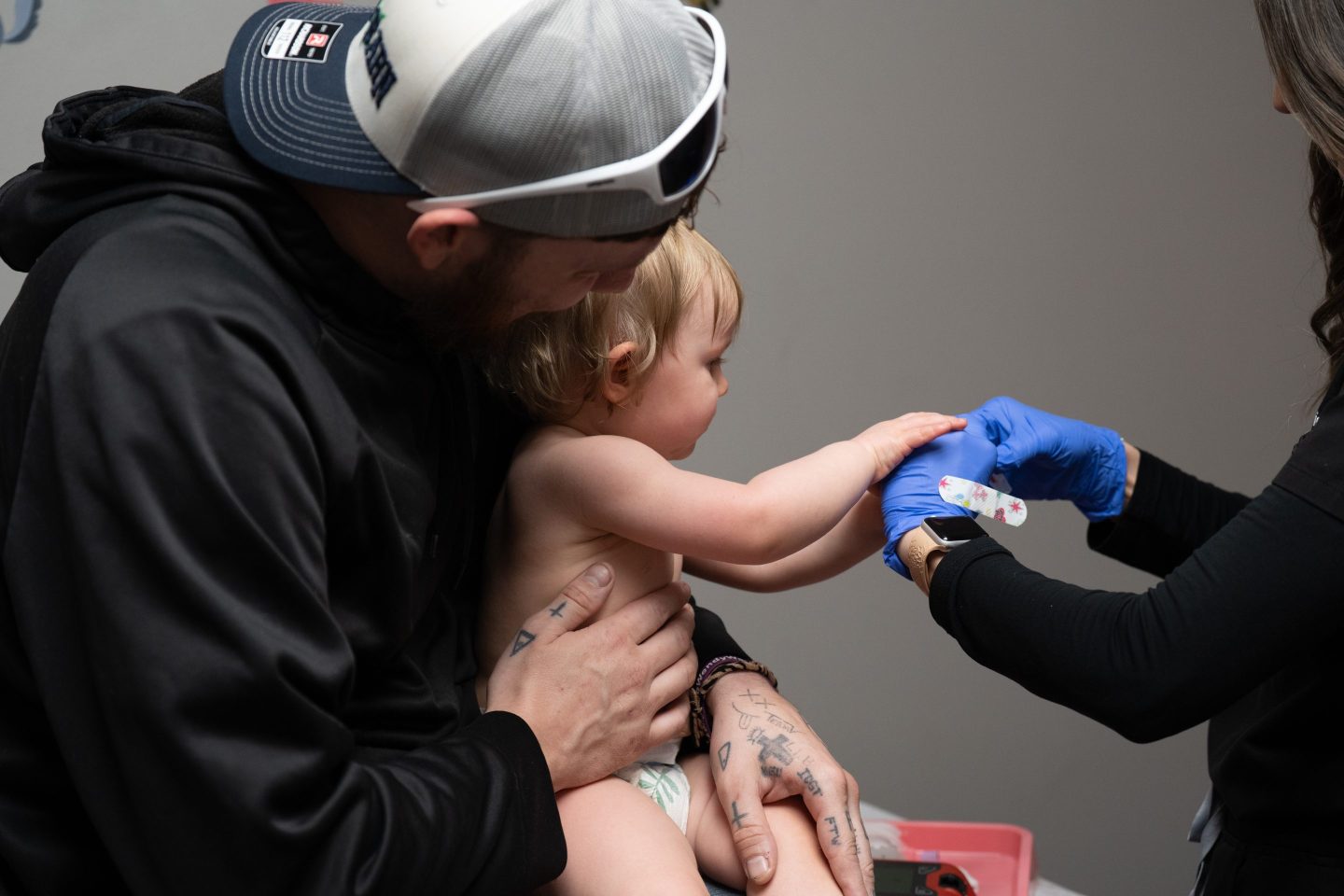
Twenty-two months after the publication of a landmark trial, a panel of experts enlisted by the NIH’s National Institute of Allergy and Infectious Diseases has issued adjusted clinical guidelines on the prevention of peanut allergies in children. The new approach (here’s a more accessible summary for parents and caregivers) is essentially a reversal of accepted practice for the last several decades—which was to keep infants who show a tendency toward allergies away from the common trigger. Now, with some caveats, allergy specialists and parents are being encouraged to give tiny amounts of peanut-containing foods (extract or powder) to their infants when they are as young as four to six months old, in some cases.
There is, it would now seem, “a window of time in which the body is more likely to tolerate a food than react to it,” Dr. Matthew Greenhawt, a food allergy expert, told the New York Times. “And if you can educate the body during that window, you’re at much lower likelihood of developing an allergy to that food.”
The Times and others have good summaries of the 2015 “LEAP trial,” which involved more than 600 allergy-high-risk infants and which led to this change in practice. But reading the new guidelines alongside the old 2010 guidelines is a good exercise in seeing how easily a paradigm shift in healthcare can occur.
But the latest report is also a reminder of how far we still have to go in preventing and treating food allergies across the board, which typically begin in childhood and can last a lifetime—causing millions of people to live snack-to-meal in a constant state of vigilance.
As many as 6% of children in the U.S. report a food allergy, a figure that has been steadily and inexplicably climbing for decades (sorry, this last paper is behind a paywall). The costs—both in ER visits due to anaphylactic reactions and in human psychic burden—are immense and growing, too. Eight foods—milk, eggs, peanuts, tree nuts, fish, shellfish, soy, and wheat—account for 90% of food allergies, but as the CDC acknowledges, “the mechanisms by which a person develops an allergy to specific foods are largely unknown.”
The good news is, there is at last some investor interest in this area. In November, for instance, Nestle put a hefty $145 million stake in Aimmune Therapeutics, a U.S. biotech, which is in late-stage trials on a peanut-allergy desensitization treatment.
I’ll be at the big J.P. Morgan Healthcare Conference next week looking for more innovation on this and other fronts. Email me if you think there’s something I should see.
Until then, Sy has the day’s news, below.
| Clifton Leaf | |
| @CliftonLeaf | |
| clifton.leaf@fortune.com |
DIGITAL HEALTH
Exclusive: Omada Health snaps up former Sanofi, Counsyl veterans in hiring push. Omada Health, a self-described "digital therapeutics" firm with a suite of tech-driven platforms to help prevent chronic conditions like diabetes and cardiovascular disease, has added former Sanofi chief medical officer Dr. Paul Chew and Tom Schoenherr, who had a significant tenure as the commercial head over at genetic sequencing firm Counsyl, as its new chief commercial officer. They are joined by Dr. Carolyn Jasik of the University of California at San Francisco and Counsyl and AstraZeneca veteran Rob Guigley. Omada's services and approach to diabetes prevention make them more akin to an actual health care provider than a services and tech company, CEO Sean Duffy tells me, adding that the firm doesn't charge employers and consumers a dime unless its platform actually improves health outcomes and reduces costs. I had a wide-ranging conversation with Duffy, Chew, and Schoenherr about the promise that digital health firms hold for tackling massive population health problems, and while pharma is beginning to look "beyond the pill," as Chew puts it. (Fortune)
Liquid biopsy star Guardant teams up with four pharma giants. Guardant Health made quite an impression at last year's American Society of Clinical Oncology (ASCO) meeting, a.k.a. the world's biggest cancer conference. The blood testing startup (no, the term doesn't have to be a dirty word) posted impressive data back then for its "liquid biopsy" diagnostic system Guardant360, which aims to distill risky and expensive surgical cancer biopsies down to a simple blood test. On Friday, the firm announced that it's teaming up with pharma giants AstraZeneca, Merck, Germany's Merck KGaA, and Pfizer to significantly expand its liquid biopsy panel to include 500-plus genes. The purpose of this particular panel and the four partnerships is to hasten drug development by eliminating the hassle of collecting tumor tissue for genetic sequencing. "With Guardant360, we have pushed our Digital Sequencing platform to the biological limits of DNA sequencing sensitivity. In a number of cases, we are now confidently detecting a single molecule of mutant circulating tumor DNA in a 10mL tube of blood drawn from an advanced cancer patient," said Helmy Eltoukhy, Guardant Health CEO and co-founder, in a statement. "Now we are applying this same underlying technology to ten times as many genomic targets in an effort to speed drug development. The result for which we are aiming is that effective drugs will get to market faster and help patients sooner." (Fortune)
How Oscar Health is prepping for the coming Obamacare storm. Backchannel has an extensive feature out on Oscar Health, the tech-driven digital insurance upstart that has family ties to one Donald J. Trump (Oscar co-founder Joshua Kushner is Trump son-in-law Jared Kushner's brother), and its plans to expand as questions swirl around the fate of the Affordable Care Act. Back in November, Kushner and Oscar CEO Mario Schlosser posted a missive on the company's website assuring investors and customers that Trump's surprise victory and hostility towards Obamacare wouldn't kill its business, which was built largely on the health law's back. One way they'll be dealing with a potential ACA dismantling? By moving beyond the rocky individual insurance market and into small group and employer plans. "Oscar does not seem to regard the probable repeal as a threat to its existence," writes Backchannel's Steven Levy. "In conversations with its top executives, they paint a picture of a company that may have made use of the ACA for its start, but can live without it." (Backchannel, Fortune)
Fitness trackers are grappling with a rough market. My colleague Adam Lashinsky is busy covering the Consumer Electronics Show (CES) in Vegas. And one of Adam's big takeaways from the week is that fitness trackers are in for a rough ride. "Gartner says about 30% of people in the U.S., Australia, and the U.K. who’ve worn fitness trackers don’t wear them anymore," he writes. "That’s a tough business model, sort of like selling diet programs to uncommitted dieters or health-club memberships to January-only athletes. In fact, it’s the ultimate uphill climb, and it explains why Jawbone is receding, Fitbit’s stock is ailing (it's now prioritizing "engagement" with existing users), and the Apple Watch is something less than the Next New Thing. (Fortune)
INDICATIONS
Sanofi/Regeneron hit a legal buzz saw over next-gen cholesterol drug. French pharma giant Sanofi and partner Regeneron faced a stunning setback on Thursday as a federal judge ordered the companies to halt sales of their next-generation cholesterol treatment Praluent for 12 years. The ruling is a coup for Amgen, which has a rival drug in the same space, and the latest salvo in an ongoing patent spat with potential billions at stake. The judge sided with Amgen's claims that Praluent infringed on patents for its own so-called PCSK9 inhibitor Repatha (these are the only two treatments of their kind that are on the market). These cholesterol-busting treatments have slashed "bad" cholesterol in clinical trials and are far more expensive than traditional statins at a list price of $14,000 per treatment course. While sales have been slow thanks to the high price and skepticism about whether or not such intense cholesterol reductions can also prevent heart problems, analysts have projected that they could eventually become multi-billion dollar per year drugs. Sanofi and Regeneron have 30 days to stop sales, and the companies plan to appeal the judge's decision during that time.
Biogen's former CEO is hopping over to a Gates Foundation-backed biotech. George Scangos, the former CEO of Biogen, is taking his talents over to a biotech startup that's drawing funding from the Bill & Melinda Gates Foundation. Vir Biotechnology is the brainchild of Arch Ventures co-founder Robert Nelsen, and it's setting out on an ambitious goal of fighting infectious diseases like tuberculosis. (Endpoints)
A big exec shakeup is underway at Eli Lilly. Eli Lilly's 2016 was marred by a clinical trial body blow that dashed the Indianapolis-based pharma's hopes of producing the first legitimately effective drug to treat Alzheimer's. The experimental solanezumab flunked a late-stage study and forced Lilly to abandon its development, which in turn forced a spate of job cuts at the company. And now that eight-year Lilly chief John Lechleiter has made his exit, new CEO David Ricks is shuffling up the executive ranks. The changes largely affect Lilly's commercial unit, which the company is attempting to streamline with fewer managers, but also involve replacing its U.S. head. Lilly is also consolidating its emerging markets and European business units into a single entity called Lilly International. (FiercePharma)
THE BIG PICTURE
Americans' feelings on Obamacare repeal are... complicated. A new Kaiser Family Foundation (KFF) survey finds that a slim plurality of Americans (49%) want to dismantle the Affordable Care Act while 47% want to preserve it. But things get a little more nuanced once you delve past the big picture question about repeal and into the nitty gritty. Of the pro-repeal crowd, most want there to be an Obamacare replacement in place rather than a "repeal-and-delay" tactic that could leave consumers, hospitals, and insurance companies alike hanging out to dry. Congress has already taken its first steps towards Obamacare repeal, and a budget resolution that would kick that process into high gear may get a final vote as early as next week. (Fortune)
Medicare failed to claw back $125 million in excess payments to insurers. The Medicare Advantage program is receiving scrutiny over a new audit finding that the federal government settled over-charging disputes with private insurers for just $3.4 million in 2012, missing out on a possible $125 million in taxpayer recompense for 2007 charges alone. "It's unclear why the Obama Administration allowed CMS to overpromise and under-deliver so badly on collecting these overpayments," said Iowa Sen. Chuck Grassley in a statement to Kaiser Health News. (NPR)
REQUIRED READING
The Top 15 Gadgets from CES So Far, by Kristen Hom
Martin Shkreli Is Looking for a Date to Donald Trump's Inauguration, by Abigail Abrams
This Japanese Company Is Replacing Its Staff With Artificial Intelligence, by Kevin Lui
Alexa Rules, Fitness Trackers Lag, and Other CES Week Revelations, by Adam Lashinsky
| Produced by Sy Mukherjee | |
| @the_sy_guy | |
| sayak.mukherjee@fortune.com |
Find past coverage. Sign up for other Fortune newsletters.