This story has been updated.
Apple has launched a legal challenge to a record $14 billion EU tax demand, arguing that EU regulators ignored tax experts and corporate law and deliberately picked a method to maximize the penalty, senior executives said.
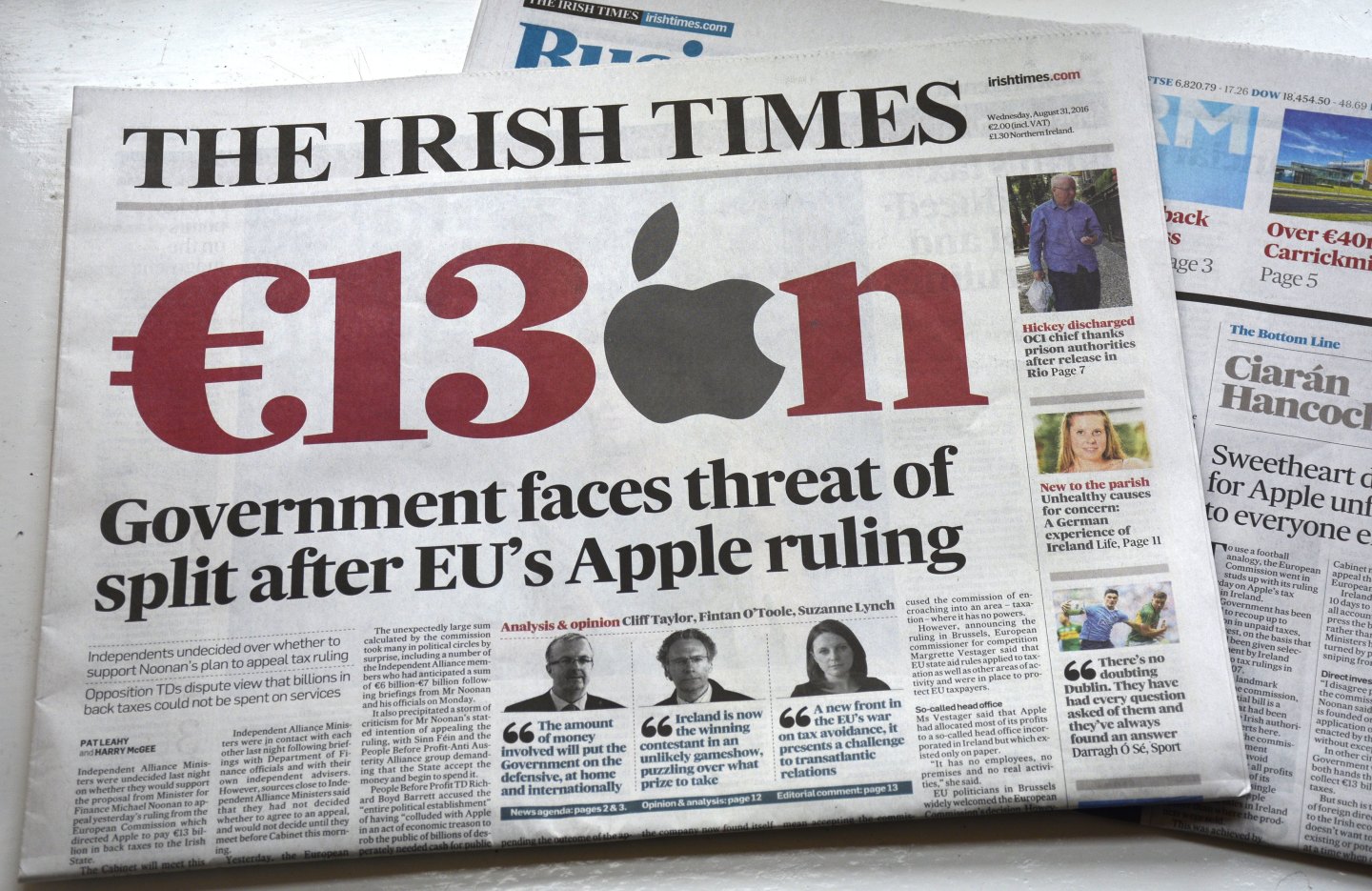
Apple’s combative stand underlines its anger with the European Commission, which said on Aug. 30 the company’s Irish tax deal was illegal state aid and ordered it to repay up to 13 billion euros ($13.8 billion) to Ireland, where Apple has its European headquarters.
European Competition Commissioner Margrethe Vestager, a former Danish economy minister, said Apple’s Irish tax bill implied a tax rate of 0.005% in 2014.
General Counsel Bruce Sewell and Chief Financial Officer Luca Maestri outlined in an interview with Reuters at Apple’s global headquarters in Cupertino the company’s plans for its appeal against the Commission’s ruling at Europe’s second highest court.
The iPhone and iPad maker was singled out because of its success, Sewell said.
“Apple is not an outlier in any sense that matters to the law. Apple is a convenient target because it generates lots of headlines. It allows the commissioner to become Dane of the year for 2016,” he said, referring to the title accorded to Vestager by Danish newspaper Berlingske last month.
Apple (AAPL) will tell judges the Commission was not diligent in its investigation because it disregarded tax experts brought in by Irish authorities.
“Now the Irish have put in an expert opinion from an incredibly well-respected Irish tax lawyer. The Commission not only didn’t attack that—didn’t argue with it, as far as we know—they probably didn’t even read it. Because there is no reference (in the EU decision) whatsoever,” Sewell said.
Sheltering Profits
The European Commission accused Ireland in 2014 of dodging international tax rules by letting Apple shelter profits worth tens of billions of dollars from tax collectors in return for maintaining jobs. Apple and Ireland denied the accusation.
On Monday the Commission published the detailed version of its decision which may provide clues as to how the Commission will deal with similar tax cases in future.
It cited, for example, notes of a meeting in 1990 between Apple’s tax adviser and the Irish revenue service discussing an appropriate level of profits Apple’s Irish unit would pay tax on—Apple’s adviser suggesting a ceiling of $30-40 million.
“[Apple’s tax adviser] confessed there was no scientific basis for the figure. However the figure was of such magnitude that he hoped it would be seen to be a bona-fide proposal,” the excerpt read.
Ireland’s tax treatment has allowed Apple to avoid tax on tens of billions of dollars of non-U.S. profit. Over the past 10 years, the company has paid tax at a rate of 3.8% on $200 billion of overseas profits, filings show. This is a fraction of the tax rate in the countries where Apple’s products are designed, made and sold.
The low rate is achieved by Apple telling U.S. tax authorities that the profits are earned by Irish units. Meanwhile it tells Ireland the profits are not earned in Ireland.
Some lawmakers in the United States and in countries where Apple has large sales have criticized the arrangement.
Ireland says if it’s not fair, it’s other countries’ fault for not closing loopholes. On Monday Ireland accused the Commission of exceeding its powers and interfering with EU member states’ national sovereignty over tax affairs.
Apple also intends to challenge the EU enforcer’s basis for its case, arguing that what Sewell called the “crazy notion of non-residency” was chosen on purpose to produce a punitive amount.
Other arguments the EU could have used could have been based on transfer pricing—the pricing strategy between a company’s units—or the “arm’s length” principle adopted by companies to sell and buy from affiliates as if they were unrelated firms.
“Both of those other two theories at least could be fleshed out, but they produced much lower numbers,” Sewell said.
He added it was not possible for Apple to comply with the EU decision because it would mean Ireland violating its own past tax laws setting different rules for residents and non-resident companies.
Apple plans to tell the court that the Commission erred when it ruled that the head office of Irish-registered units Apple Sales International (ASI) and Apple Operations Europe existed only on paper, with no justification for the billions of euros it posted in untaxed profits.
Sewell said the fact that an entity was a holding company with no employees on its books did not mean it was inactive and it could be actively managed by employees of its parent company.
“So when Tim Cook, who is the CEO of our company, makes decisions that impact ASI, the Commission says we don’t care because he is not an ASI employee, he is an Apple Inc employee. But to say that somehow Tim Cook can’t make decisions for ASI is a complete mis-statement of corporate law, it’s a misunderstanding of how corporations operate,” he said.
For more about Apple’s iPhone 7, watch:
‘Absurd Theory’
Maestri said the Commission over-estimated the importance of the company’s European headquarters in Cork in the south of Ireland.
“(Vestager) is arguing that the base on which we should pay taxes in Ireland is essentially all the profits we generate outside the United States … in a place that doesn’t do any engineering, doesn’t generate any intellectual property for us,” he said, adding it was an “absurd theory.”
The company hopes U.S. president-elect Donald Trump will enact tax reforms, Sewell said.
The U.S. tax system, Sewell said, was a worldwide system while the rest of the world had territorial systems.
“The difference between those two creates exactly the kind of loophole that the Commission has now been able to exploit,” he said.