• Home
  • Latest
  • Fortune 500
  • Finance
  • Tech
  • Leadership
  • Lifestyle
  • Rankings
  • Multimedia
Leadership

Here’s Why Repealing Obamacare Will Be Risky for Donald Trump and the GOP

By
The Associated Press
Down Arrow Button Icon
By
The Associated Press
Down Arrow Button Icon
November 22, 2016, 7:21 AM ET
Trump Health Care Law
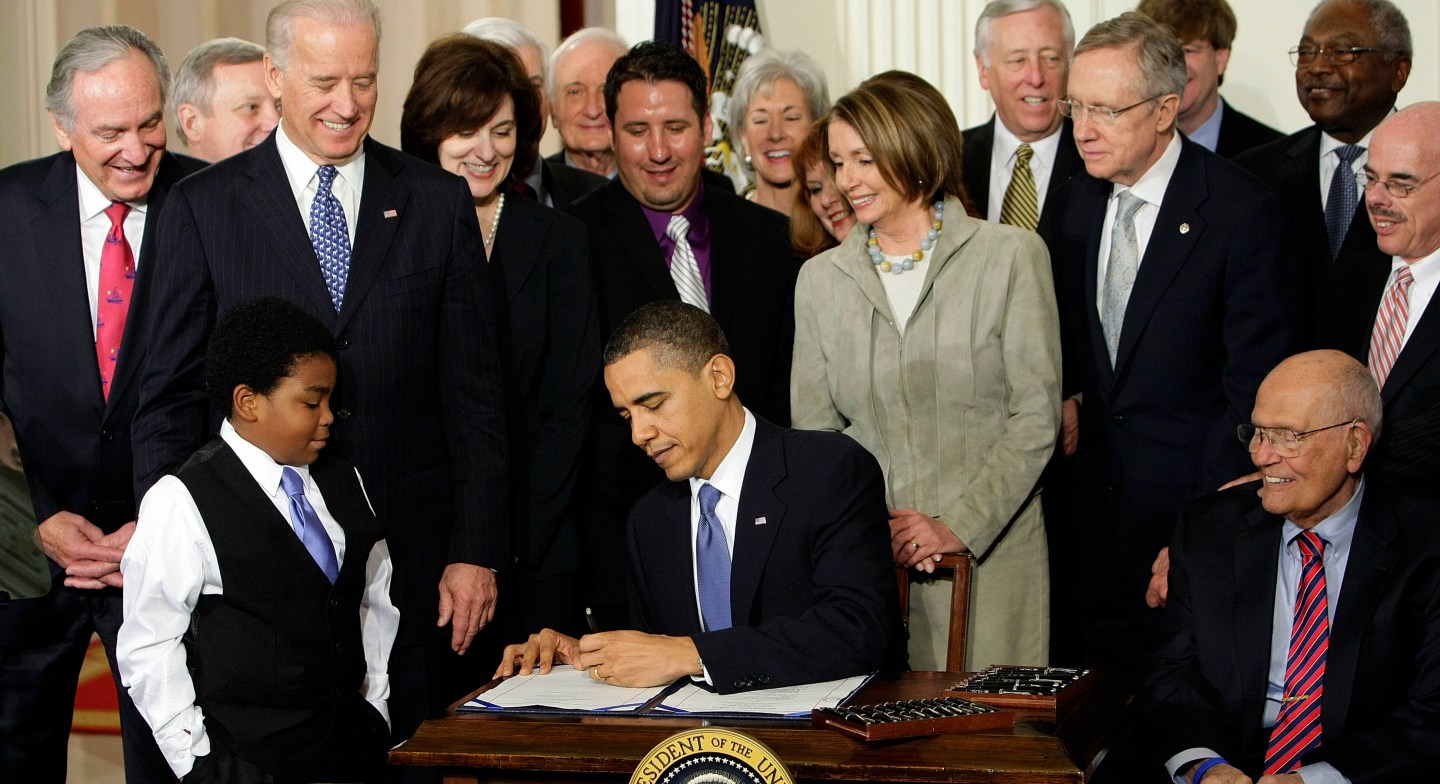
FILE - In this March 23, 2010 file photo, President Barack Obama signs the health care bill in the East Room of the White House in Washington. Here’s the idea: Swiftly pass a repeal of President Barack Obama's health care law, perhaps so Donald Trump can sign it the day he takes the presidential oath. Then approve new legislation restructuring the nation’s huge and convoluted health care system despite Republican divisions, Democratic opposition and millions of jittery constituents. (AP Photo/J. Scott Applewhite, File)Photograph by J. Scott Applewhite—AP

Here’s the idea: Swiftly pass a repeal of President Barack Obama’s health care law, perhaps soon enough for Donald Trump to sign it the day he takes the presidential oath. Then approve legislation restructuring the nation’s huge and convoluted health care system—despite Republican divisions, Democratic opposition and millions of jittery constituents.

What could go wrong?

With Republicans controlling the White House and Congress in January, they’re faced with delivering on their long-time promise to repeal and replace “Obamacare.” Here are hurdles they’ll face:


Speed vs. Deliberation

Trump and congressional Republicans will be under intense pressure from their core conservative supporters to repeal Obama’s 2010 health care law—and fast. After all, Congress already sent Obama a repeal bill last January, which he vetoed, and many GOP voters will see no reason for delays this time.

But there probably won’t be anything fast about Congress’ effort to replace Obama’s law, which is likely to take many months.

While the replacement effort is underway, Republicans will risk aggravating up to 30 million people who are covered by the law or buy policies with prices affected by its insurance marketplace. Democrats will be sure to accuse the GOP of threatening the health care of millions.


A Solution

Nothing’s been decided, but here’s one likely scenario:

The new Congress, which convenes Jan. 3, tries to quickly approve legislation repealing Obama’s health care law, maybe completing it by Trump’s Jan. 20 inauguration or soon after. But the repeal would not take effect until the future, perhaps a year later, to give lawmakers time to fashion a replacement. The version Obama vetoed had a two-year delay.

Seemingly acknowledging that two-step process, Vice President-elect Mike Pence said Sunday on Fox News Sunday that Trump “wants to focus out of the gate on repealing Obamacare and beginning the process of replacing Obamacare.”

Because Republicans will control the Senate by just 52-48, Congress will first have to approve special budget procedures to prevent Democrats from stopping repeal legislation by filibuster. Bill-killing filibusters require 60 votes to end.

But those special rules would apply only to items that affect the federal budget. Republicans, for example, would need a simple Senate majority to end IRS penalties against people who don’t buy insurance but would still need 60 votes—requiring Democratic support—for other changes such as raising limits on older people’s premiums.

House Budget Committee Chairman Tom Price, R-Ga., says that will restrain Republicans’ ability to ram a “lock, stock and barrel” repeal through Congress.


GOP Risks

One GOP danger: Congress and Trump might repeal Obama’s law, but while they’re laboring on a replacement, nervous insurance companies begin pulling out of markets and raising premiums. Insurers have been doing that under Obama, but now it would occur under a Republican government.

Another hazard: Congress’ work could spill into the 2018 campaign season, when the entire House and a third of the Senate face re-election. Republicans will grow increasingly timid about anything that might anger voters.

“We want to be the rescue party instead of the party that pushes millions of Americans who are hanging by the edge of their fingernails over the cliff,” says Sen. Lamar Alexander, R-Tenn., who chairs the Senate Health committee.


GOP Pathways

Virtually all Republicans want to get rid of the health law’s mandates that individuals buy coverage or risk IRS fines, and that large employers insure workers.

They also want to erase taxes on higher-earning people and the health care sector. And they’d like to retain parts of the law guaranteeing coverage for people with pre-existing medical problems and keeping children under age 26 on family plans.

Unifying Republicans much beyond that is a work in progress.

Trump’s health care views have varied and lack detail. His campaign website touts tax deductions for health insurance premiums and permitting policies to be sold across state lines. He’d also revamp Medicaid, which subsidizes health coverage for low-income people, directing fixed amounts of money to states and letting them structure benefits.

House Speaker Paul Ryan, R-Wis., last summer unveiled an outline of the House GOP’s solution, though it lacked cost estimates and details. It would provide tax credits, impose taxes on the most generous employer-provided health care plans, revamp Medicaid and let Medicare beneficiaries pick private plans instead of today’s fee-for-service coverage.

Senate Finance Committee Chairman Orrin Hatch, R-Utah, has also advanced a framework relying heavily on tax credits.


Remaining Questions

Thirty-one states—including Pence’s Indiana, where he is governor—plus the District of Columbia have expanded Medicaid coverage to 9 million additional people under Obama’s law. Curtailing that program will divide Republicans.

Taxing the value of some employer-provided health plans, aimed at curbing the growth of costs, is “a political land mine,” says GOP economist Douglas Holtz-Eakin. Republicans have long resisted tax increases.

Obama’s law mandates coverage for individuals because without that requirement many healthy people would forgo policies, driving up costs for everyone else and destabilizing insurance markets. Ryan has proposed shielding people from higher premiums if they’ve had “continuous coverage,” allowing higher rates for people who have not had policies, but Republicans have yet to decide how to keep insurance markets viable.
About the Author
By The Associated Press
See full bioRight Arrow Button Icon

Latest in Leadership

Finance
Lorem ipsum dolor sit amet, consectetur adipiscing elit, sed do eiusmod tempor incididunt ut labore et dolore magna aliqua. Ut enim ad minim veniam
By Fortune Editors
October 20, 2025
Finance
Lorem ipsum dolor sit amet, consectetur adipiscing elit, sed do eiusmod tempor incididunt ut labore et dolore magna aliqua. Ut enim ad minim veniam
By Fortune Editors
October 20, 2025
Finance
Lorem ipsum dolor sit amet, consectetur adipiscing elit, sed do eiusmod tempor incididunt ut labore et dolore magna aliqua. Ut enim ad minim veniam
By Fortune Editors
October 20, 2025
Finance
Lorem ipsum dolor sit amet, consectetur adipiscing elit, sed do eiusmod tempor incididunt ut labore et dolore magna aliqua. Ut enim ad minim veniam
By Fortune Editors
October 20, 2025
Finance
Lorem ipsum dolor sit amet, consectetur adipiscing elit, sed do eiusmod tempor incididunt ut labore et dolore magna aliqua. Ut enim ad minim veniam
By Fortune Editors
October 20, 2025
Finance
Lorem ipsum dolor sit amet, consectetur adipiscing elit, sed do eiusmod tempor incididunt ut labore et dolore magna aliqua. Ut enim ad minim veniam
By Fortune Editors
October 20, 2025

Most Popular

Finance
Lorem ipsum dolor sit amet, consectetur adipiscing elit, sed do eiusmod tempor incididunt ut labore et dolore magna aliqua. Ut enim ad minim veniam
By Fortune Editors
October 20, 2025
Finance
Lorem ipsum dolor sit amet, consectetur adipiscing elit, sed do eiusmod tempor incididunt ut labore et dolore magna aliqua. Ut enim ad minim veniam
By Fortune Editors
October 20, 2025
Finance
Lorem ipsum dolor sit amet, consectetur adipiscing elit, sed do eiusmod tempor incididunt ut labore et dolore magna aliqua. Ut enim ad minim veniam
By Fortune Editors
October 20, 2025
Finance
Lorem ipsum dolor sit amet, consectetur adipiscing elit, sed do eiusmod tempor incididunt ut labore et dolore magna aliqua. Ut enim ad minim veniam
By Fortune Editors
October 20, 2025
Finance
Lorem ipsum dolor sit amet, consectetur adipiscing elit, sed do eiusmod tempor incididunt ut labore et dolore magna aliqua. Ut enim ad minim veniam
By Fortune Editors
October 20, 2025
Finance
Lorem ipsum dolor sit amet, consectetur adipiscing elit, sed do eiusmod tempor incididunt ut labore et dolore magna aliqua. Ut enim ad minim veniam
By Fortune Editors
October 20, 2025
Rankings
  • 100 Best Companies
  • Fortune 500
  • Global 500
  • Fortune 500 Europe
  • Most Powerful Women
  • Future 50
  • World’s Most Admired Companies
  • See All Rankings
Sections
  • Finance
  • Leadership
  • Success
  • Tech
  • Asia
  • Europe
  • Environment
  • Fortune Crypto
  • Health
  • Retail
  • Lifestyle
  • Politics
  • Newsletters
  • Magazine
  • Features
  • Commentary
  • Mpw
  • CEO Initiative
  • Conferences
  • Personal Finance
  • Education
Customer Support
  • Frequently Asked Questions
  • Customer Service Portal
  • Privacy Policy
  • Terms Of Use
  • Single Issues For Purchase
  • International Print
Commercial Services
  • Advertising
  • Fortune Brand Studio
  • Fortune Analytics
  • Fortune Conferences
  • Business Development
About Us
  • About Us
  • Editorial Calendar
  • Press Center
  • Work At Fortune
  • Diversity And Inclusion
  • Terms And Conditions
  • Site Map
  • Facebook icon
  • Twitter icon
  • LinkedIn icon
  • Instagram icon
  • Pinterest icon

Most Popular

placeholder alt text
North America
'I meant what I said in Davos': Carney says he really is planning a Canada split with the U.S. along with 12 new trade deals
By Rob Gillies and The Associated PressJanuary 28, 2026
3 days ago
placeholder alt text
Politics
The American taxpayer spent nearly half a billion dollars deploying federal troops to U.S. cities in 2025, CBO finds
By Nick LichtenbergJanuary 28, 2026
2 days ago
placeholder alt text
Economy
Right before Trump named Warsh to lead the Fed, Powell seemed to respond to some of his biggest complaints about the central bank
By Jason MaJanuary 30, 2026
11 hours ago
placeholder alt text
C-Suite
Jeff Bezos capped his Amazon salary at $80,000: ‘How could I possibly need more incentive?’
By Sydney LakeJanuary 28, 2026
2 days ago
placeholder alt text
C-Suite
Fortune 500 CEOs are no longer giving employees an A for effort. Now they want proof of impact
By Claire ZillmanJanuary 28, 2026
3 days ago
placeholder alt text
Investing
Jerome Powell got a direct question about the U.S. ‘losing credibility’ and the soaring price of gold and silver. He punted
By Eva RoytburgJanuary 29, 2026
2 days ago

© 2026 Fortune Media IP Limited. All Rights Reserved. Use of this site constitutes acceptance of our Terms of Use and Privacy Policy | CA Notice at Collection and Privacy Notice | Do Not Sell/Share My Personal Information
FORTUNE is a trademark of Fortune Media IP Limited, registered in the U.S. and other countries. FORTUNE may receive compensation for some links to products and services on this website. Offers may be subject to change without notice.


Latest in Leadership

C-SuitePharmaceutical Industry
‘We’ll save the world from cancer’: Inside Pfizer CEO’s $23 billion post‑COVID bet on oncology
By Nick LichtenbergJanuary 30, 2026
10 hours ago
C-SuiteFortune 500 Power Moves
Fortune 500 Power Moves: Which executives gained and lost power this week
By Fortune EditorsJanuary 30, 2026
12 hours ago
Sweat cofounder Kayla Itsines
SuccessHow I made my first million
Kayla Itsines became a millionaire at 22 and sold her fitness app for $400 million—buying a gas station paid her rent
By Emma BurleighJanuary 30, 2026
12 hours ago
niccol
Workplace CultureStarbucks
‘What do you think is going on with the stock price?’: Starbucks CEO Brian Niccol says baristas’ market savvy makes him proud
By Jake AngeloJanuary 30, 2026
12 hours ago
SuccessCareers
Kevin Warsh went from selling racetrack pencils to Trump’s new Fed chair pick. His advice for Gen Z: Merit is the ultimate currency in the workplace
By Preston ForeJanuary 30, 2026
13 hours ago
phone
Arts & EntertainmentSocial Media
Twenty-somethings discover nostalgia, throwing back to a carefree time before the ‘dark days’: 2016
By Pavan Mahal and The Associated PressJanuary 30, 2026
15 hours ago