• Home
  • News
  • Fortune 500
  • Tech
  • Finance
  • Leadership
  • Lifestyle
  • Rankings
  • Multimedia
Finance

Why Bond Markets Hate Donald Trump

By
Chris Matthews
Chris Matthews
Down Arrow Button Icon
By
Chris Matthews
Chris Matthews
Down Arrow Button Icon
November 15, 2016, 4:53 PM ET
Donald Trump
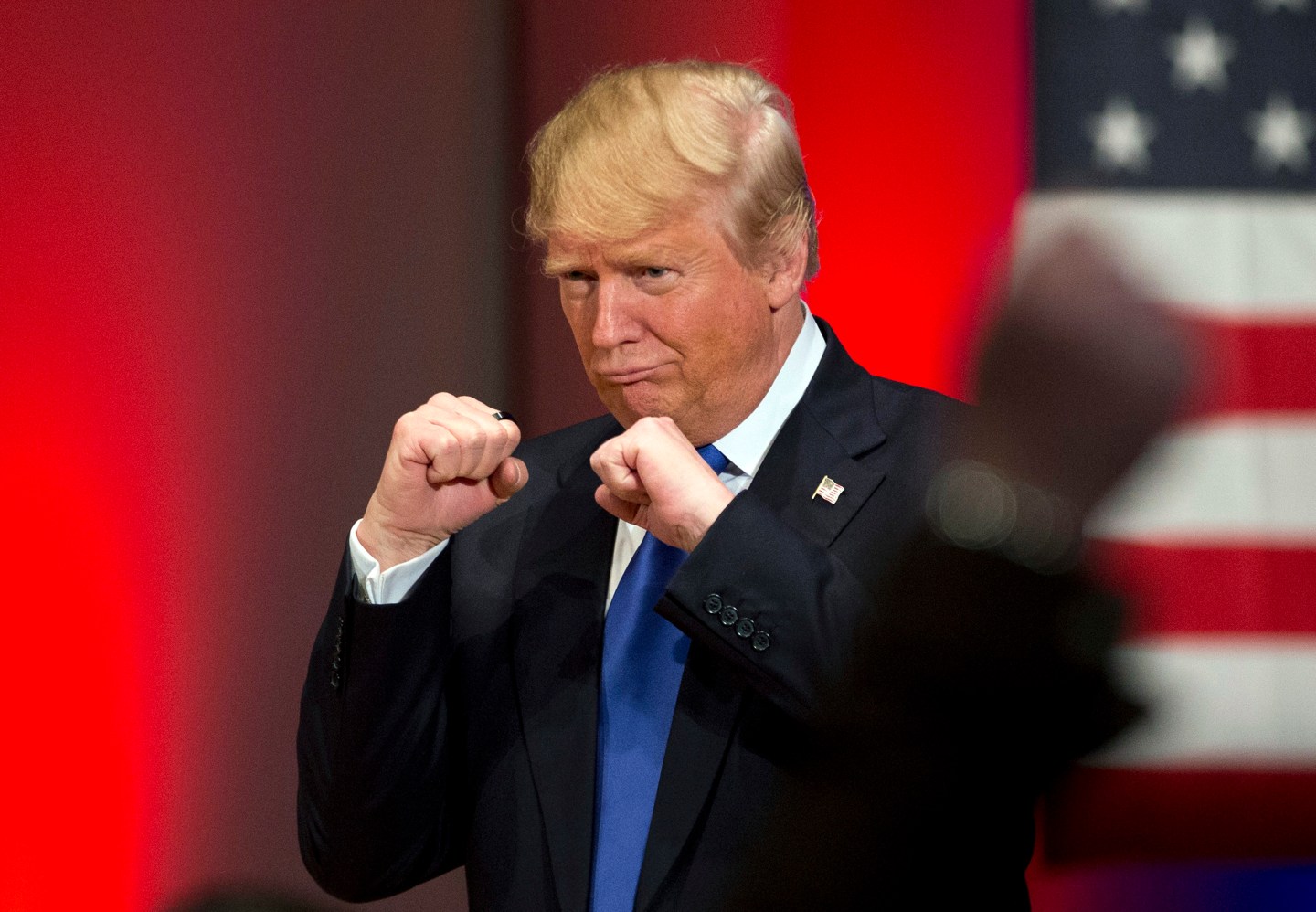
FILE - In this Jan. 28, 2016, file photo, Republican presidential candidate Donald Trump poses with a ring given to him by a group of veterans during a campaign event on the campus of Drake University in Des Moines, Iowa. (AP Photo/Jae C. Hong, File)Photograph by Jae C. Hong—AP

The biggest x factor in the global economy is the Donald Trump Administration.

Just ask financial markets, which have reacted strongly to last week’s election. Stock markets have perked up on the news, betting that Trump will increase infrastructure spending, while cutting taxes and regulations.

But bond markets have cratered—prices have fallen a big for the bond market 1.4% in past week—since the Nov. 8 election, breaking a recent streak in which stocks and bonds have been strongly correlated. That correlation has some theoretical backing: If financial assets’ value is determined by the present value of future income, then it makes sense that both stocks and bonds will be worth more if the economy is doing well, as a stronger economy means higher earnings which is a boon for both lenders and owners of stock.

But the existence of inflation throws a wrench in this logic. The higher inflation gets, the worse bonds will perform. That’s because bond investors will receive fixed payments regardless of the level of inflation, which erodes the real value of those payments over time. The value of equity investments, however, is a bit more flexible. Companies can raise prices or dividends in response to higher inflation, protecting the value of a stock investment.

But in a world of low or even nonexistent inflation, this dynamic had little effect on financial markets.

png-9465-full

As you can see from the above chart, stocks and bonds correlated strongly over the past year, but that all changed last week. According to Jim O’Sullivan, Chief U.S. Economist with High Frequency Economics, “prospects of new stimulus has clearly been a driver of the bond market,” since last week’s presidential election. Bond investors have been selling U.S. Treasuries and other bonds, predicting that a Trump Administration would follow through on its promises to spend big on infrastructure and tax cuts.

Such spending at a time of low unemployment and rising wages should cause prices to rise, eroding the value of bonds. At the same time, more government spending should boost overall demand in the economy and be a boon for stock prices, especially those in the construction sector that rely heavily on government contracts.

There are several flaws in the markets thinking, however. While the U.S. government is unified under Republican rule, it’s not unified ideologically. The Republican Congress has been pushing for tax cuts, sure, but it’s also believes in cuts in entitlement and other spending, with the goal of balancing the federal budget within 10 years. That would necessitate deep cuts to programs that benefit poor and middle-class Americans, sapping their spending power. The benefits of such a program would also filter to the well-off, who are more inclined to save windfall income rather than spend it.

Second, higher inflation could cause the Fed to move to raise rates, which won’t be good for bonds, but shouldn’t be good for stocks either. “I’m very confident that this rise in rates is very dangerous in equities as a whole, not just in some sectors,” Peter Boockvar, chief market analyst for The Lindsey Group, told MarketWatch.

Boockvar argues the the stock market is already expensive, in terms of price-to-earnings ratio, as a result of central banks pushing easy money on markets and the lack of other investment opportunities. Meanwhile, if Trump follows up on anti-growth measures like putting up trade barriers, that could take the steam out of the ability of tax and regulation cuts to increase economic growth.

This is why economists from Goldman Sachs are warning that a Trump Administration could usher in an era of “stagflation” where the economy sees rising prices but slow growth to go along with. If this scenario comes to fruition, bond markets will continue to fall, but the stock market won’t be far behind.


About the Author
By Chris Matthews
See full bioRight Arrow Button Icon

Latest in Finance

A computer screen with the Vanguard logo on it
CryptoBlockchain
Vanguard has a change of heart on crypto, lists Bitcoin and other ETFs
By Carlos GarciaDecember 2, 2025
4 hours ago
Anthropic cofounder and CEO Dario Amodei
AIEye on AI
How Anthropic’s safety first approach won over big business—and how its own engineers are using its Claude AI
By Jeremy KahnDecember 2, 2025
6 hours ago
Costco
BankingTariffs and trade
Costco sues Trump, demanding refunds on tariffs already paid
By Paul Wiseman and The Associated PressDecember 2, 2025
6 hours ago
Man on private jet
SuccessWealth
CEO of $5.6 billion Swiss bank says country is still the ‘No. 1 location’ for wealth after voters reject a tax on the ultrarich
By Jessica CoacciDecember 2, 2025
8 hours ago
Elon Musk, standing with his arms crossed, looks down at Donald Trump sitting at his desk in the Oval Office
EconomyTariffs and trade
Elon Musk says he warned Trump against tariffs, which U.S. manufacturers blame for a turn to more offshoring and diminishing American factory jobs
By Sasha RogelbergDecember 2, 2025
8 hours ago
layoffs
EconomyLayoffs
What CEOs say about AI and what they mean about layoffs and job cuts: Goldman Sachs peels the onion
By Nick LichtenbergDecember 2, 2025
8 hours ago

Most Popular

placeholder alt text
Economy
Ford workers told their CEO 'none of the young people want to work here.' So Jim Farley took a page out of the founder's playbook
By Sasha RogelbergNovember 28, 2025
4 days ago
placeholder alt text
Success
Warren Buffett used to give his family $10,000 each at Christmas—but when he saw how fast they were spending it, he started buying them shares instead
By Eleanor PringleDecember 2, 2025
15 hours ago
placeholder alt text
Success
Forget the four-day workweek, Elon Musk predicts you won't have to work at all in ‘less than 20 years'
By Jessica CoacciDecember 1, 2025
1 day ago
placeholder alt text
Economy
Elon Musk says he warned Trump against tariffs, which U.S. manufacturers blame for a turn to more offshoring and diminishing American factory jobs
By Sasha RogelbergDecember 2, 2025
8 hours ago
placeholder alt text
Innovation
Google CEO Sundar Pichai says we’re just a decade away from a new normal of extraterrestrial data centers
By Sasha RogelbergDecember 1, 2025
1 day ago
placeholder alt text
Personal Finance
Current price of gold as of December 1, 2025
By Danny BakstDecember 1, 2025
1 day ago
Rankings
  • 100 Best Companies
  • Fortune 500
  • Global 500
  • Fortune 500 Europe
  • Most Powerful Women
  • Future 50
  • World’s Most Admired Companies
  • See All Rankings
Sections
  • Finance
  • Leadership
  • Success
  • Tech
  • Asia
  • Europe
  • Environment
  • Fortune Crypto
  • Health
  • Retail
  • Lifestyle
  • Politics
  • Newsletters
  • Magazine
  • Features
  • Commentary
  • Mpw
  • CEO Initiative
  • Conferences
  • Personal Finance
  • Education
Customer Support
  • Frequently Asked Questions
  • Customer Service Portal
  • Privacy Policy
  • Terms Of Use
  • Single Issues For Purchase
  • International Print
Commercial Services
  • Advertising
  • Fortune Brand Studio
  • Fortune Analytics
  • Fortune Conferences
  • Business Development
About Us
  • About Us
  • Editorial Calendar
  • Press Center
  • Work At Fortune
  • Diversity And Inclusion
  • Terms And Conditions
  • Site Map

© 2025 Fortune Media IP Limited. All Rights Reserved. Use of this site constitutes acceptance of our Terms of Use and Privacy Policy | CA Notice at Collection and Privacy Notice | Do Not Sell/Share My Personal Information
FORTUNE is a trademark of Fortune Media IP Limited, registered in the U.S. and other countries. FORTUNE may receive compensation for some links to products and services on this website. Offers may be subject to change without notice.