• Home
  • Latest
  • Fortune 500
  • Finance
  • Tech
  • Leadership
  • Lifestyle
  • Rankings
  • Multimedia
Commentary

What the Last U.S. Presidential Debate Means for Voter Turnout

By
Robert Lowry
Robert Lowry
and
Bethany Cianciolo
Down Arrow Button Icon
October 23, 2016, 11:00 AM ET
TOPSHOT-US-VOTE-DEBATE
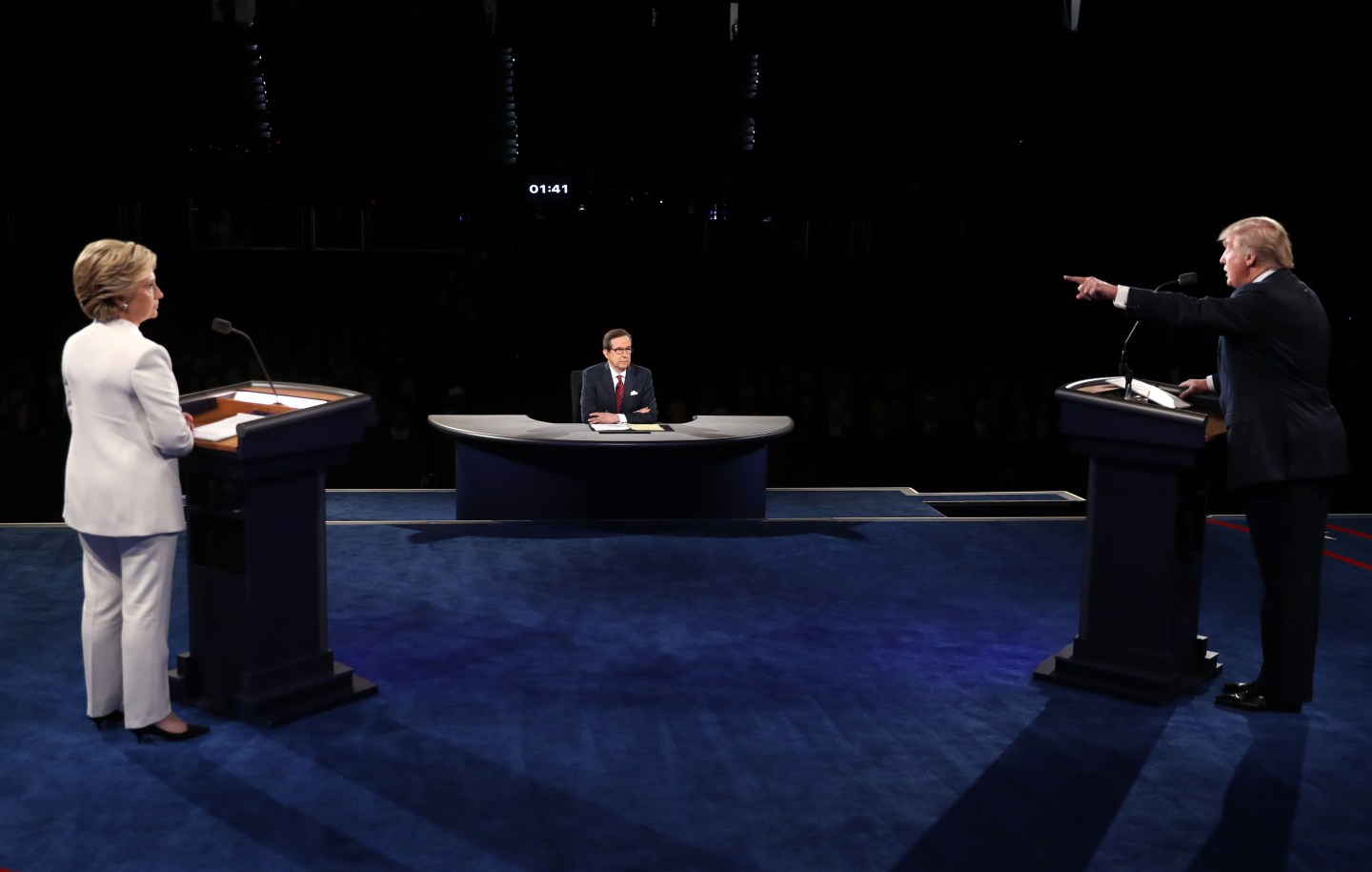
Democratic nominee Hillary Clinton (L) and Republican nominee Donald Trump take part in the final presidential debate at the Thomas & Mack Center on the campus of the University of Las Vegas in Las Vegas, Nevada on October 19, 2016. Democrat Hillary Clinton and rival Donald Trump face off in their last presidential debate on October 19, with the Republican candidate spiraling downward amid allegations of sexual misconduct and wild charges of a "rigged" US election. / AFP / POOL / joe raedle (Photo credit should read JOE RAEDLE/AFP/Getty Images)Joe Raedle — AFP/Getty Images

When teaching undergraduate political science classes, I always include essay questions on my exams. Inevitably, someone asks how long the answers should be, to which I respond that length, per se, isn’t the issue; what’s important is to answer the whole question and be specific. Don’t just write glittering generalities that dance all around the question without really answering it.

By this standard, neither Donald Trump nor Hillary Clinton fared very well in their final debate on Wednesday. The examples for Trump are everywhere. Pick any random page from the transcript, and odds are he’s changing the subject or spouting generalities—or both. And Clinton is just as guilty. A good example is her response to the question about whether donors to the Clinton Foundation received special treatment from her as secretary of state. She responded with one sentence, saying the State Department concluded that all of her actions furthered the nation’s values and interests, and then went on to praise the Foundation’s activities. The first sentence did not address her pledge to avoid even the appearance of a conflict of interest, nor did it discount the possibility that other actions—which might have served the nation just as well, or better—were never even considered. The rest of the answer was all glittering irrelevancies. If this were an undergraduate essay exam, I would give her answer no more than six out of 10 points.

There were many other issues where both candidates wandered far from the initial question. In one segment, the topic was supposed to be immigration, but somehow, they ended up arguing about whether Russia was responsible for hacking John Podesta’s emails. Between nonresponsive answers, glittering generalities, and ad hominem attacks, I still have no idea how Trump’s plan for the economy is supposed to work. He intends to negotiate “great” trade deals and cut business taxes “massively.” He never discussed how the benefits of growth resulting from a cut in business taxes would be distributed (the trickle-down effect), and independent economists have said that his proposal would add trillions to the national debt. Trump has also never said just how his trade deals would differ from current treaties. I suppose he would claim he doesn’t want to telegraph his negotiating strategy, but absent more details, his whole program boils down to, “Trust me.” Debating the nitty gritty of policy is supposed to be Clinton’s great strength, but she, too, tended to be vague. On immigration, moderator Chris Wallace pointed out that she has never been specific about how she plans to secure the southern border, and she still didn’t provide any specifics Wednesday. On many issues, she could refer viewers to her website, but a position paper on a website is no substitute for live give-and-take with a moderator and an opponent.

The problem with my argument so far is it assumes the candidates should approach the debate as they would a political science exam, where the object is to give the correct answers according to some (more-or-less) objective standard. Rather, the candidates’ objective is to win the election, and each debate is just one move in a larger game. Many viewers of the vice-presidential debate criticized Tim Kaine for interrupting and being too aggressive, but it was later reported that the campaign’s real goal in that debate was to generate sound bites that could be inserted into television ads. I am also aware that political science professors are not typical voters. It is sometimes argued that a good way to judge how voters will react to a debate is to watch it with the sound turned off, whereas I mostly care about the content of the answers. I would much rather read a transcript without pictures than watch a video without sound.

Assuming that Trump’s objective is to win the election (though I’m still not convinced he actually wants to do the day-to-day job), he needed to reassure his base, persuade some undecided voters—if there still are any, and discourage Clinton’s supporters. He probably did the first, I seriously doubt he did the second, and the third remains to be seen. Most of the post-debate attention has been focused on his statement that he may not accept the results of the election—unless he wins, of course. While some think this will depress voter turnout, it may have the opposite effect among Clinton supporters. From their standpoint, the best way to avoid an ugly situation is a convincing Clinton victory. Similarly, his refusal to accept the intelligence community’s conclusion that Russia is behind the email hacks may further motivate those who are primarily voting against Trump rather than for Clinton.


Clinton needed to avoid making any major gaffes, and build a positive case for herself rather than just a negative case against Trump. She appears to have succeeded at the first. Even on subjects like the Clinton Foundation, the problem was that she was nonresponsive, as opposed to saying something that could be used against her. Although I would have liked to see more of a positive case, I’m not sure that was the campaign’s own assessment, and in any event, the opportunity to make the case depended on the topics discussed and the amount of time she needed to spend interacting with her opponent.

For me, the bottom line is that Wednesday’s debate didn’t really change much. With respect to policy proposals, I’m not sure I gained any new, credible, substantive information. Trump reinforced existing concerns about his veracity, character, and temperament. In another election against another opponent, Clinton’s (non)answers regarding the Clinton Foundation and her and her staff’s emails could have caused real trouble. In this election, her strategy of saying little and keeping the focus on Trump isn’t going to persuade any Trump supporters, but it may not cause her to lose ground either.

As for whether the debates themselves are really all that valuable, it is important to remember that candidates are the ones who ultimately control what information they provide, and their objectives may be quite different from those of voters or the media. In particular, it is not reasonable to expect the debates to be civics lessons or public policy seminars, even in years that are not so dominated by issues of character and personality. At a minimum, debates do provide the only opportunities to compare the candidates side by side in a relatively unscripted format. And nobody is forced to watch—we can always switch over to reality shows instead.

Robert Lowry is professor of political science at The University of Texas at Dallas.

About the Authors
By Robert Lowry
See full bioRight Arrow Button Icon
By Bethany Cianciolo
See full bioRight Arrow Button Icon

Latest in Commentary

Finance
Lorem ipsum dolor sit amet, consectetur adipiscing elit, sed do eiusmod tempor incididunt ut labore et dolore magna aliqua. Ut enim ad minim veniam
By Fortune Editors
October 20, 2025
Finance
Lorem ipsum dolor sit amet, consectetur adipiscing elit, sed do eiusmod tempor incididunt ut labore et dolore magna aliqua. Ut enim ad minim veniam
By Fortune Editors
October 20, 2025
Finance
Lorem ipsum dolor sit amet, consectetur adipiscing elit, sed do eiusmod tempor incididunt ut labore et dolore magna aliqua. Ut enim ad minim veniam
By Fortune Editors
October 20, 2025
Finance
Lorem ipsum dolor sit amet, consectetur adipiscing elit, sed do eiusmod tempor incididunt ut labore et dolore magna aliqua. Ut enim ad minim veniam
By Fortune Editors
October 20, 2025
Finance
Lorem ipsum dolor sit amet, consectetur adipiscing elit, sed do eiusmod tempor incididunt ut labore et dolore magna aliqua. Ut enim ad minim veniam
By Fortune Editors
October 20, 2025
Finance
Lorem ipsum dolor sit amet, consectetur adipiscing elit, sed do eiusmod tempor incididunt ut labore et dolore magna aliqua. Ut enim ad minim veniam
By Fortune Editors
October 20, 2025

Most Popular

Finance
Lorem ipsum dolor sit amet, consectetur adipiscing elit, sed do eiusmod tempor incididunt ut labore et dolore magna aliqua. Ut enim ad minim veniam
By Fortune Editors
October 20, 2025
Finance
Lorem ipsum dolor sit amet, consectetur adipiscing elit, sed do eiusmod tempor incididunt ut labore et dolore magna aliqua. Ut enim ad minim veniam
By Fortune Editors
October 20, 2025
Finance
Lorem ipsum dolor sit amet, consectetur adipiscing elit, sed do eiusmod tempor incididunt ut labore et dolore magna aliqua. Ut enim ad minim veniam
By Fortune Editors
October 20, 2025
Finance
Lorem ipsum dolor sit amet, consectetur adipiscing elit, sed do eiusmod tempor incididunt ut labore et dolore magna aliqua. Ut enim ad minim veniam
By Fortune Editors
October 20, 2025
Finance
Lorem ipsum dolor sit amet, consectetur adipiscing elit, sed do eiusmod tempor incididunt ut labore et dolore magna aliqua. Ut enim ad minim veniam
By Fortune Editors
October 20, 2025
Finance
Lorem ipsum dolor sit amet, consectetur adipiscing elit, sed do eiusmod tempor incididunt ut labore et dolore magna aliqua. Ut enim ad minim veniam
By Fortune Editors
October 20, 2025
Rankings
  • 100 Best Companies
  • Fortune 500
  • Global 500
  • Fortune 500 Europe
  • Most Powerful Women
  • Future 50
  • World’s Most Admired Companies
  • See All Rankings
Sections
  • Finance
  • Leadership
  • Success
  • Tech
  • Asia
  • Europe
  • Environment
  • Fortune Crypto
  • Health
  • Retail
  • Lifestyle
  • Politics
  • Newsletters
  • Magazine
  • Features
  • Commentary
  • Mpw
  • CEO Initiative
  • Conferences
  • Personal Finance
  • Education
Customer Support
  • Frequently Asked Questions
  • Customer Service Portal
  • Privacy Policy
  • Terms Of Use
  • Single Issues For Purchase
  • International Print
Commercial Services
  • Advertising
  • Fortune Brand Studio
  • Fortune Analytics
  • Fortune Conferences
  • Business Development
About Us
  • About Us
  • Editorial Calendar
  • Press Center
  • Work At Fortune
  • Diversity And Inclusion
  • Terms And Conditions
  • Site Map

© 2025 Fortune Media IP Limited. All Rights Reserved. Use of this site constitutes acceptance of our Terms of Use and Privacy Policy | CA Notice at Collection and Privacy Notice | Do Not Sell/Share My Personal Information
FORTUNE is a trademark of Fortune Media IP Limited, registered in the U.S. and other countries. FORTUNE may receive compensation for some links to products and services on this website. Offers may be subject to change without notice.


Most Popular

placeholder alt text
Economy
America's $38 trillion national debt 'exacerbates generational imbalances' with Gen Z and millennials paying the price, warns think tank
By Eleanor PringleDecember 16, 2025
2 days ago
placeholder alt text
Success
As millions of Gen Zers face unemployment, McDonald's CEO dishes out some tough love career advice for navigating the market: ‘You've got to make things happen for yourself’
By Preston ForeDecember 16, 2025
2 days ago
placeholder alt text
Innovation
An MIT roboticist who cofounded bankrupt Roomba maker iRobot says Elon Musk's vision of humanoid robot assistants is 'pure fantasy thinking'
By Marco Quiroz-GutierrezDecember 16, 2025
2 days ago
placeholder alt text
Economy
The $38 trillion national debt is to blame for over $1 trillion in annual interest payments from here on out, CRFB says
By Nick LichtenbergDecember 17, 2025
12 hours ago
placeholder alt text
AI
IBM, AWS veteran says 90% of your employees are stuck in first gear with AI, just asking it to ‘write their mean email in a slightly more polite way’
By Marco Quiroz-GutierrezDecember 16, 2025
1 day ago
placeholder alt text
Success
Meetings are not work, says Southwest Airlines CEO—and he’s taking action, by blocking his calendar every afternoon from Wednesday to Friday 
By Preston ForeDecember 15, 2025
3 days ago

Latest in Commentary

layoffs
CommentaryLayoffs
The AI layoff wave is just beginning — and it’s by design
By Kevin OakesDecember 17, 2025
14 hours ago
Norbert Jung
Commentary
Factory 2030 runs on more than code. As a CEO, I see the power of agentic AI—and the trust gap that we must close
By Norbert JungDecember 17, 2025
18 hours ago
TD Jakes
CommentaryReligion
To heal a divided nation, America’s next chapter must rediscover a common unity
By T.D. JakesDecember 16, 2025
2 days ago
tree
CommentaryInflation
Colorado is suffering from Christmas Tree inflation because Denver imports most of them—from North Carolina and the Pacific Northwest
By Ali Besharat and The ConversationDecember 16, 2025
2 days ago
Charles Lamanna
CommentaryMicrosoft
I lead Microsoft’s enterprise AI agent strategy. Here’s what every company should know about how agents will rewrite work
By Charles LamannaDecember 15, 2025
3 days ago
Julian Braithwaite is the Director General of the International Alliance for Responsible Drinking
CommentaryProductivity
Gen Z is drinking 20% less than Millennials. Productivity is rising. Coincidence? Not quite
By Julian BraithwaiteDecember 13, 2025
5 days ago