• Home
  • News
  • Fortune 500
  • Tech
  • Finance
  • Leadership
  • Lifestyle
  • Rankings
  • Multimedia
CommentaryLeadership

What the Wells Fargo Fake Accounts Scandal Says About Flaws at the SEC

By
Eleanor Bloxham
Eleanor Bloxham
Down Arrow Button Icon
By
Eleanor Bloxham
Eleanor Bloxham
Down Arrow Button Icon
October 18, 2016, 9:59 AM ET
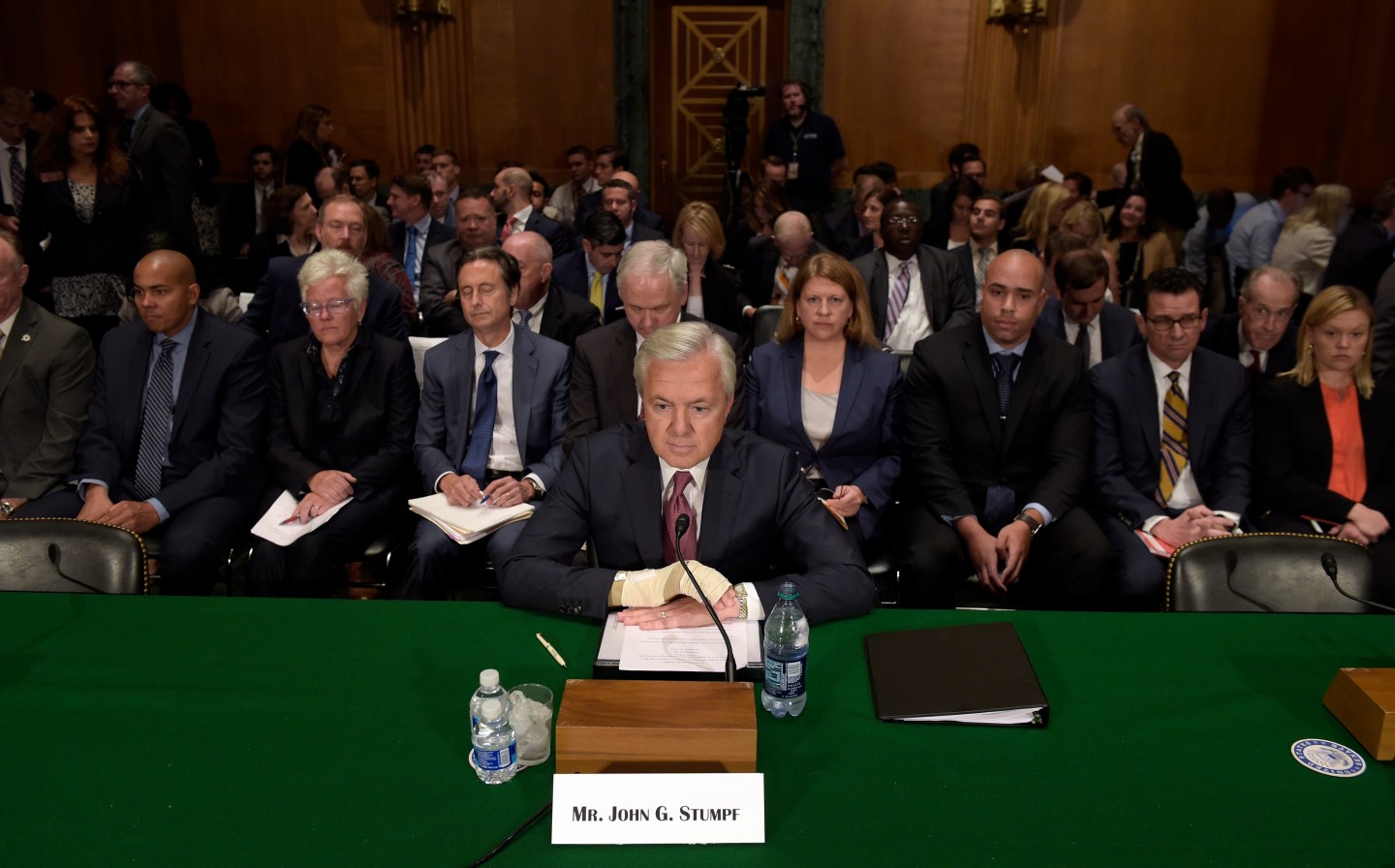
John Stumpf
Wells Fargo Chief Executive Officer John Stumpf prepares to testify on Capitol Hill in Washington, Tuesday, Sept. 20, 2016, before Senate Banking Committee. Strumpf was called before the committee for betraying customers' trust in a scandal over allegations that employees opened millions of unauthorized accounts to meet aggressive sales targets. (AP Photo/Susan Walsh)Photograph by Susan Walsh—AP

While all eyes have been on Wells Fargo in the wake of the bank’s fake accounts scandal, there is another, not so apparent culprit at the heart of the crisis: the U.S. Securities and Exchange Commission.

Under SEC Chair Mary Jo White’s watch, the agency has failed to enforce disclosure requirements at Wells Fargo and elsewhere at a time when trust in big business has hit historic lows.

The SEC’s corporate disclosure rules exist to forewarn investors about major issues that could affect a company’s well-being. Yet investors and the public were surprised last month by the alleged wide-spread multi-year Wells Fargo fraud.

The SEC had many opportunities to step in to make sure investors learned about Wells Fargo’s problems much sooner. Instead, the opposite happened. In early 2014, the agency allowed Wells Fargo and another major bank to exclude shareholder proposals from New York’s comptroller that would have provided investors with information on which employees were “capable of exposing them to major losses” because of their “bonus incentives.” As a result, Wells Fargo investors never even had a chance to vote on the measure, despite the Los Angeles Times’ Wells Fargo investigation two months earlier that had revealed “forged client signatures” and “incentive pay linked to sales.”

Under White’s watch, the SEC has been soft in enforcing disclosure requirements related to risky compensation, which were issued after the 2008 financial crisis. Any member of the SEC staff who had reviewed Wells Fargo’s 2013 annual pay report would likely have seen that Wells Fargo CEO John Stumpf and his four top lieutenants’ multi-million dollar paychecks included large stock awards as well as annual bonuses tied to sales measures. This should have been viewed as a red flag that Wells Fargo had risky compensation practices — and the board should have described those risks in its annual investor filings.

Regulators knew following the financial crisis that using sales measures to determine bank bonuses created risky behaviors and advised against them. And paying executives in stock has been a major risk concern since Enron and WorldCom. Dick Fuld, CEO of Lehman Brothers, who oversaw that bank’s collapse in the financial crisis, was the poster child for taking risky actions to goose the stock price. At the Wells Fargo Senate hearing last month, Senator Elizabeth Warren told Stumpf that he had pumped up Wells Fargo’s stock price by touting the bank’s sales culture.

The SEC has also been loath to tangle with the external auditors, the CEOs and the CFOs, who sign off on company’s financial statements. According to a New York Times report, Wells Fargo had fake accounts as far back as 2005. So for an extended time (how long exactly is unclear), Wells Fargo did not know (nor did the board’s audit committee know) whether accounts and income on its books were valid or not. If that is not a material control weakness that should be disclosed (in other words, an operational deficiency, which could cause reported numbers to be wrong), what would be?

The SEC has not just failed by omission. Against investor wishes, White has personally advocated for changes to disclosure rules at all U.S. public companies, which include eliminating important executive compensation information from investors’ voting materials.

If we are to prevent another Wells Fargo-type fiasco, we must do more than focus on one company’s management, as important as that may be. We must also look at the broken regulatory systems that enabled it.

Eleanor Bloxham is CEO of The Value Alliance, an independent board education and advisory firm. She is the author of two books on corporate governance and valuation.


About the Author
By Eleanor Bloxham
See full bioRight Arrow Button Icon

Latest in Commentary

Amit Walia
CommentaryM&A
Why the timing was right for Salesforce’s $8 billion acquisition of Informatica — and for the opportunities ahead
By Amit WaliaDecember 6, 2025
19 hours ago
Steve Milton is the CEO of Chain, a culinary-led pop-culture experience company founded by B.J. Novak and backed by Studio Ramsay Global.
CommentaryFood and drink
Affordability isn’t enough. Fast-casual restaurants need a fandom-first approach
By Steve MiltonDecember 5, 2025
2 days ago
Paul Atkins
CommentaryCorporate Governance
Turning public companies into private companies: the SEC’s retreat from transparency and accountability
By Andrew BeharDecember 5, 2025
2 days ago
Matt Rogers
CommentaryInfrastructure
I built the first iPhone with Steve Jobs. The AI industry is at risk of repeating an early smartphone mistake
By Matt RogersDecember 4, 2025
3 days ago
Jerome Powell
CommentaryFederal Reserve
Fed officials like the mystique of being seen as financial technocrats, but it’s time to demystify the central bank
By Alexander William SalterDecember 4, 2025
3 days ago
Rakesh Kumar
CommentarySemiconductors
China does not need Nvidia chips in the AI war — export controls only pushed it to build its own AI machine
By Rakesh KumarDecember 3, 2025
4 days ago

Most Popular

placeholder alt text
AI
Nvidia CEO says data centers take about 3 years to construct in the U.S., while in China 'they can build a hospital in a weekend'
By Nino PaoliDecember 6, 2025
15 hours ago
placeholder alt text
Big Tech
Mark Zuckerberg rebranded Facebook for the metaverse. Four years and $70 billion in losses later, he’s moving on
By Eva RoytburgDecember 5, 2025
2 days ago
placeholder alt text
Real Estate
The 'Great Housing Reset' is coming: Income growth will outpace home-price growth in 2026, Redfin forecasts
By Nino PaoliDecember 6, 2025
20 hours ago
placeholder alt text
Success
Nvidia CEO Jensen Huang admits he works 7 days a week, including holidays, in a constant 'state of anxiety' out of fear of going bankrupt
By Jessica CoacciDecember 4, 2025
3 days ago
placeholder alt text
Economy
The most likely solution to the U.S. debt crisis is severe austerity triggered by a fiscal calamity, former White House economic adviser says
By Jason MaDecember 6, 2025
10 hours ago
placeholder alt text
Asia
Despite their ‘no limits’ friendship, Russia is paying a nearly 90% markup on sanctioned goods from China—compared with 9% from other countries
By Jason MaNovember 29, 2025
7 days ago
Rankings
  • 100 Best Companies
  • Fortune 500
  • Global 500
  • Fortune 500 Europe
  • Most Powerful Women
  • Future 50
  • World’s Most Admired Companies
  • See All Rankings
Sections
  • Finance
  • Leadership
  • Success
  • Tech
  • Asia
  • Europe
  • Environment
  • Fortune Crypto
  • Health
  • Retail
  • Lifestyle
  • Politics
  • Newsletters
  • Magazine
  • Features
  • Commentary
  • Mpw
  • CEO Initiative
  • Conferences
  • Personal Finance
  • Education
Customer Support
  • Frequently Asked Questions
  • Customer Service Portal
  • Privacy Policy
  • Terms Of Use
  • Single Issues For Purchase
  • International Print
Commercial Services
  • Advertising
  • Fortune Brand Studio
  • Fortune Analytics
  • Fortune Conferences
  • Business Development
About Us
  • About Us
  • Editorial Calendar
  • Press Center
  • Work At Fortune
  • Diversity And Inclusion
  • Terms And Conditions
  • Site Map

© 2025 Fortune Media IP Limited. All Rights Reserved. Use of this site constitutes acceptance of our Terms of Use and Privacy Policy | CA Notice at Collection and Privacy Notice | Do Not Sell/Share My Personal Information
FORTUNE is a trademark of Fortune Media IP Limited, registered in the U.S. and other countries. FORTUNE may receive compensation for some links to products and services on this website. Offers may be subject to change without notice.