• Home
  • Latest
  • Fortune 500
  • Finance
  • Tech
  • Leadership
  • Lifestyle
  • Rankings
  • Multimedia
Tech

Why Did It Take So Long For The New York Times To Tell The Truth?

By
Mathew Ingram
Mathew Ingram
Down Arrow Button Icon
By
Mathew Ingram
Mathew Ingram
Down Arrow Button Icon
October 7, 2016, 5:05 PM ET
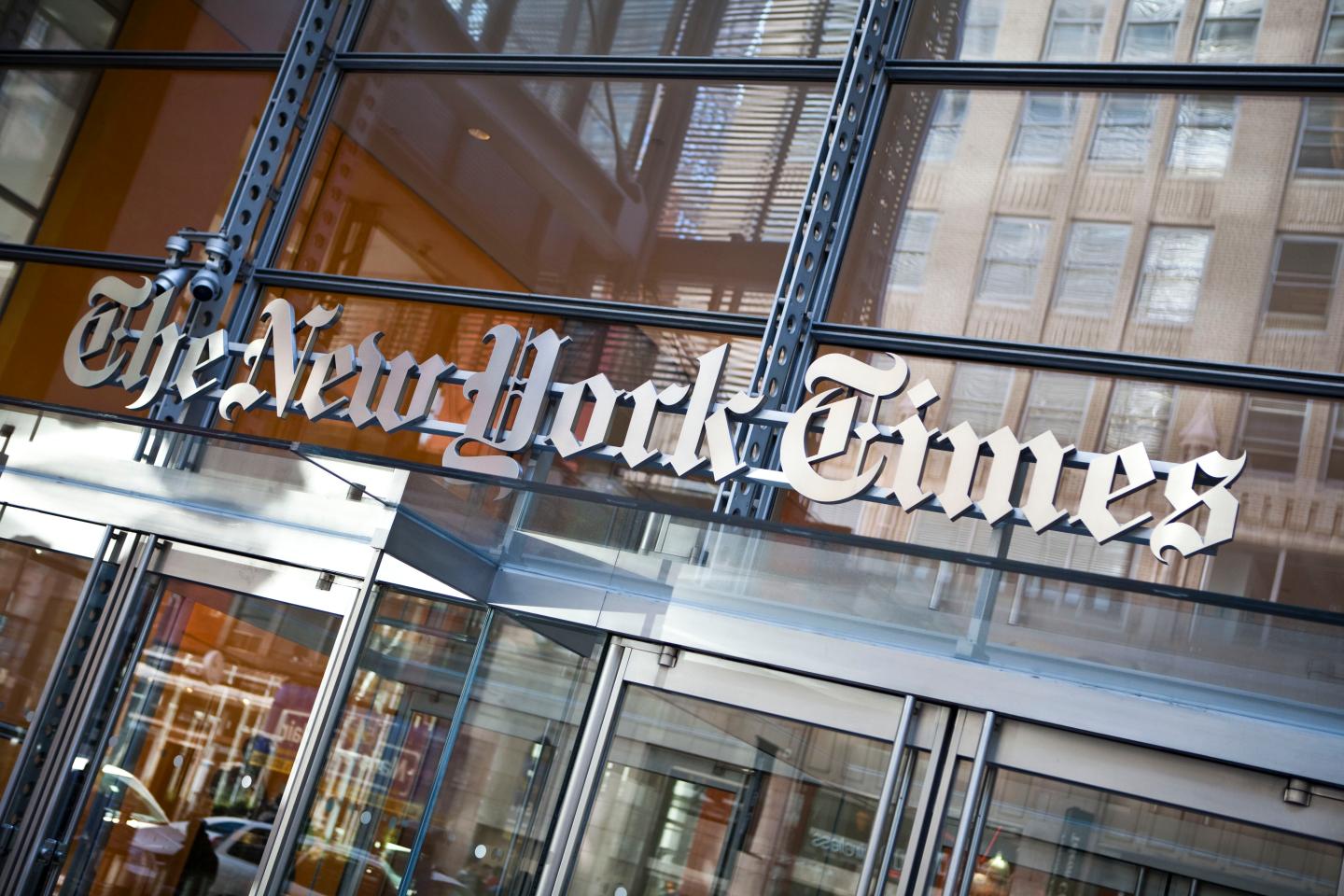
New York Times' Quarterly Profits Falls 58 Percent
Ramin Talaie Getty Images

There are a lot of things we can blame Donald Trump for, but the Republican presidential candidate has accomplished at least one thing of value: By lying so repeatedly and enthusiastically, he has managed to convince the New York Times that it needed to be more skeptical.

This assessment comes from the Times‘ executive editor Dean Baquet, in a recent interview with media analyst Ken Doctor, published by the Nieman Journalism Lab.

Before Trump came along, Baquet says the paper struggled with how to call out obvious lies. “I think that Trump has ended that struggle,” he says. “I think we now say stuff. We fact-check him. We write it more powerfully that it’s false.” At one point, Doctor suggests that Trump gave the Times “the courage” to assert the truth.

Courage? If you’re not a media insider, this might strike you as a little odd. Shouldn’t the New York Times of all places be skeptical when it comes to political statements in particular?

https://twitter.com/Anthony/status/784403208605138944

It’s not just that the Times is one of the world’s leading journalistic outlets. The paper also got a very painful reminder of how dangerous it can be to accept what politicians say at face value, when its reporting on the lead-up to the Iraq War turned out to be a tissue of lies fed to one of its reporters.

Baquet even refers to this in his interview, saying part of the problem with the Times‘ Iraq coverage was that the paper and its reporters “tend to believe what politicians tell us.”

“The dirty secret of news organizations — and I think this is part of a story of what happened with Bush and the Iraq war — [is that] newspaper reporters and newspapers describe the world we live in,” Baquet says. “We actually tend to believe what politicians tell us — which is a flaw, by the way.”

Get Data Sheet, Fortune’s technology newsletter.

The lesson of the Iraq war, the Times editor says, was that “I don’t think people really believed that the administration would actually lie about the WMDs. Who really believed that Colin Powell would get up in front of the United Nations, a guy who was known for integrity? I think that was a shock to the system.”

This shock to the system occurred in 2003. So why did it take more than a decade and the rise of Donald Trump to convince the New York Times that it should call a lie what it is?

Baquet doesn’t say. He just agrees with Doctor that “he gave us courage, if you will. I think he made us — forced us, because he does it so often, to get comfortable with saying something is false.” But why would a journalistic entity have to get comfortable with calling something a lie?

The answer, as New York Times media writer Jim Rutenberg suggested in a recent piece, probably has something to do with the commitment that the media has always had to the principle of objectivity.

In much the same way that journalists like Chris Wallace have said they don’t believe debate moderators should call out lies, because that would be equivalent to expressing an opinion, the Times and other newspapers have always believed that journalists should be rigorously balanced at all times.

A Donald Trump presidency could hurt the stock market. Watch:

As recently as 2012, the Times’ former public editor was asking whether the paper’s reporters were supposed to be “truth vigilantes” by fact-checking the statements of politicians during interviews. Just the fact that this question had to be asked said a lot about the paper’s approach.

Where this traditional “view from nowhere” (as NYU journalism professor Jay Rosen has called it) falls down is when someone like Trump says things to which there is no rational response other than “that’s a lie.”

So perhaps we should thank the Republican candidate for finally convincing the New York Times that it’s okay to say someone is flat out lying when that’s clearly what is happening. Let’s hope they continue to do so even after the current election campaign is over. It would have been nice if they had started a little sooner.

About the Author
By Mathew Ingram
See full bioRight Arrow Button Icon

Latest in Tech

robots
InnovationRobots
‘The question is really just how long it will take’: Over 2,000 gather at Humanoids Summit to meet the robots who may take their jobs someday
By Matt O'Brien and The Associated PressDecember 12, 2025
4 hours ago
Man about to go into police vehicle
CryptoCryptocurrency
Judge tells notorious crypto scammer ‘you have been bitten by the crypto bug’ in handing down 15 year sentence 
By Carlos GarciaDecember 12, 2025
5 hours ago
three men in suits, one gesturing
AIBrainstorm AI
The fastest athletes in the world can botch a baton pass if trust isn’t there—and the same is true of AI, Blackbaud exec says
By Amanda GerutDecember 12, 2025
6 hours ago
Brainstorm AI panel
AIBrainstorm AI
Creative workers won’t be replaced by AI—but their roles will change to become ‘directors’ managing AI agents, executives say
By Beatrice NolanDecember 12, 2025
6 hours ago
Fei-Fei Li, the "Godmother of AI," says she values AI skills more than college degrees when hiring software engineers for her tech startup.
AITech
‘Godmother of AI’ says degrees are less important in hiring than how quickly you can ‘superpower yourself’ with new tools
By Nino PaoliDecember 12, 2025
8 hours ago
C-SuiteFortune 500 Power Moves
Fortune 500 Power Moves: Which executives gained and lost power this week
By Fortune EditorsDecember 12, 2025
9 hours ago

Most Popular

placeholder alt text
Economy
Tariffs are taxes and they were used to finance the federal government until the 1913 income tax. A top economist breaks it down
By Kent JonesDecember 12, 2025
14 hours ago
placeholder alt text
Success
At 18, doctors gave him three hours to live. He played video games from his hospital bed—and now, he’s built a $10 million-a-year video game studio
By Preston ForeDecember 10, 2025
3 days ago
placeholder alt text
Success
Palantir cofounder calls elite college undergrads a ‘loser generation’ as data reveals rise in students seeking support for disabilities, like ADHD
By Preston ForeDecember 11, 2025
1 day ago
placeholder alt text
Arts & Entertainment
'We're not just going to want to be fed AI slop for 16 hours a day': Analyst sees Disney/OpenAI deal as a dividing line in entertainment history
By Nick LichtenbergDecember 11, 2025
1 day ago
placeholder alt text
Success
40% of Stanford undergrads receive disability accommodations—but it’s become a college-wide phenomenon as Gen Z try to succeed in the current climate
By Preston ForeDecember 12, 2025
10 hours ago
placeholder alt text
Uncategorized
Transforming customer support through intelligent AI operations
By Lauren ChomiukNovember 26, 2025
16 days ago
Rankings
  • 100 Best Companies
  • Fortune 500
  • Global 500
  • Fortune 500 Europe
  • Most Powerful Women
  • Future 50
  • World’s Most Admired Companies
  • See All Rankings
Sections
  • Finance
  • Leadership
  • Success
  • Tech
  • Asia
  • Europe
  • Environment
  • Fortune Crypto
  • Health
  • Retail
  • Lifestyle
  • Politics
  • Newsletters
  • Magazine
  • Features
  • Commentary
  • Mpw
  • CEO Initiative
  • Conferences
  • Personal Finance
  • Education
Customer Support
  • Frequently Asked Questions
  • Customer Service Portal
  • Privacy Policy
  • Terms Of Use
  • Single Issues For Purchase
  • International Print
Commercial Services
  • Advertising
  • Fortune Brand Studio
  • Fortune Analytics
  • Fortune Conferences
  • Business Development
About Us
  • About Us
  • Editorial Calendar
  • Press Center
  • Work At Fortune
  • Diversity And Inclusion
  • Terms And Conditions
  • Site Map

© 2025 Fortune Media IP Limited. All Rights Reserved. Use of this site constitutes acceptance of our Terms of Use and Privacy Policy | CA Notice at Collection and Privacy Notice | Do Not Sell/Share My Personal Information
FORTUNE is a trademark of Fortune Media IP Limited, registered in the U.S. and other countries. FORTUNE may receive compensation for some links to products and services on this website. Offers may be subject to change without notice.