• Home
  • News
  • Fortune 500
  • Tech
  • Finance
  • Leadership
  • Lifestyle
  • Rankings
  • Multimedia
TechInternet of Things

How Google Fiber Is Changing Its Strategy as Costs Grow

By
Aaron Pressman
Aaron Pressman
Down Arrow Button Icon
By
Aaron Pressman
Aaron Pressman
Down Arrow Button Icon
August 15, 2016, 9:30 AM ET
Google Brings Quirk And Clout To New DC Digs
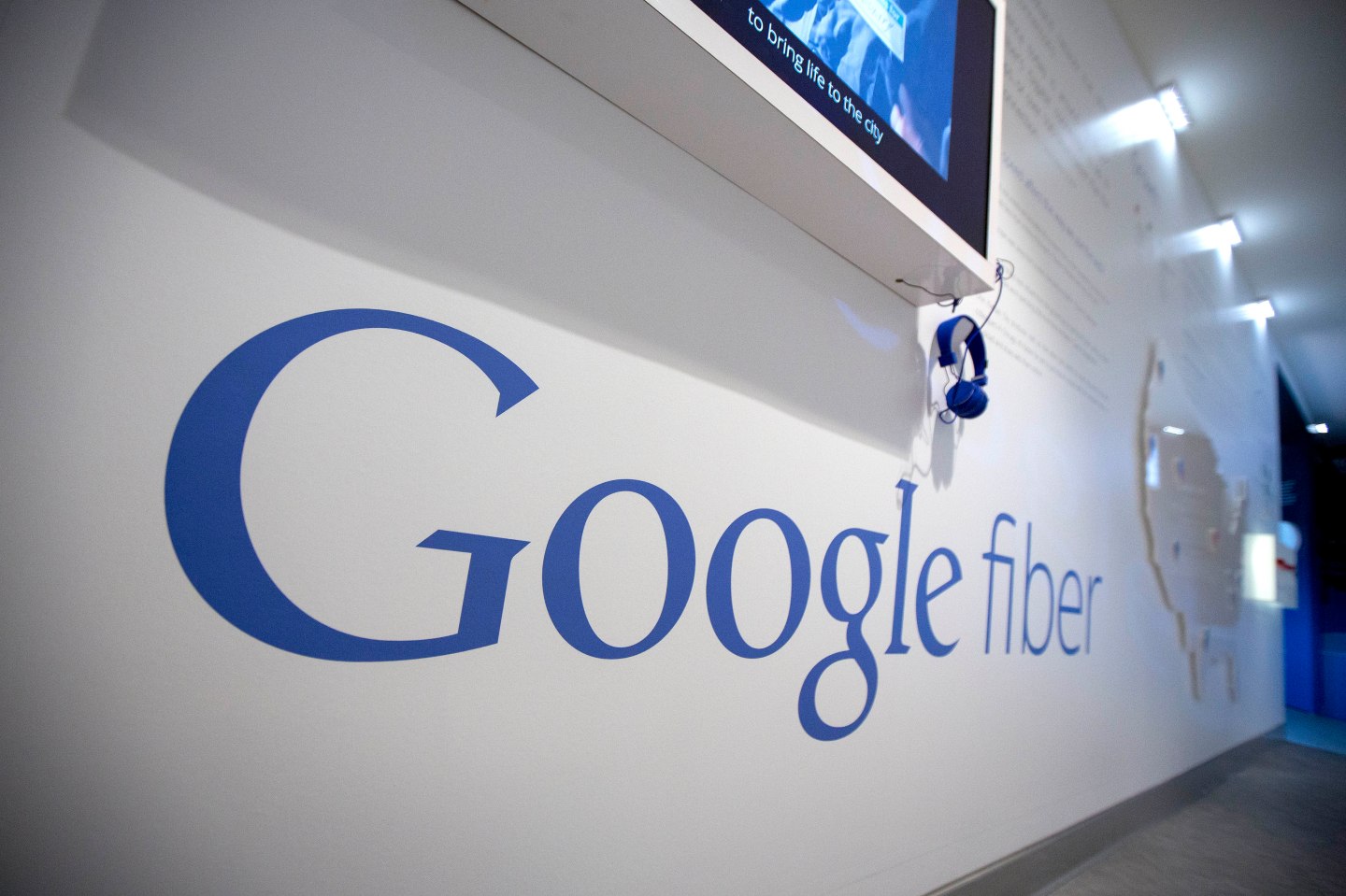
A Google Inc. Fiber display is shown at the Google office in Washington, D.C., U.S., on Tuesday, July 15, 2014. Google's presence in Washington is necessitated in part by the Federal Trade Commission and U.S. Justice Department inquiries into how the company obtains and uses private data. Additional privacy and safety concerns are likely to arise from Google projects in the works, including nose-mounted Google Glass computers and self-driving cars. Photographer: Andrew Harrer/Bloomberg via Getty ImagesPhotograph by Andrew Harrer — Bloomberg via Getty Images

Google’s effort to offer high-speed Internet access to consumers at home has run into the same economic problem that bedeviled almost every challenger in the market over the last two decades.

Turns out it is very expensive to run wires—or in Google’s case, fiber optic cables—to each and every house that wants service. Known as the “last mile” problem, the high costs, in turn, make it difficult for companies to earn a solid rate of return on the installation investment.

Google’s effort, through its unit called Fiber that launched in 2010, is now seeking alternative means to connect to consumers homes or finding other people to pay the cost. Google has sought deals with municipalities and power companies to pay for the connections and is also exploring less expensive wireless technology, the Wall Street Journal reported on Monday.

Meanwhile, Google has suspended efforts to add new cities such as San Jose, Calif., and Portland, Ore., using its prior strategy of stringing up cables to each customer’s home. Google hasn’t disclosed how many customers its Fiber unit has or any specifics about its financial results. The unit is lumped in with many projects as parts of the company’s “other bets,” which had revenue of $185 million and an operating loss of $859 million in the second quarter.

Last week, Google filed with the Federal Communications Commission to try a high-band wireless solution in up to 24 cities around the country. In theory, using the wireless technology to send Internet signals would be cheaper than wiring up individual homes. But high-band signals do not travel far and have difficulty penetrating deeply into buildings.

Get Data Sheet, Fortune’s technology newsletter.

In Huntsville, Ala., the city agreed to build the large, neighborhood-to-neighborhood fiber optic network that Google, a unit of the holding company Alphabet (GOOGL), would need. In Tampa, Fla., Google is negotiating with a local power company to build a fiber network, the Journal reported. In Irvine, Calif., Google is working with a home builder to pre-install fiber connections in new dwellings.

Google is hardly the first company to run into cost issues while trying to provide consumer Internet and cable TV service, even before the era of high-speed fiber optic connections. Dozens of upstart carriers went bankrupt in the 1990s and early 2000s trying to break into the telecommunications and cable markets.

More recently, both AT&T and Verizon Communications had difficulty. AT&T (T) decided to buy satellite service DirecTV to lower the cost of acquiring programming and connect to customers without wires. It is also pursuing fiber optic and wireless high speed connections in its GigaPower offering. Verizon (VZ) largely suspended adding new regions to its FiOS service, though it did make a recent deal to expand into Boston that will try to rely on wireless home connections.


About the Author
By Aaron Pressman
See full bioRight Arrow Button Icon

Latest in Tech

satellite
AIData centers
Google’s plan to put data centers in the sky faces thousands of (little) problems: space junk
By Mojtaba Akhavan-TaftiDecember 3, 2025
4 hours ago
Mark Zuckerberg, chief executive officer of Meta Platforms Inc., during the Meta Connect event in Menlo Park, California, US, on Wednesday, Sept. 25, 2024.
AIMeta
Inside Silicon Valley’s ‘soup wars’: Why Mark Zuckerberg and OpenAI are hand-delivering soup to poach talent
By Eva RoytburgDecember 3, 2025
5 hours ago
Greg Abbott and Sundar Pichai sit next to each other at a red table.
AITech Bubble
Bank of America predicts an ‘air pocket,’ not an AI bubble, fueled by mountains of debt piling up from the data center rush
By Sasha RogelbergDecember 3, 2025
5 hours ago
Alex Karp smiles on stage
Big TechPalantir Technologies
Alex Karp credits his dyslexia for Palantir’s $415 billion success: ‘There is no playbook a dyslexic can master … therefore we learn to think freely’
By Lily Mae LazarusDecember 3, 2025
6 hours ago
Isaacman
PoliticsNASA
Billionaire spacewalker pleads his case to lead NASA, again, in Senate hearing
By Marcia Dunn and The Associated PressDecember 3, 2025
6 hours ago
Kris Mayes
LawArizona
Arizona becomes latest state to sue Temu over claims that its stealing customer data
By Sejal Govindarao and The Associated PressDecember 3, 2025
6 hours ago

Most Popular

placeholder alt text
North America
Jeff Bezos and Lauren Sánchez Bezos commit $102.5 million to organizations combating homelessness across the U.S.: ‘This is just the beginning’
By Sydney LakeDecember 2, 2025
1 day ago
placeholder alt text
Economy
Ford workers told their CEO 'none of the young people want to work here.' So Jim Farley took a page out of the founder's playbook
By Sasha RogelbergNovember 28, 2025
5 days ago
placeholder alt text
North America
Anonymous $50 million donation helps cover the next 50 years of tuition for medical lab science students at University of Washington
By The Associated PressDecember 2, 2025
1 day ago
placeholder alt text
C-Suite
MacKenzie Scott's $19 billion donations have turned philanthropy on its head—why her style of giving actually works
By Sydney LakeDecember 2, 2025
2 days ago
placeholder alt text
Innovation
Google CEO Sundar Pichai says we’re just a decade away from a new normal of extraterrestrial data centers
By Sasha RogelbergDecember 1, 2025
2 days ago
placeholder alt text
Law
Netflix gave him $11 million to make his dream show. Instead, prosecutors say he spent it on Rolls-Royces, a Ferrari, and wildly expensive mattresses
By Dave SmithDecember 2, 2025
1 day ago
Rankings
  • 100 Best Companies
  • Fortune 500
  • Global 500
  • Fortune 500 Europe
  • Most Powerful Women
  • Future 50
  • World’s Most Admired Companies
  • See All Rankings
Sections
  • Finance
  • Leadership
  • Success
  • Tech
  • Asia
  • Europe
  • Environment
  • Fortune Crypto
  • Health
  • Retail
  • Lifestyle
  • Politics
  • Newsletters
  • Magazine
  • Features
  • Commentary
  • Mpw
  • CEO Initiative
  • Conferences
  • Personal Finance
  • Education
Customer Support
  • Frequently Asked Questions
  • Customer Service Portal
  • Privacy Policy
  • Terms Of Use
  • Single Issues For Purchase
  • International Print
Commercial Services
  • Advertising
  • Fortune Brand Studio
  • Fortune Analytics
  • Fortune Conferences
  • Business Development
About Us
  • About Us
  • Editorial Calendar
  • Press Center
  • Work At Fortune
  • Diversity And Inclusion
  • Terms And Conditions
  • Site Map

© 2025 Fortune Media IP Limited. All Rights Reserved. Use of this site constitutes acceptance of our Terms of Use and Privacy Policy | CA Notice at Collection and Privacy Notice | Do Not Sell/Share My Personal Information
FORTUNE is a trademark of Fortune Media IP Limited, registered in the U.S. and other countries. FORTUNE may receive compensation for some links to products and services on this website. Offers may be subject to change without notice.