• Home
  • Latest
  • Fortune 500
  • Finance
  • Tech
  • Leadership
  • Lifestyle
  • Rankings
  • Multimedia
How I Got Started

The Man Who Built Simplehuman Into the Apple of Houseware

By
Dinah Eng
Dinah Eng
Down Arrow Button Icon
By
Dinah Eng
Dinah Eng
Down Arrow Button Icon
June 28, 2016, 11:00 AM ET
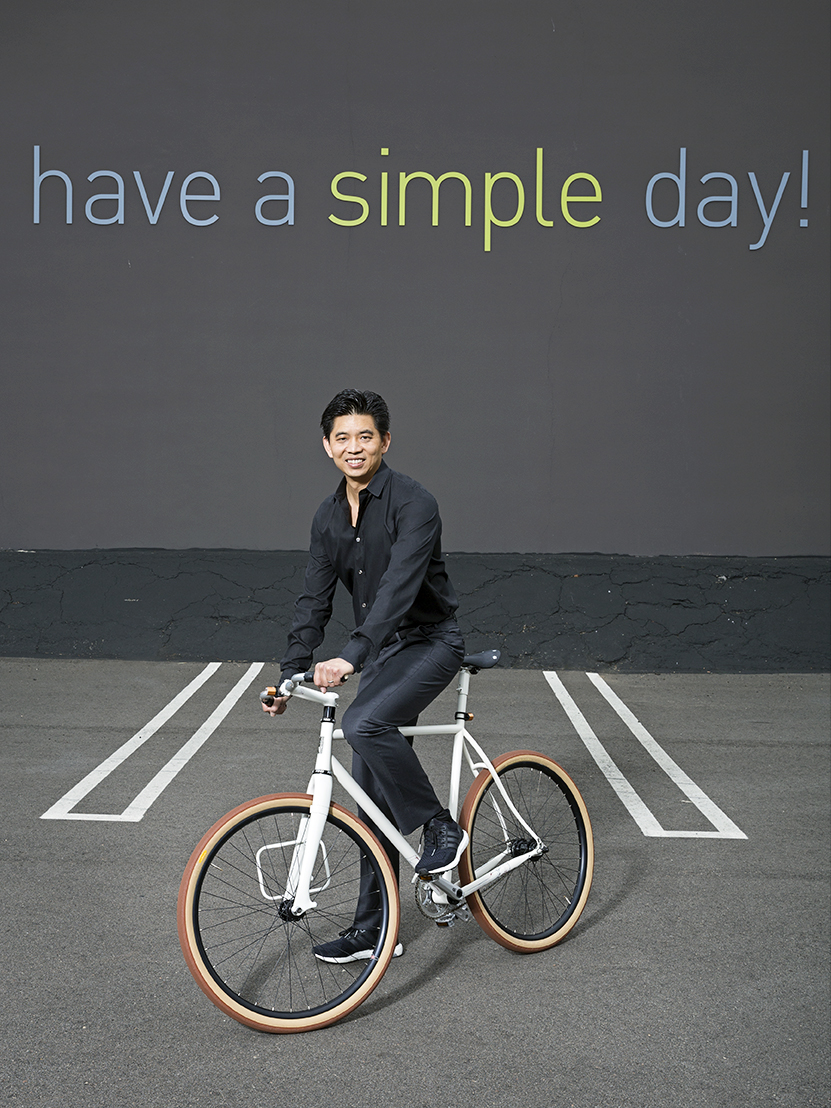
Photograph by Peter Bohler for Fortune Magazine

Few people would think to apply their spirit of invention to the humble kitchen garbage can. But Frank Yang did just that and created a new category: the most prosaic household items reconceived with panache and stainless steel. Yang, 44, was a tinkerer as a child and first learned about business by helping his dad at flea markets. Today his company, Simplehuman, sells soap pumps, high-tech vanity mirrors (with sensors that automatically turn the light on when you approach), and more. Last year the company’s sales were $150 million. Yang’s story:

I grew up in Taiwan. When people asked, “What do you want to do when you grow up?” I’d say, “I want to invent something and sell it.” As a kid, I thought there should be automatic dog feeders and stoves that turn themselves off if there are no pots on them.

When I was 10, my family immigrated to Los Angeles. My father became an importer. At first we struggled. We’d go to swap meets, where we sold dead inventory from his business—like seat cushions or mugs that chill beer—to make ends meet. I learned how to display and talk about products and negotiate in Spanish.

I was always good at fixing things. In seventh grade, we had remote-control drag racing in my neighborhood, and there was a rich kid who was a bully. I couldn’t afford an expensive car, so I fixed up a cheap one by changing the chassis and steering wheel to make the car lighter. Then I added an extra battery. It didn’t look good, but I beat the rich kid.

I went to UCLA for political science but wasn’t sure what I wanted to do. My girlfriend, who’s now my wife, was a graphic design major; she suggested I take an industrial design class. I loved it, but it was too late to change majors.

After graduating, I worked for my father’s company. I sourced products—and learned about the supply chain and how to deal with manufacturers. But I felt suffocated, so I quit and told my father I was going to design something to sell. He was doing well by then, so he gave me $200,000 to start my own company.

For more content from Fortune Venture, watch this video:

It was 2000, and I looked at housewares. I saw big displays of expensive, unattractive stainless-steel cans that weren’t much more functional than cheap plastic ones. Back then, no real thought was given to design in household products. I thought, “Everyone has a trash can. I want to design one that’s really cool.” So I hired some freelance industrial designers and one employee. We figured out how to make the pedal lighter, while trapping the odor in the can, and made it all look good.

No manufacturer wanted to talk to me. I finally found a small factory in Taiwan, owned by Mr. Wang Ding-Chou. For six months we would fax designs back and forth. Through trial and error, we made a prototype, and I went to the International Home and Housewares Show in Chicago. The Target (TGT) and Container Store (TCS) buyers loved it. The Container Store gave us a $30,000 order, then Target placed a test order.

The hardest thing to work out was the tooling process, getting the manufacturing components and machines right, which affects output, quality, and pricing. At one point, Mr. Wang made a bunch of trash cans, and I rejected them all. He was ready to give up working with me. Manufacturers are all about faster, cheaper, and I’m about higher standards. So I visited the tooling company with him, and we were able to work things out.

HOW TO CREATE A WORKPLACE FOR SMART PEOPLE

FRANK YANG, founder and CEO of Simplehuman

I believe in health and family first. At Simplehuman, individuals can set their own work hours. We’re here to make a kick-ass product, but if you need to leave for family, just go. If it’s spring break and you’re not on vacation, bring your kids to work.

We have a basketball court and gym in the middle of the office. There’s yoga at noon, Krav Maga on Friday afternoons, basketball games after work, and more. People shoot hoops while talking out product issues.

Every Tuesday a chef comes in to create healthy lunches. Every Friday we serve a breakfast built around different ethnic foods. After breakfast we have staff announcements and talk as a group about what’s happening in the company.

It’s not about partying all day. We have an environment where ­people are more open about discussing things and solving problems together. There’s something different about arguing in a ­conference room with a guy who’s also on the same basketball team as you are. We have very low turnover.

The first year we had about $800,000 in sales. I’d cold-call retailers, and most didn’t call back. But opportunities come up, and you have to be ready to take advantage of them. I remember sending some sample cans over to the Lowe’s (LOW) buyer, and the next day, he called to say another company he worked with was out of business. “Let’s talk,” he said.

Our company was initially called Canworks. When buyers wanted more products, we started making dish racks, but our name didn’t fit. I wanted people to feel efficient when using our products. We talked with naming consultants, and they came up with Simplehuman.

Eventually retailers told us to expand into the bath category. So in 2010 we introduced bath accessories. We made a bamboo tissue-box holder, but the numbers weren’t good—we were just one of many choices. I learned we can’t make everything, and lost about $750,000 on the R&D and tooling for that line. But we stuck with the bath line and went on to make sensor mirrors and soap pumps.

For me, it’s about creating something people love. We designed our soap dispenser to pump soap at 0.5 seconds. An engineer told me, “I can do it in 0.2 seconds.” I said, “Okay, do it; we’ll see what happens.” When I put my hand under that second dispenser, soap appeared instantly. It was magical. Why? People’s reaction times to visual stimuli average 0.25 seconds, so when something happens within 0.25 seconds, it’s magical. That’s what you get when you don’t settle for “good enough.”

A version of this article appears in the July 1, 2016 issue of Fortune with the headline “Inventing Products Is His Lot in Life.”

This story has been updated to correct the fact that the company once made dish racks, not dishrags.


About the Author
By Dinah Eng
See full bioRight Arrow Button Icon

Latest in

Finance
Lorem ipsum dolor sit amet, consectetur adipiscing elit, sed do eiusmod tempor incididunt ut labore et dolore magna aliqua. Ut enim ad minim veniam
By Fortune Editors
October 20, 2025
Finance
Lorem ipsum dolor sit amet, consectetur adipiscing elit, sed do eiusmod tempor incididunt ut labore et dolore magna aliqua. Ut enim ad minim veniam
By Fortune Editors
October 20, 2025
Finance
Lorem ipsum dolor sit amet, consectetur adipiscing elit, sed do eiusmod tempor incididunt ut labore et dolore magna aliqua. Ut enim ad minim veniam
By Fortune Editors
October 20, 2025
Finance
Lorem ipsum dolor sit amet, consectetur adipiscing elit, sed do eiusmod tempor incididunt ut labore et dolore magna aliqua. Ut enim ad minim veniam
By Fortune Editors
October 20, 2025
Finance
Lorem ipsum dolor sit amet, consectetur adipiscing elit, sed do eiusmod tempor incididunt ut labore et dolore magna aliqua. Ut enim ad minim veniam
By Fortune Editors
October 20, 2025
Finance
Lorem ipsum dolor sit amet, consectetur adipiscing elit, sed do eiusmod tempor incididunt ut labore et dolore magna aliqua. Ut enim ad minim veniam
By Fortune Editors
October 20, 2025

Most Popular

Finance
Lorem ipsum dolor sit amet, consectetur adipiscing elit, sed do eiusmod tempor incididunt ut labore et dolore magna aliqua. Ut enim ad minim veniam
By Fortune Editors
October 20, 2025
Finance
Lorem ipsum dolor sit amet, consectetur adipiscing elit, sed do eiusmod tempor incididunt ut labore et dolore magna aliqua. Ut enim ad minim veniam
By Fortune Editors
October 20, 2025
Finance
Lorem ipsum dolor sit amet, consectetur adipiscing elit, sed do eiusmod tempor incididunt ut labore et dolore magna aliqua. Ut enim ad minim veniam
By Fortune Editors
October 20, 2025
Finance
Lorem ipsum dolor sit amet, consectetur adipiscing elit, sed do eiusmod tempor incididunt ut labore et dolore magna aliqua. Ut enim ad minim veniam
By Fortune Editors
October 20, 2025
Finance
Lorem ipsum dolor sit amet, consectetur adipiscing elit, sed do eiusmod tempor incididunt ut labore et dolore magna aliqua. Ut enim ad minim veniam
By Fortune Editors
October 20, 2025
Finance
Lorem ipsum dolor sit amet, consectetur adipiscing elit, sed do eiusmod tempor incididunt ut labore et dolore magna aliqua. Ut enim ad minim veniam
By Fortune Editors
October 20, 2025
Fortune Secondary Logo
Rankings
  • 100 Best Companies
  • Fortune 500
  • Global 500
  • Fortune 500 Europe
  • Most Powerful Women
  • Future 50
  • World’s Most Admired Companies
  • See All Rankings
Sections
  • Finance
  • Fortune Crypto
  • Features
  • Leadership
  • Health
  • Commentary
  • Success
  • Retail
  • Mpw
  • Tech
  • Lifestyle
  • CEO Initiative
  • Asia
  • Politics
  • Conferences
  • Europe
  • Newsletters
  • Personal Finance
  • Environment
  • Magazine
  • Education
Customer Support
  • Frequently Asked Questions
  • Customer Service Portal
  • Privacy Policy
  • Terms Of Use
  • Single Issues For Purchase
  • International Print
Commercial Services
  • Advertising
  • Fortune Brand Studio
  • Fortune Analytics
  • Fortune Conferences
  • Business Development
About Us
  • About Us
  • Editorial Calendar
  • Press Center
  • Work At Fortune
  • Diversity And Inclusion
  • Terms And Conditions
  • Site Map
Fortune Secondary Logo
  • About Us
  • Editorial Calendar
  • Press Center
  • Work At Fortune
  • Diversity And Inclusion
  • Terms And Conditions
  • Site Map
  • Facebook icon
  • Twitter icon
  • LinkedIn icon
  • Instagram icon
  • Pinterest icon

Latest in

sam altman
AIOpenAI
Sam Altman tells staff at an all-hands that OpenAI is negotiating a deal with the Pentagon, after Trump orders the end of Anthropic contracts
By Sharon GoldmanFebruary 27, 2026
2 hours ago
Future of Workthe future of work
Have good taste? It may just get you a job during the AI jobs apocalypse, says Sam Altman
By Marco Quiroz-GutierrezFebruary 27, 2026
2 hours ago
CybersecurityMeta
Trump’s FTC backs off social media regulation despite finding that nearly 20% of America’s children are online for 4 hours or more
By Catherina GioinoFebruary 27, 2026
3 hours ago
Emil Michael smirks
AIAnthropic
Emil Michael, the Silicon Valley exec turned Trump official leading the war against Anthropic, has deep ties to the tech world
By Lily Mae LazarusFebruary 27, 2026
3 hours ago
C-SuiteFortune 500 Power Moves
Fortune 500 Power Moves: Which executives gained and lost power this week
By Fortune EditorsFebruary 27, 2026
3 hours ago
AIMilitary
Trump orders U.S. government to stop using Anthropic but gives Pentagon six months to phase it out while Hegseth adds supply-chain risk designation
By Jason MaFebruary 27, 2026
4 hours ago

Most Popular

placeholder alt text
Innovation
An MIT roboticist who cofounded bankrupt robot vacuum maker iRobot says Elon Musk’s vision of humanoid robot assistants is ‘pure fantasy thinking’
By Marco Quiroz-GutierrezFebruary 25, 2026
2 days ago
placeholder alt text
Success
Jeff Bezos says being lazy, not working hard, is the root of anxiety: ‘The stress goes away the second I take that first step’
By Sydney LakeFebruary 25, 2026
2 days ago
placeholder alt text
Economy
Trump claims America is ‘winning so much.’ The IMF agrees, adding that Trump’s trade policies are the only thing holding it back from even more
By Tristan BoveFebruary 26, 2026
1 day ago
placeholder alt text
Commentary
'The Pitt': a masterclass display of DEI in action 
By Robert RabenFebruary 26, 2026
1 day ago
placeholder alt text
Economy
It’s more than George Clooney moving to France: America is becoming the ‘uncool’ country that people want to move away from
By Nick LichtenbergFebruary 27, 2026
17 hours ago
placeholder alt text
Success
Gen Z Olympic champion Eileen Gu says she rewires her brain daily to be more successful—and multimillionaire founder Arianna Huffington says it really does work
By Orianna Rosa RoyleFebruary 25, 2026
2 days ago

© 2026 Fortune Media IP Limited. All Rights Reserved. Use of this site constitutes acceptance of our Terms of Use and Privacy Policy | CA Notice at Collection and Privacy Notice | Do Not Sell/Share My Personal Information
FORTUNE is a trademark of Fortune Media IP Limited, registered in the U.S. and other countries. FORTUNE may receive compensation for some links to products and services on this website. Offers may be subject to change without notice.