• Home
  • News
  • Fortune 500
  • Tech
  • Finance
  • Leadership
  • Lifestyle
  • Rankings
  • Multimedia
TechInternet of Things

Here’s How Robots Could Help Save Jobs

By
Jonathan Vanian
Jonathan Vanian
Down Arrow Button Icon
By
Jonathan Vanian
Jonathan Vanian
Down Arrow Button Icon
June 14, 2016, 3:54 PM ET
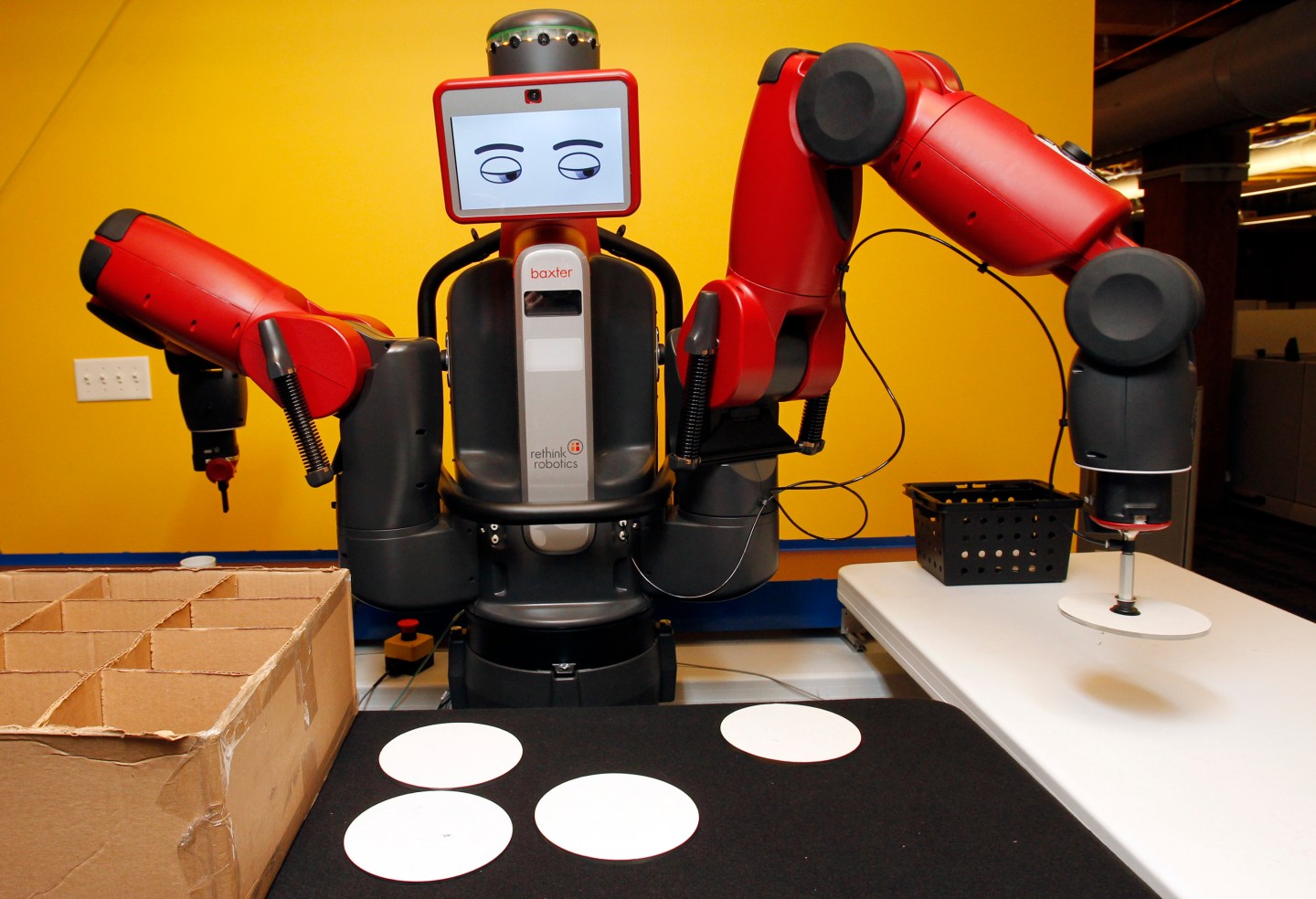
Baxter at Rethink Robotics
BOSTON, MA - FEBRUARY, 2: Baxter picks up objects and places them in a basket using a vacuum cup gripper attached to its arm during a demonstration at Rethink Robotics in Boston, Mass. 2013. (Photo by Jessica Rinaldi/For The Washington Post via Getty Images)Photograph by Jessica Rinaldi — The Washington Post via Getty Images

Robots might be getting better at performing tasks like carrying heavy equipment and tracking store inventory, but that doesn’t mean they will be replacing humans at work anytime soon.

In some cases, robots can help save jobs.

That’s the opinion of Melonee Wise, the CEO of Fetch Robotics, a company that builds robots that follow warehouse workers around facilities and act as autonomously moving storage containers. Wise spoke on Tuesday along with a panel of robotics experts at a Bloomberg technology conference in San Francisco.

Wise admitted that “people are concerned” the rise of robots could mean less jobs for humans, but she thinks that belief is a “misnomer.” In the case of her company’s warehouse robots, those devices “enable people to keep jobs longer,” she posited.

Warehouse workers with bad backs and knees don’t have to walk around huge facilities as much with robot helpers following them and carrying more supplies than what the workers can handle themselves. Because the robots carry warehouse inventory, the workers don’t need to zig-zag back and forth the warehouse as often as they would without them.

Get Data Sheet, Fortune’s technology newsletter.

She said that the robots cut down on the wear and tear of the human body, which typically occurs for these blue-collar warehouse workers and thus prolongs their careers. Additionally, facilities that use robots tend to be more efficient and are less likely to get shut down because of their increased productivity. Even if one worker loses a job because of a robot, that’s better than 40 workers losing their jobs if a warehouse gets closed, she explained.

Of course, Wise runs a robot company, so it’s likely she disagrees with the notion that more robots mean less jobs. But her opinion is noteworthy given the perception that robots have become so advanced in recent years that they stand to outperform humans in many tasks and dramatically alter the workforce.

Cheaper hardware and emerging technologies have enabled manufacturers and companies to develop robots faster than ever. Tessa Lau, co-founder of robotics company Savioke, said 3D printing has allowed her company to develop prototypes in days as opposed to months. Still, robots are far from commonplace.

Wise said there are probably only around 1.5 millions robots that have been deployed and are active in the world. Many robotic companies are developing robots in “structured environments,” like warehouses in which the environments are more mapped out and easier for a robot to orient itself in, she said. Within “unstructured environments,” like city streets for example, it’s much harder for a robot to learn the surroundings amidst many different variables and operate efficiently.

However, the work that companies like Google (GOOG) are doing on self-driving cars has the possibility to create a spill-over effect to robotic companies, and it could create a wave of “smarter” robots that can function better in environments and conditions that are less predictable, she explained.

For more about robots, watch:

Popular movies and television shows like The Jetsons portray human-like robots that look “deceptively easy” to create, suggested Lau. The reality is that “it is really, really hard” to make robots, much less the ones dreamed up by Hollywood executives. We are in the beginnings of a robotics revolution, Lau said, but it will be “slow and incremental.”


About the Author
By Jonathan Vanian
LinkedIn iconTwitter icon

Jonathan Vanian is a former Fortune reporter. He covered business technology, cybersecurity, artificial intelligence, data privacy, and other topics.

See full bioRight Arrow Button Icon

Latest in Tech

Big TechStreaming
Trump warns Netflix-Warner deal may pose antitrust ‘problem’
By Hadriana Lowenkron, Se Young Lee and BloombergDecember 7, 2025
7 hours ago
Big TechOpenAI
OpenAI goes from stock market savior to burden as AI risks mount
By Ryan Vlastelica and BloombergDecember 7, 2025
7 hours ago
AIData centers
HP’s chief commercial officer predicts the future will include AI-powered PCs that don’t share data in the cloud
By Nicholas GordonDecember 7, 2025
9 hours ago
Future of WorkJamie Dimon
Jamie Dimon says even though AI will eliminate some jobs ‘maybe one day we’ll be working less hard but having wonderful lives’
By Jason MaDecember 7, 2025
13 hours ago
CryptoCryptocurrency
So much of crypto is not even real—but that’s starting to change
By Pete Najarian and Joe BruzzesiDecember 7, 2025
18 hours ago
Elon Musk
Big TechSpaceX
SpaceX to offer insider shares at record-setting $800 billion valuation
By Edward Ludlow, Loren Grush, Lizette Chapman, Eric Johnson and BloombergDecember 6, 2025
1 day ago

Most Popular

placeholder alt text
Real Estate
The 'Great Housing Reset' is coming: Income growth will outpace home-price growth in 2026, Redfin forecasts
By Nino PaoliDecember 6, 2025
2 days ago
placeholder alt text
AI
Nvidia CEO says data centers take about 3 years to construct in the U.S., while in China 'they can build a hospital in a weekend'
By Nino PaoliDecember 6, 2025
2 days ago
placeholder alt text
Economy
The most likely solution to the U.S. debt crisis is severe austerity triggered by a fiscal calamity, former White House economic adviser says
By Jason MaDecember 6, 2025
1 day ago
placeholder alt text
Economy
JPMorgan CEO Jamie Dimon says Europe has a 'real problem’
By Katherine Chiglinsky and BloombergDecember 6, 2025
1 day ago
placeholder alt text
Big Tech
Mark Zuckerberg rebranded Facebook for the metaverse. Four years and $70 billion in losses later, he’s moving on
By Eva RoytburgDecember 5, 2025
3 days ago
placeholder alt text
Politics
Supreme Court to reconsider a 90-year-old unanimous ruling that limits presidential power on removing heads of independent agencies
By Mark Sherman and The Associated PressDecember 7, 2025
15 hours ago
Rankings
  • 100 Best Companies
  • Fortune 500
  • Global 500
  • Fortune 500 Europe
  • Most Powerful Women
  • Future 50
  • World’s Most Admired Companies
  • See All Rankings
Sections
  • Finance
  • Leadership
  • Success
  • Tech
  • Asia
  • Europe
  • Environment
  • Fortune Crypto
  • Health
  • Retail
  • Lifestyle
  • Politics
  • Newsletters
  • Magazine
  • Features
  • Commentary
  • Mpw
  • CEO Initiative
  • Conferences
  • Personal Finance
  • Education
Customer Support
  • Frequently Asked Questions
  • Customer Service Portal
  • Privacy Policy
  • Terms Of Use
  • Single Issues For Purchase
  • International Print
Commercial Services
  • Advertising
  • Fortune Brand Studio
  • Fortune Analytics
  • Fortune Conferences
  • Business Development
About Us
  • About Us
  • Editorial Calendar
  • Press Center
  • Work At Fortune
  • Diversity And Inclusion
  • Terms And Conditions
  • Site Map

© 2025 Fortune Media IP Limited. All Rights Reserved. Use of this site constitutes acceptance of our Terms of Use and Privacy Policy | CA Notice at Collection and Privacy Notice | Do Not Sell/Share My Personal Information
FORTUNE is a trademark of Fortune Media IP Limited, registered in the U.S. and other countries. FORTUNE may receive compensation for some links to products and services on this website. Offers may be subject to change without notice.