
Earlier this month, Nature Communications published an analysis of the genetic mutation process that can lead to breast cancer. The research team looked at the genomes of cells from 560 tumors in order to pinpoint the differences between mutated cells and the cells of healthy patients. They were able to locate 93 genes that, if subject to mutation, could cause the disease. These findings have been called a “milestone,” and have added to the already considerable hype over the potential of genomics to predict disease in individuals.
Such hype is not new. In 2000, a “working draft” of the human genome sequence was produced; in the intervening years there has been much excitement over the potential of genomics to revolutionize the way we detect and treat disease. It is understandable that such innovation would cause a stir. Think of it—a future where doctors need only read your genes to learn exactly which illnesses you are most at risk of developing. Armed with this information, physicians could then tailor treatments based on your specific genetic patterns to target and neutralize disease with unparalleled accuracy. Not only does this vision of precision medicine appeal to our collective faith in innovation and technology, it just seems logical. After all, if we are sophisticated enough to decode the secrets of our DNA, shouldn’t we be able to leverage this amazing information into better heath?
In some ways, we have. Pharmacogenetics, a relatively small field that studies the ways a person’s metabolism responds to drugs, has benefitted from genetic research, allowing us to learn more about the role played by genes in the complex biology of treatment. We have not, however, seen anywhere near the advances in treatment that have been promised with the emergence of precision medicine. Nor have we seen similarly consistent progress in the field of primary disease prevention in individuals, despite our ever-increasing insight into the mysteries of our DNA.
This is because the production of disease is quite complicated. Often, hundreds of genes will contribute to the cellular variation that can turn a healthy person into a sick one. There is also the crucial matter of context; just because a person has the genes that may lead to a particular illness does not mean that, however great the risk, she is going to develop the condition. Our illnesses are the result of the constant influence of our environment on our genetic makeup. The foods, chemicals, medications, and stressors that we are exposed to every day all interact with our DNA, creating the circumstances for disease to either flourish or lie dormant in our bodies. It is this interplay—which we still have a lot to learn about—more than any collection of genes, that accounts for the state of our health through the years.
At the heart of the limitations of genetic and molecular approaches is the distinction between understanding disease in populations, and understanding disease prediction in individuals. We can actually estimate risk in populations quite accurately. In the case of breast cancer, we know that there are certain factors—such as weight, age at first childbirth, and number of childbirths—that can, combined with other variables, cause cancer. This knowledge allows us to determine, for example, that black women are 42 percent more likely to die from breast cancer than white women; with that risk even higher in some parts of the US. The reasons for this disparity include the fact that white women tend to have children at an older age than black women, unequal obesity rates, and the biology of cancer itself.
But—and here is the rub—none of these factors tell us much in isolation about our risk as individuals. It is only when taken together that they may suggest a broad pattern of risk within a given group. The reason why is simple—complexity. There is a tremendous complexity of factors that influence the health of individuals, this complexity lowers the predictive value of any one test, or even any group of tests.
This is well illustrated by the two figures below, both taken from the same paper, published in The New England Journal of Medicine. Figure B shows how at the population level, groups that have particular genetic blueprint—called a genotype—are more likely to have a high rate of diabetes than those with a lower genotype score.
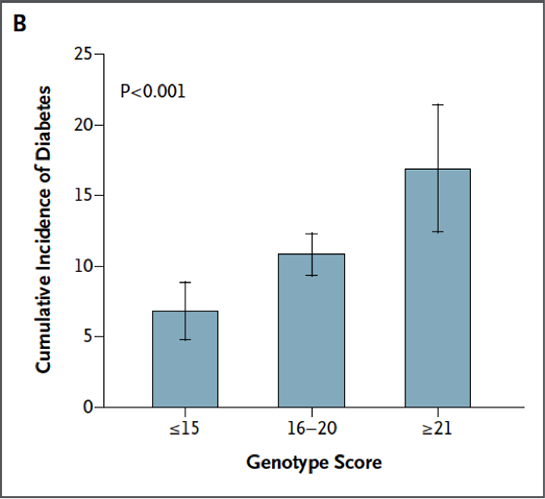
But what does this mean for you? Are you more or less likely to have diabetes if you have a genotype score of say 22 compared to 19? The answer to that lies in the second figure shown below (Figure A).
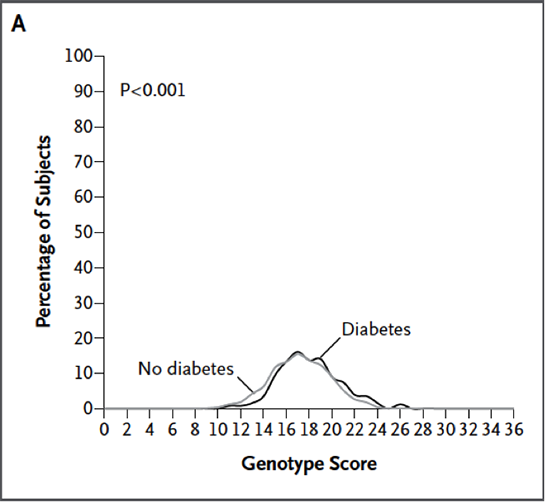
At nearly all genotype score levels, the percent of people with and without diabetes is roughly the same. This just goes to show that predicting the health of populations is very different from predicting the health of individuals.
To be clear: this is not to write-off the enormous potential of genomics, or even the potential of precision medicine. It is simply an acknowledgement that these are still very early days for this research, and that we need to think carefully about where we invest our limited resources going forward. This means a level of investment that is proportionate to the level of expected, cost-effective return. Unfortunately, this is not what we are seeing. The US government has recently gone “all-in” on precision medicine in a way that suggests that the state of the science is far more advanced than it actually is.
The US spends more on health care than any other nation on earth, yet we have worse health than any of our peer countries. This will continue as long as we persist in ignoring the bigger picture of population health and the many interrelated social, economic and environmental factors that work together to undermine it. Focusing on these structural issues may lack the cutting-edge appeal of precision medicine, but doing so will allow us to tackle the real, well-known, and highly modifiable determinants of health, which so far remain largely undealt with. This change of focus is necessary if we are ever going to improve the well-being of populations in a way that is truly “revolutionary.”
Sandro Galea is a professor and dean of the School of Public Health at Boston University.