• Home
  • News
  • Fortune 500
  • Tech
  • Finance
  • Leadership
  • Lifestyle
  • Rankings
  • Multimedia
Finance

Why Shares of the Payment System That Almost Everyone Uses Cratered 30% Today

Lucinda Shen
By
Lucinda Shen
Lucinda Shen
Down Arrow Button Icon
Lucinda Shen
By
Lucinda Shen
Lucinda Shen
Down Arrow Button Icon
June 8, 2016, 11:53 AM ET
Customers Pay With Contactless Cards
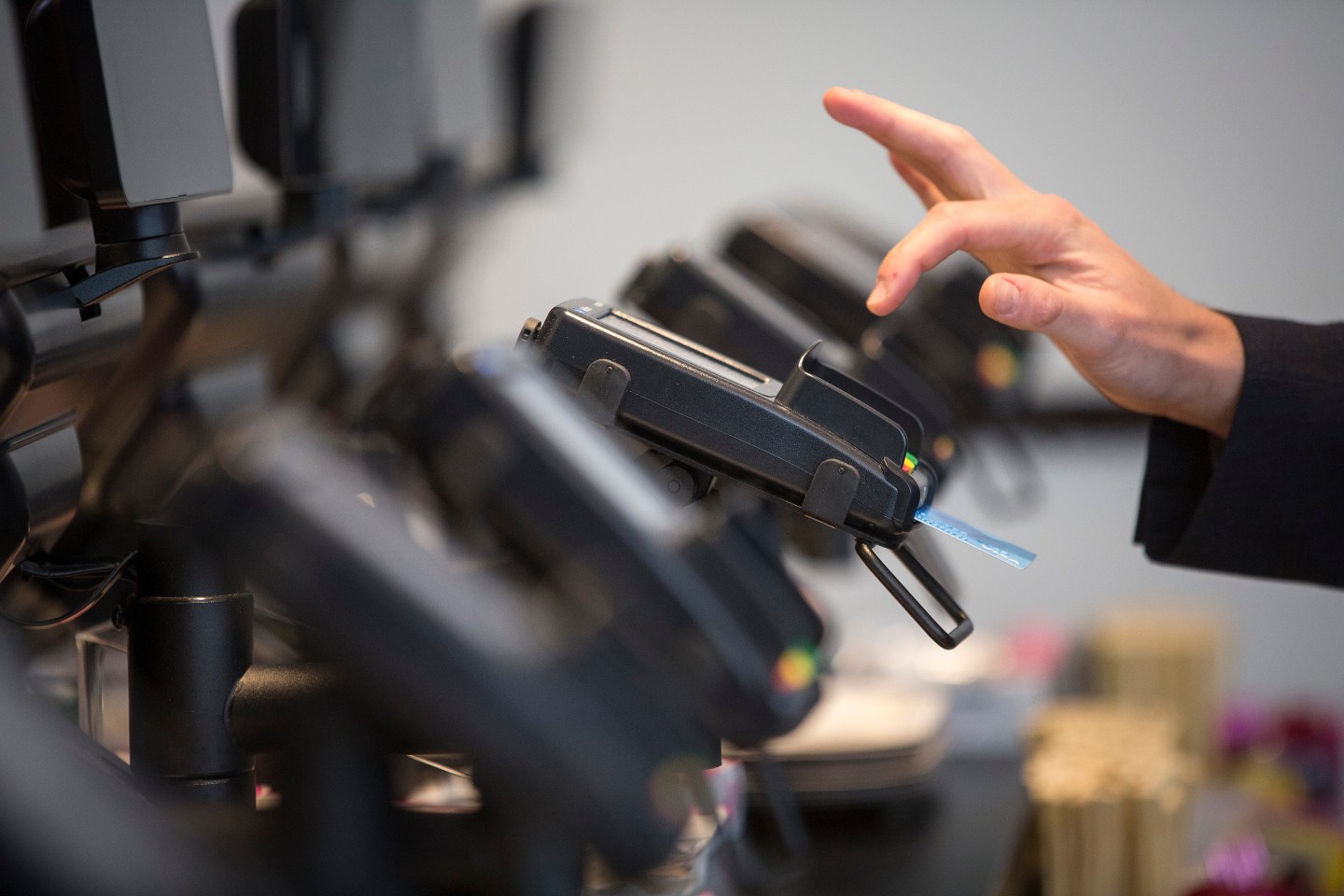
A customer enters their pin number as they make a chip and pin payment via a Verifone Systems Inc. credit card payment device at a restaurant in London, U.K., on Friday, May 22, 2015. Credit and debit cards that can be used by tapping the reader are gaining users, and mobile apps are set to further boost the popularity of contactless paying. Photographer: Simon Dawson/Bloomberg via Getty ImagesBloomberg via Getty Images

Shares of payment processor VeriFone Systems (PAY) took a deep dive in early trading Wednesday, shedding over a quarter of its value after the company drastically cut its 2016 guidance revenue by as much as $70 million, citing, among other things, the slowdown in China, and softness in the retail sector.

That took the stock down to $19.87—its lowest point since Sept. 2013.

VeriFone, which controlled over 50% of the U.S. market in 2013 according to consultancy firm Kubera Payments, slashed its full year guidance from earnings per share of $1.85 on revenue of $2.1 billion, down from its previous estimate of $2.21 to $2.24 per share on revenue of $2.15 billion to $2.17 billion in 2016.

The news came after the San Jose, Calif.-based company revealed second quarter earnings that missed Wall Street’s consensus. Earnings fell to three cents a share from 15 cents a year earlier as a result of heavier expenses. Revenue however beat expectations.

“Q2 was a mixed quarter for VeriFone as we grew our business, but experienced several difficult market dynamics,” said Paul Galant, VeriFone CEO in a statement. “In connection with these plans the company intends to reduce headcount and estimates that these activities in total will generate approximately $30 million of savings in 2017.”

Those “difficult market dynamics” that catalyzed VeriFone’s decision to reduce headcount and lower its full year expectations were likely driven in part by weaknesses in emerging markets, including Latin America and Asia.

During the company’s earnings call on Tuesday, Galant noted that the weaker Chinese economy had dampened demand for payment systems all around Asia.

“We think that perhaps in some markets, there is a bit of contagion starting in terms of the desire in those markets for acquirers and merchants to lean in and upgrade to be able to accept consumer electronic payments,” Galant said.

Because of the weaker demand, the competition for consumers in the payment space has also gotten stronger—forcing VeriFone to consider lowering prices, and pressing on the company’s margins and revenue.

Secondly, weakness in the retail space (as seen in the recent results of Tiffany’s, Macy’s, and J.C. Penney) have also pressured VeriFone’s advertising business. VeriFone controls a series of Taxi top ads and the in-taxi payment screens. But retailers have begun to pull back, killing, or delaying, some of those ads.

Following the news, the stock was downgraded by several banking firms, including a team of Barclays analysts by Darrin Pellar. The Barclays team downgraded the stock from “Overweight” (also known as “Buy”) to “Neutral” Wednesday.

“While North America results came in as expected despite continued investor cliff concerns, Verifone’s results were challenged by: 1) ongoing softness in media sales, 2) delays in U.S. EMV certifications (more of a timing issue which was offset by strength in petro), and 3) more intense competitive pricing dynamics in some emerging markets,” the team wrote. EMV refers to chip cards.

About the Author
Lucinda Shen
By Lucinda Shen
See full bioRight Arrow Button Icon

Latest in Finance

Personal Financemortgages
Home equity loan vs. home equity line of credit (HELOC)
By Joseph HostetlerDecember 3, 2025
7 hours ago
picture of two bitcoins
CryptoBitcoin
Bitcoin bounces back more than 10% after brutal week
By Carlos GarciaDecember 3, 2025
8 hours ago
Rich woman lounging on boat
SuccessWealth
The wealthy 1% are turning to new status symbols that can’t be bought—and it’s hurting Dior, Versace, and Burberry
By Emma BurleighDecember 3, 2025
8 hours ago
Greg Abbott and Sundar Pichai sit next to each other at a red table.
AITech Bubble
Bank of America predicts an ‘air pocket,’ not an AI bubble, fueled by mountains of debt piling up from the data center rush
By Sasha RogelbergDecember 3, 2025
9 hours ago
Dell
Personal FinanceWhite House
Why the government is really going to give your baby $1,000, collecting interest until they turn 18
By Moriah Balingit and The Associated PressDecember 3, 2025
10 hours ago
Bessent
BankingFederal Reserve
‘We’re going to veto them’: Bessent backs new rules to give White House more power over Federal Reserve
By Christopher Rugaber and The Associated PressDecember 3, 2025
11 hours ago

Most Popular

placeholder alt text
North America
Jeff Bezos and Lauren Sánchez Bezos commit $102.5 million to organizations combating homelessness across the U.S.: ‘This is just the beginning’
By Sydney LakeDecember 2, 2025
2 days ago
placeholder alt text
Economy
Ford workers told their CEO 'none of the young people want to work here.' So Jim Farley took a page out of the founder's playbook
By Sasha RogelbergNovember 28, 2025
5 days ago
placeholder alt text
North America
Anonymous $50 million donation helps cover the next 50 years of tuition for medical lab science students at University of Washington
By The Associated PressDecember 2, 2025
2 days ago
placeholder alt text
C-Suite
MacKenzie Scott's $19 billion donations have turned philanthropy on its head—why her style of giving actually works
By Sydney LakeDecember 2, 2025
2 days ago
placeholder alt text
Innovation
Google CEO Sundar Pichai says we’re just a decade away from a new normal of extraterrestrial data centers
By Sasha RogelbergDecember 1, 2025
2 days ago
placeholder alt text
Economy
Scott Bessent calls the Giving Pledge well-intentioned but ‘very amorphous,’ growing from ‘a panic among the billionaire class’
By Nick LichtenbergDecember 3, 2025
11 hours ago
Rankings
  • 100 Best Companies
  • Fortune 500
  • Global 500
  • Fortune 500 Europe
  • Most Powerful Women
  • Future 50
  • World’s Most Admired Companies
  • See All Rankings
Sections
  • Finance
  • Leadership
  • Success
  • Tech
  • Asia
  • Europe
  • Environment
  • Fortune Crypto
  • Health
  • Retail
  • Lifestyle
  • Politics
  • Newsletters
  • Magazine
  • Features
  • Commentary
  • Mpw
  • CEO Initiative
  • Conferences
  • Personal Finance
  • Education
Customer Support
  • Frequently Asked Questions
  • Customer Service Portal
  • Privacy Policy
  • Terms Of Use
  • Single Issues For Purchase
  • International Print
Commercial Services
  • Advertising
  • Fortune Brand Studio
  • Fortune Analytics
  • Fortune Conferences
  • Business Development
About Us
  • About Us
  • Editorial Calendar
  • Press Center
  • Work At Fortune
  • Diversity And Inclusion
  • Terms And Conditions
  • Site Map

© 2025 Fortune Media IP Limited. All Rights Reserved. Use of this site constitutes acceptance of our Terms of Use and Privacy Policy | CA Notice at Collection and Privacy Notice | Do Not Sell/Share My Personal Information
FORTUNE is a trademark of Fortune Media IP Limited, registered in the U.S. and other countries. FORTUNE may receive compensation for some links to products and services on this website. Offers may be subject to change without notice.