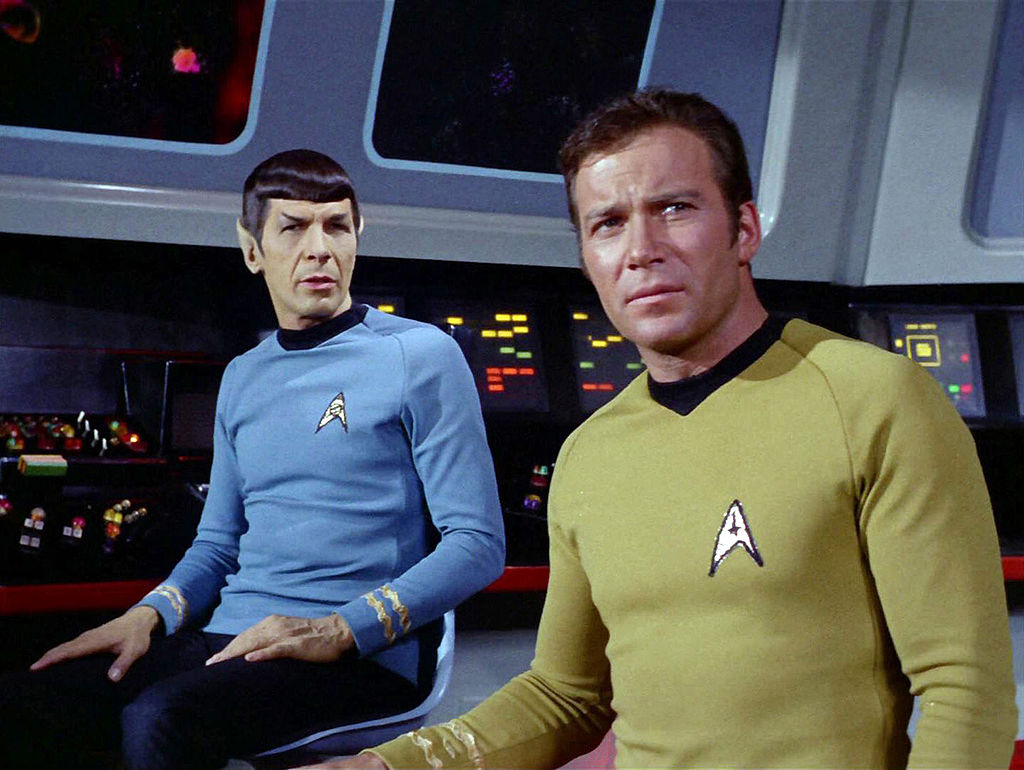
Star Trek turns 50 this year. Nobody expected the plucky TV show, originally sold to NBC as a Western in space, to grow into a global entertainment franchise, let alone a cultural icon. Yet Star Trek paved the way for the proliferation of space adventures on big and the small screens. In fact, George Lucas drew inspiration from reruns of Star Trek: The Original Series to fashion Star Wars, his own space tale brimming with robots, aliens and sleek starships.
The irony is that Star Trek was never really about aliens and starships. Its creator, Gene Roddenberry, admitted as much. All the dazzling space-age technology was only a pretext to imagine social progress.
This may not fully explain the franchise’s staying power or its passionate following, but it goes a long way to describe Star Trek’s appeal and enduring relevance.
Most of the science fiction entertainment that came on its coattails was consumed with dire warnings about our frailty and the coming robot apocalypse (e.g. Arnold Schwarzenegger’s Terminator). Star Trek, on the other hand, told us of a radiant future where humans, aliens and sentient robots would live and work in harmony amid boundless abundance. It proclaimed that automation and robots would usher humanity into a new age of economic bliss.
Strip the show of its starships and its pointy-eared aliens, and Star Trek becomes a thought experiment about how humans would conduct themselves under improved conditions, an economics textbook of the future. And the most startling of all is that it got most of the (then) future right.
In Star Trek’s hypothetical society — the Federation — poverty, greed and want no longer exist. Most goods are made for free by robots known as replicators. The obligation to work has been abolished. Work has become an exploration of one’s abilities. The people of Star Trek have solved what British economist John Maynard Keynes pithily called “the economic problem,” that is, the necessity for individuals and societies to allocate scarce goods and resources. They live secure in the knowledge that all needs will be fulfilled and free from the tyranny of base economic pursuits.
The replicator is the keystone of Star Trek’s cornucopia. It’s a Santa Claus machine that can produce anything upon request: foods, beverages, knick-knacks, and tools. Like Captain Picard of Star Trek: The Next Generation, you merely have to ask for “tea, Earl Grey, hot,” and the machine will make your beverage appear out of thin air with a satisfying, tingling visual effect.
The replicator is the perfect, and therefore last, machine. You cannot improve upon it. You ask and it makes. This signals that Star Trek speaks to us from the other side of the industrial revolution. The historical process by which machines enhance and replace human labor has reached its conclusion.
Do not look for inspiration in the innards of the machine itself — they are as unrealistic and physics-busting as the Enterprise’s faster-than-light engines. The mechanics or the engineering of the replicator don’t matter. They offer us no clue about what robotics will look like in the real world. Rather, it’s the social arrangement behind the replicator that matters.
The replicator is a public good, available to all for free. In the show’s universe, the decision was made to distribute the fruits of progress among all members of society. Abundance is a political choice as much as the end result of technological innovation. And to underscore that point, Star Trek goes so far as to feature alien societies where replicators’ services aren’t free.
To a 21st century audience, beset by growing inequality and a sense of dread in the face of coming automation, such a world seems entirely out of reach. We will probably never go where no one has gone before, nor will we ever meet alien Vulcans.
But some of Star Trek’s blissful vision of society has already come to pass.
For one, Star Trek imagined devices that later became everyday realities. The cell phone, which looks and works suspiciously like Captain Kirk’s communicator, is perhaps the most famous. And there are others: natural-language computing, ion propulsion, even iPads. To an extent, Star Trek’s creativity and poetic license shaped the world we live in.
Even more significantly, in the past 30 years, three new technologies have become available to all of us as public goods. They were initially developed as incremental improvements to existing telecommunication infrastructure and aren’t as far-reaching as Star Trek’s replicator. But they closely mirror its global and free availability. I am talking about the World Wide Web, Wikipedia and the GPS system.
The web was invented at CERN, the European physics laboratory. In 1991, CERN released it without asking for commercial license fees. WWW, as it came to be known, was given away as a convenience, to facilitate access to information. While we now pay for Internet access and data consumption, the basic software package that allows data to flow from one device to the other remains free — in other words, a global public good.
Then there is GPS, built and operated by the U.S. government. It costs taxpayers $1 billion per year, but that’s a rounding error, especially when you consider that there are an estimated 3 billion GPS receptors in circulation. The GPS constellation of satellites provides navigation data to such services as Google Maps and Uber. GPS signal is totally free and, like broadcast radio, has no limit on the number of users.
But to me, of all the tools that grew with the web, Wikipedia might come closest to the magic of Star Trek’s replicator. A free, community-maintained encyclopedia puts an ever-expanding chunk of human knowledge at everyone’s fingertips.
In effect, you can now carry a million-volume encyclopedia in the palm of your hand. Scientific articles that appear on Wikipedia make use of another free software resource, LaTeX, to display mathematical equations.
These inventions have profoundly altered the way we live, work and relate to one another. Researchers at MIT calculated that free web services accounted for roughly $400 billion in GDP not captured by statistics — and that’s without even taking into account the value of private companies like Uber which they enable.
The growth and adoption of these free, global public goods demonstrate that whether it’s software or a bunch of satellites, is not necessarily the most beneficial way to maximize society’s welfare. They are proof that, contrary to conventional economic wisdom, there is such a thing as a free lunch.
It was beyond Star Trek’s powers of imagination to conceive of the particular details of the GPS or the Internet. But Star Trek did predict that technologies like these would make the world a better place because they are freely available.
Star Trek believed that human ingenuity was at its most potent when freely shared and evenly distributed. And its model has been proven right. That is more of an accomplishment than 500 years of utopian literature and philosophy can claim.
Manu Saadia is the author of Trekonomics: The Economics of Star Trek.
This article was originally published on Money.com.