Google(GOOG) is in big trouble in Europe, after the European Commission levied a second set of antitrust charges against it. This time, the charges are about Android.
There are three strands to the new charges: Google’s insistence on manufacturers preinstalling Google Search and Chrome on Android devices if they want to use the Play Store; its prohibition on them being able to use rival versions of Android at all, if they use Google’s version on any one device; and its payments to device manufacturers and mobile operators for setting Google as the default search engine on their Android mobile devices.
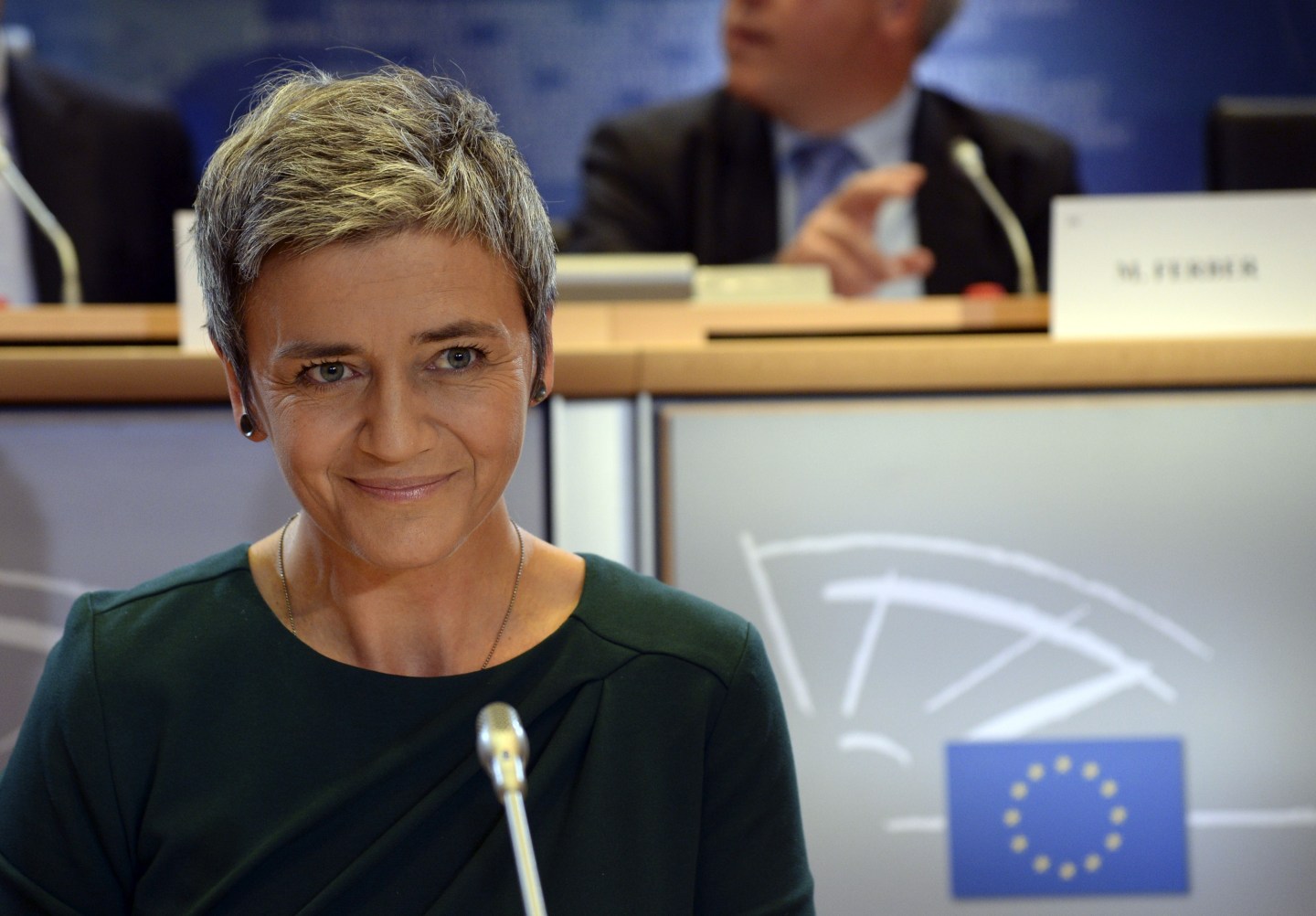
“Google pursues an overall strategy on mobile devices to protect and expand its dominant position in Internet search,” said Margrethe Vestager, the EU competition commissioner, at a press conference on Wednesday. “Dominant companies have a responsibility not to abuse their dominant position by restricting competition.”
Get Data Sheet, Fortune’s technology newsletter.
Google has a market share in Europe of over 90 percent — not only in search, but also in licensable mobile operating systems and in app stores for the Android operating system. Under antitrust law, Vestager said, this gives the company extra responsibilities.
“Based on our investigation, the Commission is concerned that Google’s behavior has harmed consumers by stifling competition and restricting innovation in the wider mobile space,” she said, arguing that rival search providers, browser firms and operating-system companies have not been “able to compete on their merits.”
Android is an open-source operating system, meaning companies other than Google can create “forked” versions that potentially create new, non-Google mobile ecosystems. However, adopting such a version would be a big risk for manufacturer who, by doing so, would have to stop selling regular Android devices at all.
“We have found evidence that, due to Google’s behavior, some manufacturers have decided not to use an alternative version of Android that has been developed by a credible competitor,” Vestager explained. “We have concerns that this hampers the development of viable versions of Android which could develop into credible platforms for competing apps and services.”
Google, of course, disagrees. It said in a blog post that its partnership agreements were voluntary, and it was trying to ensure compatibility between Android devices.
“Android has helped foster a remarkable – and, importantly, sustainable – ecosystem, based on open-source software and open innovation,” said Kent Walker, Google’s senior vice president and general counsel. “We look forward to working with the European Commission to demonstrate that Android is good for competition and good for consumers.”
The payments to manufacturers and operators for preinstalling Google Search take the form of revenue-sharing agreements, Vestager said, adding that the strength of the financial incentive was “preventing competition.”
“There is a striking feeling of ‘déjà vu’,” said Monique Goyens, the director general of the European Consumer Organization (BEUC).
“This case resembles the Microsoft(MSFT) competition saga a decade ago. Once again, a company is abusing its dominant position in the market by tying its products to its operating system. Google’s tying practices make it harder for consumers to access mobile apps of their choosing and strongly influence how consumers use their Android devices. This comes at a time when Google’s dominance in key segments of the digital economy and in the data ecosystem as a whole give it unparalleled power.”
For more on Android, watch:
The charges (which take the form of a so-called statement of objections) come a day after the Canadian authorities decided not to charge Google over its competitive practices. However, Russia has successfully charged and fined the company over its Android-related behavior, in a case with very strong parallels to the new EU charges.
Google also faces a separate set of antitrust charges in the EU over its promotion of its own comparison-shopping services in its search results — again, because of its dominance in the EU search market.
Those charges emerged almost exactly a year ago (when the Commission also announced its Android investigation). Vestager said on Wednesday that Google had given a “very detailed response” to the comparison-shopping charges and the Commission was currently “analysing the very large amount of data that we received.”
“We cannot sacrifice quality over speed,” she said.
Meanwhile, Vestager’s department is also looking into claims of Google abusing its position regarding the scraping of third-party content, the advertising market and other specialized search areas, “but these investigations are not done yet.”
Ultimately, apart from having to change its business practices, Google could pay fines of up to 10% of its global turnover for antitrust abuses in the EU, although that maximum is an unlikely outcome.