• Home
  • News
  • Fortune 500
  • Tech
  • Finance
  • Leadership
  • Lifestyle
  • Rankings
  • Multimedia
Tech

Hewlett Packard Enterprise Tech Chief Talks Up ‘the Machine’

Robert Hackett
By
Robert Hackett
Robert Hackett
Down Arrow Button Icon
Robert Hackett
By
Robert Hackett
Robert Hackett
Down Arrow Button Icon
March 2, 2016, 6:13 PM ET
Inside The HP Discover 2015 Conference
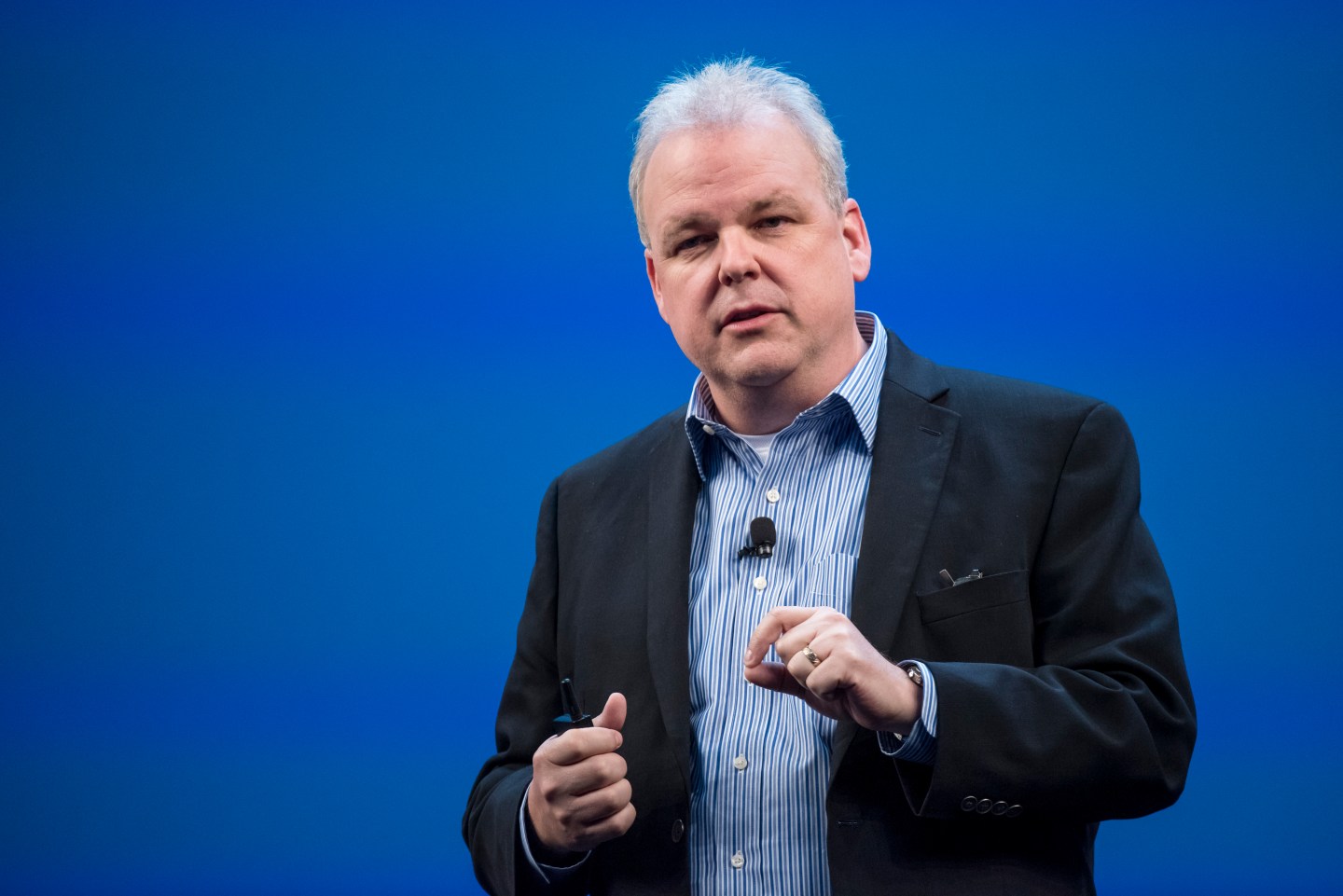
Martin Fink, chief technology officer of Hewlett-Packard Co., speaks during the HP Discover 2015 conference in Las Vegas, Nevada, U.S., on Wednesday, June 3, 2015. Hewlett Packard Enterprise, the business-focused company to be created in Hewlett-Packard's split later this year, will focus on four strategic areas, Chief Executive Officer Meg Whitman said. Photographer: David Paul Morris/Bloomberg via Getty ImagesDavid Paul Morris—Bloomberg Bloomberg via Getty Images

Martin Fink, chief technology officer at Hewlett Packard Enterprise, gave Fortune a preview of his keynote address at this year’s RSA Conference, the world’s biggest cybersecurity confab that is underway this week in San Francisco. The driving theme of his Wednesday talk is that today’s scourge of data breaches cannot be solved without network visibility. Too many organizations are fighting blind nowadays, he said.

Get Data Sheet, Fortune’s technology newsletter.

“The security problem is now an analytics problem,” Fink told Fortune days before taking the stage. He outlined his talk in three sections: a brief history of computer security, the changing role of security command centers, and the company’s bet on a proprietary technology with titillating potential that is called, cryptically, “the Machine.” (Read more about that research project in a Fortunearticle from last year.)

Fink’s first point is well known among present-day cybersecurity professionals. Perimeter defenses—securing one’s network with the digital equivalent of high walls and blockades—are not enough to prevent determined hackers from breaking into computer systems. Baddies will inevitably gain access. The trick is how to deal with them once they’re inside, an argument that leads directly into part two of Fink’s talk.

For more on cyber threats, watch:

Security operations centers, the IT divisions responsible for raising the alarm whenever a violation is detected, must evolve. The teams tasked with staying vigilant are simply flooded with too many incidents, he said. “It’s no longer reasonable to ask a human to look through 2.5 billion events per day,” Fink continued, tossing out an estimate for the number of alerts that a company might process each day. Even though an overwhelming portion will turn out to be false positives, the remainder is still too large for humans to contend with. “There’s just too much there.”

All of this plays into Fink’s coup de grâce: the aforementioned Machine. This technology, he believes, will serve as an indispensable tool in the information security tool-belt. The idea behind the system was to create a new computer design, one based on memory and data rather than a “processor-centric world,” as Fink put it. The Machine is designed to be bigger, better, and badder than anything cybersecurity pros are used to by storing more data, analyzing it faster, and operating at huge scale for its big business customers.

Fink’s team—he also heads up Hewlett Packard Labs, the company’s R&D division, which built the system—is working now to develop a version of the Machine that will hold a whopping petabyte of storage, he said, the equivalent of four times as much as the Library of Congress holds, compared with 640 terabytes of space with the current model. The Machine, which is designed to serve as a kind of howitzer cannon for analytics, is one way how Fink thinks Hewlett Packard Enterprise can help companies reduce the hundreds of days it takes them to detect network intruders on average.

The technology is still under construction, Fink said. Hewlett Packard Enterprise, which is having a rough go after its recent split with HP, Inc. (HPQ), plans to dribble out bits and piece of the Machine to market, with a completion date slated for 2020. It remains to be seen how the company will sell this innovation-in-progress. “In there we build things and prove they work,” Fink said of the R&D arm. “Then we transfer that to a business unit responsible for turning that into a business model.”

About the Author
Robert Hackett
By Robert Hackett
Instagram iconLinkedIn iconTwitter icon
See full bioRight Arrow Button Icon

Latest in Tech

Big TechStreaming
Trump warns Netflix-Warner deal may pose antitrust ‘problem’
By Hadriana Lowenkron, Se Young Lee and BloombergDecember 7, 2025
5 hours ago
Big TechOpenAI
OpenAI goes from stock market savior to burden as AI risks mount
By Ryan Vlastelica and BloombergDecember 7, 2025
5 hours ago
AIData centers
HP’s chief commercial officer predicts the future will include AI-powered PCs that don’t share data in the cloud
By Nicholas GordonDecember 7, 2025
7 hours ago
Future of WorkJamie Dimon
Jamie Dimon says even though AI will eliminate some jobs ‘maybe one day we’ll be working less hard but having wonderful lives’
By Jason MaDecember 7, 2025
11 hours ago
CryptoCryptocurrency
So much of crypto is not even real—but that’s starting to change
By Pete Najarian and Joe BruzzesiDecember 7, 2025
16 hours ago
Elon Musk
Big TechSpaceX
SpaceX to offer insider shares at record-setting $800 billion valuation
By Edward Ludlow, Loren Grush, Lizette Chapman, Eric Johnson and BloombergDecember 6, 2025
1 day ago

Most Popular

placeholder alt text
Real Estate
The 'Great Housing Reset' is coming: Income growth will outpace home-price growth in 2026, Redfin forecasts
By Nino PaoliDecember 6, 2025
2 days ago
placeholder alt text
AI
Nvidia CEO says data centers take about 3 years to construct in the U.S., while in China 'they can build a hospital in a weekend'
By Nino PaoliDecember 6, 2025
1 day ago
placeholder alt text
Economy
The most likely solution to the U.S. debt crisis is severe austerity triggered by a fiscal calamity, former White House economic adviser says
By Jason MaDecember 6, 2025
1 day ago
placeholder alt text
Big Tech
Mark Zuckerberg rebranded Facebook for the metaverse. Four years and $70 billion in losses later, he’s moving on
By Eva RoytburgDecember 5, 2025
2 days ago
placeholder alt text
Economy
JPMorgan CEO Jamie Dimon says Europe has a 'real problem’
By Katherine Chiglinsky and BloombergDecember 6, 2025
1 day ago
placeholder alt text
Uncategorized
Transforming customer support through intelligent AI operations
By Lauren ChomiukNovember 26, 2025
11 days ago
Rankings
  • 100 Best Companies
  • Fortune 500
  • Global 500
  • Fortune 500 Europe
  • Most Powerful Women
  • Future 50
  • World’s Most Admired Companies
  • See All Rankings
Sections
  • Finance
  • Leadership
  • Success
  • Tech
  • Asia
  • Europe
  • Environment
  • Fortune Crypto
  • Health
  • Retail
  • Lifestyle
  • Politics
  • Newsletters
  • Magazine
  • Features
  • Commentary
  • Mpw
  • CEO Initiative
  • Conferences
  • Personal Finance
  • Education
Customer Support
  • Frequently Asked Questions
  • Customer Service Portal
  • Privacy Policy
  • Terms Of Use
  • Single Issues For Purchase
  • International Print
Commercial Services
  • Advertising
  • Fortune Brand Studio
  • Fortune Analytics
  • Fortune Conferences
  • Business Development
About Us
  • About Us
  • Editorial Calendar
  • Press Center
  • Work At Fortune
  • Diversity And Inclusion
  • Terms And Conditions
  • Site Map

© 2025 Fortune Media IP Limited. All Rights Reserved. Use of this site constitutes acceptance of our Terms of Use and Privacy Policy | CA Notice at Collection and Privacy Notice | Do Not Sell/Share My Personal Information
FORTUNE is a trademark of Fortune Media IP Limited, registered in the U.S. and other countries. FORTUNE may receive compensation for some links to products and services on this website. Offers may be subject to change without notice.