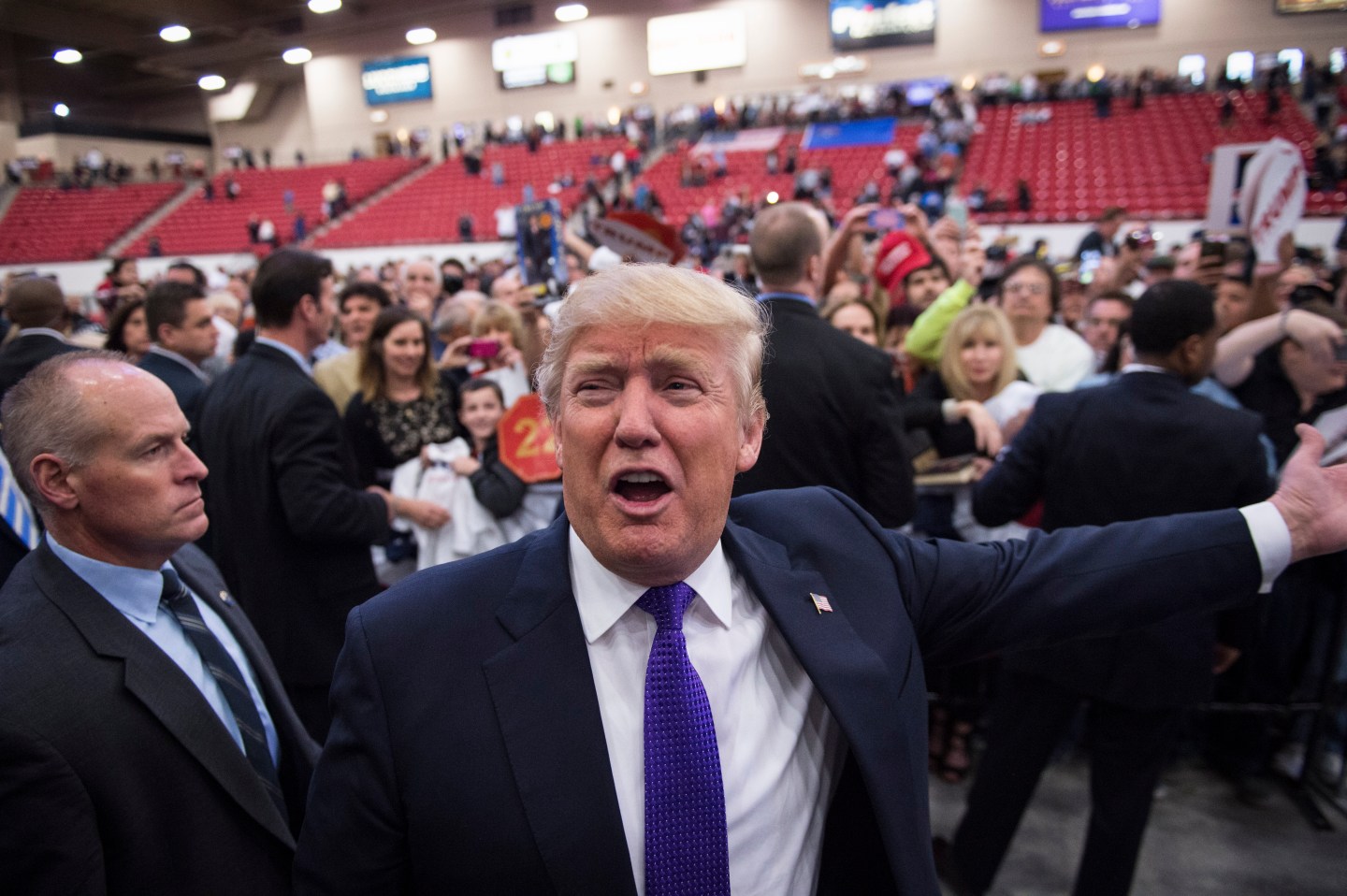
As the Nevada Republican caucuses get under way, many are expecting a Donald Trump victory. He crushed his opponents in the Republican primaries—first in “liberal” New Hampshire and then in “conservative” South Carolina over the weekend—and among the remaining Republican presidential candidates, he’s the only one who embodies all three areas of American excellence: statesmanship, wealth, and entertainment. He is a product of the time. He captures the moment like no other candidate has been able to do, and his success thus far is truly a case study in an aspect of democracy that is often overlooked: the susceptibility of democracy—especially in heterogeneous societies—to demagoguery.
The carnage wrought by demagoguery is evident in both developing societies and matured democracies. In Africa and Asia, weak institutions and even weaker economies have been unable to withstand the competitive pressures of powerful political gladiators fighting for the political crown, and the human rights abuses and violence that occasionally followed are often the result of well-executed demagoguery. In Africa, the odd pairing of democracy—in its many forms—and demagoguery has wreaked havoc on ordinary citizens and their livelihood, from Nigeria to Congo, South Africa, and Egypt. In Asia, the Gujarat riots of 2002 tested the robust democratic culture of India, the world’s largest democracy.
Prime Minister Narendra Modi was at the helm of affairs in Gujarat when many Muslims were attacked and killed by Hindu nationalists during the riots. Modi, the head of the Hindu nationalist party (BJP) that was in power at the time, was accused of doing little to stop the violence, but emerged a decade later to challenge the ruling Congress Party for control of the federal government. He was a more humbled politician who was able to see the plight of millions of fellow citizens whose lives had been upended by India’s rapid but unbalanced economic growth. In 2014, he ran an American-style campaign in a parliamentary system, crisscrossing his vast country with a disciplined Clintonesque message of attracting foreign and local investment, growing the economy in a way that benefited all Indians—not just Hindus or the elites. He won by a landslide.
In France, where Le Pen’s National Front right-wing demagoguery had been on full display since the 1970s, decades of migration from North Africa were “compounded” by the influx of refugees from the Balkans, as Eastern Europe suffered from conflicts and political disintegration in the early 2000s. Combined with economic stress, these events elevated Le Pen from a fringe party to a mainstream political movement in France in the 21st century.
Could it happen in the U.S.?
An optimistic explanation will argue that Trump’s ascension in this electoral cycle is different from the European right-wing political movement, mainly because Trump has managed to outmaneuver the restraints imposed on such behavior by America’s political culture—not its institutions—and long-standing credo, E Pluribus Unum. Unlike old-world France, for example, where Muslim immigrants are largely quartered in the ghettos outside of Paris, new-world American immigrants are, for the most part, highly integrated into the American culture and economic pursuits.
Writing for Politico, Jack Shafer hints at this cultural explanation, and attributed Trump’s stunning electoral success thus far to his exceptionalism: “The promise to get all things done holds a special appeal in our complaint-based culture. There’s too much traffic, too many flight delays, the Muslims are out to get us, crime is out of control, the economy should be growing at 6 percent, there’s a war on Christmas!, jobs are vanishing, China is getting too powerful, and so on. Always there with the simple solution, Trump eases his supporters’ woes with additional promises. His words fall flat on my ears because the job of president just doesn’t work that way: We’re electing a chief executive, not a dictator. But the same words inspire his supporters, who discover joy in sharing annoyances with him and hear music in his ‘solutions.’”
But Trump’s victory cannot be explained simply by the prevalence of kvetch in modern American culture. His margin of victory is too wide. In both New Hampshire and South Carolina, he won 35% and 33% of all votes cast, respectively, trouncing his two different closest rivals in both contests by double digits. Even more important than that, Trump won in nearly every county in both states and across vast demographic groups—men, women, blue collar, white collar, urban, rural, evangelicals, etc. In South Carolina, where the evangelical wing of the Republican Party was expected to break for one of its own, Trump took Ted Cruz to the cleaners, by winning the group by 5 percentage points over Cruz. Even more impressively, 40% of non-college-educated Republican voters in South Carolina voted for Trump, a multi-billionaire from Manhattan! The Trump juggernaut could not have been the result largely of the presence of kvetch in American culture. Rather, it’s a function of abdication of the responsibility to govern by the Republican establishment since the election of President Barack Obama.
The Republican obstructionism throughout the Obama presidency has been unprecedented in recent American history. In the early phase of the Bill Clinton presidency in the ‘90s, he ran into a brick wall of congressional Republican opposition and obstructionism. Ridiculed for his youth, lack of Washington chops, and wealth, Bill Clinton endured profound condescension from the Republican establishment, or what Hillary Clinton would later term “the vast right-wing conspiracy.” However, the initial obstructionism began to unravel after Sen. Barry Goldwater, the conservative icon par excellence, implored his fellow Republicans to snap out of it. Clinton was elected president by the American people, Goldwater emphasized, so “let him govern!” That display of establishment leadership eased Clinton’s path to a remarkable presidency with a lot of bipartisan accomplishments, from gun control to welfare reform, and ultimately a balanced budget. The U.S. economy took off like a rocket, wages surged, unemployed dropped, and optimism rose across racial, religious, and economic strata.
That Marco Rubio and Ted Cruz—two Hispanic Americans who have emerged as the most serious threat to Trump’s candidacy so far in these primaries—both opted for a political strategy to convince Republican primary voters that they’re more right-leaning than Trump has to be the greatest disappointment of this presidential election cycle. Why did they not confront Trump’s bigotry head-on as Jeb Bush did, and/or offer a message of hope and compassion as John Kasich has sought to do? What could have led these smart, lucky, immigrant young men of color on this path? It has to be their yearning to “belong,” their hunger for power, even at the risk of apostasy. And that may well turn out to be much more dangerous than the honesty and authenticity of Trump’s demagoguery.
Clement Adibe is an associate professor of political science, peace, justice, and conflict studies at DePaul University.