• Home
  • Latest
  • Fortune 500
  • Finance
  • Tech
  • Leadership
  • Lifestyle
  • Rankings
  • Multimedia
Leadership

Hillary Clinton, Bernie Sanders and the Real Definition of ‘Progressive’

By
Lily Rothman
Lily Rothman
and
TIME
Down Arrow Button Icon
February 5, 2016, 3:45 PM ET
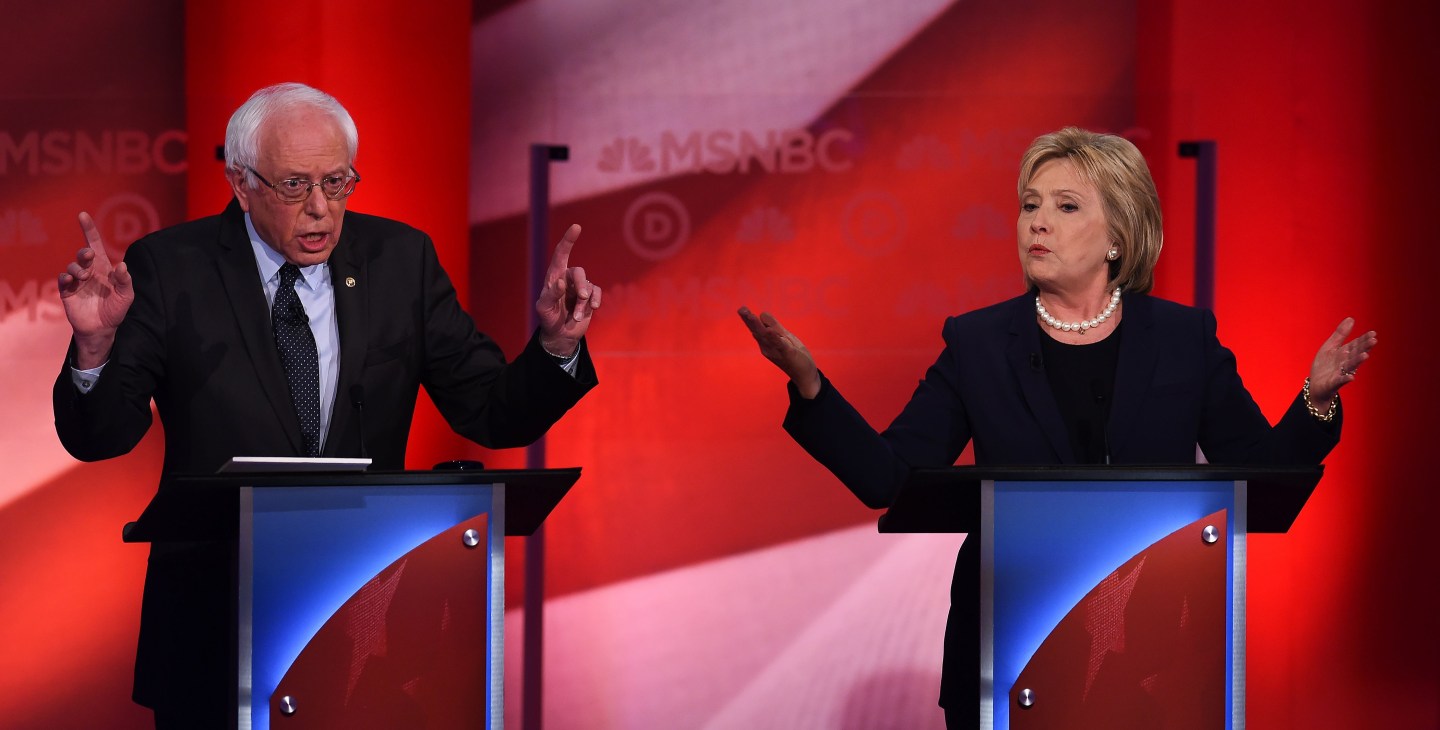
US-VOTE-DEMOCRATS-DEBATE
Jewel Samad—AFP/Getty Images

At the Democratic debate between Hillary Clinton and Bernie Sanderson Thursday night, the candidates’ discussion of the issues branched into slightly unusual territory: semantics. In a discussion that started with the question of whether Clinton was progressive enough to meet the Democratic Party’s needs, she called Sanders “the self-proclaimed gatekeeper for progressivism” and characterized his definition of “progressive” as so tough to meet that “it’s really caused [her] to wonder who’s left in the progressive wing of the Democratic Party.”

It was a thorny debate—but, it turns out, the question of what it means to be progressive in America is even more complicated than that.

“Historians don’t have a definition [of ‘progressive’] and we’ve argued for years over whether there is such a thing,” says Charles Postel, an expert on the Progressive and Populist movements who teaches history at San Francisco State University.

Yes, there was a specific Progressive Party (a.k.a the Bull Moose Party, which backed Theodore Roosevelt’s 1912 run for the White House) and a specific Progressive Era, during the first 15 or 20 years of the 20th century. But the ideas that gave that era its character—labor reform, farm reform, women’s rights, health reform, antitrust regulation, child-labor restrictions and more—had begun to spread decades earlier and didn’t stop evolving when World War I came, even if new era had otherwise begun. “This is something that historians now talk about as the ‘long Progressive Era,’” Postel says.

What’s striking about the more narrowly defined Progressive Era, Postel adds, is not so much that reformers had new ideas during that time but that they were remarkably successful in getting things done. And with so many activists making strides, it’s hard to say who should get credit for starting things or which causes were most central. But, while it’s hard to pinpoint a beginning and end for the Progressive Era, it’s a bit easier to list the reforms that set it apart. The power of corporations to influence government was a major concern for the classic progressives—in that way, “many progressives [of that time] sound like Bernie Sanders sounds today,” Postel says—as was a need for social improvement, which meant integrating immigrants into society, improving conditions for children, ending political corruption and cleaning up cities, among other efforts.

Postel argues that today’s use of the word “progressive” isn’t substantively different from the modern use of the word “liberal,” which has its own, perhaps even more complicated history. (Here’s the short version: a 19th-century liberal was someone who advocated for free markets, but during the 1930s, when the Progressive Era was still relatively fresh in the nation’s minds, proponents of the New Deal started using the word “liberal” to describe their policies, though many of them were connected to Progressive ideas. During the Reagan years, “liberal” acquired a bad reputation and eventually “progressive”—with a lower-case “p”—came back.) But there’s a logic to the Democratic candidates wanting that linguistic link to the early Progressives.

First of all, Postel says, it’s worth noting that today’s politicians who claim the progressive mantel do share a lot with their forebears. Sanders’ respect for Eugene Debs, the socialist leader of the Progressive Era, who believed that the Progressive Party had stolen the Socialist platform, is well known. As for Clinton, the historian sees a strong connection between the political stances and personal lives of the candidate and Jane Addams, one of the foremost female activists of the Progressive Era. And the policies that mark a modern candidate as progressive are generally ones that would be recognized by the reformers of a century ago. (The parallel isn’t perfect, but that’s for the best: “Progressivism in the early 20th century tended to be deeply racist, either overtly, in the sense of Woodrow Wilson who really was a segregationist, or through just negligence,” Postel says. “Today racial justice is an integral part of progressivism.”)


So, given all that history, are today’s Democratic candidates truly progressive? Is one more progressive that the other? Who was right on Thursday?

If you ask Postel, both candidates were correct, but in slightly different ways.

“There’s no question that Bernie is something to the left of Hillary on a series of questions, but I think Hillary also has a point that there is no sharp line of who is a progressive and who is not,” he says. Teddy Roosevelt, for example, was the iconic Progressive president, a supporter of national health insurance and an enemy to corporate trusts—but he was also “a pretty strong supporter of any war that he could find to get behind.”

Finding a single politician who can tick every progressive box is impossible today, but it’s been just as impossible since the movement’s earliest days. So, Postel says, though Sanders’ positions are more classically progressive, Clinton’s take on the difficulty of defining the word is historically accurate, too.

This article was originally published on Time.com.

About the Authors
By Lily Rothman
See full bioRight Arrow Button Icon
By TIME
See full bioRight Arrow Button Icon

Latest in Leadership

Finance
Lorem ipsum dolor sit amet, consectetur adipiscing elit, sed do eiusmod tempor incididunt ut labore et dolore magna aliqua. Ut enim ad minim veniam
By Fortune Editors
October 20, 2025
Finance
Lorem ipsum dolor sit amet, consectetur adipiscing elit, sed do eiusmod tempor incididunt ut labore et dolore magna aliqua. Ut enim ad minim veniam
By Fortune Editors
October 20, 2025
Finance
Lorem ipsum dolor sit amet, consectetur adipiscing elit, sed do eiusmod tempor incididunt ut labore et dolore magna aliqua. Ut enim ad minim veniam
By Fortune Editors
October 20, 2025
Finance
Lorem ipsum dolor sit amet, consectetur adipiscing elit, sed do eiusmod tempor incididunt ut labore et dolore magna aliqua. Ut enim ad minim veniam
By Fortune Editors
October 20, 2025
Finance
Lorem ipsum dolor sit amet, consectetur adipiscing elit, sed do eiusmod tempor incididunt ut labore et dolore magna aliqua. Ut enim ad minim veniam
By Fortune Editors
October 20, 2025
Finance
Lorem ipsum dolor sit amet, consectetur adipiscing elit, sed do eiusmod tempor incididunt ut labore et dolore magna aliqua. Ut enim ad minim veniam
By Fortune Editors
October 20, 2025

Most Popular

Finance
Lorem ipsum dolor sit amet, consectetur adipiscing elit, sed do eiusmod tempor incididunt ut labore et dolore magna aliqua. Ut enim ad minim veniam
By Fortune Editors
October 20, 2025
Finance
Lorem ipsum dolor sit amet, consectetur adipiscing elit, sed do eiusmod tempor incididunt ut labore et dolore magna aliqua. Ut enim ad minim veniam
By Fortune Editors
October 20, 2025
Finance
Lorem ipsum dolor sit amet, consectetur adipiscing elit, sed do eiusmod tempor incididunt ut labore et dolore magna aliqua. Ut enim ad minim veniam
By Fortune Editors
October 20, 2025
Finance
Lorem ipsum dolor sit amet, consectetur adipiscing elit, sed do eiusmod tempor incididunt ut labore et dolore magna aliqua. Ut enim ad minim veniam
By Fortune Editors
October 20, 2025
Finance
Lorem ipsum dolor sit amet, consectetur adipiscing elit, sed do eiusmod tempor incididunt ut labore et dolore magna aliqua. Ut enim ad minim veniam
By Fortune Editors
October 20, 2025
Finance
Lorem ipsum dolor sit amet, consectetur adipiscing elit, sed do eiusmod tempor incididunt ut labore et dolore magna aliqua. Ut enim ad minim veniam
By Fortune Editors
October 20, 2025
Rankings
  • 100 Best Companies
  • Fortune 500
  • Global 500
  • Fortune 500 Europe
  • Most Powerful Women
  • Future 50
  • World’s Most Admired Companies
  • See All Rankings
Sections
  • Finance
  • Leadership
  • Success
  • Tech
  • Asia
  • Europe
  • Environment
  • Fortune Crypto
  • Health
  • Retail
  • Lifestyle
  • Politics
  • Newsletters
  • Magazine
  • Features
  • Commentary
  • Mpw
  • CEO Initiative
  • Conferences
  • Personal Finance
  • Education
Customer Support
  • Frequently Asked Questions
  • Customer Service Portal
  • Privacy Policy
  • Terms Of Use
  • Single Issues For Purchase
  • International Print
Commercial Services
  • Advertising
  • Fortune Brand Studio
  • Fortune Analytics
  • Fortune Conferences
  • Business Development
About Us
  • About Us
  • Editorial Calendar
  • Press Center
  • Work At Fortune
  • Diversity And Inclusion
  • Terms And Conditions
  • Site Map

© 2025 Fortune Media IP Limited. All Rights Reserved. Use of this site constitutes acceptance of our Terms of Use and Privacy Policy | CA Notice at Collection and Privacy Notice | Do Not Sell/Share My Personal Information
FORTUNE is a trademark of Fortune Media IP Limited, registered in the U.S. and other countries. FORTUNE may receive compensation for some links to products and services on this website. Offers may be subject to change without notice.


Most Popular

placeholder alt text
Economy
The $38 trillion national debt is to blame for over $1 trillion in annual interest payments from here on out, CRFB says
By Nick LichtenbergDecember 17, 2025
2 days ago
placeholder alt text
C-Suite
Red Lobster CEO Damola Adamolekun says the key to being a better leader is being a better person: ‘Leadership is self-improvement’
By Sydney LakeDecember 17, 2025
2 days ago
placeholder alt text
AI
'Robots are going to be amongst us': Qualcomm exec says buckle up for the next 5 years. Your car is going to be the first shoe to drop
By Nino PaoliDecember 17, 2025
2 days ago
placeholder alt text
Success
As millions of Gen Zers face unemployment, McDonald's CEO dishes out some tough love career advice for navigating the market: ‘You've got to make things happen for yourself’
By Preston ForeDecember 16, 2025
3 days ago
placeholder alt text
Success
Britain’s defense chief calls on Gen Z grads leaving university to skip corporate jobs and join the military as war with Russia becomes a growing risk
By Emma BurleighDecember 17, 2025
2 days ago
placeholder alt text
Future of Work
LinkedIn CEO says it's 'outdated' to have a five-year career plan: It's a 'little bit foolish' considering the pace AI is changing the workplace
By Sydney LakeDecember 18, 2025
16 hours ago

Latest in Leadership

Jelly Roll
LawCrime
Jelly Roll, country-rap superstar who found music while serving prison time, pardoned by Tennessee governor in front of Christmas Tree
By Jonathan Mattise and The Associated PressDecember 18, 2025
8 hours ago
RetailWomen
Walmart’s women truckers surge thanks to $115,000 starting pay and other perks bringing in nontraditional candidates
By Marco Quiroz-GutierrezDecember 18, 2025
8 hours ago
unemployed
CommentaryLayoffs
The AI efficiency illusion: why cutting 1.1 million jobs will stifle, not scale, your strategy
By Katica RoyDecember 18, 2025
12 hours ago
Joe Anders and Kate Winslet
SuccessCareers
Her two Gen Z children have starred in her films, but Oscar award-winning actress Kate Winslet says nepo baby allegations are ‘silly’
By Emma BurleighDecember 18, 2025
14 hours ago
David Kostin
SuccessCareers
As graduates face a ‘jobpocalypse,’ Goldman Sachs exec tells Gen Z they need to know their commercial impact 
By Preston ForeDecember 18, 2025
14 hours ago
Future of WorkCareer Advice
LinkedIn CEO says it’s ‘outdated’ to have a five-year career plan: It’s a ‘little bit foolish’ considering the pace AI is changing the workplace
By Sydney LakeDecember 18, 2025
16 hours ago