• Home
  • News
  • Fortune 500
  • Tech
  • Finance
  • Leadership
  • Lifestyle
  • Rankings
  • Multimedia
Leadership

This Supreme Court Case Could Deal A Major Blow to Public Unions

Claire Zillman
By
Claire Zillman
Claire Zillman
Editor, Leadership
Down Arrow Button Icon
Claire Zillman
By
Claire Zillman
Claire Zillman
Editor, Leadership
Down Arrow Button Icon
January 10, 2016, 8:30 AM ET
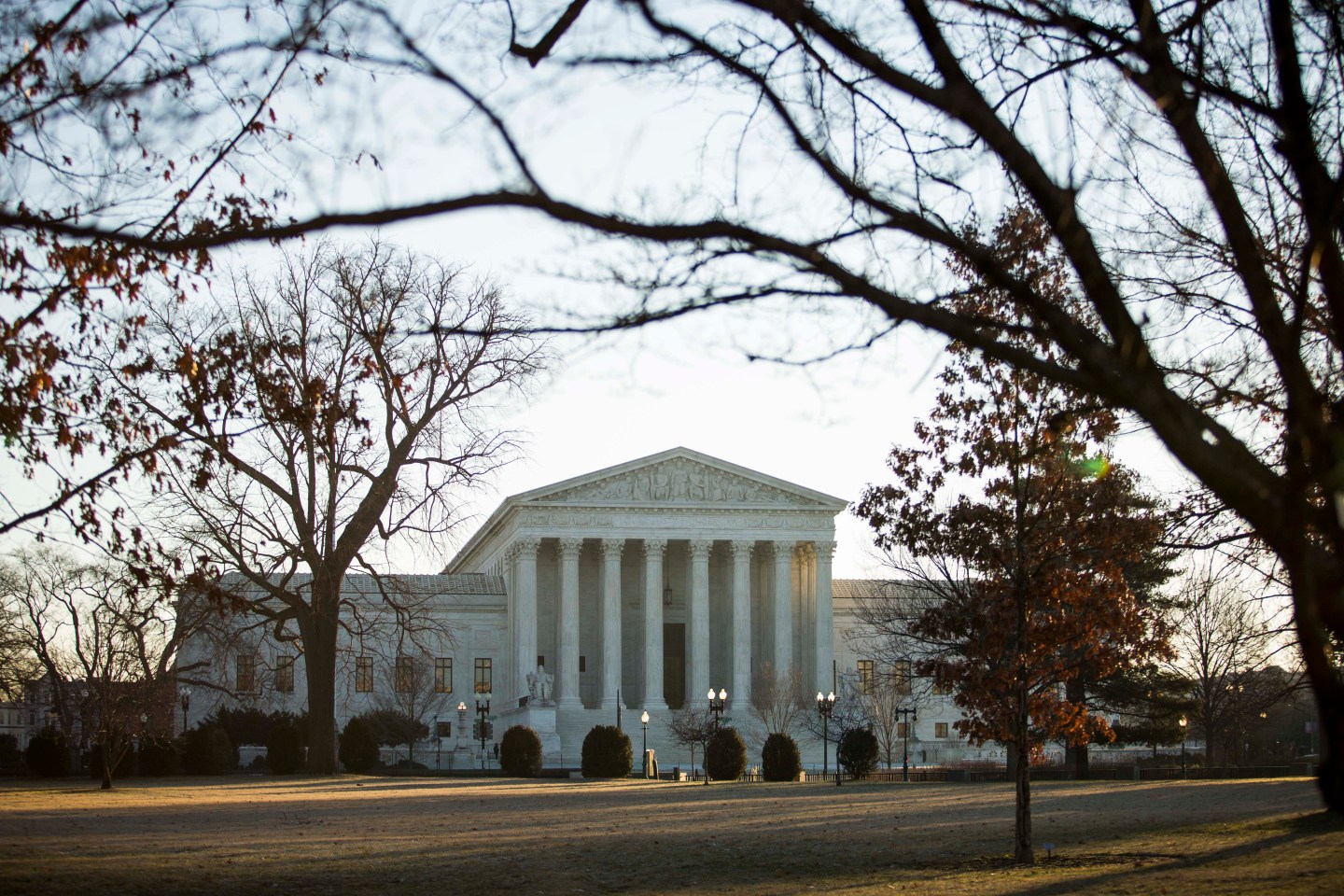
Supreme Court Meets In Closed Conference To Decide On Hearing Same-Sex Marriage Cases From Several States
WASHINGTON, DC - JANUARY 16: A view of the Supreme Court, January 16, 2015 in Washington, DC. On Friday, the Supreme Court is meeting in closed conference to decide whether it will take up cases on the issues of same sex-marriage and marriage recognition from several states. (Drew Angerer/Getty Images)Drew Angerer Getty Images

For years, unions in the United States have been under threat from a dwindling manufacturing base and the proliferation of state “right-to-work laws,” which have restricted the organizations’ ability to collect member dues.

On Monday, organized labor—specifically public unions—face another major challenge, when the United States Supreme Court hears oral arguments in Friedrichs v. California Teachers Association.

The justices will devote 80 minutes—20 more than usual—to the case, which was brought by 10 teachers and an advocacy group, the Christian Educators Association, seeking to overturn a 39-year-old precedent for how public unions can collect dues from the non-union members that they represent.

The teachers are taking aim at a 1977 Supreme Court’s decision, Abood v. Detroit Board of Education, that says that a union that collectively bargains on behalf of public employees—some of whom are union members and some of whom aren’t—cannot collect dues from non-members that are used for political activity, but it can charge non-members “fair share” or “agency” fees to cover the cost of negotiating on their behalf.

The teachers, who are non-members of the CTA and disagree with the union’s positions, are basing their challenge to that precedent on the theory that collective bargaining by a public union counts as political activity because their salaries and benefits come from a public budget, and they should therefore be able to opt out of paying dues. In their petition asking the Supreme Court to hear their case, the teachers said that their union’s collective bargaining influences governmental decision-making. They said, “it is difficult to imagine more politically charged issues than how much money cash-strapped local governments should devote to public employees, or what policies public schools should adopt to best educate children.”

The justices will consider the teachers’ assertion that being forced to pay such fees constitutes compelled speech and violates their First Amendment rights.

On the flip side, the CTA and the State of California are asking the Supreme Court to keep the Abood precedent in place. They argue that the dues paid by non-members are essential to the union’s ability to negotiate on behalf of all its members, and that there’s little chance anyone would interpret non-members’ payment of dues as acquiescence to the union’s political leanings. The U.S. government submitted a “friend of the court” brief supporting this stance.

In two similar cases in the past—Harris v. Quinn in 2014 and Knox v. Service Employees International Union, Local 1000 in 2012—the Supreme Court has hinted that the First Amendment bars obligatory union dues, which suggests that the justices will rule in the teachers’ favor. Such a decision would no doubt deal a blow to public unions by reducing their dues-paying pool to only those members and non-members who choose to contribute. A win for the teachers could also undermine organized labor altogether—private and public unions alike—since the labor movement is being increasingly propped up by government workers.

The total number of American workers represented by organized labor has shrunk from 18 million in 2000 (15% of all workers) to 16 million in 2014 (12% of all employed Americans). And unions’ influence has become more concentrated in government jobs even though the public workforce is one-fifth the size of private employment.


About the Author
Claire Zillman
By Claire ZillmanEditor, Leadership
LinkedIn iconTwitter icon

Claire Zillman is a senior editor at Fortune, overseeing leadership stories. 

See full bioRight Arrow Button Icon

Latest in Leadership

CryptoBinance
Binance has been proudly nomadic for years. A new announcement suggests it’s finally chosen a headquarters
By Ben WeissDecember 7, 2025
20 minutes ago
Future of WorkJamie Dimon
Jamie Dimon says even though AI will eliminate some jobs ‘maybe one day we’ll be working less hard but having wonderful lives’
By Jason MaDecember 7, 2025
10 hours ago
business
C-Suitechief executive officer (CEO)
Inside the Fortune 500 CEO pressure cooker: surviving is harder than ever and requires an ‘odd combination’ of traits
By Nick LichtenbergDecember 7, 2025
14 hours ago
Alex Amouyel is the President and CEO of Newman’s Own Foundation
Commentaryphilanthropy
Following in Paul Newman and Yvon Chouinard’s footsteps: There are more ways for leaders to give it away in ‘the Great Boomer Fire Sale’ than ever
By Alex AmouyelDecember 7, 2025
15 hours ago
Hank Green sipping tea
SuccessPersonal Finance
Millionaire YouTuber Hank Green tells Gen Z to rethink their Tesla bets—and shares the portfolio changes he’s making to avoid AI-bubble fallout
By Preston ForeDecember 7, 2025
16 hours ago
MagazineWarren Buffett
Warren Buffett: Business titan and cover star
By Indrani SenDecember 7, 2025
17 hours ago

Most Popular

placeholder alt text
Real Estate
The 'Great Housing Reset' is coming: Income growth will outpace home-price growth in 2026, Redfin forecasts
By Nino PaoliDecember 6, 2025
2 days ago
placeholder alt text
AI
Nvidia CEO says data centers take about 3 years to construct in the U.S., while in China 'they can build a hospital in a weekend'
By Nino PaoliDecember 6, 2025
1 day ago
placeholder alt text
Economy
The most likely solution to the U.S. debt crisis is severe austerity triggered by a fiscal calamity, former White House economic adviser says
By Jason MaDecember 6, 2025
1 day ago
placeholder alt text
Big Tech
Mark Zuckerberg rebranded Facebook for the metaverse. Four years and $70 billion in losses later, he’s moving on
By Eva RoytburgDecember 5, 2025
2 days ago
placeholder alt text
Economy
JPMorgan CEO Jamie Dimon says Europe has a 'real problem’
By Katherine Chiglinsky and BloombergDecember 6, 2025
1 day ago
placeholder alt text
Uncategorized
Transforming customer support through intelligent AI operations
By Lauren ChomiukNovember 26, 2025
11 days ago
Rankings
  • 100 Best Companies
  • Fortune 500
  • Global 500
  • Fortune 500 Europe
  • Most Powerful Women
  • Future 50
  • World’s Most Admired Companies
  • See All Rankings
Sections
  • Finance
  • Leadership
  • Success
  • Tech
  • Asia
  • Europe
  • Environment
  • Fortune Crypto
  • Health
  • Retail
  • Lifestyle
  • Politics
  • Newsletters
  • Magazine
  • Features
  • Commentary
  • Mpw
  • CEO Initiative
  • Conferences
  • Personal Finance
  • Education
Customer Support
  • Frequently Asked Questions
  • Customer Service Portal
  • Privacy Policy
  • Terms Of Use
  • Single Issues For Purchase
  • International Print
Commercial Services
  • Advertising
  • Fortune Brand Studio
  • Fortune Analytics
  • Fortune Conferences
  • Business Development
About Us
  • About Us
  • Editorial Calendar
  • Press Center
  • Work At Fortune
  • Diversity And Inclusion
  • Terms And Conditions
  • Site Map

© 2025 Fortune Media IP Limited. All Rights Reserved. Use of this site constitutes acceptance of our Terms of Use and Privacy Policy | CA Notice at Collection and Privacy Notice | Do Not Sell/Share My Personal Information
FORTUNE is a trademark of Fortune Media IP Limited, registered in the U.S. and other countries. FORTUNE may receive compensation for some links to products and services on this website. Offers may be subject to change without notice.