On the eve of its press conference at the Consumer Electronics Show in Las Vegas, Ford chief executive Mark Fields was still coy on the automaker’s reported deal to partner with Google to build self-driving, Ford-branded cars.
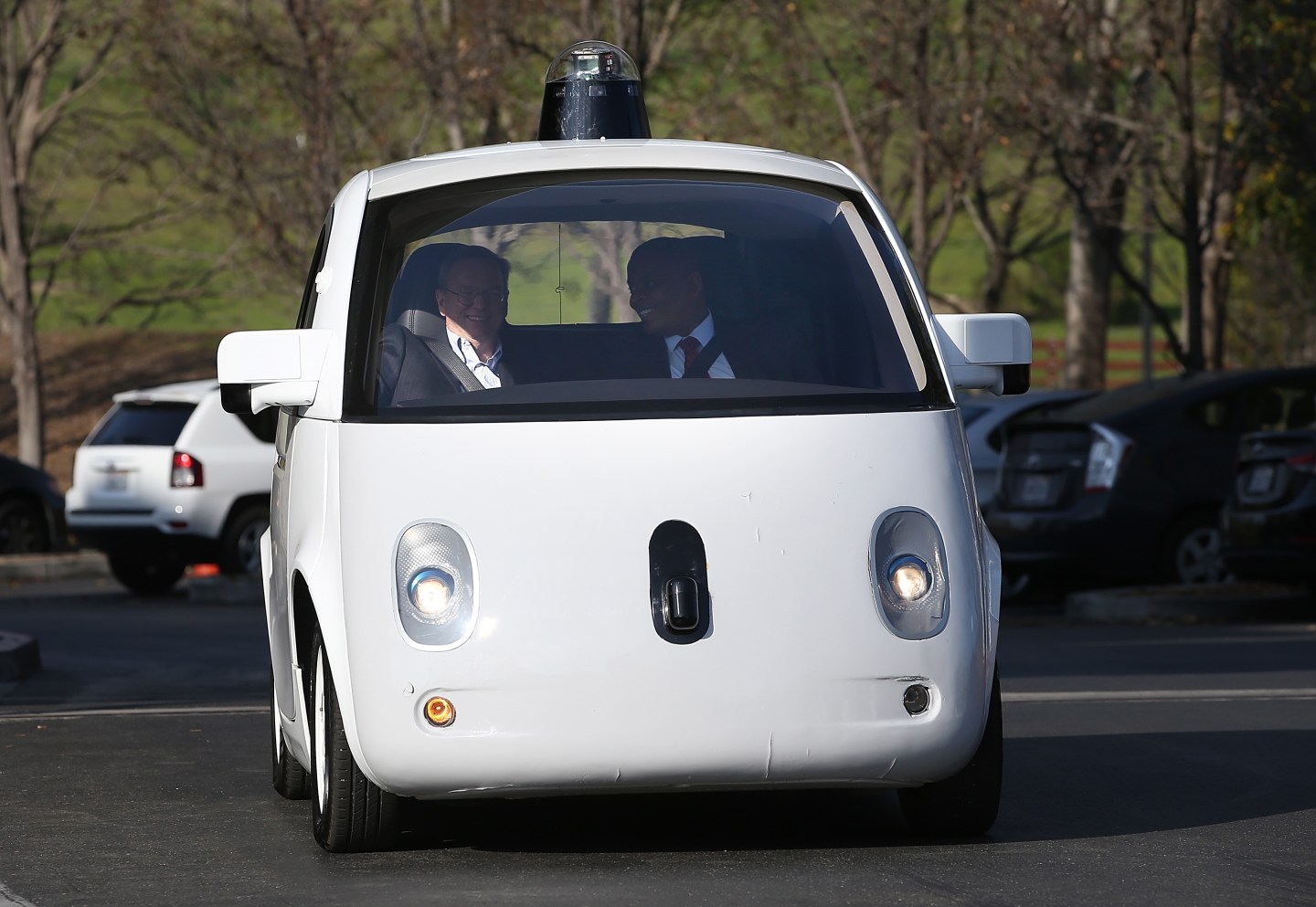
“We’re talking with everyone,” Fields said during a sit-down in a New York hotel, just before he zipped to Teterboro Airport for a flight to Vegas. But with analysts assuring us that a Ford-Google deal is imminent, it’s worth recalling the latest hoax perpetrated by a conscienceless tech media: that before long, we’d all be dorking around town in the Google Car, the famously Weebles-styled, self-driving bubble.
The tech giant’s self-driving technology is real, but the car itself is vaporware. Google (GOOG) says it has no intention of creating and selling its own car. As for an iCar from Apple (AAPL), only a gullible fanboy should wait in line. Yet Google didn’t even need to trot out familiar, Tesla-esque promises (TSLA) to revolutionize the industry. All it had to do was putt around California in its little bumper car, and its tech toadies did the work for them.
I’ve come to believe that many in the cynical tech media—your Wired, your Fast Company—not only don’t care to get it right, they don’t care if they’re wrong. With memories and attention spans measured in milliseconds, the Internet means never having to say you’re sorry. If more proof were needed, the Great Google Hoax shows that the extravagant soothsayers who cover Silicon Valley can never be trusted to get the automotive story straight. There’s only one narrative that fits, one gospel with which to snare eyeballs and flatter their self-regarding consumers: Silicon Valley is Lord and Savior. Detroit and other hidebound corners of the earth are the Devil, only much dumber.
The idea that the profit minters of Mountain View would spend tens of billions of dollars to become low-margin automakers was dubious to begin with. Why should they, when they’ve finally found easy entry through the back door? Google is now rightly focused on licensing its self-driving technology to multiple partners. All it needs is a genius microchip and a wireless connection to open up shop in your car. Google never needed to build cars like millions of game pieces, if it can be the invisible hand that shuffles them around the automated game board.
As for cautious mainstream buyers, they’re not likely to trade in their Ford (F), or Audi (AUDVF) or Toyota (TM), to take a flyer on a startup—even a Teflon-coated Apple—that has never produced or serviced a single car. Google, the company that knows more than any other about our brand loyalties and deepest desires, surely recognizes this. So it never mattered whether the Google Car was a utopian bubble, their original retrofitted Lexus SUV or a red Radio Flyer wagon: The thingy on wheels was always a Trojan Horse for the software inside. A truly breakthrough, fully self-driving car might be a different story. But some leading lights in autonomy, from the nerve center of Stanford to engineers at Audi or Nissan (NSANY), argue that any Google edge in software and hardware is exaggerated or short-lived.
Thanks to the wonderful world of metadata that got Edward Snowden exiled, Google (and Facebook and phone companies and the NSA) already has a great idea of not only what you do online, but where you go, who you talk to and how you live. For them, the time you spend in your car is a critical node to fill in the remaining blanks. It’s a kill-or-be-killed opportunity to develop or dominate the networks that control automated cars and in-car infotainment. That includes the ability to sell you more stuff 24/7, from apps to content to a J. Crew sweater. Make the car fully automated, and the human race is freed to stare, well, Google-eyed, at paid content on the car’s ever-larger screen displays. Or to see a Chick-fil-A discount magically appear as you cruise past its interstate exit.
But make no mistake: Nissan, Audi, Ford, Mercedes-Benz (DDAIF) and other legacy automakers will design, build, market and service the self-driving and connected car. Google’s contribution—for those who choose to align with the company—will largely be limited to the software code whirring behind the scenes, or the stuff streaming through an interface. Don’t be surprised if automakers find ways to block tech companies from sharing the spoils in their newly profitable cabins. Bowing to customers’ demands for convenient smartphone links, Fields says that Ford will offer Apple CarPlay and Android Auto in every 2017 Ford and Lincoln equipped with its Sync connectivity system. Yet Ford is also pushing its open source SmartDeviceLink software for phone apps—ironically to cock-block Google and Apple’s services. Big players like Toyota and QNX Software have already joined up.
More from The Drive:
• 10 Most Googled Cars of 2015
• The Drive’s Essential Guide to Self-driving Cars
• Ford Joins Google, Audi in California Self-Driving Car Tests
Fields says that Ford will partner up where it makes sense and go it alone where it doesn’t. Ford intends to develop mainstream cars, not just pricey luxury models, that achieve Level 4 autonomy, meaning the ability for drivers to sit back, check out and let the car handle virtually any situation.
Ford is tripling its autonomous Fusion test fleet to 30 cars, is testing at University of Michigan’s MCity simulated environment, and got a license to test on public roads in California. It’s working with Velodyne’s Lidar system, which Ford has experience with dating back to the autonomous DARPA challenge of 2005. Such Lidar systems pump out invisible illumination, nearly a million pulses per second, to create incredibly detailed 3D images of their surroundings. The latest, dramatically scaled-down Lidar hardware, Fields said, “is literally the size of a hockey puck,” making it easy to integrate into a production car.
While a Ford-Google deal is not yet fait accompli, there are signs in its favor. Alan Mulally, Fields’ retired predecessor, now sits on Google’s board of directors. John Krafcik, who heads up Google’s self-driving project, is a former Ford engineer.
Like most of us, Fields can’t predict what the automotive industry will look like in five or 15 years, or who will bring the first true robocar to market. But the tech media keeps insisting it knows, as shamelessly and recurringly as the next fawning CEO cover story. And people keep buying it. Tell you what: The next time someone inflates a shiny bubble of B.S. around the Valley, remind him what bubbles tend to do in that corner of the world.
This article was previously published on The Drive.