• Home
  • News
  • Fortune 500
  • Tech
  • Finance
  • Leadership
  • Lifestyle
  • Rankings
  • Multimedia
MPW

You Won’t Live To See Gender Pay Equality

By
Valentina Zarya
Valentina Zarya
Down Arrow Button Icon
By
Valentina Zarya
Valentina Zarya
Down Arrow Button Icon
November 19, 2015, 10:53 AM ET
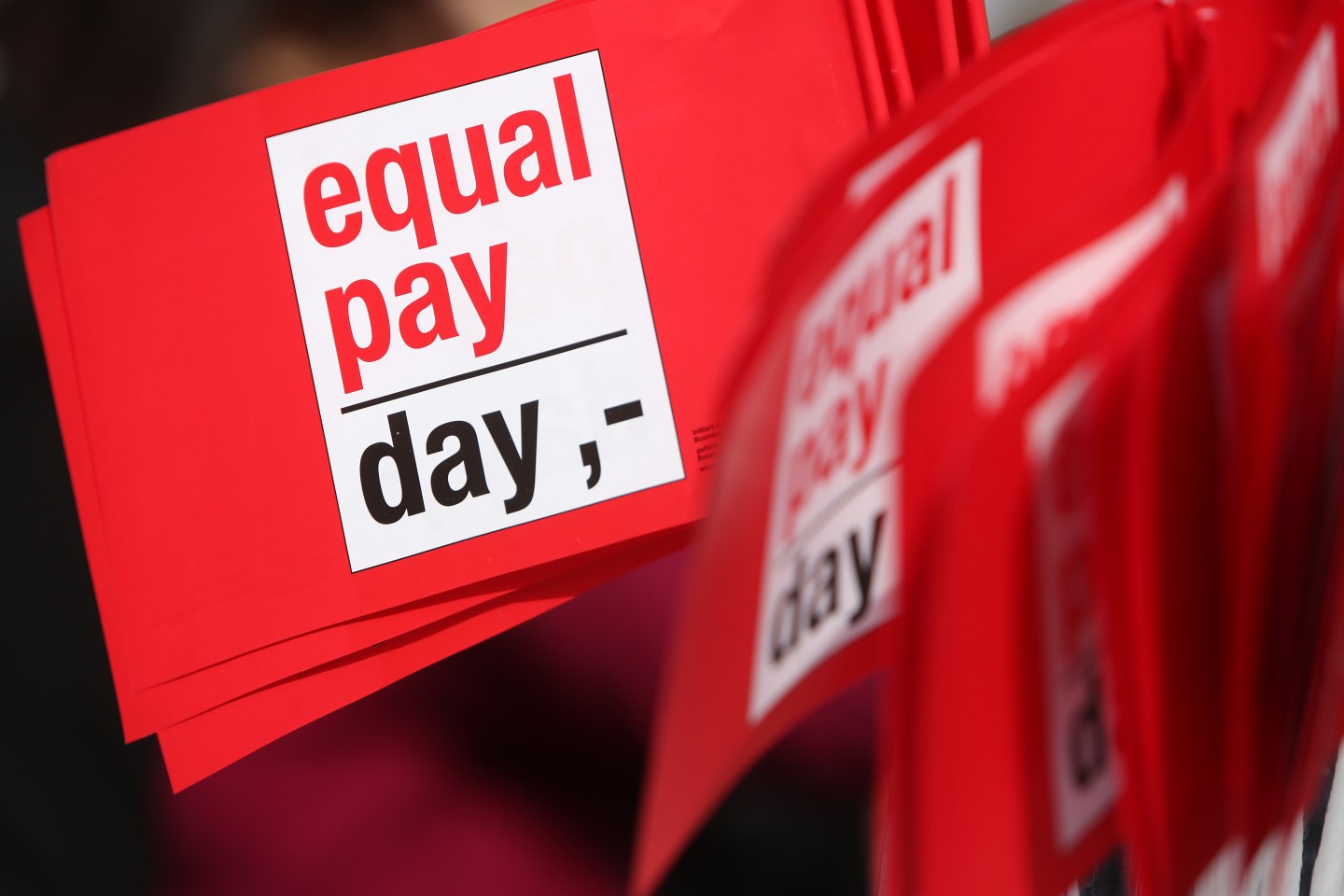
"Equal Pay Day" Protesters Demand Equal Pay For Women
BERLIN, GERMANY - MARCH 21: Flags reading 'Equal Pay Day' are seen during the 'Equal Pay Day' demonstration on March 21, 2014 in Berlin, Germany. The annual event recognizes the wage gap between the sexes in the country, where women's salaries still lag behind that of men, particularly in the states that were once East Germany. (Photo by Adam Berry/Getty Images)Photograph by Adam Berry — Getty Images

If you think global economic equality between men and women is possible in your lifetime, think again.

It will take the world another 118 years—or until 2133—to close the economic gender gap, according to the World Economic Forum’s Global Gender Gap Report 2015, which launched Thursday. Today, women are earning close to what men were paid back in 2006, when the Forum first developed its Global Gender Gap Index.

The Forum’s 2133 calculation is based on the current snail-like pace of improvement. The gender gap in health, education, economic opportunity and political representation has narrowed by 4% in the past 10 years, while the gap in wage equality and labor force parity has shrunk by just 3%.

Of course, the situation varies globally. The U.S., for example, is expected to reach economic gender equality in 2059, according to the Institute for Women’s Policy Research. America ranks 28th out of the 145 nations on the WEF’s Gender Gap Index, putting it below most European countries, including the UK, France, and Germany, as well as some African ones: Rwanda ranks sixth on the list, while South Africa ranks 17th.

The best news comes from—where else?—the Nordic countries: Iceland, Norway, Finland, and Sweden, which occupy the top four spots in the index. In that past 10 years, Iceland managed to shrink the gap by 11%, which means the country’s men and women are on track to reach economic equality in a decade, says Saadia Zahidi, head of employment and gender initiatives at the Forum.

Why are these countries so successful in closing the gap? “They have had a long tradition of putting social equality as a central tenet of their development,” says Zahidi. “They have been doing that for the last 100 years.” In these Nordic nations—and in Sweden in particular—government policy has been reinforcing gender equality, something that most countries do not do, she explains. “For most parts of the world, policy changes are really slow.” In the U.S., “there have been a few changes and some experiments, but most organizations are still looking like they did 30, 40, 50 years ago.”

In order to close the gender gap, countries must actually change the social policy model, as well as educate women and encourage them to join the workforce, Zahidi says. Currently, most social policy is still based on the idea of a single-income household where a man is the breadwinner and a woman is the caregiver. The reality, of course, is that it is becoming increasingly difficult for a family with children to subsist on a single income, and women and men are sharing at-home responsibilities more and more frequently.

The best example of how social policy can affect a population is Sweden, which, in addition to being the fourth most equal country in the world in terms of gender, also has the third-highest fertility rate in Europe. This is in contrast to the 1980s, when Sweden’s fertility rate was among the lowest. What’s different? The country has introduced publicly-run services for children, support for mothers’ employment, support for father involvement, and support for single mothers. In essence, reducing the stresses of combining employment and parenthood has made Swedish parents want more children.

If they want economic parity—and thus economic prosperity—other countries are going to need to start take a leaf out of Sweden’s social policy book.

Subscribe to theBroadsheet, Fortune’s daily newsletter on the world’s most powerful women.

About the Author
By Valentina Zarya
See full bioRight Arrow Button Icon

Latest in MPW

C-SuiteLeadership Next
Ulta Beauty CEO Kecia Steelman says she has the best job ever: ‘My job is to help make people feel really good about themselves’
By Fortune EditorsNovember 5, 2025
27 days ago
ConferencesMPW Summit
Executives at DoorDash, Airbnb, Sephora and ServiceNow agree: leaders need to be agile—and be a ‘swan’ on the pond
By Preston ForeOctober 21, 2025
1 month ago
Jessica Wu, co-founder and CEO of Sola, at Fortune MPW 2025
MPW
Experts say the high failure rate in AI adoption isn’t a bug, but a feature: ‘Has anybody ever started to ride a bike on the first try?’
By Dave SmithOctober 21, 2025
1 month ago
Jamie Dimon with his hand up at Fortune's Most Powerful Women Summit
SuccessProductivity
JPMorgan CEO Jamie Dimon says if you check your email in meetings, he’ll tell you to close it: ’it’s disrespectful’
By Preston ForeOctober 17, 2025
2 months ago
Pam Catlett
ConferencesMPW Summit
This exec says resisting FOMO is a major challenge in the AI age: ‘Stay focused on the human being’
By Preston ForeOctober 16, 2025
2 months ago
AsiaMost Powerful Women
DBS CEO Tan Su Shan’s one big lesson for getting through Trump’s tariffs: ‘Diversify’
By Nicholas GordonOctober 15, 2025
2 months ago

Most Popular

placeholder alt text
Economy
Ford workers told their CEO 'none of the young people want to work here.' So Jim Farley took a page out of the founder's playbook
By Sasha RogelbergNovember 28, 2025
4 days ago
placeholder alt text
Success
Forget the four-day workweek, Elon Musk predicts you won't have to work at all in ‘less than 20 years'
By Jessica CoacciDecember 1, 2025
24 hours ago
placeholder alt text
Success
Warren Buffett used to give his family $10,000 each at Christmas—but when he saw how fast they were spending it, he started buying them shares instead
By Eleanor PringleDecember 2, 2025
6 hours ago
placeholder alt text
Innovation
Google CEO Sundar Pichai says we’re just a decade away from a new normal of extraterrestrial data centers
By Sasha RogelbergDecember 1, 2025
22 hours ago
placeholder alt text
Personal Finance
Current price of gold as of December 1, 2025
By Danny BakstDecember 1, 2025
1 day ago
placeholder alt text
Big Tech
Elon Musk, fresh off securing a $1 trillion pay package, says philanthropy is 'very hard'
By Sydney LakeDecember 1, 2025
1 day ago
Rankings
  • 100 Best Companies
  • Fortune 500
  • Global 500
  • Fortune 500 Europe
  • Most Powerful Women
  • Future 50
  • World’s Most Admired Companies
  • See All Rankings
Sections
  • Finance
  • Leadership
  • Success
  • Tech
  • Asia
  • Europe
  • Environment
  • Fortune Crypto
  • Health
  • Retail
  • Lifestyle
  • Politics
  • Newsletters
  • Magazine
  • Features
  • Commentary
  • Mpw
  • CEO Initiative
  • Conferences
  • Personal Finance
  • Education
Customer Support
  • Frequently Asked Questions
  • Customer Service Portal
  • Privacy Policy
  • Terms Of Use
  • Single Issues For Purchase
  • International Print
Commercial Services
  • Advertising
  • Fortune Brand Studio
  • Fortune Analytics
  • Fortune Conferences
  • Business Development
About Us
  • About Us
  • Editorial Calendar
  • Press Center
  • Work At Fortune
  • Diversity And Inclusion
  • Terms And Conditions
  • Site Map

© 2025 Fortune Media IP Limited. All Rights Reserved. Use of this site constitutes acceptance of our Terms of Use and Privacy Policy | CA Notice at Collection and Privacy Notice | Do Not Sell/Share My Personal Information
FORTUNE is a trademark of Fortune Media IP Limited, registered in the U.S. and other countries. FORTUNE may receive compensation for some links to products and services on this website. Offers may be subject to change without notice.